
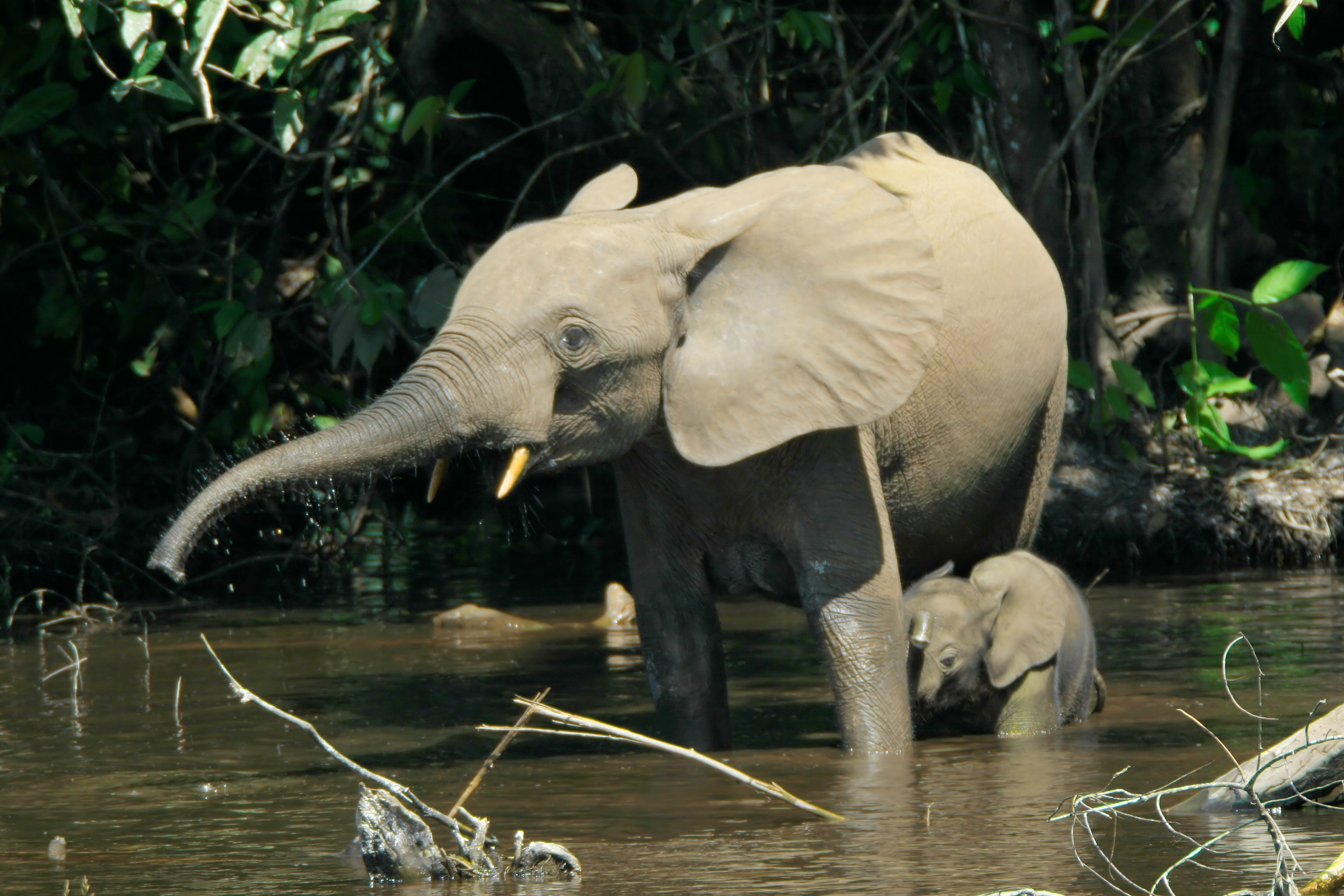
African Forest Elephant (Loxodonta cyclotis)
Introduction
Deep within the equatorial heart of the Congo Basin, where morning light barely penetrates the sixty-metre canopy overhead, a shadow moves between the buttressed roots of ancient Entandrophragma trees. It is neither swift nor silent — a four-tonne animal cannot be either — but there is something measured and purposeful in its passage. The African Forest Elephant pauses, lifts its trunk to read the chemical vocabulary of the air, then moves deeper into the darkness. In its gut, the seeds of at least a dozen tree species are beginning their journey toward germination. By the time this animal defecates three days later, those seeds will have travelled as far as fifty kilometres from their parent trees, scattered across forest terrain that no wind, bird, or smaller mammal could have reached. The tree that grows from those seeds may stand for three hundred years. This is ecological engineering at a planetary scale, and it is disappearing.
Loxodonta cyclotis — the African Forest Elephant — occupies a position of extraordinary ecological authority in the world's second-largest tropical rainforest system. Formally recognised as a species distinct from its savanna-dwelling cousin Loxodonta africana in 2001 following comprehensive genetic analysis, the forest elephant is not simply a smaller variation of a familiar animal. It is a fundamentally different organism, shaped over millions of years by the demands of dense forest life, and it has reshaped that forest in return. Its tusks curve downward rather than outward, adapted to probe forest floors and strip bark from trees. Its skull is harder, its legs proportionally shorter, its social structure more dispersed. It is, in every measurable ecological sense, a specialist — and specialists pay a heavy price when their world narrows.
That world is narrowing rapidly. The African Forest Elephant is listed as Critically Endangered on the IUCN Red List, having lost more than 86% of its population over just three generations — a decline so steep that it rivals the trajectories of the most threatened large mammals on Earth. Ivory poaching drove the initial catastrophe. Deforestation, agricultural encroachment, and infrastructure development are accelerating the residual collapse. What makes the African Forest Elephant conservation crisis uniquely devastating is not merely the fate of the animal itself, but what its disappearance means for the Congo Basin ecosystem — a system that stores more carbon per hectare than nearly any other terrestrial environment on Earth, and one whose structural integrity is, in measurable ways, maintained by the movement of these elephants.
This analysis examines the full ecological architecture of that relationship: why Loxodonta cyclotis matters beyond sentiment, how its population decline propagates through forest systems, and what conservation engineering can and cannot realistically achieve before the window of ecological recovery closes.
"The forest elephant is not living in the forest. The forest elephant is building it. When we lose this animal, we are not losing a species — we are losing a constructor."
— Dr. Stephen Blake, Forest Elephant Research Programme
Population Dynamics
Reconstructing the historical population of the African Forest Elephant is methodologically challenging. Unlike savanna elephants, which can be surveyed by aerial transect across open grassland, forest elephants occupy dense canopy environments that defeat airborne counting entirely. Population estimates rely on dung-count surveys — painstaking grid transects through the forest where trained teams count elephant faecal deposits and use decay rates to estimate density. This methodology carries substantial uncertainty margins, and for decades, African Forest Elephants were lumped statistically with savanna elephants, obscuring the true trajectory of their decline.
What the current evidence shows is catastrophic. The most comprehensive continent-wide analysis, published in 2021 and informing the IUCN reassessment, estimated the total African Forest Elephant population at fewer than 100,000 individuals — with some regional assessments placing the central-range figure closer to 70,000–90,000 animals. Against estimates of 700,000 forest elephants existing in the early twentieth century, this represents a decline exceeding 86% within a period of roughly ninety years, and more than 62% within just thirty-one years — the equivalent of three forest elephant generations.
The generation-length figure is critical to understanding why recovery is so difficult. African Forest Elephants have one of the slowest reproductive rates of any terrestrial mammal. Females reach sexual maturity at approximately eleven to twelve years of age, carry a twenty-two-month gestation — the longest of any land animal — and typically produce a single calf every four to six years. A female forest elephant may produce only four to six surviving offspring across her entire reproductive lifetime. This means that when poaching removes adults from the population at rates above 5–7% annually, the birth rate cannot compensate. The population enters a demographic deficit from which natural recovery may require decades even if all killing were to stop immediately.
Juvenile survival compounds the problem. Forest elephant calves depend on their mothers and extended social group for guidance in forest navigation, food identification, and seasonal ranging patterns. When poachers target large-tusked adults — disproportionately older females who form the matriarchal core of elephant family units — they do not simply reduce population numbers. They destroy the social knowledge infrastructure that makes calf survival possible. Studies in Gabon's Lopé National Park have documented elevated calf mortality in family groups that have lost matriarchs, as younger females lack the experiential range to lead calves to dry-season water sources and mineral licks.
Regional population dynamics show sharp geographic variation. Gabon now hosts the largest remaining forest elephant population, estimated at 40,000–50,000 animals, primarily because Gabon's government has maintained relatively effective anti-poaching enforcement and has over 11% of its national territory formally protected. The Congo Republic (Brazzaville), the Democratic Republic of Congo, Cameroon, and the Central African Republic hold significant but heavily fragmented and declining populations. West Africa — once home to substantial forest elephant herds across Côte d'Ivoire, Ghana, and Sierra Leone — has been functionally emptied. Estimates for West African forest elephant populations number fewer than 3,000 animals distributed across disconnected remnant patches.
Fun FactA single African Forest Elephant can disperse seeds from more than 90 different plant species in a single day, travelling ranges of 30–57 km — making it the most effective long-distance seed disperser of any land animal in the African rainforest system.
Habitat Stability & Ecological Pressure
The African Forest Elephant's habitat — the lowland tropical rainforests of Central and West Africa — represents one of the most ecologically complex terrestrial systems on Earth. The Congo Basin rainforest alone covers approximately 3.3 million square kilometres, making it second only to the Amazon in total area. Within this system, forest elephants have historically ranged widely, following seasonal fruiting patterns, mineral lick locations, and water availability across territories that can exceed 1,000 square kilometres per individual in low-density forest zones.
The structural integrity of this habitat is deteriorating across multiple pressure fronts simultaneously. Industrial logging concessions cover vast swaths of the Congo Basin, and while selective logging does not always immediately destroy forest cover, it opens road networks that provide previously inaccessible entry points for poachers. Studies across the Central African Republic and Democratic Republic of Congo have consistently demonstrated that forest elephant density drops sharply within ten kilometres of any logging road — not because the trees are gone, but because the access enables killing.
Agricultural conversion is accelerating along forest margins. The expanding demand for palm oil, rubber, and subsistence agriculture is converting forest-edge habitat into a mosaic of cleared land and degraded secondary vegetation. For forest elephants, this is not merely habitat reduction — it is habitat fragmentation, which operates differently and in some respects more destructively. A forest elephant cut off from its seasonal ranging territory by an agricultural boundary cannot simply adapt to a smaller range. The fruiting cycles of the trees it depends on are distributed across hundreds of kilometres. Restricting movement compresses animals into areas that cannot support their nutritional requirements across all seasons, driving crop-raiding behaviour as a starvation-avoidance strategy, which in turn generates lethal human-wildlife conflict.
Wetland systems within the forest — bais, or forest clearings with waterlogged soils — are of particular ecological importance and particular vulnerability. Bais are among the only locations where forest elephants aggregate in significant numbers, drawn by the mineral-rich, sodium-laden soils that supplement their forest diet. They serve as critical social interaction zones and represent a significant proportion of known forest elephant reproduction activity. Where agricultural drainage or road construction disrupts the hydrology feeding these clearings, the impacts ripple through elephant social structure and reproductive biology simultaneously.
Climate pressure is not yet the dominant driver of habitat degradation for forest elephants — logging and poaching carry that distinction for now — but it is altering the phenological timing of forest fruiting patterns in ways that undermine the reliability of the food calendar that forest elephant movement has been calibrated to across generations. The interaction between climate disruption and habitat fragmentation represents an emerging tipping point: as fruiting events become less predictable and habitats become less connected, the capacity of forest elephants to buffer nutritional stress through long-range movement is progressively reduced.
Ecological Role (Keystone Analysis)
To understand what Loxodonta cyclotis does for the Congo Basin forest, one must first understand the concept of a megagardener — an animal whose body size, dietary breadth, and ranging distance make it capable of ecological engineering at a scale no other species can replicate. The African Forest Elephant is the Congo Basin's megagardener, and the forests of Central Africa are, in a meaningful and measurable sense, partly an artefact of millions of years of elephant movement.
Seed dispersal is the most well-documented and ecologically significant of the forest elephant's ecological functions. Many of the Congo Basin's largest trees — the hardwood giants that constitute the structural backbone of the canopy and contribute disproportionately to the forest's carbon storage capacity — produce fruits too large for birds, bats, or small primates to consume effectively. These megafaunal fruits, as ecologists call them, evolved in association with large-bodied consumers. The African Forest Elephant is the primary consumer of fruits from species including Balanites wilsoniana, Omphalocarpum, Mammea africana, and numerous members of the Sapotaceae and Annonaceae families. Seeds consumed by elephants pass through the digestive tract intact and are deposited in dung piles — which themselves function as high-nutrient germination beds — far from the parent tree, reducing sibling competition and colonising forest gaps created by canopy disturbance.
Research published in Nature Geoscience in 2019 modelled what would happen to Congo Basin forest carbon stocks in the absence of African Forest Elephants. The results were stark. The selective removal of megafaunal-fruited hardwood trees — which would gradually occur as those species failed to regenerate without their dispersal agent — would reduce forest biomass carbon by approximately 6–9%, equivalent to the annual carbon output of several mid-sized industrialised nations. The forest would not collapse immediately, but it would structurally simplify: transitioning toward lighter-wooded, lower-carbon tree communities that do not require megafaunal dispersal. This is not ecological theorising. It is a trajectory already observable in areas where forest elephants have been locally extirpated for more than fifty years.
Beyond seed dispersal, forest elephants perform critical physical engineering functions. Their trails become semi-permanent pathways through dense vegetation, used by dozens of other forest species including forest buffalo, sitatunga, bongo, forest duikers, and primates. Their wallowing sites create small pools of standing water that persist through dry season and support aquatic invertebrates, amphibians, and water-dependent birds. Their feeding activity — stripping bark, uprooting shrubs, breaking branches — creates light gaps that maintain structural heterogeneity in what would otherwise be uniformly closed-canopy forest, and this heterogeneity supports a dramatically higher diversity of understory plant and animal species.
If Loxodonta cyclotis disappears from the Congo Basin, the ecological consequences are not linear — they are cascading. The hardwood trees stop regenerating across large portions of their range. Carbon storage capacity declines. The forest becomes structurally simpler and less diverse. The species that depend on elephant trails, wallows, and clearings lose habitat. The mineral licks that elephants maintain through repeated use — sites where dozens of butterfly species, birds, primates, and ungulates access essential minerals — begin to vegetate over. The cascade does not stop at the forest's edge. It propagates outward into atmospheric carbon dynamics, regional hydrology, and the livelihoods of tens of millions of people who depend on intact Congo Basin rainfall and climate regulation.
In the predawn darkness of Odzala-Kokoua National Park in the Republic of Congo, a research team following acoustic monitoring data made their way through chest-high undergrowth toward a bai clearing that had been silent for three weeks. The clearing — perhaps forty metres across, its centre a dark pool of mineral-rich mud — had been a consistent congregation point for forest elephants for as long as local rangers could remember. That silence had been ominous.
When the team arrived at the clearing's margin, they found the forest in recovery. Grass was threading back through the mud. The wallowing depression that elephants had maintained for years was drying at its edges. A family of red river hogs that had used the clearing regularly had not been recorded since the elephants left. The mineral lick was still there, but without the mechanical disturbance of elephant feet and trunks excavating fresh mineral-rich substrate, the sodium and calcium concentrations at the surface were declining as rainfall leached the upper layer.
The elephants had been driven away three months earlier after a wave of snare-based poaching swept the park's buffer zone. Two matriarchs were lost. The family group had shifted its range westward. What the team was observing, in miniature, was what ecologists mean when they describe ecosystem memory — the residue of a species' presence that persists briefly after the animal is gone, then slowly unravels. Within two years, the bai had partly vegetated over. The butterflies were gone. The hogs rarely visited. The forest had begun, quietly, to forget.
Human-Wildlife Conflict
The expansion of subsistence and commercial agriculture into forest margins across Central and West Africa has positioned African Forest Elephants and human communities in an increasingly direct and often lethal competition. Forest elephants raiding agricultural fields are not behaving aberrantly — they are following ancestral movement routes across landscapes that have been converted since those routes were established. From the elephant's perspective, a cassava field is a high-calorie food source in the precise location where a section of its traditional range used to be. From the farmer's perspective, a single night of elephant visitation can destroy months of subsistence production and threaten food security for an entire family.
The frequency and intensity of crop-raiding events is increasing as elephant range contracts. Compressed into smaller habitat patches, forest elephant populations encounter agricultural boundaries more frequently. Crop damage events generate retaliatory killing — pit traps, wire snares, and increasingly, poisoned projectiles — that add measurable mortality to already-declining populations. Unlike in East African savanna systems where mitigation tools like beehive fences and chilli pepper barriers have demonstrated some efficacy, these techniques have been less extensively tested and deployed in dense forest environments where visibility is low and agricultural fields are typically small and irregularly shaped.
Infrastructure development represents a structural threat at a different scale. The planned expansion of road networks across the Congo Basin — particularly the CAFI (Central African Forest Initiative) corridor projects and various national road development programmes — would dramatically improve connectivity for human populations and economic activity, but at the cost of opening previously intact forest to logging, agricultural encroachment, and poaching pressure. Each new sealed road through forest elephant habitat effectively imposes a mortality multiplier: research across Central African sites consistently shows that forest elephant density within five kilometres of sealed roads is 70–90% lower than in comparable road-free forest.
Mining concessions introduce a distinct conflict dynamic. Artisanal mining for coltan, gold, and diamonds in forest elephant range countries draws migrant worker populations into remote forest areas, generating local bushmeat markets — including elephant bushmeat — and creating demand for ivory as a tradeable commodity. The interaction between mining economics and elephant mortality is not incidental. Studies in the DRC have documented that periods of elevated coltan price correlate with increased artisanal mining activity, which correlates with increased local bushmeat offtake, which includes forest elephants in proximity to mining camps.
Climate Change Vulnerability
The African Forest Elephant's climate change vulnerability profile differs substantially from that of its savanna counterpart. Savanna elephants face relatively direct climate threats — expanding drought frequency, waterhole desiccation, grass cover decline — that are already producing measurable population stress in southern and eastern Africa. Forest elephants, insulated within the thermal buffering of a closed-canopy forest system, face a more complex and temporally delayed set of climate risks, but those risks are no less serious for being slower in onset.
The Congo Basin's rainfall regime is driven by a combination of Atlantic Ocean sea surface temperatures, the Intertropical Convergence Zone oscillation, and critically, the forest's own evapotranspiration feedback — meaning the forest generates much of its own rainfall by recycling moisture through transpiration. Climate modelling consistently predicts that as deforestation reduces forest cover in the Congo Basin, the evapotranspiration feedback weakens, reducing rainfall across the interior of the basin. Forest elephants depend on rainfall indirectly through fruiting phenology and directly through water availability. A sustained drying trend in the Congo Basin interior would stress both.
Temperature increases of 1.5–2°C across equatorial Africa by 2050 — within the range of current IPCC projections — would alter the phenological timing of fruiting events for many of the tree species that forest elephants depend on. This matters because elephant movement calendars are calibrated to fruit availability: elephants in many parts of the Congo Basin make predictable seasonal movements to access particular fruit species in particular locations. If those fruiting events shift in timing or magnitude, and if elephants cannot compensate by ranging more widely — because their range is increasingly fragmented — the nutritional consequences for individual fitness and reproductive success are significant.
The question of adaptability is where forest elephants present a genuinely uncertain picture. Behavioural plasticity in elephants is well-documented in savanna contexts, where populations have shifted temporal activity patterns, altered diet composition, and shifted ranges in response to human pressure. Forest elephants, by contrast, are dietary specialists within a specialist habitat. Their ability to shift diet in response to fruiting failure is limited by the structure of the forest itself — they cannot simply adopt a grass-based diet the way a savanna elephant might shift dietary proportions. Range shifting as a climate response is constrained by the fragmented nature of remaining forest. There is, in short, relatively little slack in the system for behavioural adaptation to absorb climate stress on top of the existing poaching and habitat pressures.
Fun FactThe African Forest Elephant's tusks are straighter and harder than those of savanna elephants — an evolutionary adaptation for digging mineral licks and probing forest soils. These unique tusks are also, tragically, highly prized in illegal ivory markets, making this adaptation a liability in a world where ivory is commercially valuable.
Genetic Diversity Concerns
Genetic diversity is the raw material of evolutionary resilience. A population with high allelic diversity across its genome carries within it the variance that allows natural selection to operate when environments change — disease resistance, thermal tolerance, dietary flexibility. A population that has passed through a severe bottleneck, or that has been fragmented into isolated sub-populations with little gene flow between them, progressively loses that diversity. The consequences are not immediately visible but accumulate over generations in the form of reduced immune function, declining reproductive success, and diminishing capacity to respond to novel stressors.
The African Forest Elephant's current genetic situation is a direct product of its population history. The 86%+ population collapse over three generations has almost certainly imposed a severe demographic bottleneck across much of the species' range. Habitat fragmentation has compounded this by isolating surviving sub-populations in forest patches separated by agricultural land, logging concessions, and road infrastructure — barriers that are effectively impermeable to elephant movement. A sub-population of 200 forest elephants isolated in a Central African Republic forest fragment cannot exchange genes with the 40,000-strong Gabon population. Over decades, that isolated sub-population will become progressively more inbred, with declining heterozygosity and elevated expression of deleterious recessive alleles.
Genetic studies of African Forest Elephants have revealed historically distinct genetic clusters corresponding roughly to the West African and Central African ranges, with further sub-structuring within the Congo Basin corresponding to geographical barriers such as the Congo River. The Congo River acts as a partial reproductive barrier for forest elephants, contributing to genetic differentiation between populations on its northern and southern banks. This historical population structure is now being overlaid with fragmentation-driven isolation that is neither historically natural nor genetically stable over the long term.
The West African forest elephant populations deserve particular attention from a genetic perspective. With total numbers potentially below 3,000 animals distributed across disconnected forest fragments in Côte d'Ivoire, Ghana, Guinea, Sierra Leone, and Liberia, these populations face the most acute inbreeding risk. Some individual forest patches may hold fewer than fifty elephants — well below the minimum viable population threshold of 500–1,000 individuals commonly used as a conservation benchmark. Below this threshold, demographic stochasticity — random fluctuations in birth and death rates — can drive populations to extinction independently of any external threat.
There is an additional complication in the form of hybridisation. At the ecological boundaries between forest and savanna, where Loxodonta cyclotis and Loxodonta africana ranges overlap — notably in parts of West Africa and along savanna-forest ecotones — hybridisation has been documented. Hybrid individuals represent a genetic compromise that may diminish the ecological specialisation of both species: hybrid animals are neither as effective in dense forest environments as pure forest elephants nor as adapted to open savanna conditions as pure savanna elephants. As forest fragmentation drives forest elephants toward forest-edge environments where savanna elephant populations may persist, hybridisation pressure may increase — a genetic concern overlaid on an already complex conservation crisis.
Conservation Engineering Solutions
Conservation engineering for the African Forest Elephant operates within a set of constraints that distinguish this challenge from most megafauna conservation programmes. The density and extent of the Congo Basin forest creates both an operational challenge — intervening in a system of three million square kilometres of dense rainforest is logistically formidable — and a strategic opportunity, in that intact forest cover still exists in quantities sufficient to support genuine population recovery if mortality pressures can be reduced and habitat connectivity can be maintained.
Anti-poaching technology deployment represents the most urgent short-term engineering priority. Acoustic detection systems, specifically those developed around the Rainforest Connection (RFCx) platform, have demonstrated genuine efficacy in Central African forest environments. Solar-powered listening devices mounted in the forest canopy use machine-learning algorithms trained on the acoustic signatures of chainsaws and gunshots to detect illegal activity in real time, transmitting alerts to ranger stations via cellular or satellite networks. In pilot deployments across Cameroon and the Republic of Congo, these systems have demonstrated detection ranges of up to two kilometres for chainsaw activity and have reduced poaching incidents in monitored areas by 40–60% compared to pre-deployment baselines.
Wildlife corridor engineering is the medium-term strategic priority. The connectivity between protected areas across the Congo Basin is currently insufficient to allow forest elephant populations to maintain the long-range movement patterns their ecology requires. Biological corridor design for forest elephants must account for their specific requirements: wide enough to function as genuine habitat rather than mere passage routes (research suggests minimum corridor widths of 10–15 kilometres for elephant use), linked to secure anchor habitat at both ends, and protected from encroachment along the corridor's length. In practice, this requires negotiated land-use agreements with logging concessionaires, agricultural communities, and national governments — a governance challenge as much as a technical one.
Camera trap networks and GPS collar monitoring programmes provide the population assessment data that conservation decision-making requires. The irregular spacing and methodological inconsistency of historical dung-count surveys has left significant uncertainty in forest elephant population estimates. Systematic deployment of camera trap grids — combined with the genetic individual-identification possible from dung DNA analysis — is beginning to produce more precise density estimates for key populations. GPS collaring, while expensive and requiring capture operations that carry some mortality risk, provides direct movement data that is invaluable for identifying critical corridor routes, bai usage patterns, and the specific locations where poaching pressure is highest.
Community-based conservation programmes in forest-margin communities represent the social engineering dimension without which technical solutions cannot succeed long-term. In areas where community members serve as wildlife monitors and receive tangible economic benefits from conservation outcomes — through ecotourism, REDD+ carbon payments, or conservation employment — poaching rates and human-elephant conflict tend to decline. The Sangha Lodge community conservation programme along the Central African Republic-Congo border and the WWF community ranger programme in northern Congo represent models of this approach, with documented reductions in illegal activity and improved community tolerance of elephant presence.
| Conservation Tool | Primary Benefit | Limitation | Cost Level |
|---|---|---|---|
| Acoustic detection (RFCx) | Real-time anti-poaching alerts | Requires cellular/satellite coverage | Medium |
| GPS satellite collaring | Individual movement data | Capture risk; battery life | High |
| Wildlife corridors | Gene flow, range connectivity | Political and land-use complexity | Very High |
| Camera trap networks | Population density estimates | Limited to fixed locations | Medium |
| Community ranger programmes | Local enforcement, social buy-in | Requires sustained funding | Medium |
| REDD+ carbon payments | Economic incentive for forest protection | Complex MRV requirements | Variable |
Ecosystem Interdependence
The African Forest Elephant does not exist as an isolated entity within the Congo Basin — it exists as a node in a web of interdependencies so complex and so ancient that the full structure of those relationships is still being mapped. Understanding the species' ecosystem interdependence requires tracing those relationships in both directions: what does the forest provide to the elephant, and what does the elephant provide to the forest?
The forest provides the elephant with a diversified nutritional landscape. Forest elephants are opportunistic generalists within a specialist system — they consume the fruits, bark, leaves, roots, and soil minerals of hundreds of plant species, and their dietary composition shifts seasonally and geographically in response to what is available. The mineral licks — bais — are not merely social gathering points. They supply essential sodium, calcium, magnesium, and trace minerals that forest diets are chronically deficient in. Some bais have been used by elephants for so long that their chemical composition has been altered by generations of elephant excavation, concentrating minerals at depths accessible to elephant trunks. The interdependence here is mutualistic: elephants have shaped the bais, and the bais are necessary for elephant health.
The forest's invertebrate community benefits from elephant dung in ways that extend well beyond simple nutrient cycling. Dung beetle communities in the Congo Basin show compositional responses to elephant density: areas with higher elephant populations support more diverse and abundant dung beetle assemblages, which in turn contribute to secondary seed dispersal, soil aeration, and nutrient cycling. Several dung beetle species in Central Africa appear to be ecologically dependent on large mammal dung — particularly elephant dung, which is produced in large quantities and has a distinctive moisture content and particle size distribution that makes it attractive for brood ball formation. The local extinction of elephants from an area is followed within a few years by measurable declines in dung beetle diversity.
Primate communities, particularly gorillas and chimpanzees, use elephant trails extensively and overlap with forest elephants in their use of fruit trees and mineral licks. The relationship is not strictly competitive — the fruiting phenology of different tree species creates temporal partitioning in fruit availability — and elephant trail maintenance reduces the energetic cost of primate movement through dense forest. Where elephants have been extirpated, some primate populations show reduced movement range, likely reflecting the higher energetic cost of trail-free forest travel.
The relationship between forest elephants and large carnivores in the Congo Basin is understudied but ecologically relevant. Leopards (Panthera pardus) prey on elephant calves in some areas, and the presence of a functioning elephant population in a forest system contributes to the prey base complexity that supports leopard persistence. More significantly, the ecosystem engineering that elephants perform — creating forest clearings, water pools, and structural heterogeneity — generates habitat for the entire guild of forest floor and mid-story species that large carnivores depend on. The interdependence is not binary but systemic.
Fun FactAfrican Forest Elephants can detect infrasound — low-frequency vocalisations below the threshold of human hearing — across distances of up to 10 kilometres through forest floor substrate. This acoustic communication system allows separated family groups to coordinate movement across vast forest territories, a capability that population fragmentation is progressively disrupting.
Future Extinction Risk Modelling
Population viability analysis (PVA) for African Forest Elephants produces sobering projections under most realistic threat scenarios. The combination of slow reproductive rates, high adult mortality from poaching, and progressive habitat fragmentation creates a population dynamic in which even modest improvements in protection produce slow recovery timelines measured in decades, while even relatively small increases in poaching pressure can push populations below critical viability thresholds within a single elephant generation.
Modelling work by the Elephant Specialist Group and associated researchers, using age-structured population models calibrated to known forest elephant demographic parameters, indicates that at current mortality rates — estimated at 5–10% annually in heavily poached areas — forest elephant populations will continue to decline even with ongoing conservation effort. The models consistently identify adult female survival as the critical demographic parameter: because adult females are the reproductive core of the population and the repositories of social knowledge, their selective removal by poachers targeting large-tusked individuals has population consequences disproportionate to their numerical representation.
The spatial dimension of extinction risk adds further complexity. The African Forest Elephant is not a single panmictic population — it is a meta-population composed of sub-populations of varying size and connectivity. PVA frameworks applied at the meta-population level suggest that the extinction of the smallest and most isolated sub-populations — particularly in West Africa — is effectively certain under current trajectory without dramatic and immediate intervention. These losses matter beyond their numerical contribution to total population size, because they represent the loss of genetic and ecological diversity, and because they eliminate the demographic reservoirs that, in a connected landscape, would allow regional population recovery following local catastrophic events.
Modelling the interaction between forest elephant decline and forest carbon storage presents perhaps the most consequential dimension of future extinction risk analysis. If the seed dispersal role of forest elephants is sufficiently compromised — through either population decline or range contraction — the transition of portions of the Congo Basin forest from high-biomass hardwood-dominated communities to lighter-wooded, lower-carbon assemblages would represent a carbon feedback to the atmosphere with global climate consequences. This is not an immediate tipping point risk, but it is a pathway that begins operating as soon as elephant density falls below the threshold required for effective seed dispersal — a threshold that has already been crossed in some parts of the Congo Basin's periphery.
Recovery scenarios modelled by conservation biologists suggest that a population of African Forest Elephants could stabilise and begin growing if adult mortality from poaching could be reduced to below 3% annually — approximately half of current estimated rates in the most heavily poached areas — and if key habitat corridors could be protected to allow the demographic exchange between sub-populations that population viability requires. However, achieving both conditions simultaneously would require a sustained investment in anti-poaching enforcement and corridor protection that substantially exceeds current funding levels across all range states combined. The gap between what the models say is necessary and what current conservation funding can provide is not small.
Conservation Policy & Governance
The African Forest Elephant exists across nine range states — Republic of Congo, Democratic Republic of Congo, Gabon, Cameroon, Central African Republic, Equatorial Guinea, Côte d'Ivoire, Ghana, and Liberia — each with distinct governance structures, enforcement capacity, economic conditions, and political will toward conservation. This jurisdictional complexity means that the species' fate is determined not by any single policy framework but by the interplay of nine national regulatory systems with international agreements imposed from above and local community realities pressing from below.
At the international level, the African Forest Elephant is protected under CITES Appendix I, which prohibits international commercial trade in ivory from African elephants. The practical effect of this prohibition has been complicated by the 1997 and 1999 CITES-authorised stockpile sales to Japan, which conservation researchers have consistently linked to demand signal increases in Asian ivory markets and consequent increases in illegal killing. The current international ivory trade ban represents the appropriate policy position for forest elephant survival, but its enforcement is undermined by the persistence of domestic ivory markets — particularly in China, despite the 2017 ban, and across Southeast Asia — that provide demand destinations for illegally trafficked tusks.
The CITES Appendix I listing is supported by the Convention on Biological Diversity's Aichi Target framework and the post-2020 Kunming-Montreal Global Biodiversity Framework, which has established targets for protecting 30% of land and sea areas by 2030. However, the gap between target-setting and ground-level enforcement remains enormous across most of the Congo Basin. Protected area coverage in range states varies dramatically: Gabon, which protects over 11% of its territory across thirteen national parks, represents best practice in the region. The DRC, which contains perhaps the largest remaining extent of forest elephant habitat but faces severe governance deficits, infrastructure limitations, and active armed conflict in its eastern provinces, represents the opposite extreme — vast areas are nominally protected but effectively unmanaged.
Indigenous and community-based governance systems represent an underutilised but increasingly recognised component of the conservation governance architecture. Forest-dependent communities — the Baka, Bayaka, and Bongo peoples of the Congo Basin, among others — have managed relationships with forest elephants across centuries and in many cases possess detailed knowledge of elephant movement, behaviour, and habitat use that supplements or surpasses formal scientific monitoring data. Conservation approaches that engage these communities as governance partners, rather than as passive recipients of externally designed programmes, have shown superior outcomes in terms of both enforcement effectiveness and social sustainability.
Funding architecture for African Forest Elephant conservation remains severely inadequate relative to the scale of the challenge. Total conservation funding directed at forest elephant protection across all range states is estimated at tens of millions of dollars annually — an order of magnitude below what population viability analyses suggest is required for effective protection at landscape scale. The CAFI (Central African Forest Initiative) represents the most significant international funding mechanism for Congo Basin forest conservation, providing hundreds of millions of dollars over five-year cycles for forest protection and sustainable development. However, the allocation of CAFI funding toward elephant-specific anti-poaching and corridor protection has been limited, reflecting competition for resources from the broader forest governance agenda.
IUCN Red List Analysis
Current IUCN Status
The African Forest Elephant (Loxodonta cyclotis) is classified as Critically Endangered (CR) on the IUCN Red List, assessed in March 2021 following the completion of comprehensive range-wide population surveys and a formal revision of the species' demographic history. Prior to 2021, African Forest Elephants were assessed together with African Savanna Elephants under a combined Loxodonta africana designation at Vulnerable status, a classification that masked the far more severe trajectory of the forest species.
The Critically Endangered classification is assigned under IUCN criterion A2 — a reduction in population size, estimated as a decline exceeding 80% over three generations (or ten years, whichever is longer), where the causes of decline have not ceased and may not be fully understood or reversible. For African Forest Elephants, the assessed decline exceeds 86% over a 31-year period corresponding to approximately three generations. This places the species at the most severe category of threat before Extinct in the Wild, reflecting population losses that, in any other large mammal, would have generated an international conservation emergency response orders of magnitude larger than what has actually materialised.
The scientific basis for the Critically Endangered classification rests on range-wide dung survey data, aerial count data for populations in accessible areas, historical range mapping, and demographic modelling. The classification is considered robust by the IUCN's African Elephant Specialist Group, with the primary source of uncertainty being the difficulty of precisely quantifying forest elephant density in the most remote and inaccessible portions of the DRC's forest interior.
Population Trend
The population trend for African Forest Elephants is assessed as decreasing. Current total population estimates range from approximately 70,000 to 100,000 individuals across all range states, with the largest single population concentration in Gabon, estimated at 40,000–50,000 animals. This compares against a historical estimate of approximately 700,000 individuals in the early twentieth century, and a more recent baseline of approximately 700,000 in the 1980s, which was already severely reduced from pre-colonial levels.
The rate of decline has been most rapid during periods of elevated ivory prices in Asian markets — particularly during the 2009–2015 period, when a combination of demand growth in China and relatively weak enforcement across range states produced a poaching crisis that removed an estimated 65% of the forest elephant population of the Minkébé forest in northern Gabon within a decade. Even in Gabon, which has the strongest protection framework in the region, population surveys have identified poaching as an ongoing mortality cause in protected areas adjacent to international borders with Cameroon and Equatorial Guinea.
West African forest elephant populations are in the most advanced stage of collapse. Surveys across Côte d'Ivoire, Ghana, Sierra Leone, and Liberia consistently identify small, isolated remnant populations — often fewer than 100 individuals per forest patch — with no effective connectivity between them. Without intervention, these populations face probabilistic extinction within decades through demographic stochasticity and continued poaching pressure.
Main Threats
Ivory poaching is the primary documented driver of the species' population collapse. African Forest Elephant ivory — characterised by its distinctive pinkish hue, high density, and relative lack of the nerve-line striations present in savanna elephant ivory — commands a premium in illegal Asian markets and has historically been marketed specifically as forest elephant ivory. Poaching rates across the Congo Basin peaked during the 2009–2015 period but have not receded to pre-crisis levels in most range states, and in poorly governed areas such as eastern DRC and border zones of the Central African Republic, killing rates remain ecologically unsustainable.
Habitat loss and fragmentation operate in concert with poaching and are increasingly the dominant pressure in areas where anti-poaching enforcement has improved. Industrial logging, agricultural conversion, and road infrastructure development are reducing and fragmenting the forest habitat that elephants depend on, compressing populations into smaller areas, elevating human-elephant conflict, and reducing the long-range movement that forest elephant ecology requires.
Human-wildlife conflict generates direct elephant mortality through retaliatory killing, pit traps, and wire snares, and generates indirect pressure through the political and social environment that makes conservation investment politically difficult in communities that view elephants primarily as agricultural threats.
Climate change, while not yet a dominant current threat, is altering fruiting phenology, rainfall reliability, and river hydrology across the Congo Basin in ways that reduce food availability predictability and may increase human-elephant conflict as elephants ranging in search of food encounter agricultural areas more frequently.
Ecological Consequences
Further population decline of Loxodonta cyclotis carries cascading ecological consequences that extend far beyond the boundaries of elephant conservation. The progressive loss of effective seed dispersal for megafaunal-fruited tree species will reduce the regenerative capacity of the Congo Basin's highest-biomass hardwood communities, shifting forest composition toward lighter-wooded species and reducing the forest's carbon sequestration and storage function. This represents a direct feedback to global atmospheric carbon dynamics at a time when the maintenance of existing carbon stocks is a climate imperative.
The structural simplification of the forest associated with elephant loss will reduce habitat heterogeneity for the hundreds of species — mammals, birds, reptiles, insects, and amphibians — that depend on the micro-habitats created by elephant ecological engineering. Forest floor biodiversity, in particular, will decline as wallowing pools, mineral lick clearings, and trail networks are lost. Dung beetle communities, which perform critical secondary seed dispersal and nutrient cycling functions, will decline in diversity and abundance. The accumulation of these losses constitutes a biodiversity cascade that fundamentally changes the ecological character of the forest.
Conservation Efforts
The primary conservation effort for African Forest Elephants operates through a network of protected areas across the Congo Basin, supplemented by international NGO programming, government law enforcement, and international funding mechanisms. The Trinational Sangha Landscape — spanning national parks in Cameroon (Lobéké), the Central African Republic (Dzanga-Ndoki), and the Republic of Congo (Nouabalé-Ndoki) — represents the most ambitious transboundary protection effort, covering approximately 746,000 hectares of near-continuous forest habitat and supporting one of the most intensively monitored forest elephant populations in the world.
WWF, Wildlife Conservation Society, African Wildlife Foundation, and Save the Elephants operate active programmes across the range, covering anti-poaching support, community conservation, ecological monitoring, and policy advocacy. The Elephant Crisis Fund, a joint initiative of Save the Elephants and the Wildlife Conservation Network, has directed over $30 million to anti-poaching and conservation programmes since 2013, with significant allocations to Central African forest elephant range states.
International ivory trade bans — particularly China's 2017 closure of its domestic ivory market — have reduced demand pressure and, with a lag, contributed to declining illegal killing rates in some range states. However, the market reduction achieved has not yet been sufficient to bring poaching mortality below the species' replacement rate in most of the range, and demand recovery as regulatory attention shifts is an ongoing risk.
Future Outlook
The future outlook for the African Forest Elephant is genuinely uncertain, and the range of plausible outcomes in the next thirty years spans from cautious demographic stabilisation in the strongest-protected populations to continued decline toward functional extinction across significant portions of the range. The species possesses intrinsic recovery capacity — forest elephants can rebuild populations when mortality is reduced — but the slow generation time means that recovery to historical population levels would require not years but centuries even under optimal conditions.
The most realistic near-term scenario under current trajectory is continued decline in West Africa toward sub-population extinctions, stabilisation in Gabon and the best-protected areas of the Congo Basin, and variable outcomes across the DRC, Cameroon, and CAR depending on governance stability and enforcement investment. Long-term survival of the species as an ecologically effective component of the Congo Basin forest system requires sustained reductions in poaching mortality, expansion of effectively managed protected areas, and restoration of habitat connectivity through corridor protection — goals that are technically achievable but politically and financially demanding in ways that current conservation structures have not yet fully addressed.
Conclusion
The African Forest Elephant is a conservation crisis of planetary proportions compressed into the body of a single species. Its decline is not a tragedy at the periphery of ecological importance — it is occurring at the centre, in an animal whose ecological function is structurally necessary for the maintenance of the world's second-largest tropical forest system. Every aspect of the Congo Basin's biology, from its carbon stocks to its dung beetle communities, from its primate diversity to its hydrological stability, exists in some degree of dependence on the movement of these elephants through the forest.
The Critically Endangered designation that Loxodonta cyclotis now carries is accurate, but it is also inadequate as a descriptor of what is actually at stake. The loss of this species would not be the loss of an animal. It would be the beginning of a structural transformation of the Congo Basin forest — a slow ecological unravelling whose timeline is measured in tree generations, and whose consequences for global climate, regional hydrology, and African biodiversity are genuinely difficult to overstate.
There is still time. Gabon's elephants are not yet gone. The forest of the Trinational Sangha still hears infrasound. The Odzala-Kokoua clearings still carry the mineral footprint of a thousand years of elephant excavation. What the African Forest Elephant requires is not the discovery of new conservation techniques — the techniques exist. It requires the sustained application of political will, financial commitment, and governance at a scale commensurate with the ecological scale of what is being lost. That is a human decision, and it is one that grows more consequential with each passing year.
"The question is not whether we can save the forest elephant. The question is whether we will decide that it is worth saving, and act accordingly — before the forest itself gives us the answer."
— Dr. Fiona Maisels, Wildlife Conservation Society
Sources & Attribution
Data and ongoing research referenced for this article come from the following authoritative sources — peer-reviewed publishers, official taxonomic registers, and global biodiversity programmes:
- IUCN Red List — African Forest Elephant — official IUCN Red List assessment including population trend, threats, and conservation actions.
- Wikipedia — African Forest Elephant — taxonomy, distribution, and an overview with onward citations to primary literature.
- GBIF — African Forest Elephant — global occurrence and distribution records from the Global Biodiversity Information Facility.
- iNaturalist — African Forest Elephant — observation records and field photographs contributed by naturalists worldwide.
- Encyclopedia of Life — African Forest Elephant — multilingual species pages aggregating taxonomic and natural-history data.
- WWF — World Wildlife Fund — global wildlife conservation programmes and research summaries.
- Nature — research on African Forest Elephant — peer-reviewed studies indexed by Nature on related ecology and behaviour.
- ITIS — Integrated Taxonomic Information System — federal-grade taxonomy and nomenclature.
Frequently Asked Questions
What is the conservation status of the African Forest Elephant?
The African Forest Elephant (Loxodonta cyclotis) is listed as Critically Endangered on the IUCN Red List, a classification formally established in March 2021. This is the most severe threat category before Extinct in the Wild and reflects a documented population decline exceeding 86% over the past three generations — approximately thirty-one years.
Prior to 2021, forest elephants were assessed collectively with African Savanna Elephants under the species name Loxodonta africana, which obscured the far more acute trajectory of forest elephant decline. The 2021 reassessment, which formally recognised the two as separate species for IUCN purposes, produced a Critically Endangered classification for the forest elephant and Endangered for the savanna elephant.
How many African Forest Elephants are left in the wild?
Current estimates place the total African Forest Elephant population at approximately 70,000 to 100,000 individuals. The largest single population concentration is in Gabon, which is estimated to hold 40,000–50,000 animals. The Democratic Republic of Congo, Republic of Congo, Cameroon, and the Central African Republic hold significant but declining populations. West African populations are critically small, with total regional estimates of fewer than 3,000 animals.
These estimates carry significant uncertainty because forest elephants inhabit dense canopy environments that prevent aerial counting and require labour-intensive dung-count surveys. The true total could be somewhat higher or lower than these figures, but all credible assessments point to a population a fraction of its historical size.
What is the difference between an African Forest Elephant and an African Savanna Elephant?
Although closely related, African Forest Elephants and African Savanna Elephants are now formally recognised as distinct species. Forest elephants are smaller — adults typically weigh 2–4 tonnes compared to the savanna elephant's 4–6 tonnes — with more rounded ears, harder and straighter downward-pointing tusks, and a more domed skull. Their social structure is also different: forest elephant family groups are smaller and more widely dispersed, reflecting the lower resource density of forest environments compared to open savanna.
Ecologically, the two species play fundamentally different roles. The savanna elephant is a grassland and woodland engineer, while the forest elephant is a forest megagardener — a seed disperser for large-fruited trees and a structural maintainer of the tropical rainforest system. They share the Loxodonta genus but diverged genetically approximately 2–6 million years ago, a separation comparable to the divergence between Asian and African elephants.
Why is the African Forest Elephant so important to the Congo Basin ecosystem?
The African Forest Elephant is the primary seed disperser for many of the Congo Basin's largest and most carbon-rich tree species. These megafaunal-fruited trees produce fruits too large for birds, bats, or small mammals to consume and disperse effectively — they evolved in association with large-bodied consumers like the forest elephant. Without elephant dispersal, these trees fail to regenerate across significant portions of their range, and over decades the forest gradually simplifies into lower-biomass plant communities.
Beyond seed dispersal, forest elephants maintain the mineral licks, trails, clearings, and wallowing sites that hundreds of other species — from gorillas to dung beetles — depend on. Research has estimated that the loss of forest elephants from the Congo Basin would reduce forest carbon storage by 6–9%, equivalent to enormous quantities of CO₂, purely through compositional shift in the tree community. This makes the African Forest Elephant not just an ecological asset but a climate asset of global significance.
What is the biggest threat to the African Forest Elephant?
Ivory poaching is the single largest documented driver of the African Forest Elephant's population collapse. Forest elephant ivory — dense, hard, and distinctively pinkish in tone — commands a premium in illegal markets, particularly in Asia. Poaching rates peaked during the 2009–2015 period but have not fallen to ecologically sustainable levels across most of the range. In some areas, particularly eastern DRC and border zones of the Central African Republic, killing continues at rates that exceed the population's biological replacement capacity.
Habitat loss and fragmentation represent the second major threat, accelerating as agricultural conversion, industrial logging, and road construction reduce and disconnect forest habitat across the elephants' range. These two threats interact: logging roads open previously inaccessible forest to poachers, while habitat fragmentation compresses elephant populations into smaller areas where they encounter humans more frequently, elevating both poaching risk and human-wildlife conflict.
Where do African Forest Elephants live?
African Forest Elephants inhabit the lowland tropical rainforests of Central and West Africa, with the vast majority of the remaining population concentrated in the Congo Basin — spanning Gabon, the Republic of Congo, the Democratic Republic of Congo, Cameroon, the Central African Republic, and Equatorial Guinea. West African populations persist in small, isolated fragments across Côte d'Ivoire, Ghana, Guinea, Sierra Leone, and Liberia, but these are critically small and functionally disconnected from the Central African range.
Within forest systems, forest elephants use a diverse array of micro-habitats: closed-canopy lowland forest for fruit feeding, riparian forest for water access, and forest clearings known as bais for mineral lick exploitation and social interaction. They range widely — individual home ranges can exceed 1,000 square kilometres — and their movement is closely tied to the seasonal fruiting calendars of the trees they depend on.
Can African Forest Elephants recover from their current population decline?
Recovery is biologically possible but will be extremely slow, even under the most optimistic scenario. Forest elephants have one of the slowest reproductive rates of any terrestrial mammal — females produce approximately one calf every four to six years, and the gestation period is twenty-two months. Even if all poaching were eliminated today, the population would take decades to return to pre-poaching levels in protected areas, and centuries to approach historical population sizes at range-wide scale.
Population viability models suggest that stabilisation is achievable if adult mortality from poaching can be reduced to below 3% annually — roughly half the current estimated rate in heavily poached areas — and if habitat connectivity is maintained through protected corridor networks. Both conditions require sustained political commitment, significant financial investment, and governance capacity that currently exceeds what most range states are providing. Recovery in Gabon, where conditions are most favourable, is credible within decades. Recovery in West Africa without dramatic and immediate intervention is not.
What are African Forest Elephants' tusks used for in the illegal ivory trade?
African Forest Elephant ivory is particularly prized in illegal markets because of its distinctive physical properties. Forest elephant tusks are harder and denser than savanna elephant ivory, with a characteristic pinkish or rosy hue and fewer visible internal lines, making them highly valued by ivory carvers in Asia — particularly in China, Japan, and Southeast Asian markets. Some dealers have historically marketed forest elephant ivory specifically as a premium product distinct from savanna elephant ivory.
This market premium for forest elephant ivory has driven disproportionately high poaching pressure on the species, with large-tusked adults — typically older females who are also the social knowledge repositories of their family groups — targeted preferentially. The loss of these matriarchal animals has consequences for elephant social structure and calf survival that extend far beyond simple population number reduction.
Are African Forest Elephants protected by international law?
Yes. African Forest Elephants, along with all African elephant species, are listed on Appendix I of CITES — the Convention on International Trade in Endangered Species of Wild Fauna and Flora — which prohibits international commercial trade in ivory and other elephant products. This is the highest level of CITES protection and represents international consensus that commercial trade poses an unacceptable extinction risk.
The listing is supported by national laws in all range states that prohibit killing elephants and trading ivory domestically. However, the practical enforcement of these protections varies enormously across range states, and the persistence of illegal ivory trafficking networks — combined with residual domestic ivory markets in some consumer countries — means that legal protection and on-the-ground protection are not equivalent. The strength of the protection in practice depends heavily on anti-poaching investment, governance capacity, and judicial follow-through in prosecuting ivory trafficking cases.
How do African Forest Elephants communicate?
African Forest Elephants use a sophisticated multi-channel communication system adapted to their dense forest environment, where visual signals are limited by vegetation. Infrasound — low-frequency vocalisations below the threshold of human hearing, produced in the nasal passage and conducted through both air and forest substrate — is a primary communication channel, detectable by other elephants across distances of up to ten kilometres. This allows dispersed family groups to coordinate movement and maintain social contact across vast forest territories despite limited visual contact.
Chemical communication through glandular secretions, urine, and dung also conveys information about individual identity, reproductive status, and territory use. Physical communication — touching, trunk contact, and tactile reassurance — operates at close range within family groups. This multi-channel communication system, refined over millions of years in forest conditions, is being disrupted by population fragmentation that separates individuals and family groups beyond the range of even infrasound communication.
What role do bais play in African Forest Elephant ecology?
Bais — natural forest clearings with waterlogged, mineral-rich soils — are among the most ecologically important habitats in the African Forest Elephant's range. These clearings provide essential minerals, particularly sodium and calcium, that the forest diet is chronically deficient in. Elephants actively excavate bais with their feet and trunks, maintaining access to mineral-rich substrate at depth and progressively concentrating minerals at the surface through repeated disturbance. Some bais have been used and modified by elephants for centuries.
Beyond their mineral function, bais serve as social aggregation sites where family groups interact, reproduce, and engage in the complex social bonding that is central to elephant society. They also function as multi-species resource points: gorillas, forest buffalo, sitatunga, bongo antelope, numerous bird species, and hundreds of butterfly species visit bais to access minerals. When elephant populations are reduced and bai excavation ceases, the mineral concentrations at accessible depths decline, and the multi-species ecological function of these sites progressively diminishes — another example of the cascading consequences of elephant population decline.
What can individuals do to help African Forest Elephant conservation?
The most impactful individual contributions to African Forest Elephant conservation are financial — supporting organisations with demonstrated, on-the-ground effectiveness in Central Africa, including Wildlife Conservation Society, WWF, Save the Elephants, the African Wildlife Foundation, and the Elephant Crisis Fund. These organisations fund anti-poaching operations, community conservation programmes, and ecological monitoring across forest elephant range states, and they operate in areas where the funding gap between need and available resources is measurably large.
Avoiding products derived from illegal ivory is an obvious commitment, but one that most readers in Western countries will already make by default given legal prohibitions. More consequentially, political advocacy — supporting government policies that maintain strong international ivory trade bans, oppose trade rule relaxation at CITES meetings, and fund international conservation through bilateral and multilateral mechanisms — carries influence proportionate to the scale of the political decision it targets. The future of the African Forest Elephant is ultimately determined by governance decisions: what protection is funded, what laws are enforced, and what diplomatic pressure wealthy nations apply to range states and consumer markets. Individual engagement in those governance processes is the most structurally significant thing that people who care about this species can do.
Image: Wikipedia/Wikimedia Commons — “African forest elephant”
Comments
Post a Comment