
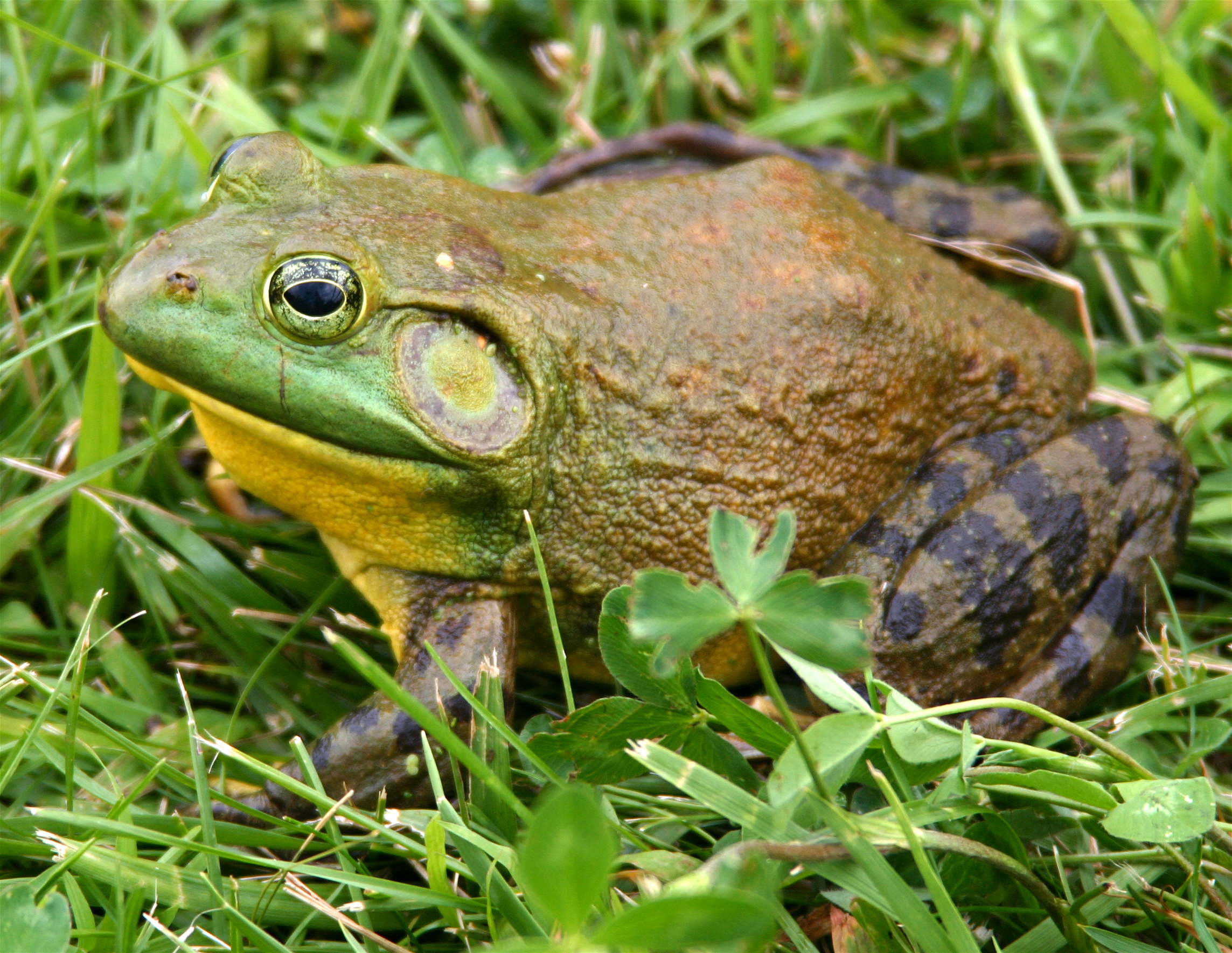
American Bullfrog (Lithobates catesbeianus)
Introduction
The surface of a warm summer pond sits perfectly still in the hour before dusk. Cattails stand rigid at the water's edge. A great blue heron holds its frozen vigil nearby, and dragonflies trace erratic circuits above the lily pads. Then, from somewhere in the reeds, a sound rises that is less like a call and more like a percussion instrument struck from beneath the earth — a deep, resonant jug-o-rum that rolls across the water and vibrates in the chest of anyone standing nearby. The American Bullfrog has announced its presence.
Few amphibians in the world carry the cultural and ecological weight of Lithobates catesbeianus. It is the largest frog native to North America, a predator of extraordinary opportunism, an acoustic force in its wetland landscape, and — in much of the world beyond its original range — one of the most consequential invasive species ever introduced. To study the American Bullfrog is to confront a paradox: an animal that is simultaneously a cornerstone of its native ecosystems and a destroyer of foreign ones.
Bullfrogs occupy virtually every freshwater system across eastern and central North America, from the sluggish oxbow lakes of the Mississippi Delta to the sun-warmed ponds of the Canadian Great Lakes basin. They are not subtle animals. They are large, vocal, territorial, and relentlessly carnivorous. Their biology reflects millions of years of evolutionary refinement in the role of a mid-tier predator — adaptable enough to exploit almost any food source, resilient enough to survive drought and frost, and fecund enough to colonise new territory with alarming speed.
This article explores the American Bullfrog not merely as a species to be catalogued, but as a living ecological engine — one whose influence on wetland communities, both native and introduced, reveals the complex interconnections that define functional ecosystems.
"The frog does not drink up the pond in which it lives."
— Native American Proverb
Scientific Classification
Kingdom: Animalia
Phylum: Chordata
Class: Amphibia
Order: Anura
Family: Ranidae
Genus: Lithobates
Species: Lithobates catesbeianus (Shaw, 1802)
Common Names: American Bullfrog, North American Bullfrog
Former Nomenclature: Rana catesbeiana (the older binomial still widely used in literature)
The taxonomic placement of the American Bullfrog has undergone revision in the modern era. For most of its documented scientific history, the species resided comfortably within the large, cosmopolitan genus Rana. In 2006, molecular phylogenetic studies led by Frost and colleagues reorganised the New World true frogs into a separate genus, Lithobates, based on genetic divergence from Old World Ranidae. The move remains contested among some herpetologists who prefer the original Rana classification for taxonomic stability, but Lithobates catesbeianus is the currently accepted designation by the IUCN and most major herpetological authorities.
The species epithet catesbeianus honours the English naturalist Mark Catesby (1683–1749), whose illustrated work The Natural History of Carolina, Florida and the Bahama Islands was among the earliest systematic surveys of North American fauna. The name is a fitting tribute — Catesby documented the bullfrog's call and size with evident astonishment, recording an animal clearly unlike anything in the English countryside he knew.
Physical Characteristics
The American Bullfrog is a substantial animal by any measure. Adult females, which grow larger than males, regularly reach snout-vent lengths of 15 to 20 centimetres, with exceptional individuals documented at close to 23 centimetres. Body mass in large females can exceed 750 grams, though 400 to 600 grams is more typical for mature adults. Males are slightly smaller, generally ranging between 9 and 15 centimetres in snout-vent length. The overall impression of a large adult bullfrog is one of compressed power — a wide, flat body with enormous hind limbs folded beneath it like coiled springs.
Colouration follows a pattern that serves equally well for camouflage and thermoregulation. The dorsal surface is typically olive green to brownish green, often with darker mottling or irregular brown patches across the back and flanks. The underside is cream to white, sometimes yellowish, and may show faint grey or brown marbling. Populations vary geographically, and individuals can modulate skin pigmentation slightly depending on temperature and light exposure, a physiological capacity related to melanophore activity in the skin.
The head is broad and rounded, dominated by an enormous mouth that stretches nearly the full width of the skull. The eyes are large and protuberant, positioned near the top and sides of the head — an arrangement that allows near-360-degree vision without body movement. The pupils are horizontally elliptical, maximising light intake in low-contrast wetland environments at dawn and dusk. Behind each eye sits the tympanic membrane, the circular disc of stretched skin that functions as the eardrum. In males, the tympanum is noticeably larger than the eye — often considerably so — while in females the tympanum and eye are approximately equal in diameter. This size difference is one of the most reliable field characters for sex determination.
The hind limbs are powerfully muscled and webbed between all four toes, making the bullfrog a formidable swimmer. A single explosive contraction of the hind limb musculature can propel the animal distances of nearly two metres through open water. The forelimbs are shorter and less muscular, used primarily for balance and to manipulate prey during swallowing. The skin is smooth and moist, maintained by mucous glands distributed across the body surface, which also produce mild antimicrobial secretions that help protect against infection.
Fun Fact The American Bullfrog's tympanic membrane can detect sound frequencies as low as 100 Hz and as high as 3,000 Hz — perfectly tuned to detect both the deep advertising calls of rival males and the higher-frequency distress calls of prey animals.
Habitat & Geographic Distribution
The native range of the American Bullfrog spans much of eastern and central North America, extending from Nova Scotia and the Great Lakes region in the north, south through the entire eastern United States to Florida and the Gulf Coast, and westward through the central states roughly to the Rocky Mountains. Isolated native or long-established populations exist in parts of Texas, Kansas, and Nebraska. The species reaches its highest densities in the humid lowlands of the Mississippi River basin and the Atlantic Coastal Plain, where productive wetlands offer abundant food and stable water.
Beyond this native range, the American Bullfrog has been introduced — deliberately and accidentally — to an enormous number of locations worldwide. Western North America, including California, Oregon, Washington, Nevada, and British Columbia, now hosts substantial populations that originated from aquaculture escapes and deliberate release in the late nineteenth and early twentieth centuries. Europe harbours established populations in France, Italy, Belgium, the Netherlands, Germany, Spain, and Portugal. Significant invasive populations exist in Mexico, Brazil, Colombia, and Argentina in the Americas, and in China, Japan, South Korea, Taiwan, and numerous other Asian nations. The bullfrog has even appeared in parts of sub-Saharan Africa. This global footprint makes it one of the most widely distributed amphibians on Earth outside its natural habitat.
Within its preferred habitat, the American Bullfrog is highly committed to permanent bodies of standing or slowly moving fresh water. Ponds, lakes, reservoirs, marshes, swamps, river backwaters, and slow-moving stream margins all provide suitable habitat, provided the water does not freeze completely during winter. This requirement for permanent water explains much of the species' distributional pattern — it cannot survive in seasonal wetlands that dry completely, and it is largely absent from areas where winters are severe enough to freeze water bodies to the bottom.
Optimal bullfrog habitat combines open water of at least 50 to 100 centimetres in depth for overwintering, extensive areas of emergent vegetation for shelter and larval development, basking sites along exposed banks or on floating debris, and a high density of invertebrate prey. Agricultural ponds, park lakes, and reservoir margins frequently provide exactly this combination, explaining why bullfrogs have thrived in heavily modified human landscapes where many other amphibians have declined.
Habitat Feature | Optimal Condition | Limiting Threshold |
|---|---|---|
Water permanence | Year-round standing water | Seasonal pools drying <3 months |
Water depth (overwintering) | >75 cm | <30 cm freezes completely |
Vegetation cover | 50–70% emergent/floating cover | Open water only or fully choked |
Water temperature (breeding) | 22–28°C | <15°C suppresses spawning |
Shoreline structure | Gradual slopes, muddy substrate | Steep, concrete, or rocky margins |
Behaviour & Social Structure
The American Bullfrog is not a social animal in any cooperative sense. It does not form cohesive groups, share resources, or engage in communal defence. Its social structure is built around two competing pressures: the male drive to monopolise prime breeding territories during the reproductive season, and the broader individual imperative to secure feeding space throughout the active season. Outside the breeding period, most interactions between bullfrogs are either neutral or gently competitive, with individuals spacing themselves across available habitat to reduce direct interference.
Male territoriality during the breeding season, however, is intense and well-documented. Males establish calling stations along shorelines, typically on partially submerged vegetation or muddy banks, and defend these positions against rivals through a combination of acoustic advertisement, visual displays, and physical combat. The advertisement call — the famous jug-o-rum — serves simultaneously as a declaration of territory to rival males and as an attraction signal to females. Call frequency and acoustic complexity correlate positively with male body size and condition, giving females reliable information about potential mate quality without direct contact.
When two male bullfrogs meet at a territory boundary, the interaction follows a predictable escalating sequence. First, both animals call intensely at close range, each attempting to out-compete the other acoustically. If neither retreats, visual assessment follows — males inflate their bodies, orient toward the rival, and raise themselves on extended forelimbs to maximise apparent size. If the standoff persists, physical combat erupts: the males grapple and attempt to push each other underwater or drive each other from the bank. These wrestling matches can last several minutes and occasionally result in minor injury, though lethal combat is rare. Smaller males typically withdraw before physical contact.
Female bullfrogs are largely non-territorial. They move through male-held territories during the breeding season, apparently evaluating males based on territory quality and call characteristics before selecting a mate. Outside breeding season, females occupy larger home ranges than males and move more extensively in search of food. Telemetry studies have recorded individual females ranging over areas of several hectares in a single season.
Sensory communication in bullfrogs extends beyond acoustic signalling. The lateral line system, retained from aquatic ancestors, allows tadpoles and juveniles to detect water movement. Adults use visual cues extensively — the bullfrog's visual system is highly sensitive to movement, particularly the movement patterns associated with prey animals. Vibration sensitivity through the substrate also plays a role in detecting approaching threats, and bullfrogs respond to substrate tremors with immediate alert postures even before visible or acoustic cues register.
Daily Life & Activity Cycle
The American Bullfrog follows a strongly seasonal activity pattern governed by temperature. In the northern parts of its range, where winters bring freezing temperatures, adults enter a state of winter dormancy — not true hibernation in the mammalian sense, but a marked reduction in metabolism and activity. Animals settle into the soft mud at the bottom of ponds or lakes, often partially buried, where water temperature remains just above freezing. During this period, cutaneous respiration — oxygen exchange directly through the moist skin — provides sufficient metabolic support at the reduced rate required by a cold, inactive frog. As water temperatures climb above approximately 10 to 12 degrees Celsius in spring, bullfrogs emerge and begin feeding.
Within the active season, bullfrogs are predominantly crepuscular and nocturnal, though they engage in significant daytime basking activity. Basking is not merely behavioural thermoregulation — it is also physiologically essential for vitamin D synthesis and for optimising digestive enzyme activity, which operates most efficiently at elevated body temperatures. On warm, humid days, individuals may remain active throughout the day, particularly when feeding opportunities are high. Hot, dry afternoons typically drive bullfrogs to the water's edge or into shallow water, where evaporative cooling through the permeable skin can be managed.
Nighttime activity centres on feeding and, during the breeding season, on calling and mate assessment. Males take up their calling stations as light fades, often beginning their advertisement calls at dusk and continuing intermittently through the night. Feeding activity peaks in the two to three hours after dark, when prey density near the water surface is high and visual predators like herons and hawks are inactive. During peak feeding periods, a large bullfrog may remain motionless at the water's edge for extended intervals — sometimes over an hour — before a single explosive lunge captures a prey item.
Movement patterns through the landscape are more extensive than commonly assumed. Radio-tracking studies have demonstrated that large adults, particularly females, regularly move 50 to 300 metres overland between water bodies during warm, wet nights. This overland dispersal capability is crucial to understanding both the species' colonisation of new habitats and its role as a vector in the spread of amphibian pathogens across landscapes.
On a July night in the Okefenokee Swamp, a large female bullfrog has occupied the same stretch of muddy bank for three weeks. Her weight exceeds 600 grams — unusual even for her sex — and she has eaten well in this season of abundance. Now, in the hours after midnight, she sits motionless at the water's edge, her pale belly resting lightly on wet mud, her eyes processing a visual field that encompasses nearly everything behind, beside, and in front of her.
A leopard frog surfaces four metres away, climbing awkwardly onto a half-submerged log. The bullfrog's eyes register the movement — a neural cascade begins that is both ancient and precise. She does not lunge immediately. Her tongue, attached at the front of her lower jaw, is already beginning its pre-launch positioning. Her hind legs press slightly into the mud, testing traction. The leopard frog pauses, unaware.
The strike, when it comes, covers the distance in approximately 150 milliseconds. The sticky tongue makes contact, the mouth engulfs, and the bullfrog's forelimbs press the struggling prey into the gape. Within ninety seconds, the leopard frog has been swallowed head-first. The female bullfrog settles back into her hunting posture, motionless again, as if nothing has occurred.
Somewhere across the water, a male's jug-o-rum rolls through the humid air. She does not move toward it. The breeding season ended three weeks ago. Now, the only thing that matters is food.
Diet & Survival Strategies
The American Bullfrog is one of the most generalist predators in North American freshwater ecosystems. Its diet, documented across decades of stomach content analyses, is remarkable not just for its breadth but for the size of prey items it routinely includes. Adults consume insects, spiders, earthworms, crayfish, small fish, tadpoles (including their own species), smaller frogs, salamanders, small snakes, young turtles, small rodents, bats, and birds. This is not a species with a narrow dietary niche — it is, effectively, anything the bullfrog can overpower and fit into its mouth.
The predatory strategy is predominantly ambush-based. Bullfrogs use a sit-and-wait approach, positioning themselves at productive feeding locations — typically the water's edge, partially submerged vegetation, or emergent bank substrates — and remaining stationary for extended periods. Prey detection is primarily visual, driven by sensitivity to movement. When a prey item moves within striking range — generally 10 to 25 centimetres — the attack sequence is initiated. The tongue, which is anchored at the front of the lower jaw rather than the base as in most vertebrates, flips outward with explosive speed, making contact with adhesive secretions on its surface. For larger or more mobile prey, the forelimbs are used to push the struggling animal into the gape while swallowing.
Tadpoles occupy a radically different dietary niche. Bullfrog larvae are filter feeders and grazers, consuming algae, biofilms, detritus, and suspended organic matter. This herbivorous-to-omnivorous larval diet gradually transitions as the tadpoles develop toward metamorphosis, and newly metamorphosed froglets begin taking tiny invertebrates almost immediately after their first terrestrial forays.
Dietary competition between bullfrogs and other wetland predators — herons, otters, raccoons, large fish — is partially mitigated by niche partitioning. Bullfrogs specifically exploit the interface between water and land in ways that many aquatic predators cannot match. They are equally effective attacking prey in shallow water, on emergent vegetation, and on dry land within a body's length of water. This edge specialisation gives them access to prey communities not efficiently harvested by purely aquatic or purely terrestrial predators.
During periods of food scarcity — late winter emergence, drought conditions, or high population density — bullfrogs exhibit notable dietary flexibility. They shift toward smaller, more abundant prey classes, increase their active foraging behaviour rather than relying entirely on ambush, and expand the distance they travel from water bodies in search of food. This dietary plasticity is one of the key factors underlying the species' ecological success in both native and invasive contexts.
Fun Fact American Bullfrogs have been documented catching and consuming bats in flight — striking upward from the water surface at low-flying individuals. This predatory behaviour, while uncommon, illustrates the extreme opportunism of the species.
Interaction with Other Animals
The American Bullfrog sits at a dynamic middle position in wetland food webs — simultaneously a significant predator of a wide array of smaller animals and an important prey species for numerous larger predators. This dual role means the species is deeply embedded in the trophic structure of its ecosystems, with its population dynamics influencing both layers above and below it in the food web.
As a predator, the bullfrog's most ecologically significant interactions are with other amphibians. In its native range, it co-exists with green frogs, leopard frogs, pickerel frogs, wood frogs, various salamander species, and smaller ranids, all of which are potential prey items for large adults. The relationship is not one of straightforward predation in isolation — bullfrogs also compete with these species for food resources, breeding sites, and basking positions. Evidence suggests that high bullfrog densities in certain ponds reduce populations of smaller frog species, though the magnitude of this effect in native habitats appears to be partially buffered by evolutionary co-adaptation between the species.
In invasive contexts, these interactions become far more severe. Native frog species encountering bullfrogs for the first time lack the anti-predator responses that co-evolved prey animals possess. They do not freeze, flee, or avoid areas occupied by bullfrogs with the same efficiency as evolutionarily experienced prey, and bullfrog predation pressure in these contexts can drive local populations of native amphibians to extinction. This dynamic has been particularly well-documented in California, where native species including the California red-legged frog and the foothill yellow-legged frog have suffered severe declines in ponds colonised by bullfrogs.
As prey, adult bullfrogs are targeted by a suite of predators including great blue herons, great egrets, American bitterns, osprey, alligators, large snapping turtles, water moccasins, various species of water snake, otters, raccoons, mink, and large predatory fish such as largemouth bass and pike. Juvenile frogs face predation from a much wider array of species due to their smaller size, including herons, kingfishers, bullfrogs themselves, and even large invertebrates such as diving beetles and giant water bugs. Tadpoles are consumed by fish, aquatic insects, turtles, and water birds.
The relationship between bullfrogs and largemouth bass deserves special attention. In managed recreational ponds and reservoirs across North America, the two species co-exist in a predator-prey relationship that is simultaneously reciprocal and habitat-structuring. Large bass consume juvenile bullfrogs and tadpoles, while large adult bullfrogs occasionally take small bass near the surface. Both species preferentially use vegetated margins, creating competitive overlap in habitat use that regulates the density of both populations in shared water bodies. Studies have shown that the removal of large bass from ponds leads to measurable increases in bullfrog abundance, and vice versa.
Interaction with Environment
The American Bullfrog shapes its physical environment in ways that extend beyond simple feeding and breeding activity. As tadpoles, bullfrogs are among the most ecologically significant grazers in temperate freshwater systems. Dense tadpole aggregations — which can reach extraordinary densities in productive ponds — graze algae and periphyton from submerged surfaces with remarkable efficiency. This grazing pressure influences phytoplankton community composition, modulates water clarity and light penetration, and affects the growth of submerged aquatic vegetation. In ponds with high tadpole density, algal biomass can be substantially reduced, with cascading effects on the invertebrate communities that depend on algal resources.
Adult bullfrogs contribute to nutrient cycling through their feeding activity and waste production. By consuming terrestrial and semi-terrestrial prey and defecating in or near water, they facilitate the movement of nutrients — particularly phosphorus and nitrogen — from terrestrial to aquatic systems. This cross-boundary nutrient transfer, while not unique to bullfrogs, is significant at high population densities and contributes to the overall productivity of the wetland.
The burrowing and bank-edge activity of bullfrogs also has minor but measurable effects on sediment disturbance in shallow water zones. The construction of calling stations and the regular movement of large individuals along muddy banks disturbs fine sediment, influencing the distribution of benthic invertebrates and the germination success of emergent wetland plants in frequently used areas.
Perhaps most significantly from an ecological standpoint, bullfrogs are implicated in the spread of the chytrid fungus Batrachochytrium dendrobatidis (Bd), the pathogen responsible for chytridiomycosis — the most catastrophic infectious disease ever recorded in vertebrates. Bullfrogs appear to carry Bd with relatively low mortality compared to many other amphibian species, making them effective reservoirs and vectors. As they move overland between water bodies and as they are transported globally in the aquaculture and exotic pet trades, they carry Bd into naïve amphibian communities with devastating consequences.
Reproduction & Parenting
Reproduction in the American Bullfrog is a large-scale, energetically demanding, and ecologically conspicuous event. The breeding season is triggered by rising water temperatures in late spring and early summer, typically beginning when water temperatures consistently exceed 20 to 22 degrees Celsius. In the southern parts of the range, this may occur as early as late April. In northern latitudes or high elevations, breeding may not begin until late June or even early July. The season typically extends over six to eight weeks, with the peak of calling and mating activity compressed into a shorter window of two to three weeks.
Males arrive at breeding sites before females and immediately establish territories along the shoreline. The density of calling males during peak season can reach impressive levels — studies in productive ponds have documented 20 to 40 calling males around a single small pond. Each male defends a calling station of roughly two to four metres of shoreline, and the acoustic environment above a breeding pond during a warm June night is dominated by the overlapping, resonant advertising calls of competing males.
Females enter the pond and move through male territories over the course of several nights, apparently assessing multiple males before selecting a mate. The selection criteria appear to include male body size (detectable through call pitch and tympanum size), territory quality (proximity to deep water, vegetation cover, and absence of predators), and male persistence (sustained calling effort over time). Larger males with higher-quality territories achieve consistently higher mating success.
Amplexus — the mating embrace in which the male clasps the female from behind and fertilises eggs externally as she deposits them — typically occurs in shallow, vegetated water. A single female deposits an enormous egg mass: recordings of bullfrog clutch sizes typically range from 10,000 to 20,000 eggs, with some large females producing up to 25,000 eggs in a single reproductive event. The eggs are arranged in a surface film, a flat gelatinous sheet that spreads across the water surface and anchors to emergent vegetation. This surface position maximises solar warming and oxygen availability for the developing embryos.
Embryos hatch in two to five days depending on temperature, releasing tiny tadpoles of 5 to 6 millimetres. There is no parental care following spawning. Tadpoles are entirely self-sufficient from hatching, immediately beginning to feed on algae and organic matter. Unlike many temperate frog species, whose tadpoles metamorphose within the same year, American Bullfrog tadpoles undergo a prolonged larval period. In the northern parts of the range, tadpoles routinely overwinter and metamorphose in their second, or even third, summer. Southern populations may complete larval development in a single year. This extended larval period is one of the most distinctive life history features of the species, and it has major ecological implications — large tadpole cohorts persist through multiple seasons, accumulating biomass and exerting sustained grazing pressure on the aquatic community.
Life Stage | Duration | Key Activity | Primary Threat |
|---|---|---|---|
Egg | 2–5 days | Embryonic development | Desiccation, predation, UV-B |
Tadpole | 1–3 years | Grazing, growth | Fish, aquatic invertebrates |
Froglet | Several months | Terrestrial adjustment | Herons, snakes, bass, bullfrogs |
Juvenile | 1–4 years | Growth, dispersal | Wading birds, snakes, raccoons |
Adult | 7–10+ years | Breeding, territorial defence | Herons, alligators, large snakes |
Evolutionary Adaptations
The American Bullfrog's success across such a broad range of environments reflects a suite of evolutionary adaptations refined over millions of years of wetland predation. Understanding these adaptations requires looking beyond individual traits to appreciate how they function together as an integrated biological system.
The sit-and-wait predatory strategy, and the sensory systems that support it, represent perhaps the most fundamental adaptive package. The bullfrog's visual system is exquisitely tuned to detect motion in complex visual fields. Specialised retinal ganglion cells act as movement detectors, essentially filtering out stationary background information and flagging moving objects with high neural priority. This means a bullfrog can remain motionless in visually complex vegetation and still detect the movement of a small insect against a background of swaying reeds with remarkable accuracy. The trade-off is reduced sensitivity to stationary objects — a bullfrog will frequently ignore a dead prey item placed directly in front of it, but will strike at a moving leaf.
Thermoregulatory adaptations allow the bullfrog to remain active across a broader temperature range than many amphibian species. As an ectotherm, it cannot generate body heat internally, but it manages heat exchange through behavioural and physiological means. On cold days, it maximises solar basking to elevate body temperature for feeding and movement. In hot conditions, it shifts to shade and water immersion to prevent lethal desiccation and overheating. The mucous secretions of the skin, constantly renewed by dermal glands, act as an evaporative cooling mechanism that provides a degree of thermal buffering during terrestrial activity.
The extended larval period is itself an evolutionary adaptation to nutritional uncertainty. Rather than committing to rapid metamorphosis in a single season, bullfrog tadpoles can extend larval development by one or two additional years if food resources are inadequate or if competitive conditions favour remaining in the aquatic phase. This developmental plasticity — the ability to adjust the timing of metamorphosis based on environmental conditions — buffers the species against poor reproductive seasons and increases the likelihood that at least some cohort members will metamorphose in conditions favourable to survival.
Vocalisations represent both a physiological and an evolutionary specialisation. The male bullfrog's resonant call is amplified by paired vocal sacs, which inflate during calling to act as resonating chambers. The depth and resonance of the call correlate with the size of the vocal anatomy, creating an honest signal of body size that rivals can assess without physical contact. This acoustic assessment system has co-evolved with female mate choice preferences, creating a situation in which honest signalling of quality is continuously maintained by selective pressure from both directions.
Cutaneous defence mechanisms, while less dramatic in bullfrogs than in many other amphibian species, are nonetheless present. The skin secretions of Lithobates catesbeianus contain peptides with antimicrobial properties, including ranacyclin and ranatuerin compounds identified through biochemical analysis. These are not potent toxins capable of deterring large predators, but they provide meaningful protection against bacterial and fungal infection — a critical adaptation for an animal that lives at the permanently moist interface between terrestrial and aquatic environments, where pathogen load is high.
Ecological Importance
The American Bullfrog functions as a significant ecological link in temperate freshwater food webs, channelling energy and biomass across multiple trophic levels and across the terrestrial-aquatic boundary. Its ecological importance is best understood at three scales: individual pond ecology, landscape-level connectivity, and global amphibian disease dynamics.
At the pond scale, bullfrogs are simultaneously top consumers and major prey items. Large adults represent a substantial biomass sink, concentrating energy from a broad spectrum of invertebrate and vertebrate prey into a single body that is then accessible to larger predators — herons, otters, alligators, and large snakes. The conversion of dispersed prey biomass into concentrated, high-quality vertebrate prey represents a meaningful ecological service to these apex predators. Ponds with abundant bullfrog populations typically support higher densities of wading birds and semi-aquatic mammals than comparable ponds without them.
As larval grazers, bullfrog tadpoles perform a significant algal control function. Dense tadpole populations graze down algal blooms that would otherwise reduce water clarity and depress submerged aquatic vegetation. This grazing function indirectly supports the entire community of organisms dependent on light penetration and plant growth in the shallow water zone. Experimental removal of tadpole grazing pressure from enclosed pond sections has shown measurable increases in algal biomass and corresponding decreases in submerged plant cover within weeks.
At the landscape level, bullfrogs facilitate nutrient transfer between water bodies through overland movement. They also serve as prey for wide-ranging predators like great blue herons and river otters, which move through entire watersheds and use multiple water bodies. The availability of bullfrog prey at individual ponds influences the foraging territory size, movement patterns, and breeding success of these landscape-level predators.
The ecological importance of the bullfrog is, paradoxically, most clearly illustrated by the disruption caused when it appears in ecosystems where it does not belong. The catastrophic effects of bullfrog introduction on native amphibian communities worldwide demonstrate how effectively bullfrogs suppress competitor and prey populations — and, by extension, how much ecological space they occupy in functional wetland systems.
Threats & Conservation
The conservation situation of the American Bullfrog is unusual and genuinely complex. As a native species across much of eastern North America, the bullfrog faces relatively few serious threats. Its populations in the native range are generally stable to increasing, supported by the species' broad habitat tolerance, high fecundity, and adaptability to human-modified landscapes. Agricultural ponds, drainage ditches, retention basins, and park lakes all provide viable habitat, and the bullfrog thrives in many of the wetland environments that have proven hostile to more specialised amphibian species.
Within its native range, the primary threats are localised and largely connected to extreme habitat degradation: the draining of wetlands for agriculture and development, pollution from pesticide and fertiliser runoff that can depress prey availability and directly damage tadpoles, and water extraction leading to the drying of permanent water bodies. In the southwestern portions of the native range — parts of Texas and Oklahoma — some populations face pressure from prolonged drought conditions associated with changing precipitation patterns.
The commercial harvest of bullfrogs for human consumption has been a significant industry in North America for over a century. Bullfrogs' large and meaty legs have been a food item since at least the mid-1800s, and commercial frog-gigging operations targeting bullfrogs were common across the southeast and midwest for much of the twentieth century. Heavy harvest pressure in some regions may have contributed to local population reductions, though the species' high reproductive rate means recovery from moderate harvesting is generally rapid.
The most profound conservation concern associated with the American Bullfrog, however, is not the conservation of the species itself but the conservation consequences of its invasion. The combination of direct predation, competitive displacement, and disease transmission (particularly of Batrachochytrium dendrobatidis) makes the invasive bullfrog one of the most significant drivers of amphibian biodiversity loss globally. Controlling invasive bullfrog populations is an active conservation priority in western North America, Europe, and parts of Asia and South America, where management programmes employ lethal removal, habitat modification, and exclusion barriers in efforts to protect native amphibian communities.
IUCN Red List Analysis
Current IUCN Status
The American Bullfrog (Lithobates catesbeianus) is currently assessed as Least Concern (LC) on the IUCN Red List of Threatened Species. This classification, which reflects the most recent formal assessment, is based on the species' extremely broad native range across eastern and central North America, its high population numbers, its tolerance of a wide variety of habitat conditions including heavily modified landscapes, and the absence of evidence of rapid range-wide population decline at a rate sufficient to trigger a higher threat category.
The Least Concern designation reflects the biological reality that Lithobates catesbeianus is one of the most ecologically resilient amphibians in the world. It is adaptable in diet, flexible in habitat requirements, highly fecund, and capable of persisting in degraded environments where more specialised species fail. In its native range, there is no credible evidence of population decline at the scale required for threatened status under IUCN criteria — the species would need to demonstrate a 30 percent or greater reduction over ten years or three generations to qualify for Vulnerable status.
Population Trend
The global population trend for the American Bullfrog is assessed as stable, with no evidence of significant range-wide decline. In many parts of the native range, local populations have actually increased over recent decades, driven by the proliferation of artificial water bodies — farm ponds, retention basins, reservoir margins — that provide excellent bullfrog habitat. The spread of the bullfrog in introduced ranges has added enormously to the global population, making it one of the most numerous large frog species on Earth.
Estimating the total global population of the American Bullfrog with precision is not feasible given the species' extensive range and varied population densities, but it is certainly in the hundreds of millions, and possibly exceeds a billion individuals when all life stages across the native and introduced range are considered. In the native range, population densities in optimal wetland habitat can reach 40 to 80 adults per 100 metres of shoreline during the breeding season.
There are local exceptions to this broadly stable trend. In some regions where wetland drainage has been extensive, or where water pollution has severely degraded habitat quality, local populations have declined. Harvest pressure in some areas of the southeastern United States has reduced densities in accessible water bodies. However, these local declines are not reflected in any range-wide population trend that would alter the overall Least Concern assessment.
Main Threats
Habitat loss through wetland drainage and modification remains the primary threat in the native range. Agricultural drainage, urban expansion, and the channelisation of river systems have reduced the total area of suitable permanent wetland habitat across much of the bullfrog's range over the past century. While the species can utilise artificial water bodies to a significant degree, the loss of natural wetland complexity reduces the prey base, breeding habitat diversity, and overwintering opportunities available to large populations.
Water pollution affects bullfrog populations through multiple pathways. Pesticide runoff, particularly from agricultural operations using organophosphate and pyrethroid compounds, can directly depress invertebrate prey density, reducing food availability for adults and tadpoles. Nitrogen and phosphorus pollution from fertiliser runoff can trigger algal blooms that initially appear to benefit tadpole grazers but ultimately lead to oxygen depletion events (hypoxia) that kill tadpoles and juveniles in poorly oxygenated bottom water. Endocrine-disrupting compounds such as atrazine have been documented to affect bullfrog gonadal development, potentially reducing reproductive success in heavily agricultural landscapes.
Climate change represents an emerging long-term threat, primarily through changes in precipitation patterns that affect the permanence of water bodies in the more arid western portions of the range, and through increasing frequency of extreme temperature events that can cause direct mortality of eggs and early tadpoles. In introduced ranges, climate warming may expand the species' potential distribution further into currently marginal areas, intensifying the ecological impacts of invasion.
Disease, while less devastating to bullfrogs than to many other amphibian species due to their relative tolerance of Bd, may still affect heavily stressed populations. Ranaviruses — a group of DNA viruses distinct from Bd — can cause mortality events in bullfrog populations, particularly among tadpoles and recently metamorphosed juveniles. The interaction between ranavirus, Bd, and environmental stressors such as pollution and thermal extremes represents a complex disease ecology that is not fully understood.
Ecological Consequences
A significant decline in American Bullfrog populations in the native range would have measurable cascading effects on wetland food webs. The species' role as a prey item for wading birds, semi-aquatic mammals, and large reptiles means that its decline would reduce food availability for a suite of ecologically important larger predators. Great blue heron populations, which are partly dependent on frog prey during summer months, could experience reduced breeding success in areas where bullfrog density dropped substantially.
The loss of tadpole grazing pressure from bullfrog populations would likely lead to measurable increases in algal biomass in productive ponds, reducing water clarity and suppressing submerged aquatic vegetation communities. This in turn would affect the invertebrate communities associated with those plants, creating a trophic cascade from the bottom of the food web upward.
In the broader context of global amphibian decline, a significant reduction in bullfrog numbers would represent the loss of a functional ecological role currently occupied by no other equally abundant species. The mid-trophic position and dual aquatic-terrestrial lifestyle of the bullfrog make it an ecological generalist that links energy flows across habitat boundaries in ways that would be difficult to replace.
Conservation Efforts
Given the species' Least Concern status in its native range, formal conservation programmes specifically targeting the American Bullfrog are limited. Wetland protection legislation across the United States and Canada — including the US Clean Water Act, the Migratory Bird Treaty Act (which protects many of the predators that depend on bullfrog prey), and various state-level wetland protection statutes — provides indirect habitat protection that benefits bullfrog populations along with the broader wetland community.
In the context of invasive populations, conservation efforts run in precisely the opposite direction: intensive management programmes are actively working to reduce or eliminate bullfrog populations from areas outside the native range. In western North America, agencies including the US Fish and Wildlife Service, California Department of Fish and Wildlife, and numerous state and provincial bodies fund active removal programmes targeting invasive bullfrogs in habitats critical to endangered native amphibians. These programmes employ electrofishing, netting, trapping, and targeted shooting to reduce bullfrog densities, with varying degrees of success depending on the accessibility and hydrological connectivity of the target habitat.
International conservation frameworks relevant to bullfrog management include the European Union Regulation on Invasive Alien Species (Regulation 1143/2014), which lists the American Bullfrog as a species of Union concern and requires member states to implement management measures in areas where it is established. Research programmes in Europe, Japan, and Brazil are developing more cost-effective control methods, including reproductive disruption, targeted toxicants, and biological control investigation, though none of the latter has yet been deployed at scale.
Future Outlook
The outlook for the American Bullfrog as a native species is broadly positive. Its adaptability, fecundity, and tolerance of disturbed habitats suggest that it will persist in its native range for the foreseeable future, even under continued habitat modification and climate change. Regional declines in specific areas of the native range are possible, particularly in the most arid southwestern portions where water availability may become increasingly limiting, but range-wide decline to threatened status seems unlikely under current projections.
The future of invasive bullfrog populations is more uncertain, and the trajectory of those invasions has direct implications for global amphibian biodiversity. Unless substantially more effective and scalable control methods are developed and deployed, established invasive populations in Europe, western North America, and Asia are unlikely to be eradicated at landscape scale. The continued presence of these invasive populations, combined with ongoing global trade in live bullfrogs for food and the pet industry, creates a persistent risk of establishment in new regions. The most significant long-term risk may be the continued range expansion of both the species and the pathogens it carries into amphibian communities in biodiversity-rich tropical and subtropical regions where native species have had no evolutionary exposure to either.
Human Relationship
Few North American wildlife species have maintained as long or as multifaceted a relationship with human cultures as the American Bullfrog. For Indigenous communities across eastern North America, the bullfrog was a familiar presence at seasonal camps near water, incorporated into oral traditions as a symbol of rain, transformation, and the power of bodies of water. The deep, carrying call of the bullfrog was read as a weather forecaster — an increase in calling frequency before storms was noted with accuracy by communities deeply attuned to their environments.
European settlers encountered bullfrogs with a combination of fascination and pragmatism. The first written European scientific record of the species dates to Mark Catesby's eighteenth-century natural history, where it was noted as producing a sound like a bull bellowing — the origin of the common name. By the nineteenth century, frog legs had become a popular food item in American cities, and commercial harvesting of bullfrogs was sufficiently widespread to prompt early concerns about local depletion in accessible water bodies along the eastern seaboard.
Bullfrog aquaculture — the farming of bullfrogs for food — became a significant commercial enterprise in the twentieth century. Breeding facilities operated in many countries, and frozen bullfrog legs became a major international commodity. This aquaculture industry is directly responsible for the establishment of invasive populations on multiple continents: escapes from frog farms, and deliberate releases by operators transitioning out of business, seeded populations in France, Belgium, the Netherlands, Japan, and multiple South American countries. The global frog leg trade continues today, with China, Indonesia, and several South American nations as major exporters, perpetuating both the economic value of the species and the risk of further introductions.
Bullfrogs occupy an interesting space in popular American culture. The sound of a bullfrog on a warm summer night is deeply embedded in the sonic landscape of American rural and suburban settings — a sound associated with summer evenings, fishing trips, and the particular quality of humid nights near water. This cultural familiarity has sometimes obscured the species' ecological complexity, leading to a simplified public perception of the bullfrog as simply a large, vocal pond resident rather than the ecologically consequential predator it actually is.
In scientific and educational contexts, the American Bullfrog — and particularly its tadpole stage — has been central to biological education and research for generations. Bullfrog tadpoles and adults were mainstays of biology classroom dissection programmes throughout the twentieth century. Research on bullfrog physiology, particularly on amphibian neurology, hormone systems, and metamorphosis, has contributed significantly to broader biological understanding. The bullfrog's tolerance of captivity and its tractable behaviour in laboratory settings make it a useful model organism for studies of amphibian biology and environmental toxicology.
Unique & Rare Facts
Cannibalistic tadpoles: American Bullfrog tadpoles are known to cannibalise smaller individuals of the same species, including recently hatched siblings, when food resources are limiting. This intraspecific predation among larvae is more common in high-density aggregations and represents a form of density-dependent mortality that partially regulates population size in the larval stage.
Multi-year tadpole development: In the northernmost parts of the range, bullfrog tadpoles may spend up to three winters in the aquatic larval stage before metamorphosing. Some individuals have been documented spending even longer in the larval phase under extreme cold conditions, making the bullfrog one of the few temperate anurans with a multi-year larval period.
Acoustic deception: Small male bullfrogs occasionally employ a satellite strategy — remaining silent and stationary near the territory of a calling male, attempting to intercept females attracted to the resident's call. These satellite males avoid the energetic cost of calling and territorial defence while still achieving occasional mating opportunities.
Skin peptide pharmacology: Bullfrog skin contains numerous bioactive peptides with pharmaceutical potential. Compounds isolated from bullfrog skin secretions have shown activity against antibiotic-resistant bacteria in laboratory studies, and research into their potential applications in medical antimicrobial treatment is ongoing.
Temperature-dependent sex ratios: Some evidence suggests that extreme incubation temperatures can influence the sex ratio of hatching bullfrog embryos, though the mechanism and magnitude of this effect remain under active investigation. Climate-induced shifts in sex ratios could have population-level implications under warming scenarios.
Bat predation: As mentioned in the diet section, adult bullfrogs have been documented capturing low-flying bats over water surfaces at night, representing one of the more unusual predator-prey interactions recorded in North American freshwater systems.
Depth of winter torpor: During winter dormancy, a bullfrog's heart rate can drop to fewer than five beats per minute, and oxygen consumption falls to less than two percent of its active-season rate. The animal essentially operates on the biochemical margin of life, supported entirely by cutaneous respiration through ice-free water.
Call distance: Under calm atmospheric conditions over still water, the male advertising call of a large bullfrog can be heard by human listeners at distances exceeding 800 metres. This extraordinary acoustic reach means that a single calling male can potentially attract females and repel rivals across an entire small lake system.
Longevity in captivity: American Bullfrogs have lived for over sixteen years in captivity under optimal conditions, though wild lifespans rarely exceed seven to nine years due to predation and environmental stress. Females, which invest more energy in growth than in early reproduction, tend to be longer-lived than males.
Fun Fact The American Bullfrog is listed among the world's 100 worst invasive species by the International Union for Conservation of Nature — a remarkable designation for a species simultaneously assessed as Least Concern in its native range. It is one of very few vertebrates to appear on both lists simultaneously, illustrating the profoundly context-dependent nature of ecological impact.
Conclusion
Standing at the edge of a wetland on a late June evening, listening to the rolling chorus of calling males over warm water, it is easy to experience the American Bullfrog as simply an element of landscape — a sound, a silhouette, a splash. But the deeper you examine this animal, the more it reveals about how ecosystems are actually built: not from simple relationships, but from layered, contested, reciprocal interactions between organisms that have been shaping each other for millions of years.
The bullfrog is simultaneously a predator and prey, a grazer and a vector, a native cornerstone and an alien destroyer. It is the same species in all these contexts — only the ecosystem around it changes. That paradox is not a contradiction; it is a lesson. Ecological function is not an intrinsic property of a species in isolation but the product of the relationships between that species and the community it inhabits. The bullfrog in its native pond in Ohio and the bullfrog in its invasive pond in southern France are genetically identical animals behaving in biologically predictable ways. The difference in outcome is a measure of what has been lost when evolutionary relationships are severed by geography.
What the American Bullfrog ultimately demands of us is ecological literacy — the understanding that no species can be fully understood in isolation from the web of relationships that defines its role. The bullfrog's success as an invader does not make it a villain; it makes it a mirror. Every established invasive population worldwide reflects a human decision: to move, to sell, to release, or simply to fail to prevent. The frog is only doing what millions of years of evolution have shaped it to do.
"The question is not what you look at, but what you see."
— Henry David Thoreau
To hear a bullfrog call across a summer pond is to hear one of the most ancient soundscapes in North American ecology. It is worth listening more carefully to what that sound actually means — and to what our response to it says about our relationship with the natural world.
Sources & Attribution
Data and ongoing research referenced for this article come from the following authoritative sources — peer-reviewed publishers, official taxonomic registers, and global biodiversity programmes:
- IUCN Red List — American Bullfrog — official IUCN Red List assessment including population trend, threats, and conservation actions.
- Wikipedia — American Bullfrog — taxonomy, distribution, and an overview with onward citations to primary literature.
- GBIF — American Bullfrog — global occurrence and distribution records from the Global Biodiversity Information Facility.
- iNaturalist — American Bullfrog — observation records and field photographs contributed by naturalists worldwide.
- Encyclopedia of Life — American Bullfrog — multilingual species pages aggregating taxonomic and natural-history data.
- WWF — World Wildlife Fund — global wildlife conservation programmes and research summaries.
- Nature — research on American Bullfrog — peer-reviewed studies indexed by Nature on related ecology and behaviour.
- ITIS — Integrated Taxonomic Information System — federal-grade taxonomy and nomenclature.
Frequently Asked Questions
What does the American Bullfrog eat?
The American Bullfrog is an exceptionally generalist predator. Adults consume a wide range of prey including insects, crayfish, earthworms, small fish, other frogs, tadpoles, salamanders, small snakes, small mammals, and occasionally bats and birds. The key criterion is that the prey must move and be small enough to be overpowered and swallowed whole. Tadpoles feed on algae, biofilms, and organic detritus.
The bullfrog uses an ambush sit-and-wait strategy, remaining motionless for long periods before striking at moving prey with its sticky, forward-anchored tongue. Larger prey is subdued using the forelimbs and pushed into the gape. This dietary breadth is one of the primary reasons the species is such a successful predator in both native and invasive ranges.
How big does an American Bullfrog get?
The American Bullfrog is the largest frog native to North America. Adult females, which grow larger than males, typically reach snout-vent lengths of 15 to 20 centimetres, with exceptional individuals approaching 23 centimetres. Body mass in large females commonly reaches 400 to 600 grams, with the heaviest documented individuals exceeding 750 grams. Males are somewhat smaller, generally ranging from 9 to 15 centimetres.
Growth rate is highly dependent on temperature, food availability, and larval period duration. In northern populations where tadpoles overwinter for two or three years, the resulting adults tend to be larger at metamorphosis than those from faster-developing southern populations.
Why is the American Bullfrog considered invasive outside its native range?
The American Bullfrog has been introduced to many parts of the world outside its native eastern North American range — including western North America, Europe, South America, and Asia — primarily through the aquaculture (frog leg) industry and the exotic pet trade. In these introduced regions, it causes serious harm to native amphibian communities through direct predation, competition for food and habitat, and through carrying the chytrid fungus Batrachochytrium dendrobatidis, which causes the fatal disease chytridiomycosis in many amphibian species.
Native amphibians in introduced regions often lack the evolutionary experience of co-existing with bullfrogs and therefore do not exhibit effective anti-predator responses. This makes bullfrog predation particularly devastating to naïve prey populations. For this reason, the IUCN lists the American Bullfrog among the world's 100 worst invasive alien species.
How long do American Bullfrogs live?
In the wild, American Bullfrogs typically live seven to nine years, though reaching this age requires surviving an extended larval period and the high predation pressure faced by juveniles and sub-adults. Mortality is highest in the first year after metamorphosis, when small froglets are vulnerable to a wide range of predators.
In captivity, bullfrogs have been documented living over sixteen years under optimal conditions with consistent food supply and absence of predators. Wild females, which invest energy in body growth rather than early reproduction, tend to achieve greater maximum ages than males, who begin breeding at a smaller size and face higher energetic costs from territorial defence and calling activity.
How do American Bullfrogs reproduce?
Breeding is triggered by rising water temperatures in late spring and early summer. Males establish and defend shoreline territories, advertising with the characteristic deep jug-o-rum call to attract females and repel rivals. Females assess multiple males over several nights before selecting a mate, likely evaluating call quality, body size, and territory quality. Mating occurs via external fertilisation during amplexus — the male clasps the female from behind as she deposits the egg mass.
A single female can produce 10,000 to 25,000 eggs in one reproductive event, deposited as a surface film in shallow, vegetated water. Eggs hatch in two to five days. Tadpoles are entirely independent from hatching, with no parental care. The larval period lasts one to three years depending on climate, making this one of the longest larval development periods of any temperate frog.
What eats American Bullfrogs?
Adult bullfrogs are preyed upon by great blue herons, great egrets, American bitterns, various hawk and owl species, alligators, large water moccasins and other water snakes, snapping turtles, otters, mink, and raccoons. In water, large largemouth bass and pike are significant predators of juvenile frogs and tadpoles.
Young frogs face the highest predation pressure, as their small size makes them vulnerable to a much wider predator community including kingfishers, large aquatic insects, and even adult bullfrogs of their own species. This high juvenile mortality is partly offset by the enormous clutch sizes that adult females produce each season.
Are American Bullfrogs dangerous to humans?
American Bullfrogs are not dangerous to humans in any meaningful sense. They cannot inflict significant injury through biting (though a large adult can apply noticeable pressure with its jaws if handled), they produce no potent skin toxins, and they carry
Image: Wikipedia/Wikimedia Commons — “American bullfrog”
Comments
Post a Comment