

European Fire-Bellied Toad (Bombina bombina)
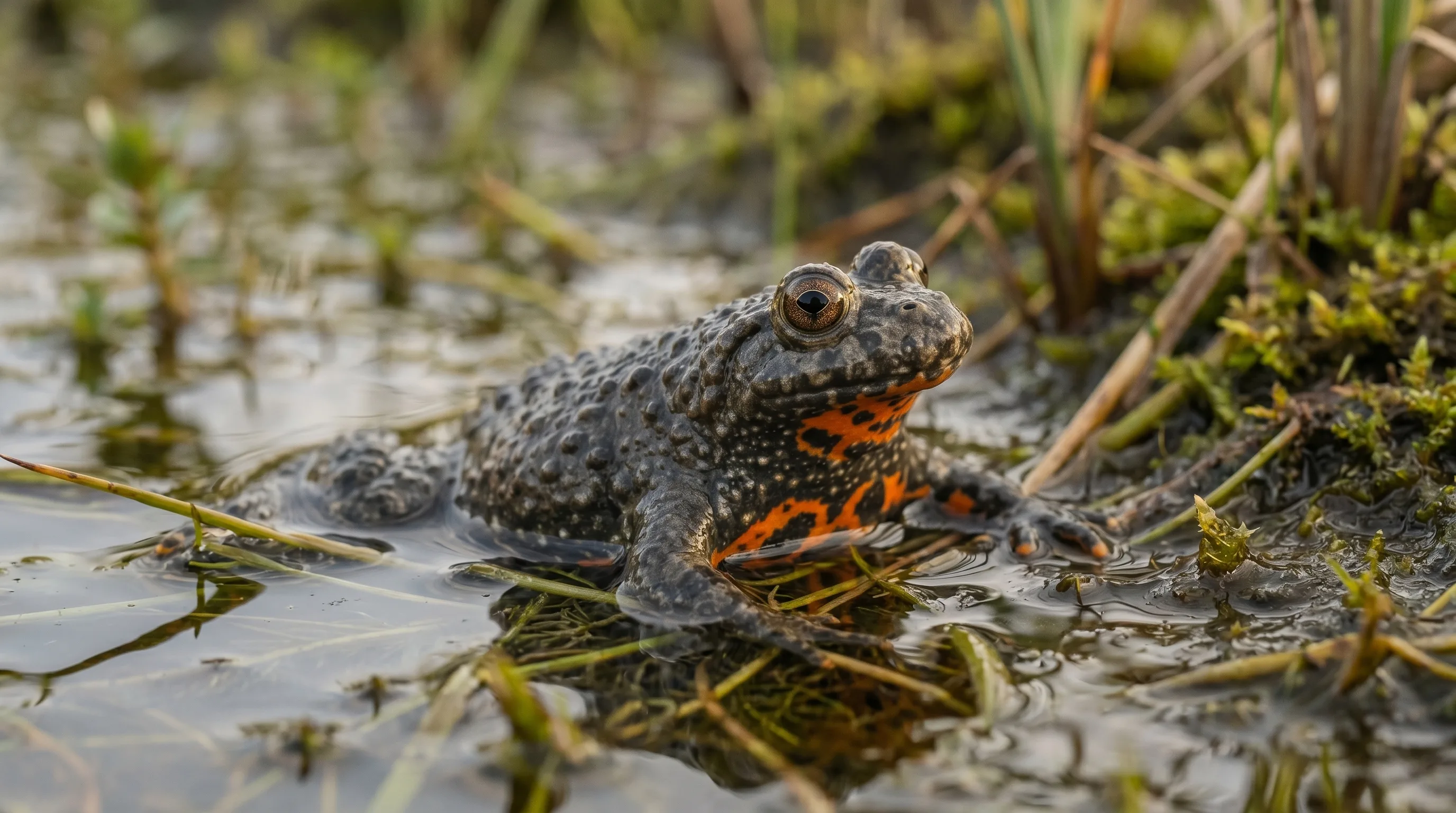
European Fire-Bellied Toad (Bombina bombina)
Introduction
Stand at the edge of a sunlit floodplain pond in Central Europe in late May. The air carries the smell of wet earth and reed pollen. Somewhere below the surface, half-submerged among floating leaves and stalks of emergent vegetation, a small amphibian floats motionless — its back the colour of dead bark and shadow, its presence almost invisible against the silted shallows. Then, disturbed by the vibration of your footstep on the soft bank, it flips. In a reflex so ancient it predates human civilisation by tens of millions of years, the animal arches its spine and lifts its limbs skyward, revealing an underside of blazing orange and jet black — a biological warning painted in the most vivid terms nature knows. This is the European fire-bellied toad, Bombina bombina, and that single gesture — the unken reflex — encapsulates everything extraordinary about this animal: its duality, its chemical armoury, and the evolutionary arms race that has shaped it.
The European fire-bellied toad occupies a curious space in the ecological imagination of the continent. It is neither as celebrated as the great crested newt nor as conspicuous as the common toad. It rarely makes the front page of conservation campaigns. Yet for the wetlands of Central and Eastern Europe, it is quietly indispensable — an apex invertebrate predator in shallow-water ecosystems, a host to specialised parasites, a prey base for herons, grass snakes, and water shrews, and a living bioindicator of floodplain health. Where fire-bellied toads thrive, the wetland is functioning. Where they disappear, something essential has been lost.
This article examines Bombina bombina in full biological depth: its anatomy, ecology, behaviour, reproductive biology, evolutionary story, and its increasingly fragile position on a continent that has drained, polluted, and fragmented its wetland habitats with alarming speed over the past century. Understanding this small, brilliant-bellied amphibian is to understand the wetland itself — a world of slow water, chemical communication, and survival strategies refined across geological time.
"In every drop of water, there is a story of life."
— Wetlands International
Scientific Classification
Kingdom: Animalia
Phylum: Chordata
Class: Amphibia
Order: Anura
Family: Bombinatoridae
Genus: Bombina
Species: Bombina bombina (Linnaeus, 1761)
Common Names: European fire-bellied toad, lowland fire-bellied toad (English); Rotbauchunke (German); kumak nizinny (Polish)
The genus Bombina belongs to the ancient family Bombinatoridae, a lineage with deep evolutionary roots that separated early from the main anuran radiation. The family contains only two genera: Bombina with eight species, and the monotypic Barbourula from Borneo and the Philippines. The name Bombina derives from the Latin bombus, meaning a humming or buzzing sound — a reference to the males' soft, repetitive mating calls. Linnaeus formally described Bombina bombina in 1761 based on specimens from what was then part of the broader Swedish natural-historical tradition, placing it among the early catalogued European amphibians.
Within the genus, Bombina bombina is most closely related to the yellow-bellied toad (Bombina variegata), with which it shares much of its Central European range and occasionally hybridises along a well-studied contact zone. This hybrid zone — stretching across parts of Germany, Austria, and the Balkans — has become one of the most scientifically significant natural laboratories for studying speciation, reproductive isolation, and the genetics of hybrid incompatibility in vertebrates.
Physical Characteristics
The European fire-bellied toad is a compact, dorsoventrally flattened amphibian measuring between 4 and 5.5 centimetres in total body length, with females typically slightly larger than males. Adults rarely exceed 6 centimetres. Despite its modest size, its body proportions convey a sense of robustness: the head is broad and flat, the limbs sturdy and well-adapted for both swimming and clambering through aquatic vegetation, and the overall silhouette is distinctly toad-like — squat, wide-bodied, with a short snout and widely spaced, prominent eyes.
The dorsal surface is the toad's camouflage canvas. The skin is covered in small, rounded tubercles — wart-like structures that break up the body's outline and whose surfaces contain the glandular tissue responsible for chemical secretions. The background colouration of the back is variable: typically a grey-brown, olive-brown, or occasionally greenish tone, liberally patterned with darker spots and blotches. Some individuals show a distinctly greenish cast, particularly when inhabiting heavily vegetated ponds. This dorsal cryptic pattern is highly effective — a fire-bellied toad resting on a muddy substrate or partially submerged in leaf litter is almost impossible to detect.
The ventral surface stands in absolute contrast. The belly and the undersides of the limbs are vivid combinations of orange-red or scarlet and dense, irregular black spots and patches. The exact patterning is individually unique — no two toads share the same ventral pattern — making it theoretically possible to identify individuals by their belly markings. The orange pigmentation comes from carotenoid-based pigments, likely derived partly from dietary sources, and its brightness correlates with both the individual's health and its toxic potency. Brighter-bellied individuals tend to be avoided more strongly by predators, suggesting aposematic honesty: the signal reliably reflects the chemical threat beneath it.
One of the most distinctive anatomical features of Bombina bombina — and the entire Bombina genus — is the shape of the pupil. Unlike most frogs and toads, which have horizontal or vertical slit pupils, fire-bellied toads possess a triangular or heart-shaped pupil that closes to a roughly inverted-triangle or biconvex form in bright light. This unusual pupil shape is a synapomorphy of the genus and provides excellent light-regulation in shallow, sun-drenched water bodies. The iris surrounding the pupil is a rich golden-copper colour, giving the toad an intense, almost jewelled gaze that betrays none of its cryptic intentions.
Males can be distinguished from females during the breeding season by the development of nuptial pads — dark, roughened swellings on the inner surfaces of the first and second fingers and the inner aspect of the forearm. These pads enhance grip during amplexus. Outside the breeding season, sexing by external features alone is difficult, though males tend to be slightly smaller on average, and their vocal sacs — though not visibly inflated as balloons — are present as paired internal resonating chambers.
Fun Fact The ventral pattern of each European fire-bellied toad is entirely unique — no two individuals share the same arrangement of orange and black — making it a natural biometric fingerprint for researchers conducting population studies.
Habitat & Geographic Distribution
The European fire-bellied toad is fundamentally a lowland species. Its name — sometimes rendered as the "lowland fire-bellied toad" to distinguish it from the mountain-dwelling Bombina variegata — points directly to its ecological preference for flat, low-lying terrain where water accumulates, spreads, and lingers. It occurs across a broad arc of Central and Eastern Europe, from eastern Germany and Austria in the west, through Poland, the Czech Republic, Slovakia, Hungary, Romania, Bulgaria, and the Balkan Peninsula, to the Baltic states, Belarus, Ukraine, and extending eastward into Russia as far as the Ural foothills.
The species is quintessentially a creature of floodplain systems. Historically, before the large-scale river regulation works of the 18th through 20th centuries, the great lowland rivers of Europe — the Elbe, Oder, Vistula, Danube, Prut, and Dniester — periodically inundated vast floodplain meadows and forest margins, creating a dynamic mosaic of temporary pools, backwaters, oxbow lakes, and seasonally flooded grasslands. This landscape of ephemeral and semi-permanent water bodies was the ecological heartland of Bombina bombina. The species evolved in, and depends upon, this kind of hydrological dynamism.
Within these landscapes, fire-bellied toads show a distinct preference for shallow, warm, often turbid water bodies with dense emergent or floating vegetation. Ponds, flooded meadows, rice paddies, irrigation ditches, oxbow lakes, drainage channels, and even large wheel ruts filled with rainwater all serve as suitable breeding and foraging habitats. Water depth is rarely critical — the toad is perfectly comfortable in pools only centimetres deep — but water temperature matters greatly. Sunlit, south-facing pools that warm quickly in spring initiate breeding activity; cold, shaded water inhibits it.
Terrestrial habitat around water bodies is also important. Fire-bellied toads do not venture far from water, and densely vegetated margins — with tall grasses, sedges, reeds, and shrubs — provide crucial cover from predators and microclimatic buffering against desiccation. The species avoids exposed agricultural land, heavily grazed pastures without water, and built-up areas almost entirely. It is a wetland obligate in the truest sense.
Habitat Feature | Bombina bombina (European) | Bombina variegata (Yellow-bellied) |
|---|---|---|
Preferred elevation | Lowlands (0–200 m asl) | Hills and mountains (200–2,000 m asl) |
Water body type | Ponds, floodplains, oxbows | Temporary pools, streams, ruts |
Vegetation density | Highly vegetated margins | Often sparse vegetation, open areas |
Water temperature preference | Warm, still lowland water | Cooler, often flowing or shaded |
Geographic range | Central and Eastern Europe | Central Europe, Balkans, Alps |
Altitude is a critical distributional boundary. The European fire-bellied toad rarely occurs above 200 metres above sea level, and most populations are concentrated below 100 metres. This contrasts sharply with Bombina variegata, which regularly inhabits mountain streams and hillside pools up to 2,000 metres. This altitudinal partitioning, combined with differential habitat preferences, is one of the primary mechanisms that maintains reproductive isolation between the two species where their ranges meet.
Behaviour & Social Structure
Bombina bombina is not a solitary recluse, nor is it a highly social species in the mammalian sense. Its social structure is best described as loosely aggregative — individuals congregate at suitable water bodies driven by reproductive and foraging imperatives, and within these aggregations, complex acoustic and chemical communication structures emerge, particularly during the breeding season. Understanding the social behaviour of fire-bellied toads requires understanding that their primary social medium is sound.
Male fire-bellied toads are among the most persistent callers in European amphibian communities. From late April through August, males position themselves at the water surface — often partially submerged, occasionally perched on floating vegetation — and produce their characteristic advertisement call: a soft, melancholic "oonk" or "woonk" repeated at regular intervals of one to three seconds. The call is quiet by the standards of European frogs; it lacks the explosive volume of the common frog's choruses or the penetrating rasp of the natterjack toad. Instead, it is subtle, almost contemplative — a low moan that carries across still water with surprising efficiency. On warm, windless evenings, a chorus of several dozen males creates a continuous, overlapping drone that is one of the most atmospheric sounds of Central European wetlands.
The calling behaviour is not random. Males establish loose acoustic territories around favoured calling positions, and will react to the calls of neighbouring males with increased calling rate — a competitive escalation that signals presence and fitness without physical confrontation. Physical combat between males is rare; the primary currency of competition is vocal persistence and positioning. A male that can maintain a calling station in the warmest, most vegetated part of a pond for the longest period accumulates the greatest likelihood of attracting a mate.
The most famous behavioural feature of Bombina bombina is the unken reflex (from the German Unkenreflex). When seized or strongly threatened, the toad adopts a rigid, characteristic posture: the back is arched downward while the limbs are raised and curled outward, displaying the brightly coloured ventral surfaces to the attacker. The head may tilt back to expose the throat's colouration. The animal becomes temporarily motionless — a theatrical display of warning that communicates, with biochemical honesty, the message: "I am toxic. Release me." This reflex is shared across the Bombina genus and is a textbook example of aposematic behaviour combined with chemical defence.
Intelligence in fire-bellied toads is difficult to assess by conventional metrics, but their behavioural flexibility is notable. They demonstrate habituation — individuals in frequently disturbed environments eventually reduce their escape responses to stimuli that prove non-threatening. They show thermoregulatory behaviour, moving between sun-exposed and shaded sections of a water body across the day to maintain preferred body temperatures. And they exhibit spatial memory sufficient to return reliably to favoured calling and basking sites across multiple days and seasons.
Daily Life & Activity Cycle
The European fire-bellied toad is predominantly diurnal and crepuscular, most active during daylight hours and the early hours of dusk. This activity pattern is driven by its thermoregulatory needs — as an ectotherm, it requires external heat sources to reach operative body temperatures for efficient metabolism, muscle function, and digestion. Cool Central European mornings typically see the toad basking at the water surface, absorbing solar radiation before moving into foraging mode as temperatures rise through mid-morning.
A typical active-season day begins shortly after sunrise. The toad emerges from its overnight resting position — often buried in shallow mud at the pond margin, tucked beneath floating vegetation, or wedged among leaf litter near the water's edge — and moves to an exposed surface position to bask. This thermoregulatory basking session may last 30 to 90 minutes, depending on ambient temperature and cloud cover. Once a suitable body temperature is reached, the toad transitions to active foraging along the vegetated margins of its water body.
Foraging is largely sit-and-wait interspersed with slow, deliberate movement through shallow water. The toad moves with a characteristic half-swimming, half-crawling motion in very shallow water, pausing frequently to scan for invertebrate prey. Prey is detected primarily visually — movement triggers a strike response — though chemical cues from the water may also play a role in detecting invertebrate concentrations.
During the breeding season, calling males interrupt their foraging activity with extended periods of surface-floating and vocalisation. A calling male may remain stationary at its calling station for hours, occasionally interrupted by brief foraging excursions. This calling investment represents a significant energetic cost — males lose condition over the breeding season and must compensate with intensive post-breeding foraging.
Seasonal activity follows a clear annual cycle. In Central Europe, fire-bellied toads emerge from hibernation between late March and April, depending on latitude and local microclimate. Spring emergence is triggered by rising soil and water temperatures rather than by photoperiod alone — the critical threshold appears to be water temperatures consistently above 10–12°C. The period from emergence to first calling is typically two to four weeks, as the toads re-feed and restore depleted energy reserves from winter. The breeding season extends from May through July, with calling activity peaking in May and June. Late summer — August and September — is a period of intensive foraging as the toads accumulate fat reserves for hibernation. They enter hibernation between October and November, burrowing into soft soil, mud, leaf litter, or beneath logs and stones near or within water bodies, where frost penetration is minimal.
Fun Fact European fire-bellied toads can remain submerged and breathe cutaneously (through their skin) for extended periods — an adaptation that allows them to overwinter underwater in oxygen-rich, frost-free conditions in deeper parts of ponds.
Diet & Survival Strategies
The European fire-bellied toad is a generalist predator of small invertebrates, with a diet shaped by the astonishing biodiversity of aquatic and semi-aquatic wetland ecosystems. Its dietary breadth is one of its key ecological assets: rather than specialising on a narrow prey type, it exploits whatever invertebrate resource is most abundant in its environment at any given time, shifting its foraging focus seasonally and with local prey availability.
Adult fire-bellied toads consume a wide range of prey. Aquatic invertebrates dominate the diet during periods of full aquatic activity: water fleas (Daphnia spp.), ostracods, amphipods, aquatic insect larvae (including chironomid midges, mayfly nymphs, and water beetle larvae), small aquatic beetles, water snails, and worms. In shallow marginal zones, terrestrial invertebrates that fall onto the water surface — small beetles, flies, spiders, caterpillars, ants — are taken opportunistically. Larger adults may occasionally consume very small tadpoles of other species, though cannibalism of conspecific tadpoles appears rare.
The strike mechanism is a combination of jaw snap and, in some Bombina species, a partial tongue projection. Unlike the explosive, projectile tongue of tree frogs and bufonid toads, the fire-bellied toad's tongue is relatively less specialised for long-range projection — it is more effective at capturing slow-moving or stationary prey within close range. This means the toad must approach prey more closely, relying on stealth and the visual detection of movement rather than ambush from a distance.
Tadpoles of Bombina bombina occupy a different dietary niche entirely. Newly hatched larvae are microphagous filter feeders, consuming suspended phytoplankton, bacteria, and fine organic detritus. As they develop, their dietary range expands to include periphyton — the film of algae and associated microorganisms coating submerged surfaces — which they scrape with their keratinised mouthparts. Late-stage tadpoles are opportunistic omnivores, consuming detritus, algae, and small invertebrates.
Food scarcity is managed through metabolic flexibility. During cold periods or temporary droughts that reduce invertebrate abundance, fire-bellied toads can dramatically lower their metabolic rate and reduce activity, surviving on stored fat reserves for weeks at a time. Their relatively flat, water-efficient body form minimises evaporative water loss during periods when they cannot remain continuously submerged, extending their tolerance of sub-optimal conditions. This metabolic resilience is part of what makes them successful colonisers of marginal, unpredictable wetland habitats.
It is a warm June afternoon on the floodplain of the lower Vistula in central Poland. The oxbow lake — a crescent of still, tea-coloured water left behind when the river changed its course decades ago — is alive with sound. Dozens of male fire-bellied toads call from the surface, their "oonk, oonk" overlapping into a continuous, hypnotic pulse. The water surface is a mosaic of lily pads, hornwort, and floating pondweed, and among these structures, the toads float like small, dappled islands, their warty backs indistinguishable from the debris around them.
A grey heron stalks the shallow margins twenty metres away, lifting each foot with glacial deliberateness. It strikes once, twice — on the third attempt it emerges with a small toad clamped in its bill. The toad's response is immediate: it arches into the unken reflex, its brilliant orange belly blazing in the afternoon light. The heron pauses. It has learned this lesson before. With a head-shake that seems almost contemptuous, it drops the toad back into the shallows and resumes its patient hunt for fish.
The toad rights itself without apparent distress, bobs to the surface, and within two minutes resumes calling. The exchange lasted less than fifteen seconds, but it encapsulated an evolutionary relationship millions of years in the making — predator experience, aposematic chemistry, and the fire-bellied toad's quiet insistence on survival.
Interaction with Other Animals
The web of interactions in which Bombina bombina is embedded is remarkably dense for such a small animal. It occupies simultaneous roles as predator, prey, competitor, and chemical deterrent in the wetland food web, and its relationships with other species are among the most ecologically important in its ecosystem.
As a prey species, the fire-bellied toad faces pressure from a diverse guild of predators — but this pressure is dramatically modified by its chemical defences. The skin secretions of Bombina bombina contain a complex mixture of bioactive compounds, most notably bombesin-like peptides, bombinin peptides, and bombesins, as well as bufadienolides — steroidal compounds similar to those found in true toads (Bufo spp.). These compounds are variably toxic, causing intense irritation to mucous membranes and, in sufficient quantities, can be systemically toxic to naive predators. The effect on an inexperienced predator that seizes a fire-bellied toad is typically rapid and unambiguous: excessive salivation, head-shaking, eye-rubbing, and prompt release of the prey.
However, not all predators are deterred. Grass snakes (Natrix natrix) are well-documented, effective predators of fire-bellied toads; their feeding behaviour involves rapid swallowing that minimises contact with the toad's skin secretions, and they appear to have some tolerance for bombinin toxins. European water shrews (Neomys fodiens) and common kingfishers (Alcedo atthis) also prey on fire-bellied toads, apparently with limited aversion. Herons — grey herons (Ardea cinerea) and night herons (Nycticorax nycticorax) — are variable: some individuals learn to avoid fire-bellied toads after negative experiences, while others incorporate them into their regular prey base. White storks (Ciconia ciconia), which forage extensively in floodplain habitats, are also documented predators.
In competitive interactions, fire-bellied toads share their habitat with a range of other amphibian species: the marsh frog (Pelophylax ridibundus), the edible frog (Pelophylax esculentus), the common frog (Rana temporaria), various newt species, and — where ranges overlap — the yellow-bellied toad (Bombina variegata). Competition for breeding sites and invertebrate prey is likely, though direct competitive exclusion has rarely been documented. The fire-bellied toad's preference for warm, shallow, heavily vegetated ponds often differentiates it from the deeper-water preferences of marsh frogs, reducing direct competition.
The hybrid zone between Bombina bombina and Bombina variegata represents one of the most studied amphibian competitive interactions in science. Where the two species meet, hybrids occur, but hybrid fitness is generally reduced relative to pure-species individuals — a phenomenon described as hybrid unfitness. This creates a "tension zone" that tends to remain stable or move only slowly across the landscape, with neither species fully displacing the other. This contact zone has been studied for decades as a natural model of reinforcement, speciation, and selection against hybridisation.
Parasitological interactions are ecologically significant. Fire-bellied toads harbour a range of endoparasites, including nematodes (particularly Rhabdias species in the lungs and Oswaldocruzia in the gut), trematode larvae encysted in muscle tissue, and trypanosomes in the blood. These parasite communities both track the toad's movements and contribute to broader wetland food web dynamics — some trematode cycles involve aquatic snails as intermediate hosts, connecting the toad to mollusc populations. The toad's immune system's ongoing relationship with these parasites drives significant immune gene diversity, which may have implications for disease susceptibility at the population level.
Interaction with Environment
The European fire-bellied toad is not merely an inhabitant of wetland ecosystems — it is an active participant in shaping them. Its ecological interactions with the physical and biological environment operate at multiple scales, from the microscopic (through its influence on invertebrate communities in water bodies) to the landscape level (through its role as a prey base that subsidises terrestrial predators).
At the most immediate scale, the toad's predatory activity on aquatic invertebrates exerts measurable top-down control on invertebrate community structure. In ponds where fire-bellied toad densities are high, populations of certain zooplankton groups — particularly larger cladocerans and copepods — tend to be suppressed, which in turn reduces grazing pressure on phytoplankton and alters the competitive dynamics among algal species. The toad thus participates, alongside other predatory vertebrates, in the trophic cascade that regulates water quality and clarity in small water bodies. The ecological concept of the "green world hypothesis" — the idea that herbivore populations are kept in check by predators, allowing plant communities to flourish — plays out in miniature form in the ponds that fire-bellied toads inhabit.
The tadpoles of Bombina bombina contribute a different kind of environmental interaction. As scrapers and filter feeders, they process significant quantities of periphyton and suspended organic matter, converting algal and microbial biomass into animal tissue that is then available to predators higher in the food chain. In productive, eutrophic ponds, large tadpole populations can measurably reduce algal biomass and suspended organic loads — a service that influences water clarity and the oxygen dynamics of the water body.
The toad's cutaneous permeability — its skin absorbs water, dissolved gases, and chemicals from the environment with little selectivity — makes it an extraordinarily sensitive monitor of water quality. This biological openness, which is an asset in clean wetland environments, becomes a liability in polluted systems. Pesticides, herbicides, heavy metals, and acidification all penetrate the toad's body with ease, making Bombina bombina populations reliable sentinels for wetland contamination. The disappearance of fire-bellied toads from a historically occupied water body frequently signals the deterioration of water quality before other monitoring methods detect it.
The toad also participates in nutrient cycling. Its excretion of nitrogen and phosphorus compounds into water bodies contributes to aquatic nutrient budgets, and the decomposition of dead individuals releases accumulated nutrients back into wetland soils. In aggregate across a population, these individual contributions are ecologically non-trivial — a population of several hundred toads occupying a single pond represents a significant, biologically mediated nutrient flux over a season.
Reproduction & Parenting
Reproduction in Bombina bombina is a protracted, acoustically driven, energetically demanding process that extends across the warmest months of the Central European year. Unlike many temperate amphibians that breed explosively in a brief window of early spring, the fire-bellied toad pursues a prolonged breeding strategy — a repeated-breeder that may produce multiple clutches across a season lasting from late April to August. This strategy spreads reproductive risk across time, reducing the chance that a single cold snap, drought event, or predation pressure can eliminate an entire year's reproductive output.
Males arrive at breeding water bodies slightly before females, establishing calling positions and initiating advertisement behaviour as soon as water temperatures become suitable. The male's advertisement call — the soft, repetitive "oonk" — serves both to attract females and to advertise calling station quality. Female arrival at breeding sites typically lags male arrival by several days to two weeks, a pattern consistent with female mate choice: females have the luxury of comparing calling males before selecting a partner.
Once a female selects a calling male and approaches, he initiates amplexus — the physical grip that aligns his cloaca with hers for external fertilisation. The amplexus in Bombina bombina is inguinal (lumbar) rather than axillary: the male grasps the female around her waist, just in front of the hind limbs, rather than behind the forelimbs. This inguinal position is a primitive character shared with other members of the family Bombinatoridae and related ancient anuran lineages, contrasting with the axillary amplexus typical of more derived frogs. The pair may remain in amplexus for several hours to days as the female oviposits.
Eggs are deposited in small clusters of 2 to 20 eggs, attached to submerged vegetation, stones, or floating debris. A single female may produce 80 to 300 eggs per clutch, and may breed multiple times per season if environmental conditions remain suitable. The eggs are small — approximately 1.5 to 2 mm in diameter — and enclosed in a clear, gelatinous capsule that provides both physical protection and a micro-environment for early development. Incubation is temperature-dependent: at 20°C, hatching occurs in approximately 3 to 5 days.
Parental investment ends completely at oviposition. Like the vast majority of anurans, fire-bellied toads provide no post-spawning care. Their reproductive strategy is essentially bet-hedging through quantity and temporal spreading rather than intensive care of few offspring. Larvae must fend entirely for themselves from the moment they hatch.
Tadpoles hatch as small, suspension-feeding larvae and undergo a developmental trajectory lasting 5 to 8 weeks under typical summer conditions. The larval period is highly sensitive to temperature — warmer water accelerates development, enabling tadpoles to complete metamorphosis and emerge onto land before autumn in the most favourable years. Newly metamorphosed toadlets are tiny — barely 10 mm in body length — and immediately disperse from the natal water body into surrounding terrestrial habitat. Growth is rapid in the first year if food is abundant, but sexual maturity is not reached until the second or third year of life. Maximum longevity in the wild is estimated at 10 to 15 years, though many individuals in natural populations do not survive beyond 5 to 7 years.
Evolutionary Adaptations
The evolutionary toolkit of Bombina bombina reads like a case study in the arms race between amphibian prey and vertebrate predator — a contest that has been running for at least 70 million years and has produced some of the most elegant biological solutions in the animal kingdom.
The centrepiece of these adaptations is the chemical defence system. The granular glands of the dorsal skin produce a complex secretion containing bombinin peptides — small antimicrobial and cytotoxic peptides — as well as bombesins (gastrointestinal peptides with potent physiological effects in mammals and birds), physalaemin-related peptides, and bufadienolide steroids. The bombinin peptides are particularly remarkable: they include both L-amino acid forms and D-amino acid isoforms, and the D-bombinins are among the first naturally occurring D-amino acid peptides discovered in any vertebrate. The significance of D-amino acid peptides lies in their resistance to proteolytic degradation — enzymes that break down normal L-amino acid proteins cannot efficiently process D-amino acid chains, making D-bombinins far more persistent and potent in a predator's oral mucosa than their L-form equivalents would be.
The unken reflex itself is an evolved behavioural-morphological complex: it only makes functional sense in conjunction with the aposematic colouration of the ventral surface, which in turn only makes functional sense in conjunction with the toxic skin chemistry. The three elements — posture, colour, and chemistry — form an integrated defensive system, and their joint evolution represents one of the cleanest examples of co-evolution between morphology, behaviour, and biochemistry in vertebrates.
Cryptic dorsal colouration represents a complementary, parallel defensive strategy. The toad's first line of defence is not to be seen at all — the brown, grey-green, and spotted dorsal pattern provides highly effective camouflage against the substrates the toad typically inhabits. Only when cryptic concealment fails — when a predator detects and seizes the toad — does the secondary chemical-aposematic defence activate. This two-tier defence system minimises the energetic cost of maintaining the chemical arsenal: it is deployed only when necessary.
The heart-shaped pupil represents a sensory adaptation to the toad's specific light environment. Shallow, sun-drenched lowland ponds experience extreme light intensity variation — full sun at midday in an open pond, deep shade under reed canopy at the margins. The unusual pupil shape allows a greater range of light regulation than a standard circular pupil, potentially providing better visual acuity across a broader range of lighting conditions. This matters for a visually oriented predator that must detect the movement of small invertebrates in both bright and shaded water.
The toad's tolerance of hypoxic conditions — enabled by cutaneous respiration through the highly vascularised, permeable skin — represents a metabolic adaptation that opens ecological niches unavailable to less physiologically flexible vertebrates. Shallow floodplain pools frequently experience severe oxygen depletion during hot summer nights as bacterial decomposition of organic matter consumes dissolved oxygen. Fire-bellied toads can survive these conditions by supplementing pulmonary respiration with cutaneous gas exchange, accessing oxygen directly from the water through their skin.
Ecological Importance
Bombina bombina occupies a pivotal position in the ecology of Central European lowland wetlands — a position whose full significance becomes apparent only when we consider what happens to ecosystem function when the species is removed. Far from being a peripheral element of wetland biodiversity, the fire-bellied toad functions as a keystone component of the invertebrate food web, a critical prey base for higher-level consumers, a regulator of water quality, and a bioindicator of ecological health.
Its role as an invertebrate predator is quantitatively significant. In productive lowland ponds, fire-bellied toad populations may reach densities of several hundred individuals per hectare of water surface. At these densities, the aggregate predatory impact on aquatic invertebrates is substantial — the toad community collectively processes enormous quantities of chironomid larvae, zooplankton, small beetles, and molluscs every season. This predatory pressure shapes invertebrate community composition and prevents any single invertebrate taxon from achieving the kind of numerical dominance that can destabilise food web structure.
As prey, fire-bellied toads — despite their chemical defences — represent a meaningful energy subsidy to wetland and riparian predators. Grass snakes, herons, white storks, and water shrews all rely partly on amphibians as a food source, and the toad's extended breeding season and large aggregations at water bodies make it a reliable, concentrated food resource during the late spring and early summer period when predator energy demands are highest (corresponding to the breeding and chick-rearing seasons of birds, and the active foraging season of reptiles and mammals). A decline in fire-bellied toad populations therefore ripples upward through the food chain, reducing the energy available to these dependent predators.
At the landscape scale, the toad's movements between aquatic breeding sites and terrestrial foraging areas create energetic and nutrient connections between these two ecosystem compartments. Emerging metamorphs transport energy and nutrients from aquatic to terrestrial systems; adult toads that die on land after foraging do the reverse. These "biological pumps" are ecologically important in fragmented landscapes where wetland and upland habitats may otherwise exchange little material.
The species also functions as an umbrella species for wetland conservation. Where habitat management protects sufficient suitable habitat for Bombina bombina populations — clean, shallow, warm, vegetated water bodies within accessible floodplain landscapes — this same management simultaneously benefits hundreds of other wetland species: invertebrates, aquatic plants, waterfowl, wading birds, other amphibians, and riparian mammals. The toad's specific habitat requirements serve as a high-quality template for comprehensive wetland conservation planning.
Threats & Conservation
The European fire-bellied toad has experienced dramatic population declines across much of its range over the past century, driven by a convergence of threats that each individually would be significant and in combination have proven devastating. The species has vanished entirely from large portions of its former western range and persists only in isolated, fragmented populations across much of Central Europe. Understanding the full threat profile requires examining each pressure in detail.
Wetland drainage and habitat destruction represent by far the most severe threat. European lowland wetlands have been drained, channelised, and converted to agricultural land at extraordinary rates since the 18th century. An estimated 60–90% of European lowland wetlands have been destroyed in the last two centuries alone. The dynamic floodplain systems that once characterised the lowland rivers of Central Europe — with their annually regenerating mosaic of pools, backwaters, and seasonally flooded meadows — have been replaced by engineered, regulated rivers flanked by drained agricultural land. This transformation has obliterated the habitat matrix on which fire-bellied toad populations depend at the landscape scale.
Agricultural intensification affects surviving habitat patches through multiple mechanisms. Pesticide and herbicide runoff degrades water quality and directly kills aquatic invertebrates, eliminating the toad's prey base. Nutrient runoff from fertilised fields drives eutrophication of water bodies, leading to algal blooms, oxygen depletion, and the collapse of the diverse aquatic invertebrate communities the toad depends upon. Mechanical drainage of field margins and ditches eliminates many of the small, temporary water bodies that serve as critical supplementary breeding sites. Cattle grazing of pond margins, while sometimes beneficial in moderation, can destroy the vegetation structure that provides terrestrial shelter when grazing is intensive.
Habitat fragmentation compounds these habitat-quality issues through isolation effects. Fire-bellied toad populations require connectivity between water bodies to maintain genetic diversity and to allow recolonisation after local extinction events. Isolated populations in fragmented landscapes become genetically depauperate over time, suffer from inbreeding depression, and cannot recover from local catastrophes — disease outbreaks, drought, pollution events — because immigration from neighbouring populations is blocked. Infrastructure barriers — roads, urban areas, drainage ditches with steep banks — prevent individual movement between sites and effectively strand populations in habitat islands.
Disease pressure from the chytrid fungus Batrachochytrium dendrobatidis (Bd) has been confirmed in European fire-bellied toad populations, and while mass mortality events attributable to chytridiomycosis in this species are less dramatically documented than in some other European amphibians, the fungus remains a background threat. The emergence of the second chytrid, Batrachochytrium salamandrivorans (Bsal), from Asia represents a potential future threat to European amphibian communities broadly, though its primary documented impacts to date have been on salamanders rather than anurans.
IUCN Red List Analysis
Current IUCN Status
The European fire-bellied toad (Bombina bombina) is currently assessed as Least Concern (LC) on the IUCN Red List of Threatened Species. This global assessment reflects the species' broad geographic range across Central and Eastern Europe and the relatively large total population estimate when considered at the continental scale. At the global level, Bombina bombina does not meet the quantitative thresholds for Vulnerable, Endangered, or Critically Endangered status — it is neither sufficiently restricted in range, nor has its total population declined sufficiently rapidly over three generations, to qualify for a higher threat category under IUCN criteria.
However, the Least Concern classification requires critical contextual interpretation. The global assessment masks pronounced regional and national variation in conservation status. In Germany, the species is listed as Endangered (Gefährdet or Stark gefährdet depending on the federal state); in Austria, it is listed as Endangered; in Switzerland it is regionally extinct; in the Netherlands, it has been extirpated. Even within countries where it remains nominally widespread — Poland, Hungary, Romania — populations are fragmented and locally declining. The global LC status reflects the security of large Eastern European populations in areas of less intensive agricultural development, not the trajectory of the species across its most modified western and central range.
Population Trend
The population trend for Bombina bombina is assessed as Decreasing. While precise global population estimates are not available, regional monitoring data from across the species' range consistently document decline. Long-term monitoring studies in Germany document local population extinctions and the progressive fragmentation of the remaining metapopulation network. In Poland, regional assessments of floodplain amphibian communities report reduced occupancy of historically inhabited water bodies, associated with agricultural drainage and land-use intensification.
Historical range contraction is particularly severe in Western and Central Europe. The species has lost an estimated 50–70% of its former occupied area in Germany, Austria, and the Czech Republic over the past 50 years, primarily through wetland loss. In contrast, large portions of the Eastern European range — particularly in the river floodplains of Ukraine, Belarus, and western Russia — retain more extensive suitable habitat and support comparatively stable, dense populations. The species' overall global population trajectory is downward, and without sustained conservation intervention, this trajectory is unlikely to reverse in the western and central parts of the range.
Main Threats
Wetland drainage and habitat loss remain the dominant threat, directly responsible for the elimination of breeding and foraging habitat across the western and central range. River regulation works, agricultural drainage schemes, and urban development have eliminated the floodplain dynamics that produce the heterogeneous wetland mosaic the species requires. Once a floodplain is drained and converted to arable land, reversion to functional fire-bellied toad habitat is a decades-long ecological process even with active restoration.
Agricultural intensification degrades habitat quality in remaining patches through pesticide and nutrient pollution, inappropriate grazing management, and the drainage of small water features within agricultural landscapes. Neonicotinoid insecticides are particularly concerning: as systemic compounds absorbed by plants and leaching into water bodies, they can severely deplete aquatic invertebrate communities that constitute the toad's prey base, creating a habitat that appears suitable but is functionally impoverished.
Habitat fragmentation and population isolation interrupt the metapopulation dynamics necessary for long-term population viability. Road infrastructure in particular is a significant source of direct mortality (road-kill during breeding migrations) and a barrier to genetic exchange between populations. The construction of motorways and other high-traffic roads across floodplain landscapes has severed connectivity between formerly interconnected population networks.
Climate change introduces compounding stressors. Increased frequency of summer droughts in Central Europe threatens to dry out shallow water bodies during the breeding season, eliminating oviposition sites and causing tadpole mortality. Conversely, increased winter precipitation and flood events may inundate hibernation sites, disrupting overwintering survival. Phenological mismatch — where the toad's emergence timing becomes uncoupled from peak invertebrate availability due to differential climate-driven shifts in phenology — is a subtler but potentially significant long-term consequence.
Disease, particularly chytridiomycosis caused by Batrachochytrium dendrobatidis, represents an ongoing background pressure. While dramatic mass mortality events have not been documented in Bombina bombina on the scale seen in some other species, subclinical infection likely contributes to reduced survival in some populations, and the spread of Bsal to fire-bellied toad populations remains a concern requiring ongoing surveillance.
Ecological Consequences
The continued decline of Bombina bombina populations would trigger a cascade of ecological consequences at multiple levels of wetland food web organisation. The removal of the toad's predatory pressure on aquatic invertebrates would shift invertebrate community composition, potentially allowing certain taxa — particularly chironomid midges and small cladocerans — to increase disproportionately, with downstream effects on phytoplankton dynamics and water quality. The loss of the toad's role as an "ecological pump" transferring energy between aquatic and terrestrial systems would reduce the energy subsidies available to terrestrial riparian predators.
Predators that currently rely significantly on fire-bellied toads — particularly white storks, grey herons, and grass snakes in lowland floodplain habitats — would experience reduced prey availability during critical periods of their annual cycle, potentially affecting breeding success and population productivity in these species. Wetland food webs show considerable interconnectedness, and the removal of a moderate-density, geographically widespread prey species creates realignments across the system that are difficult to predict precisely but are unlikely to be ecologically neutral.
The species' value as a bioindicator would also be lost. Bombina bombina populations currently serve as sensitive, cost-effective monitors of wetland ecosystem health. Their disappearance from monitoring networks would reduce early-warning capacity for wetland degradation, potentially allowing deterioration of water quality and habitat condition to progress further before detection by other means.
Conservation Efforts
Conservation efforts for the European fire-bellied toad operate at national, regional, and international levels, ranging from habitat protection and restoration to captive breeding programmes and landscape-scale wetland management initiatives. The species is listed in Annex II of the European Union's Habitats Directive (Directive 92/43/EEC), which obligates EU member states to maintain or restore favourable conservation status and to designate Special Areas of Conservation (SACs) for the species. This legal framework provides the most powerful formal conservation instrument available in EU member states, creating a legal duty of care for the species and its habitats.
Habitat restoration is the most effective long-term conservation tool. Wetland restoration projects across Germany, Poland, Hungary, and the Czech Republic have created or restored shallow, vegetated ponds within floodplain landscapes, providing new breeding and foraging habitat for isolated populations. LIFE+ projects funded by the European Union have delivered targeted habitat creation for fire-bellied toads in Germany (particularly Saxony and Brandenburg), Hungary (Tisza floodplain), and Poland (Vistula and Narew river valleys), demonstrating that populations can recover rapidly when suitable habitat is restored in connected landscapes.
Captive breeding and headstarting programmes operate in several European zoos and specialist herpetological conservation centres, producing metamorphs for reintroduction to restored habitat patches. While captive breeding cannot substitute for habitat protection, it provides an insurance mechanism for locally extinct populations and enables genetic management of isolated populations susceptible to inbreeding depression.
Road mortality mitigation — through the installation of amphibian tunnels, toad fences, and wildlife crossing structures at migration hotspots — has been implemented at several sites in Germany and Poland, with documented positive effects on population connectivity and survival during spring breeding migrations.
Future Outlook
The long-term survival of Bombina bombina in Western and Central Europe depends fundamentally on the trajectory of wetland conservation policy and land-use change across the region. In the near term, the EU Biodiversity Strategy for 2030 — which includes commitments to restore degraded ecosystems and halt biodiversity loss — provides a policy framework that, if implemented effectively, could benefit wetland habitats across the species' range. The EU Nature Restoration Law, adopted in 2024, includes specific commitments to restore wetland ecosystems that, if honoured at the national level, would create new opportunities for fire-bellied toad habitat restoration at landscape scale.
In Eastern Europe, the species' status is comparatively more secure in the short to medium term, as large areas of relatively intact floodplain habitat persist in Ukraine, Belarus, and parts of Russia. However, the economic development pressures facing these regions — intensifying agriculture, infrastructure investment, and industrial development — suggest that this security should not be assumed to be permanent.
Climate projections for Central Europe indicate increased frequency and intensity of summer droughts over the coming decades, which directly threatens the shallow, warm water bodies that fire-bellied toads depend upon. Without proactive management — water level management in existing ponds, creation of deeper water bodies as insurance against drought, and landscape-scale water retention measures — this climatic trajectory will accelerate population declines independent of direct habitat destruction.
Overall, the future outlook for Bombina bombina can be characterised as cautiously uncertain. The species is not on the immediate trajectory toward global extinction, and targeted conservation has demonstrated its effectiveness. But the convergence of habitat loss, fragmentation, agricultural pollution, and climate change creates a threat matrix whose individual components are each capable of driving local and regional population collapses, and whose combined effects are not yet fully understood.
Human Relationship
The relationship between Bombina bombina and human communities in Central and Eastern Europe is ancient, complex, and culturally layered in ways that reflect the deep entanglement of human civilisation with wetland landscapes. In agricultural communities throughout the toad's range, the appearance of fire-bellied toads at the edges of village ponds and flooded meadows in late spring was historically noted as a reliable phenological signal — an indicator that the warm growing season had truly arrived and that planting conditions were favourable. The toad's soft, persistent call on warm spring evenings was embedded in the sensory texture of rural life for generations of Central European farmers.
In German folklore, the Unke — the regional name for fire-bellied toads and related species — appears in proverbial usage. "Unken" as a verb in German means to utter gloomy predictions or to croak about misfortune, reflecting the toad's mournful, repetitive call and perhaps an association between wetland animals and the unpredictability of floodplain environments. The Unke appears in fairy tales, nature poetry, and the rural cultural memory of Central European communities with an ambivalence that mirrors the ambiguity of wetlands themselves — simultaneously productive and dangerous, fertile and malarial, beautiful and ominous.
Scientific interest in fire-bellied toads has been substantial and historically significant. The hybrid zone between Bombina bombina and Bombina variegata was one of the first vertebrate hybrid zones to receive intensive molecular genetic analysis, contributing foundational insights into the evolutionary processes of speciation. The biochemistry of bombinin peptides — particularly the discovery of D-amino acid peptides — opened an entirely new chapter in peptide biology and has driven pharmaceutical research into antimicrobial compounds with medical potential. The toad's skin secretions have been examined as sources of novel antibiotic and anti-tumour compounds, reflecting a broader pharmaceutical interest in amphibian skin chemistry that has generated numerous drug candidates.
In conservation tourism, fire-bellied toads occupy a modest but real niche. Wetland nature reserves in Germany, Poland, and Hungary that support significant fire-bellied toad populations attract naturalists and herpetologists, and guided evening excursions to listen to calling choruses are offered by some eco-tourism operators in floodplain reserves. This tourism interest, while modest compared to the drawing power of charismatic megafauna, contributes to the economic justification for wetland conservation in agricultural landscapes where competing land-use pressures are intense.
Human-wildlife conflict with fire-bellied toads is largely indirect — the species poses no danger to humans or livestock and is not a pest of agriculture. However, the species' requirement for landscape-scale wetland connectivity creates occasional friction with agricultural and infrastructure development interests, as conservation requirements for amphibian migration corridors and protected water bodies can restrict land-use options for landowners. In Germany and Austria, legal protections for the species under the EU Habitats Directive have occasionally delayed or prevented drainage works, pond infilling, and construction projects, generating local tensions between conservation obligations and economic development pressures.
Unique & Rare Facts
D-amino acid peptides: The skin secretions of Bombina bombina contain bombinin-H peptides incorporating D-amino acids — a phenomenon extraordinarily rare in nature and of major biochemical interest. D-amino acid peptides resist enzymatic degradation far longer than their mirror-image L-form equivalents, making them potent and persistent antimicrobial agents.
Individually unique belly patterns: Every fire-bellied toad's ventral colour pattern is unique to that individual, functioning as a biometric fingerprint. Researchers have developed photo-identification databases using belly images to track individual toads across seasons without the need for invasive marking.
Heart-shaped pupils: The triangular, heart-shaped pupil is unique to the genus Bombina among all European amphibians and is one of the most anatomically distinctive features of any European vertebrate.
Dual defence architecture: The toad employs genuinely separate defensive systems operating in series — passive cryptic camouflage as the first line, and active aposematic chemical display as the second — a two-tier defence strategy rarely as cleanly realised as in Bombina bombina.
Hybrid zone model system: The contact zone between Bombina bombina and Bombina variegata is one of the most extensively studied vertebrate hybrid zones in science, contributing to evolutionary biology, population genetics, and speciation theory across several decades of research.
Skin breathing: Fire-bellied toads can absorb up to 50% of their oxygen requirements through their skin under certain conditions, enabling survival in hypoxic environments that would be lethal to purely pulmonary-breathing vertebrates.
Multiple breeding events per season: Unlike most European amphibians that breed once per year, fire-bellied toads are repeat breeders capable of producing multiple clutches across a breeding season stretching from April to August — an unusual reproductive flexibility in the European anuran fauna.
Parasitic discovery: Studies of Bombina bombina skin microbiome and parasite communities have yielded novel nematode and trematode species previously unknown to science, demonstrating that even well-studied European species carry scientifically undescribed biodiversity.
Pharmaceutical relevance: Bombinin peptides isolated from fire-bellied toad skin have shown potent activity against antibiotic-resistant bacterial strains including MRSA (Methicillin-resistant Staphylococcus aureus), positioning the toad as a potential source of novel antimicrobial compounds in the context of the global antibiotic resistance crisis.
Longevity surprise: Under optimal captive conditions, European fire-bellied toads have been recorded living beyond 20 years — a lifespan remarkable for such a small amphibian — suggesting that wild populations, where environmental attrition takes a heavy toll, are operating far below theoretical longevity limits.
Fun Fact The term "unken" has entered the German language as a verb meaning to predict doom or misfortune — derived directly from the fire-bellied toad's melancholic, repetitive call echoing across dark wetlands on still evenings.
Conclusion
The European fire-bellied toad is a small animal carrying a disproportionate ecological and scientific legacy. In the span of four centimetres and a few grams of biochemically sophisticated tissue, it embodies tens of millions of years of evolutionary refinement: a chemical armoury of remarkable complexity, a behavioural repertoire calibrated with extraordinary precision against the predators it shares its world with, a reproductive strategy that balances opportunity against risk across the whole arc of summer, and a sensory architecture tuned to the specific light, chemistry, and acoustics of shallow lowland water.
It also embodies something more uncomfortable: the vulnerability of specialisation. A species so thoroughly shaped by floodplain ecosystems — so exquisitely fitted to the dynamics of shallow, warm, vegetated, interconnected water bodies — is inevitably exposed when those systems are dismantled. The fire-bellied toad did not evolve to survive in drained arable fields, polluted ditches, or isolated ponds marooned in an agricultural matrix. It evolved for the living wetland, the dynamic floodplain, the messy, productive, biodiverse water-world that once stretched across the lowlands of a continent. That world has been reduced to fragments, and the toad's declining populations are an honest and unambiguous measure of what has been lost.
Yet the fire-bellied toad also offers a measure of hope. Restoration works. Where suitable habitat has been created or reinstated — where floodplains have been rewetted, ponds restored, and migration corridors reconnected — the toad has returned. It is not an animal that demands much: clean, shallow, warm water; abundant invertebrates; vegetated margins; connected landscapes. These are conditions that human effort can provide, and their provision benefits not only Bombina bombina but the entire community of species that shares its world.
"We do not inherit the earth from our ancestors; we borrow it from our children."
— Antoine de Saint-Exupéry (attributed)
To hear the quiet, insistent calling of fire-bellied toads across still water at dusk is to hear one of the oldest sounds of European summer — a sound that has persisted through ice ages and interglacials, through the rise and fall of civilisations, through centuries of agricultural transformation. Whether it persists through the centuries ahead depends not on the toad's evolutionary resilience, which has proven itself across geological time, but on the choices that human societies make about how to manage the last surviving fragments of the wetland world this small, brilliant-bellied amphibian calls home.
Sources & Attribution
Data and ongoing research referenced for this article come from the following authoritative sources — peer-reviewed publishers, official taxonomic registers, and global biodiversity programmes:
- IUCN Red List — European Fire-Bellied Toad — official IUCN Red List assessment including population trend, threats, and conservation actions.
- Wikipedia — European Fire-Bellied Toad — taxonomy, distribution, and an overview with onward citations to primary literature.
- GBIF — European Fire-Bellied Toad — global occurrence and distribution records from the Global Biodiversity Information Facility.
- iNaturalist — European Fire-Bellied Toad — observation records and field photographs contributed by naturalists worldwide.
- Encyclopedia of Life — European Fire-Bellied Toad — multilingual species pages aggregating taxonomic and natural-history data.
- WWF — World Wildlife Fund — global wildlife conservation programmes and research summaries.
- Nature — research on European Fire-Bellied Toad — peer-reviewed studies indexed by Nature on related ecology and behaviour.
- ITIS — Integrated Taxonomic Information System — federal-grade taxonomy and nomenclature.
Frequently Asked Questions
What does the European fire-bellied toad eat?
Adult European fire-bellied toads are generalist aquatic and semi-aquatic predators, consuming a wide range of small invertebrates. Their diet includes water fleas (Daphnia), ostracods, amphipods, chironomid midge larvae, mayfly nymphs, aquatic beetle larvae, water snails, earthworms, and terrestrial insects that fall onto the water surface. Prey is detected visually through movement.
Tadpoles eat very differently from adults: newly hatched larvae are filter feeders consuming suspended phytoplankton and fine organic particles, while older tadpoles scrape periphyton — algal films — from submerged surfaces using their keratinised mouthparts. Late-stage tadpoles become opportunistically omnivorous, consuming detritus and small invertebrates in addition to algae.
Are European fire-bellied toads poisonous?
Yes, the European fire-bellied toad produces toxic skin secretions through specialised granular glands in its dorsal skin. These secretions contain a complex mixture of bombinin peptides (including rare D-amino acid forms), bombesins, and bufadienolide steroids. If ingested or brought into contact with mucous membranes, these compounds cause intense irritation, salivation, and distress in predators.
For humans, direct contact with the skin secretions is not normally dangerous but can cause mild irritation to sensitive skin or mucous membranes. Handling fire-bellied toads should be followed by thorough hand-washing, and contact with eyes or mouth should be avoided. The toad is not venomous — it cannot inject toxins — but its chemical defences are effective enough to deter most inexperienced predators.
Where does the European fire-bellied toad live?
The European fire-bellied toad is found across a broad arc of Central and Eastern Europe, from eastern Germany and Austria in the west to Russia and Ukraine in the east, including Poland, the Czech Republic, Slovakia, Hungary, Romania, Bulgaria, the Baltic states, and the Balkan Peninsula. It is primarily a lowland species, occurring mostly below 200 metres above sea level.
Within this range, the species inhabits shallow, warm, vegetated water bodies in floodplain landscapes: ponds, oxbow lakes, flooded meadows, drainage ditches, and other standing or slow-moving waters with abundant aquatic and emergent vegetation. It is strongly associated with intact or restored floodplain systems and avoids deep, cold, or heavily modified water bodies.
What is the unken reflex in fire-bellied toads?
The unken reflex is a defensive behaviour unique to the genus Bombina. When seized or strongly threatened, the fire-bellied toad adopts a characteristic posture: it arches its back downward while raising and curling its limbs outward, simultaneously exposing the brightly coloured orange-and-black ventral surface to the attacker. The animal becomes temporarily rigid in this posture. The German term "Unkenreflex" gives the behaviour its scientific name.
This reflex is an example of aposematic behaviour — a warning display that honestly communicates the toad's chemical toxicity. Predators that have previously experienced the toad's skin secretions learn to associate the vivid orange-and-black warning coloration with an unpleasant chemical experience and avoid fire-bellied toads in future encounters. The reflex is automatic and immediate, activating within fractions of a second of capture.
How does Bombina bombina reproduce?
The European fire-bellied toad breeds from late April through August in Central Europe. Males call from the water surface to attract females, using a soft, repetitive "oonk" advertisement call. After a female selects a calling male, the pair enters inguinal amplexus — the male grips the female around her waist just in front of the hind limbs — and remains coupled for hours to days while the female deposits eggs.
Eggs are laid in small clusters of 2 to 20, attached to submerged vegetation or debris. A female may produce 80 to 300 eggs per clutch and breed multiple times per season. Eggs hatch in 3 to 5 days at 20°C, producing tadpoles that complete metamorphosis in 5 to 8 weeks. Newly metamorphosed toadlets are tiny (around 10 mm) and reach sexual maturity after 2 to 3 years.
What is the conservation status of the European fire-bellied toad?
The European fire-bellied toad is classified as Least Concern (LC) on the global IUCN Red List, reflecting its broad distribution across Central and Eastern Europe and the large total population when assessed at the continental scale. However, the population trend is Decreasing, and many regional and national assessments rate the species as Endangered or Vulnerable, reflecting severe declines in Western and Central Europe.
The species is protected under Annex II of the EU Habitats Directive, obligating EU member states to maintain or restore favourable conservation status and designate Special Areas of Conservation. Conservation priorities include wetland habitat restoration, creation of connected networks of suitable water bodies, mitigation of agricultural pollution, and road mortality reduction through amphibian tunnels and crossing structures.
How long do European fire-bellied toads live?
In natural populations, European fire-bellied toads typically live between 7 and 15 years, with many individuals not surviving beyond their fifth or sixth year due to predation, disease, drought, and other environmental stressors. Survival rates are highest in high-quality, connected habitats with low predator pressure and reliable water availability.
In captivity under optimal conditions, the species has been recorded living beyond 20 years — a remarkable longevity for such a small amphibian. This suggests that wild populations are not approaching their physiological lifespan limits, and that improving habitat quality and reducing mortality sources in natural environments could meaningfully extend the average lifespans of wild individuals.
What are the main differences between Bombina bombina and Bombina variegata?
The two species are closely related and overlap in range across a contact zone in Central Europe. The most reliable distinguishing features are ventral colouration and habitat preference. Bombina bombina (European fire-bellied toad) has orange-red belly colouration, while Bombina variegata (yellow-bellied toad) has yellow or yellow-orange ventral colouration. Bombina bombina also tends to have more uniform dark spots on the belly, while Bombina variegata shows more irregular patterns.
Ecologically, Bombina bombina is a lowland species associated with warm, vegetated ponds and floodplain water bodies at altitudes typically below 200 metres. Bombina variegata is a montane and sub-montane species that inhabits smaller, often temporary pools, wheel ruts, and stream margins at higher elevations. Where the two species meet, they hybridise, but hybrid fitness is generally reduced, maintaining the two species as distinct evolutionary lineages.
Why is the European fire-bellied toad important to wetland ecosystems?
The European fire-bellied toad plays multiple important ecological roles in lowland wetland systems. As an aquatic invertebrate predator, it exerts top-down regulation on zooplankton and benthic invertebrate communities, influencing the trophic cascade and contributing to water quality regulation. As a prey species, it provides energy subsidies to higher-level predators including herons, white storks, grass snakes, and water shrews during critical periods of the annual cycle.
Its tadpoles process algal biomass and fine organic matter in the water column, contributing to nutrient cycling and water clarity. The toad also serves as a highly sensitive bioindicator of wetland health — its presence reflects suitable water quality, appropriate habitat structure, and landscape-scale connectivity, making it a useful indicator for conservation monitoring. Where fire-bellied toads persist in healthy populations, the wetland ecosystem is functioning; their disappearance signals ecological deterioration.
Can European fire-bellied toads be kept as pets?
European fire-bellied toads are occasionally kept in terraria by experienced amphibian keepers, but legal restrictions apply across their range. In EU member states, the species is protected under the Habitats Directive, making collection from the wild illegal without special permits. Captive-bred individuals from licensed breeders are available in some countries and can be kept legally where national regulations permit.
In captivity, they require semi-aquatic enclosures with a large, shallow water area, suitable hiding places, regular water changes to maintain quality, and a diet of live small invertebrates (crickets, waxworms, small earthworms). Handlers must always wash their hands after contact with the toads due to skin secretions. Wild fire-bellied toads should never be collected for the pet trade, both for legal reasons and because removal further stresses already declining wild populations.
Image: Wikipedia/Wikimedia Commons — “European fire-bellied toad”
Comments
Post a Comment