
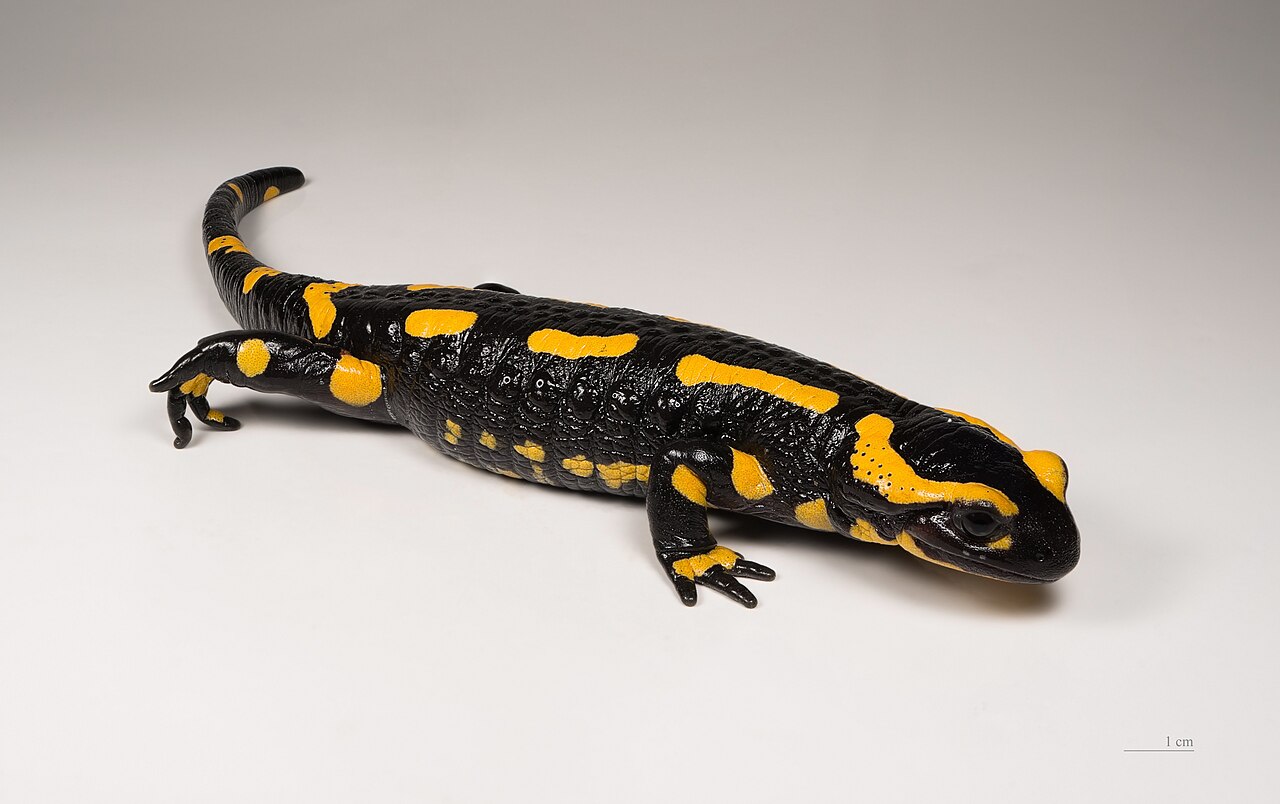
Fire Salamander (Salamandra salamandra)
Introduction
The forest floor is soaked after a night of autumn rain. Leaf litter steams faintly in the cool morning air, and a dense carpet of moss clings to the roots of ancient beech trees. Then, almost impossibly vivid against the brown and grey of the woodland understory, a creature emerges. Its glossy black body is splashed with bold yellow markings — irregular blotches and streaks that look almost painted on, as though nature itself decided to make a statement. Moving with unhurried deliberation across the damp earth, this is the fire salamander, one of Europe's most striking and ecologically important amphibians.
Salamandra salamandra has haunted the imaginations of humans for millennia. Ancient people believed these creatures were born from fire, crawling unharmed from burning logs — a myth almost certainly born from observing salamanders fleeing the flames when gathered wood was placed on a hearth. The truth, while far less magical, is in many ways more extraordinary. This amphibian is a master of chemical warfare, a slow-burning predator of remarkable patience, and a creature so finely tuned to its forest microhabitat that its presence serves as one of the clearest indicators of ecological health in central and southern European woodlands.
Found across much of Europe and parts of the Middle East, the fire salamander occupies a world of cool, humid forests and spring-fed streams. It is primarily nocturnal, secretive, and surprisingly long-lived for an amphibian. Adults have been recorded surviving beyond 20 years in the wild, with some captive individuals exceeding 30 years. Despite its conspicuous colouration, it spends much of its life hidden beneath rocks, logs, and leaf litter, venturing out mainly after rainfall when the forest floor becomes an open hunting ground.
This article explores the full ecological reality of the fire salamander — its biology, behaviour, evolutionary history, ecological role, and the growing threats it faces in a rapidly changing world. From the chemical arsenal it carries in its skin to its unusual method of giving birth to live larvae, Salamandra salamandra rewards deep examination at every level.
"The clearest way into the Universe is through a forest wilderness."
— John Muir
Scientific Classification
Kingdom: Animalia
Phylum: Chordata
Class: Amphibia
Order: Urodela
Family: Salamandridae
Genus: Salamandra
Species: Salamandra salamandra (Linnaeus, 1758)
The fire salamander is the nominal species of the genus Salamandra, which currently contains seven recognised species across Europe and the Middle East. The broader family Salamandridae includes some 21 genera and over 120 species, encompassing newts, true salamanders, and their relatives. Salamandra salamandra itself is divided into numerous subspecies — estimates range from 13 to more than 20 depending on the taxonomic authority consulted — reflecting considerable geographic variation across its range. Recognised subspecies include S. s. salamandra, S. s. terrestris, S. s. gallaica, S. s. fastuosa, and S. s. bernardezi, among others. The latter subspecies is particularly notable for being fully viviparous, giving birth to fully metamorphosed juveniles rather than aquatic larvae, an exceptional trait even within an already unusual species.
Physical Characteristics
The fire salamander is a moderately large, robust salamander. Adults typically measure between 15 and 25 centimetres in total length, with females generally growing slightly larger than males. Body mass ranges from around 14 to 40 grams in most individuals, though well-fed adults in productive habitats can reach the upper end of this range comfortably. The body is stout and somewhat flattened dorsoventrally, with four sturdy limbs and a rounded snout. The tail is roughly cylindrical and tapers toward the tip, comprising about a third to half of total body length.
The skin is smooth and glistening, kept perpetually moist by mucous secretions. The dorsal colouration is deep, jet black, overlaid with vivid yellow or occasionally orange markings. These markings vary enormously between individuals and subspecies — some animals carry broad yellow bands running longitudinally along the back, while others display irregular spots, blotches, or stripes. This variation is heritable and can serve as a basis for distinguishing populations and subspecies across the species' range. The ventral surface is typically dark grey to black.
Parotoid glands — large, swollen structures positioned behind the eyes and along the dorsal surface — are the most functionally important anatomical features of the skin. These glands, along with additional glandular structures distributed across the back, secrete alkaloid toxins that make the fire salamander one of the most chemically defended vertebrates in Europe. The eyes are large and prominent, with rounded pupils and a golden or brown iris. This eye structure supports a wide visual field, useful for detecting prey movement in low-light conditions.
Sexual dimorphism is subtle but present. Females are noticeably larger-bodied, reflecting the reproductive demands of carrying developing larvae internally. Males can be distinguished during the breeding season by a swollen cloaca. The legs are well-developed and the feet lack webbing, reflecting a largely terrestrial lifestyle compared to many other salamander species.
Fun FactThe yellow and black pattern of the fire salamander is one of the most recognisable examples of aposematism — warning colouration — in European wildlife. Predators quickly learn to associate these colours with an intensely unpleasant chemical experience.
Habitat & Geographic Distribution
The fire salamander's range spans a wide arc across the European continent and into parts of western Asia and the Middle East. Its core distribution covers central Europe — Germany, Austria, Switzerland, Poland, the Czech Republic — extending west through France, the Iberian Peninsula, and the British Isles in limited pockets, and south through Italy, the Balkans, Turkey, and the Levant. In North Africa, isolated populations exist in the Rif and Atlas mountains of Morocco and Algeria.
Throughout this range, the species shows a strong preference for cool, humid deciduous and mixed woodland. Beech forest is a particularly favoured habitat type across much of central Europe, and the species' distribution closely follows the distribution of old-growth deciduous woodland. Altitude is an important variable: fire salamanders are found from sea level to elevations of around 2,000 metres, though most populations occupy mid-elevation zones between 200 and 1,000 metres where forest cover, moisture levels, and temperature ranges are optimal.
Proximity to clean, cold water is a critical habitat requirement. Females require permanent or semi-permanent water bodies — typically small, fast-flowing hill streams, spring seeps, or pools — where larvae can develop. The water must be well-oxygenated and largely free of chemical contamination, which makes the fire salamander a reliable bioindicator of water quality. The surrounding terrestrial habitat must provide abundant refugia: large rocks, fallen logs, dense leaf litter, and burrow systems that maintain the cool, moist microclimate the species depends on year-round.
Fire salamanders are not migratory in any seasonal long-distance sense, but they do undertake local movements between terrestrial retreats and larval deposition sites, particularly during autumn and early spring when rainfall triggers surface activity. Home ranges are relatively small — typically 100 to 500 square metres in productive habitat — and individuals demonstrate strong site fidelity, returning to the same refugia year after year.
Habitat Feature | Preferred Condition | Tolerance Limit |
|---|---|---|
Vegetation type | Deciduous/mixed broadleaf woodland | Conifer plantations (marginal) |
Temperature range | 5–15°C (active season) | Up to ~20°C briefly |
Moisture level | High humidity, post-rain activity | Aestivation during dry spells |
Altitude | 200–1,000 m | Up to ~2,000 m |
Water access | Clean, cold springs and streams | Still pools (less preferred) |
Ground cover | Deep leaf litter, logs, rock crevices | Sparse ground cover (avoided) |
Behaviour & Social Structure
The fire salamander is largely a solitary species. Outside of the brief interactions associated with mating, adults do not form stable social groups, cooperative units, or hierarchical structures in the way that mammals or some fish species do. Each individual maintains its own territory of suitable refugia and foraging ground, and encounters between adults are generally neutral or mildly antagonistic rather than cooperative.
Territorial behaviour does occur, particularly in males during the breeding season. Males will confront rivals through postural displays and, occasionally, physical combat — biting and wrestling have been observed in captive settings and occasionally in the field. However, these confrontations are rarely escalated to serious injury. The primary means of territorial assertion appears to be chemical: the fire salamander has a sophisticated ability to leave scent trails and chemical marks in its environment, and conspecifics appear to assess the occupancy status of refugia partly through chemosensory investigation.
The species shows impressive navigational intelligence. Field studies using mark-recapture methods have demonstrated that individuals displaced from their home range are capable of finding their way back across distances of several hundred metres, navigating through unfamiliar terrain. This suggests spatial memory of considerable sophistication relative to brain size. Fire salamanders appear to use olfactory cues, visual landmarks, and possibly even low-frequency vibrations to orient in their environment.
Communication in Salamandra salamandra is predominantly chemical. Glandular secretions, including skin toxins, play a dual role: they defend against predators, but they also carry information about the identity, sex, reproductive condition, and possibly the body condition of the secreting individual. Males may assess rival quality and female reproductive status through chemosensory contact, pressing their snouts to the substrate or to conspecifics to sample chemical signals.
Visual communication is less prominent but not absent. The bold aposematic colouration is directed at potential predators rather than conspecifics, but it may also play a role in species recognition during breeding encounters. Posturing behaviours — arching the back, tilting the body to expose bright flank markings — have been observed as defensive displays directed at both predators and approaching rivals.
Daily Life & Activity Cycle
The fire salamander is primarily a nocturnal animal, emerging after dark to forage, explore, and interact with its environment. During daylight hours, it retreats to cool, moist refugia — beneath flat stones, inside decaying logs, within burrow systems made by small mammals, or deep in piles of fallen leaves. These retreats are not merely resting places; they regulate the animal's body temperature and hydration levels, both of which are critical to its survival as an ectotherm.
Activity levels are governed heavily by temperature and moisture. The species is most active at surface temperatures between 8 and 18 degrees Celsius and relative humidity above 80 percent. Rain is perhaps the single most reliable trigger for surface activity: even a light shower will bring fire salamanders out of hiding in numbers, as the moistened environment reduces desiccation risk and simultaneously brings earthworms and other invertebrates to the surface. Field observers in central European beech forests during autumn report that fire salamanders can appear almost simultaneously across large areas following rainfall, as though the forest floor suddenly comes alive.
Seasonality shapes the activity cycle profoundly. In temperate populations, fire salamanders enter a period of winter inactivity — not true hibernation in the physiological sense, but a deep torpor during which metabolic rate drops significantly. They retreat to frost-free refugia: deep burrow systems, chambers beneath rocks below the frost line, or cave entrances. This period typically runs from November through February or March, though mild winters in recent decades have seen some individuals remaining active at surface temperatures well below 5 degrees Celsius.
The spring emergence, triggered by warming temperatures and spring rains, initiates the most active phase of the annual cycle. Adults begin foraging intensively to rebuild fat reserves depleted during winter torpor. This is also when females carrying larvae from the previous autumn's mating move toward water bodies to deposit their offspring. Summer brings a secondary reduction in activity during the driest and warmest weeks — a period of semi-aestivation when individuals retreat to the deepest, coolest refugia. Autumn is again a peak activity period, combining intensive foraging, the mating season, and preparation for winter.
Diet & Survival Strategies
The fire salamander is a generalist carnivore, consuming virtually any animal prey it can overpower and swallow. The core of the diet in most studied populations consists of earthworms, slugs, and snails — soft-bodied invertebrates that are energetically profitable and abundant in the moist forest floor environments the salamander inhabits. Arthropods, including beetles, centipedes, spiders, and woodlice, contribute substantially to the diet where they are available. Larger individuals will occasionally take small vertebrates including juvenile frogs, newts, and even small lizards, though this appears to be opportunistic rather than targeted predation.
Hunting strategy is one of patient ambush and active pursuit combined. Fire salamanders do not pin themselves to fixed ambush sites in the manner of some reptilian predators; instead, they move slowly and methodically through their foraging territory during nocturnal activity bouts, investigating every crevice and patch of leaf litter with the tongue and snout. Prey detection appears to be primarily olfactory and mechanoreceptive. The tongue is short and non-projectile — unlike the long, rapidly-deployed tongues of plethodontid salamanders — and prey is typically seized with a direct lunge and grasped with the jaws.
Earthworms appear to be preferentially targeted when available. Studies of gut contents have found earthworm remains dominating stomach samples from populations across central Europe during spring and autumn. This preference likely reflects the high moisture content, digestibility, and caloric density of earthworms relative to the energetic cost of capture. Slugs are taken almost as readily, and the ability to handle mucus-covered, chemically defended slugs — some of which are distasteful to many other predators — gives the fire salamander access to a food resource that few other forest floor vertebrates exploit effectively.
During periods of food scarcity, the fire salamander's low metabolic rate is a significant survival advantage. Unlike endothermic vertebrates, which must consume calories continuously to maintain body temperature, fire salamanders can substantially reduce energy expenditure during cool or dry periods, surviving on stored fat reserves for weeks or even months. This metabolic flexibility allows the species to persist in highly seasonal environments where invertebrate prey availability fluctuates dramatically between summer and winter.
On a wet October evening in the Siebengebirge hills of western Germany, a fire salamander moves across a path carpeted in fallen beech leaves. It moves at perhaps two body lengths per minute — deliberate, almost contemplative — stopping to investigate a decomposing log with slow lateral sweeps of its blunt snout. Its skin catches the light from a distant street lamp, and the yellow markings glow against the blackness like embers.
Beneath the log, an earthworm has surfaced in response to the vibrations of rain still dripping from the canopy above. The salamander detects it immediately. There is a short, rapid lunge — faster than the slow gait of the approach would suggest possible — and the worm is seized crosswise. Over the next thirty seconds, using a combination of jaw movements and walking motions that inch the prey deeper into the mouth, the earthworm is consumed entirely.
The salamander pauses, motionless, for several minutes after feeding. Then it turns toward the slope below the path, moving with fresh purpose toward the small spring-fed stream that runs through the valley bottom. It is a female, her flanks slightly swollen, carrying larvae she has been gestating since last autumn's mating encounter. Tonight, or perhaps tomorrow night, she will deposit them in the stream, completing a cycle that has continued uninterrupted in these hills for thousands of generations.
By dawn, she will have vanished beneath the leaf litter once more, invisible to the dog walkers who will pass this path in a few hours' time, entirely unaware that one of Europe's most ancient amphibian lineages performed its ancient rituals among them in the dark.
Interaction with Other Animals
The fire salamander occupies both predator and prey positions within its forest ecosystem, and its interactions with other species are shaped by this dual ecological role. As a predator, it competes for invertebrate prey with a range of other forest floor insectivores including common toads, various newt species, shrews, and ground beetles. Competition with these species is generally diffuse rather than intense, as each occupies a somewhat different activity period, microhabitat, or prey size class.
Predation pressure on the fire salamander is significant, despite its chemical defences. Grass snakes (Natrix natrix) are documented predators that show some tolerance to salamander toxins and will actively pursue and consume fire salamanders. European hedgehogs have been observed attacking fire salamanders, though the outcome of these encounters varies — hedgehogs may foam at the mouth, suggesting skin secretion uptake, but some individuals succeed in consuming the salamander. Storks, ravens, and other large corvids occasionally take fire salamanders, seemingly able to manage low doses of skin toxins. Domestic cats and dogs will mouth fire salamanders and then drop them, suggesting rapid aversive conditioning — an encounter typically more distressing for the mammal than for the salamander.
Interactions with other amphibian species are primarily competitive rather than predatory. In many central European woodlands, fire salamanders share their habitat with alpine salamanders (Salamandra atra), various species of newt, and common frogs and toads. Larval fire salamanders in streams compete directly with aquatic invertebrates and the larvae of other amphibians for food resources, and larger larvae will consume smaller individuals of other species — a form of intraguild predation that has implications for community structure in small streams.
An interesting interaction exists between fire salamanders and invertebrate prey that possesses its own chemical defences. Millipedes, for example, produce hydrogen cyanide compounds and other repellent chemicals that deter many predators. Fire salamanders appear to investigate millipedes and then generally reject them, suggesting some capacity for learned or innate prey discrimination. The complex prey community of the European forest floor has likely exerted selective pressure on salamander chemosensory and dietary discrimination capabilities over millions of years of co-evolution.
Interaction with Environment
The fire salamander's relationship with its habitat is one of extraordinary intimacy. Unlike highly mobile species that range across large landscapes, this amphibian lives embedded within a relatively small area of woodland, its daily existence shaped by the minute details of substrate moisture, temperature gradients, and microhabitat availability. This tight ecological coupling means the species is acutely sensitive to environmental change — but it also means that, where conditions are stable, fire salamanders can persist in the same location for decades or centuries.
The relationship with water is foundational. Spring-fed streams and seeps within forest ecosystems are not simply larval deposition sites — they are anchors around which fire salamander populations organise themselves. The distribution of adult animals across the surrounding woodland reflects the location of these water bodies, with population density typically highest within 200 to 300 metres of a suitable stream. The quality of these water bodies depends on the health of the surrounding catchment: undisturbed forest soils filter and buffer rainfall, maintaining the cool, clear, oxygen-rich conditions that larval fire salamanders require. When catchment forest is removed, stream temperatures rise, sediment loads increase, and water chemistry changes in ways that larval survival cannot accommodate.
The fire salamander contributes to nutrient cycling within its woodland habitat. By consuming large quantities of invertebrates — particularly earthworms and slugs — and excreting nitrogen-rich waste, it functions as a consumer that links the invertebrate community to the vertebrate trophic level while simultaneously contributing to the decomposer-based energy pathway. Its own body, when it dies, returns nutrients directly to the forest floor, feeding fungi, bacteria, and the invertebrates that constitute its living diet.
The species also interacts with forest structure in a less obvious way: its requirement for retreats — decaying logs, deep leaf litter, rock piles, mammal burrows — means that it depends on the structural complexity that only old or mature forest provides. In managed forests where dead wood is systematically removed and understory vegetation kept sparse, fire salamander densities drop markedly even when the tree canopy appears intact. The species thus serves as a strong argument for retention of dead wood and structural diversity in forest management.
Reproduction & Parenting
The reproductive biology of Salamandra salamandra is among the most studied and most fascinating aspects of its natural history. The species is notable within the amphibian world for its internal fertilisation and, in most subspecies, the retention of developing larvae within the female's body until they are deposited in water as free-swimming larvae — a strategy known as ovoviviparity or, more precisely, larviparity.
Mating typically occurs on land, most commonly during autumn, though spring and summer matings are documented in some populations. The male approaches a receptive female and initiates courtship through a combination of body-rocking behaviours and chemical investigation. He manoeuvres beneath the female and deposits a spermatophore — a gelatinous capsule containing sperm — on the substrate. The female then lowers her cloaca to take up the spermatophore, and fertilisation is internal. A female can store sperm in specialised receptacles (spermathecae) within her reproductive tract for extended periods — potentially years — meaning that a single mating event can fertilise multiple subsequent clutches without repeat copulation.
After fertilisation, embryos develop within the female's paired uteri. In the most widespread subspecies, the embryos develop into fully aquatic larvae — typically between 10 and 70 in number per female, though the average brood size is closer to 20 to 40 in most populations. The gestation period is variable but typically spans between six and twelve months. Development rate responds to the female's body temperature, which in turn reflects ambient environmental conditions. Females carrying larvae in autumn may overwinter with the developing offspring inside them, completing gestation and deposition the following spring.
Larval deposition occurs at the surface of a shallow, slow-moving section of a stream or seep, often at the very margins where water depth is minimal. The female lowers herself into the water and releases larvae one or a few at a time. Deposited larvae are already well-developed — typically 25 to 35 millimetres in length — with functioning gills, four limbs, and the beginnings of a predatory lifestyle. They are immediately independent; there is no parental care following deposition.
In water, larvae are active predators. They feed on aquatic invertebrates, grow rapidly, and undergo metamorphosis typically within two to five months, depending on water temperature and food availability. Metamorphs emerge from the water at 40 to 70 millimetres in length and immediately adopt the terrestrial lifestyle of the adult. Sexual maturity is reached at approximately two to four years of age in most populations. The exceptional subspecies S. s. bernardezi from northern Spain has abandoned aquatic larval development entirely: females carry embryos through complete metamorphosis, depositing fully terrestrial juveniles that are miniature copies of the adult.
Fun FactFemale fire salamanders can store viable sperm inside their bodies for up to two years or more, allowing them to fertilise eggs without needing to encounter a male again — a form of reproductive insurance that has significant survival value in low-density populations.
Evolutionary Adaptations
The fire salamander's evolutionary history stretches back tens of millions of years. The family Salamandridae diverged from other salamander lineages during the Cretaceous period, and fossil evidence suggests that salamandrids have occupied broadly similar ecological niches in European and Asian forests for a very long time. The genus Salamandra itself appears to have originated in the Miocene, with diversification into current species occurring primarily during Pliocene and Pleistocene climatic oscillations that fragmented and reconnected European forest habitats repeatedly.
The most spectacular evolutionary adaptation of the fire salamander is its toxin production system. The alkaloid toxins secreted by the parotoid and dorsal skin glands belong primarily to a group of steroidal alkaloids called salamandrins — specifically salamandrine, samandarine, and related compounds. These substances act as sodium channel blockers in vertebrate neural and muscle tissue, causing severe convulsions, hypertension, and respiratory distress in potential predators. The concentration and composition of these toxins varies between populations and subspecies, suggesting ongoing evolutionary refinement in response to local predator communities.
The aposematic colouration that accompanies this toxin system represents a second adaptive layer: it teaches predators to avoid fire salamanders through a single unpleasant encounter rather than requiring lethal toxicity. The exact pattern of yellow markings on individual fire salamanders is variable and heritable, and studies have suggested that both the degree of toxicity and the conspicuousness of the aposematic signal can co-evolve in response to predator learning capacity and population density — a finding consistent with the evolutionary dynamics of aposematism in other taxa.
The shift from oviparity (egg-laying) to larviparity (live larval birth) represents a major reproductive adaptation. By retaining embryos internally, the female protects developing offspring from aquatic predators, desiccation, and water quality fluctuations. The embryos receive nutrition from yolk stores and, in more derived forms, possibly from uterine secretions — a primitive form of matrotrophy. The extreme case seen in S. s. bernardezi, where full metamorphosis occurs within the uterus, demonstrates that this evolutionary trajectory can progress to complete independence from standing water bodies, dramatically expanding the range of terrestrial habitats the species can colonise.
Longevity is itself an adaptive strategy. In environments where juvenile survival is unpredictable due to the boom-and-bust nature of invertebrate prey availability and larval habitat conditions, surviving to reproductive age and then breeding across many successive years buffers the population against catastrophic single-season reproductive failures. This "bet-hedging" life history strategy is widespread in long-lived ectotherms and appears well-developed in fire salamanders.
Ecological Importance
Within central European woodland ecosystems, the fire salamander plays a role that extends well beyond its modest size. As a mid-level predator specialising in soil and leaf-litter invertebrates, it occupies a critical position in the transfer of energy from the detrital food web to higher trophic levels. Earthworms, slugs, and beetles that might otherwise channel their nutrient content into the decomposer pathway are redirected through the fire salamander into the vertebrate food web — ultimately feeding snakes, storks, and foxes that might occasionally consume adult salamanders.
Population density studies in productive central European beech forests have recorded densities of fire salamanders reaching several adults per hundred square metres in optimal habitat. At these densities, the collective predation pressure exerted on invertebrate communities is substantial. Fire salamanders likely suppress slug populations to a meaningful degree in woodland ecosystems, with implications for plant damage and seed predation rates — though the magnitude of this effect has not been fully quantified in field experiments.
As already noted, fire salamanders function as bioindicators of outstanding sensitivity. Their requirement for clean, cold, well-oxygenated water for larval development, combined with their dependence on structurally complex mature forest, makes their population status a reliable indicator of ecosystem health. Monitoring fire salamander populations provides data not just on the species itself but on water quality, forest management impact, and microclimate stability across large woodland landscapes.
The species also contributes to the maintenance of biodiversity at the community level by competing with and occasionally preying upon other amphibian species and invertebrate communities, preventing any single species from dominating and thereby maintaining diversity. In stream ecosystems, larval fire salamanders are significant predators of aquatic invertebrates, influencing the structure of invertebrate communities in small hill streams that would otherwise have few vertebrate predators.
Threats & Conservation
The fire salamander faces an array of threats that operate at different scales and through different mechanisms. Some are acute and local; others are chronic and systemic. Together, they have caused measurable population declines across much of the species' range over the past several decades, prompting increasing conservation concern.
Habitat destruction and fragmentation are the primary chronic threats. As European forests have been converted to agriculture, urbanised, or replanted with monoculture conifer plantations, fire salamander populations have been isolated into increasingly disconnected patches of suitable habitat. This fragmentation reduces gene flow between populations, increases local extinction risk, and prevents recolonisation of restored habitats following local population losses. Road mortality is a related problem of serious magnitude: fire salamanders crossing roads during rain-triggered migration events can suffer catastrophic losses at high-traffic roads bisecting woodland habitats.
Water pollution affects larval survival directly. Agricultural runoff carrying nitrates, phosphates, and pesticides enters the small streams and seeps that fire salamanders use as larval deposition sites. Even modest increases in nutrient loading can trigger algal blooms that reduce dissolved oxygen levels and physically clog gill surfaces. Acidification of streams in areas affected by acid rain has historically been a significant mortality factor for larvae in parts of central and northern Europe.
Climate change is emerging as an increasingly serious threat. The fire salamander's dependence on cool, moist forest conditions makes it particularly vulnerable to the warming and drying trends being recorded across much of Europe. Extended summer droughts reduce surface activity periods, increase desiccation mortality, and reduce prey availability. Warming stream temperatures threaten larval survival and accelerate the drying of seeps and springs that are critical larval deposition sites.
Perhaps the most acute threat currently facing fire salamander populations in western Europe is the fungal pathogen Bsal — Batrachochytrium salamandrivorans. First described in the Netherlands in 2013, this chytrid fungus — related to the infamous Bd (Batrachochytrium dendrobatidis) that has devastated amphibian populations worldwide — attacks the skin of salamanders and can cause catastrophic, near-total mortality in affected populations within months. Dutch fire salamander populations experienced declines exceeding 99 percent following Bsal introduction, believed to have arrived via the international pet trade from Asia. The fungus has since been detected across Belgium, Germany, and Spain, and its potential spread represents an existential threat to fire salamander populations across Europe.
IUCN Red List Analysis
Current IUCN Status
The fire salamander (Salamandra salamandra) is currently listed as Least Concern (LC) on the IUCN Red List of Threatened Species, a classification last reviewed in 2008. This designation reflects the species' broad geographic range, large overall population size, and occurrence across a wide range of habitat types and elevations. The Least Concern classification does not imply that the species faces no threats; rather, it indicates that, at the time of assessment, it did not meet the quantitative thresholds for Vulnerable, Endangered, or Critically Endangered status under any of the five IUCN Red List criteria.
It is important to note that the 2008 assessment predates the emergence of Bsal as a documented threat, the full characterisation of climate-related population trends, and the accumulation of more than a decade of additional population monitoring data. Many conservation scientists have called for a reassessment of Salamandra salamandra's status in light of these developments, and it is widely expected that a revised assessment would reflect significantly greater concern than the current LC designation implies.
Population Trend
The global population trend for fire salamanders is classified as decreasing. While no comprehensive global population estimate exists for the species, regional and national monitoring programmes across central Europe have documented consistent downward trends over the past two to three decades. In the Netherlands, the collapse was sudden and catastrophic: populations that numbered in the tens of thousands before Bsal arrived were reduced to fewer than a hundred individuals within a few years of the fungus being detected. German populations in the Eifel region — close to the Belgian border where Bsal has been confirmed — have shown sharp declines.
Beyond Bsal-affected areas, long-term monitoring data from Germany, Switzerland, and Austria suggests slower but persistent declines associated with habitat loss, road mortality, and water quality degradation. Some mountain populations in the Alps and Apennines appear relatively stable due to the protection afforded by their remote, inaccessible habitat, but lowland and peri-urban populations have declined substantially in most regions where monitoring data exists.
Main Threats
Batrachochytrium salamandrivorans (Bsal): This chytrid fungus represents the single most immediately acute threat to fire salamander populations in western and central Europe. It infects skin tissue, causing erosive lesions that compromise the amphibian's ability to respire, osmoregulate, and maintain electrolyte balance. Mortality in infected populations can reach 100 percent within months of introduction. The pathogen spreads through waterways, soil contact, and potentially via animal vectors. There is currently no effective field treatment, and biosecurity measures to prevent further spread depend heavily on controlling the movement of live amphibians.
Habitat loss and fragmentation: The ongoing conversion of deciduous woodland to agriculture, urbanisation, and plantation forestry eliminates fire salamander habitat irreversibly. Even where forest patches remain, linear infrastructure — roads, motorways, rail lines — fragments populations, increases road mortality during activity events, and prevents natural recolonisation. Drainage of wetlands and channelisation of streams removes larval deposition sites permanently.
Climate change: Increased frequency and severity of summer droughts reduces surface activity periods and prey availability. Rising stream temperatures push larval development conditions beyond tolerable thresholds. Earlier snow melt in montane habitats can desynchronise the reproductive cycle. Extreme precipitation events increase sediment delivery to streams, smothering larval habitats.
Water quality degradation: Agricultural runoff, urban stormwater, and acid deposition continue to degrade the quality of small streams and seeps that fire salamanders depend on for larval development. Even in areas where catchment land use has improved in recent decades, legacy contamination and the lag effects of past land management continue to affect water chemistry.
Road mortality: High-traffic roads crossing through or adjacent to fire salamander habitat cause significant mortality during rain-triggered migration events. Studies from Germany have estimated that road mortality may constitute a significant component of adult mortality in some populations, sufficient to affect population viability over time.
Ecological Consequences
The loss of fire salamander populations from woodland ecosystems would not be ecologically neutral. As a significant predator of slugs, earthworms, and other invertebrates, the species exerts top-down regulatory pressure on invertebrate communities. In its absence, slug populations — already problematic in agricultural contexts — might increase, with cascading effects on plant diversity and seedling survival in regenerating woodland. Earthworm community structure might shift in response to reduced predation pressure, with consequences for soil structure and nutrient cycling.
In stream ecosystems, the loss of fire salamander larvae would remove a significant aquatic invertebrate predator from small hill streams. Macroinvertebrate community composition would shift, likely toward dominance by the more abundant prey taxa that previously faced salamander predation pressure. The detailed consequences of this shift for stream ecosystem function are not fully understood but are likely to include changes in organic matter processing rates and nutrient export.
At the landscape scale, the disappearance of fire salamanders would compromise the bioindicator value of European forest monitoring systems. The species currently serves as an early-warning indicator of habitat degradation and water quality decline. Its loss would remove a sensitive, easily monitored signal of ecosystem health, potentially delaying detection of environmental deterioration that would ultimately affect a much wider range of species.
Conservation Efforts
Conservation responses to fire salamander declines have accelerated dramatically since the confirmation of Bsal in western Europe. In the Netherlands, emergency conservation measures established captive insurance populations from the few surviving wild individuals immediately after the Bsal-driven collapse was recognised. These captive populations, maintained in biosecure facilities, now represent the primary reservoir of Dutch fire salamander genetic diversity and are the basis for future reintroduction attempts pending the development of field-deployable treatments or the identification of surviving wild individuals with apparent resistance.
Research into Bsal treatment and management is ongoing across multiple European institutions. Probiotic treatments — applying live bacterial cultures to salamander skin that produce antifungal compounds — have shown promising results in laboratory settings and limited field trials. Biocontrol approaches targeting the fungus itself are under investigation. International coordination through the Bsal Task Force, convened under the umbrella of the Amphibian Survival Alliance, is developing biosecurity protocols, detection methods, and management guidelines for affected range states.
Habitat management initiatives across Germany, Austria, Switzerland, and other range states have implemented measures to increase structural complexity in managed forests, including dead wood retention programmes, culvert installation at road crossing points, and restoration of stream riparian zones. Road mitigation — particularly the installation of tunnels and guiding barriers to redirect fire salamanders under roads rather than over them — has been demonstrated to significantly reduce road mortality and has been implemented at several priority crossing sites in Germany and Switzerland.
The species benefits from legal protection across most of its European range under national legislation and is listed in Annex III of the Bern Convention, which requires signatory states to regulate exploitation and take measures to prevent population declines.
Future Outlook
The outlook for fire salamanders is genuinely uncertain and varies dramatically by region. In areas currently unaffected by Bsal — particularly the eastern, southern, and montane portions of the range — populations face the chronic but manageable pressures of habitat loss and climate change, and conservation efforts focused on habitat quality and connectivity offer a credible pathway to long-term persistence. In these regions, the species' broad distribution, ecological flexibility, and long lifespan provide a degree of resilience.
In western and central Europe, the Bsal threat transforms the outlook fundamentally. The fungus is present across the Netherlands, Belgium, Germany, and Spain. Its potential spread eastward and southward — aided by natural dispersal through waterways, wildlife movements, and the continued operation of the amphibian trade — represents a scenario that could reduce fire salamander populations across vast portions of the range to ecological insignificance within decades. Without an effective field-deployable treatment or the emergence of natural resistance in populations, the probability of continued catastrophic losses is high.
Climate change adds a further layer of uncertainty. Modelling studies project significant contraction of suitable habitat across the southern and lower-elevation portions of the range under mid-century warming scenarios, potentially extirpating entire regional populations in Mediterranean-adjacent areas before any other threat reaches them. The combination of Bsal, climate change, and habitat fragmentation represents a threat synergy that could be genuinely catastrophic for this ancient lineage if current trajectories continue.
Human Relationship
The fire salamander has occupied a distinctive place in European human culture for centuries, shaped almost entirely by its striking appearance and the mythology surrounding fire. The ancient belief that fire salamanders were immune to fire — or indeed generated from it — persisted across Greek, Roman, and mediaeval European traditions. Pliny the Elder wrote in his Naturalis Historia that the salamander was so cold in nature that it could extinguish fire by contact. Leonardo da Vinci wrote of the salamander as a creature that found its nourishment in fire, drawing its skin from the element. This mythology entered heraldry, literature, and art, with the salamander becoming a symbol of endurance, courage in adversity, and the indestructibility of the soul — qualities that made it an appealing emblem for monarchs and knights. Francis I of France famously adopted the fire salamander as his royal emblem, with the motto "Nutrisco et extinguo" — "I nourish and I extinguish."
In contemporary Europe, the fire salamander has transitioned from mythological symbol to conservation icon. Its visibility — a large, conspicuous amphibian that appears reliably on rain-soaked woodland paths — makes it one of the most frequently encountered and photographed European amphibians, and its striking appearance ensures wide recognition among the general public. Nature tourism in areas with healthy fire salamander populations — particularly in central German upland forests, the Swiss Jura, and the Austrian Alps — includes salamander watching as an informal activity, with dedicated enthusiasts making night walks after autumn rain.
Human-wildlife conflict in the traditional sense is minimal for this species. Fire salamanders are not agricultural pests, do not threaten livestock, and have no commercial value in legal trade. The illegal pet trade remains a concern: wild-caught individuals are occasionally offered through online marketplaces, both within Europe and internationally, contributing to the very movement pathways that allowed Bsal to spread. This trade, though relatively small in scale compared to the trade in other exotic species, carries disproportionate conservation risk given the fungal pathogen context.
Road mortality represents perhaps the most direct and regular negative human-wildlife interaction for this species. The systematic expansion of road networks through European forest habitats, combined with fire salamanders' tendency to cross roads in large numbers during rain events, creates mortality events that local conservation groups have documented repeatedly. Community-based road closure initiatives during peak salamander migration nights — practiced in some German and Swiss communities — represent one of the most direct expressions of public engagement with fire salamander conservation.
Unique & Rare Facts
Chemical complexity: The skin alkaloids of fire salamanders are among the most pharmacologically complex substances produced by any European vertebrate. Samandarine, the primary active compound, has been studied for potential pharmaceutical applications due to its precise mechanism of action on sodium channel receptors.
Exceptional longevity: Wild fire salamanders have been documented living beyond 20 years, and captive individuals have been confirmed at 30 years and older. This makes them among the longest-lived salamander species on Earth.
Sperm storage: Females can store viable sperm in specialised receptacles for up to two years or more, a reproductive adaptation with significant implications for population genetics in isolated populations.
Bsal resistance variation: Research has identified individual fire salamanders — particularly in some Iberian populations — that appear to tolerate Bsal exposure with less severe disease progression than individuals from western European populations. This variation may reflect co-evolutionary history with the fungus or related pathogens and offers a potential basis for selective breeding programmes.
Larval cannibalism: In some populations, larger larvae deposited by females earlier in the season will consume smaller larvae deposited by the same or different females. This intra-specific predation may function as a population regulation mechanism in small, resource-limited streams.
Navigational precision: Displacement experiments have demonstrated that fire salamanders can home to their territory across distances of several hundred metres through unfamiliar terrain, suggesting spatial memory and navigational abilities that exceed what might be expected from a small-brained ectotherm.
Subspecies diversity: With 13 to more than 20 recognised subspecies depending on taxonomic authority, Salamandra salamandra is one of the most subspecifically diverse amphibian species in Europe, reflecting deep population structure shaped by Pleistocene glacial refugia and post-glacial recolonisation.
Full viviparity in S. s. bernardezi: This north Spanish subspecies has abandoned aquatic larval development entirely, giving birth to fully metamorphosed, terrestrial juveniles — an extreme derived reproductive mode rare among amphibians globally.
Mycorrhizal forest dependence: Fire salamanders depend on structurally complex forests with abundant dead wood — ecosystems that themselves depend on mycorrhizal fungi and long ecological continuity. In a sense, the salamander's presence signals an entire web of ecological complexity invisible to the casual observer.
Ancient cultural symbol: The fire salamander is one of the few real animals whose myth-image in European culture predates the scientific understanding of the animal — a creature whose cultural history is as old and complex as European civilisation itself.
Fun FactFire salamanders can live for more than 30 years in captivity — making them longer-lived than many domesticated dog breeds and rivalling the lifespan of animals many times their size. In the wild, individuals exceeding 20 years have been confirmed through long-term mark-recapture studies.
Conclusion
In a continent whose wildlife has been substantially transformed by millennia of human activity, the fire salamander endures as something close to a living relic — a species whose lineage predates the forests it now inhabits, whose chemistry predates the predators it now defends against, and whose cultural presence in human imagination predates the science that has begun to reveal its true nature. To encounter one on a wet autumn night, moving with its characteristic unhurried certainty across a rain-soaked forest path, is to stand in proximity to something genuinely ancient.
The ecological reality of Salamandra salamandra is that it is not merely a striking amphibian but an integrated component of a woodland ecosystem whose health it both depends upon and helps to maintain. Its presence in a forest announces something important: clean water flows here, mature trees stand here, the soil is deep and complex, the invertebrate community is rich. When fire salamanders disappear from a landscape, they take with them this ecological testimony, and the forest they occupied becomes a little less legible, a little less alive.
The threat picture facing this species — the convergence of a catastrophic fungal pathogen, accelerating climate change, and the chronic attrition of habitat loss — represents one of the more urgent conservation challenges in contemporary European wildlife management. Unlike iconic megafauna whose declines generate international headlines, the fire salamander's crisis is largely hidden: played out on night-time woodland paths, in the chemistry of small hill streams, in the invisible spread of microscopic spores through damp soil. It demands not just scientific attention but public awareness and political will.
"What we are doing to the forests of the world is but a mirror reflection of what we are doing to ourselves and to one another."
— Mahatma Gandhi
The fire salamander has survived ice ages, volcanic epochs, and the reorganisation of entire continental landscapes. Whether it survives the converging pressures of the twenty-first century will depend entirely on how seriously the ecosystems it inhabits — and the humans who share them — take the responsibility of stewardship. This is a species that has earned, by virtue of its antiquity, its ecological complexity, and the extraordinary evolutionary solutions it carries in its skin, every effort we can bring to its protection.
Sources & Attribution
Data and ongoing research referenced for this article come from the following authoritative sources — peer-reviewed publishers, official taxonomic registers, and global biodiversity programmes:
- IUCN Red List — Fire Salamander — official IUCN Red List assessment including population trend, threats, and conservation actions.
- Wikipedia — Fire Salamander — taxonomy, distribution, and an overview with onward citations to primary literature.
- GBIF — Fire Salamander — global occurrence and distribution records from the Global Biodiversity Information Facility.
- iNaturalist — Fire Salamander — observation records and field photographs contributed by naturalists worldwide.
- Encyclopedia of Life — Fire Salamander — multilingual species pages aggregating taxonomic and natural-history data.
- WWF — World Wildlife Fund — global wildlife conservation programmes and research summaries.
- Nature — research on Fire Salamander — peer-reviewed studies indexed by Nature on related ecology and behaviour.
- ITIS — Integrated Taxonomic Information System — federal-grade taxonomy and nomenclature.
Frequently Asked Questions
Are fire salamanders poisonous or venomous?
Fire salamanders are poisonous but not venomous — an important distinction. They do not inject toxins through a bite or sting; instead, they secrete alkaloid compounds through specialised glands in their skin. When a predator mouths or bites a fire salamander, these secretions are absorbed through mucous membranes in the mouth, causing severe irritation, muscle spasms, excessive salivation, and in sufficient doses, cardiovascular and respiratory distress.
The primary toxins are steroidal alkaloids called salamandrins, with samandarine being the most studied. For humans, casual skin contact with a fire salamander poses minimal risk — the toxins do not readily penetrate intact human skin. However, handling a fire salamander and then touching the eyes or mouth can cause significant irritation, and washing hands after any contact is strongly recommended. For most potential predators in the wild, the experience of encountering a fire salamander's skin secretions is sufficiently aversive to ensure that the encounter is not repeated.
Where do fire salamanders live in Europe?
Fire salamanders are distributed broadly across central and southern Europe, from the Iberian Peninsula in the west to Turkey and parts of the Middle East in the east. Core populations occur in Germany, Austria, Switzerland, France, the Czech Republic, Poland, Italy, and the Balkans. Isolated populations exist in North Africa (Morocco and Algeria) in suitable mountain habitats.
Within this range, fire salamanders are strongly associated with cool, humid deciduous and mixed woodland, particularly beech forest at mid-elevations. They require proximity to clean, cold springs and streams for larval deposition. They are absent from open agricultural landscapes, dense urban areas, dry Mediterranean lowlands, and monoculture plantations lacking structural complexity.
What do fire salamanders eat?
Fire salamanders are carnivorous predators that feed primarily on invertebrates found on and within the forest floor. Earthworms and slugs constitute the bulk of the diet in most populations, supplemented by beetles, centipedes, spiders, woodlice, and other arthropods. Larger adults occasionally take small vertebrates including juvenile frogs and newts.
Hunting occurs primarily at night, with prey detected through olfactory and mechanoreceptive senses. The fire salamander uses a combination of slow methodical searching and a rapid lunge and jaw strike to capture prey. It does not use a projectile tongue like some other salamander species. Food availability strongly influences body condition, growth rate, and reproductive success, and the species can survive prolonged periods of food scarcity by reducing metabolic activity and drawing on stored fat reserves.
How do fire salamanders reproduce?
Fire salamanders reproduce through internal fertilisation, which occurs on land. The male deposits a spermatophore that the female picks up with her cloaca. She can store the sperm for extended periods — up to two years or more — before using it to fertilise eggs. Embryos develop inside the female's body over a gestation period of approximately six to twelve months.
In most subspecies, the female deposits aquatic larvae — already fully formed, gilled, and mobile — directly into shallow, cold, clean water. These larvae feed and grow aquatically for two to five months before metamorphosing and emerging as terrestrial juveniles. The subspecies S. s. bernardezi from northern Spain is exceptional: it completes full metamorphosis within the uterus and gives birth to fully terrestrial juveniles, with no aquatic larval stage.
What is Bsal and why is it such a serious threat to fire salamanders?
Batrachochytrium salamandrivorans (Bsal) is a chytrid fungus that was first described causing catastrophic mortality in fire salamander populations in the Netherlands in 2013. It infects and destroys the skin of salamanders, leading to erosive lesions, failure of cutaneous respiration and osmoregulation, and death. In the Netherlands, fire salamander populations crashed by over 99 percent within a few years of the fungus being detected.
Bsal is believed to have originated in Asia and to have been introduced to Europe via the international trade in live salamanders and newts. It has since been detected in Belgium, Germany, and Spain. Unlike Batrachochytrium dendrobatidis, which affects a broad range of amphibians, Bsal appears particularly lethal to European and North American salamanders, which have no evolutionary history of exposure to the pathogen and therefore little natural resistance. There is currently no effective method of treating Bsal infection in wild populations, making prevention of further spread and captive insurance population management the primary conservation strategies.
How long do fire salamanders live?
Fire salamanders are exceptionally long-lived for an amphibian of their size. Wild individuals have been documented surviving beyond 20 years in long-term field studies using mark-recapture techniques. Captive individuals have been reliably recorded at ages exceeding 30 years, with anecdotal reports of individuals kept for longer periods still.
This longevity is an adaptive feature of the species' life history strategy. Sexual maturity is reached relatively late — typically at two to four years of age — and individuals that survive to reproduce can contribute to population recruitment across many successive years. This extended reproductive lifespan buffers populations against years of poor juvenile survival, as experienced breeders continue to produce offspring even when recruitment from the current cohort is low.
Why do fire salamanders come out in the rain?
Rain triggers surface activity in fire salamanders for several interconnected reasons. As ectotherms that respire partly through their moist skin, fire salamanders are highly vulnerable to desiccation during dry conditions and must minimise time exposed in low-humidity environments. Rainfall raises ambient humidity to levels that allow prolonged surface activity without dangerous water loss, dramatically expanding the time window during which the animal can safely forage and move.
Rain also brings prey to the surface: earthworms, which constitute a major part of the diet, emerge from waterlogged soil in large numbers during and after rain. Slugs similarly become more active in wet conditions. The rain-triggered activity of fire salamanders thus represents an energy-efficient strategy that concentrates foraging effort in the periods when both physical conditions and prey availability are most favourable.
Are fire salamanders endangered?
Globally, the fire salamander is currently listed as Least Concern on the IUCN Red List, reflecting its broad distribution and large overall population. However, this assessment dates from 2008 and predates the emergence of Bsal as a major documented threat. Many scientists consider a reassessment to be urgently needed.
At the regional level, the situation is considerably more serious. Dutch fire salamander populations have experienced near-total collapse following Bsal introduction. Populations across western Germany and Belgium face significant risk. Across the range more broadly, habitat loss, water quality degradation, road mortality, and climate change are driving persistent population declines. The combination of these threats means that while the species is not globally endangered in the current formal sense, it faces a genuinely uncertain future across much of western Europe.
Can fire salamanders regenerate lost limbs?
Unlike some salamander species — most notably the axolotl (Ambystoma mexicanum) and related ambystomatids — fire salamanders do not possess significant limb regeneration capacity. They belong to the family Salamandridae, which is generally considered to have reduced regenerative abilities compared to the Ambystomatidae. Fire salamanders can heal wounds and regenerate some tail tissue, but full limb regeneration of the kind seen in axolotls has not been documented in Salamandra salamandra.
This distinction is relevant because fire salamanders rely on their chemical defences as a primary anti-predator strategy rather than on the self-sacrifice of disposable body parts. The investment in toxin production may represent an evolutionary trade-off: the metabolic resources directed toward maintaining an effective chemical defence system may not be simultaneously available for investment in elaborate regenerative tissue repair mechanisms.
What is the difference between a fire salamander and a newt?
Fire salamanders and newts both belong to the family Salamandridae, making them close relatives, but they differ in several important ways. Fire salamanders are primarily terrestrial as adults, venturing into water only briefly for larval deposition. Their skin is smooth and kept moist by mucous secretions. They are large-bodied and slow-moving compared to most newt species.
Newts, by contrast, are typically more aquatic — particularly during the breeding season, when many species return to water for extended periods and develop aquatic adaptations including flattened tails for swimming. Newt skin is generally rougher and less glossy than that of fire salamanders. While fire salamanders are exclusively associated with terrestrial adult life and brief aquatic larval stages, newts spend significant portions of their adult lives in or around permanent water bodies. In many European woodland habitats, fire salamanders and newt species such as the smooth newt (Lissotriton vulgaris) or palmate newt (L. helveticus) coexist, partitioning habitat by their different ecological requirements.
How do fire
Image: Wikipedia/Wikimedia Commons — “Fire salamander”
Comments
Post a Comment