
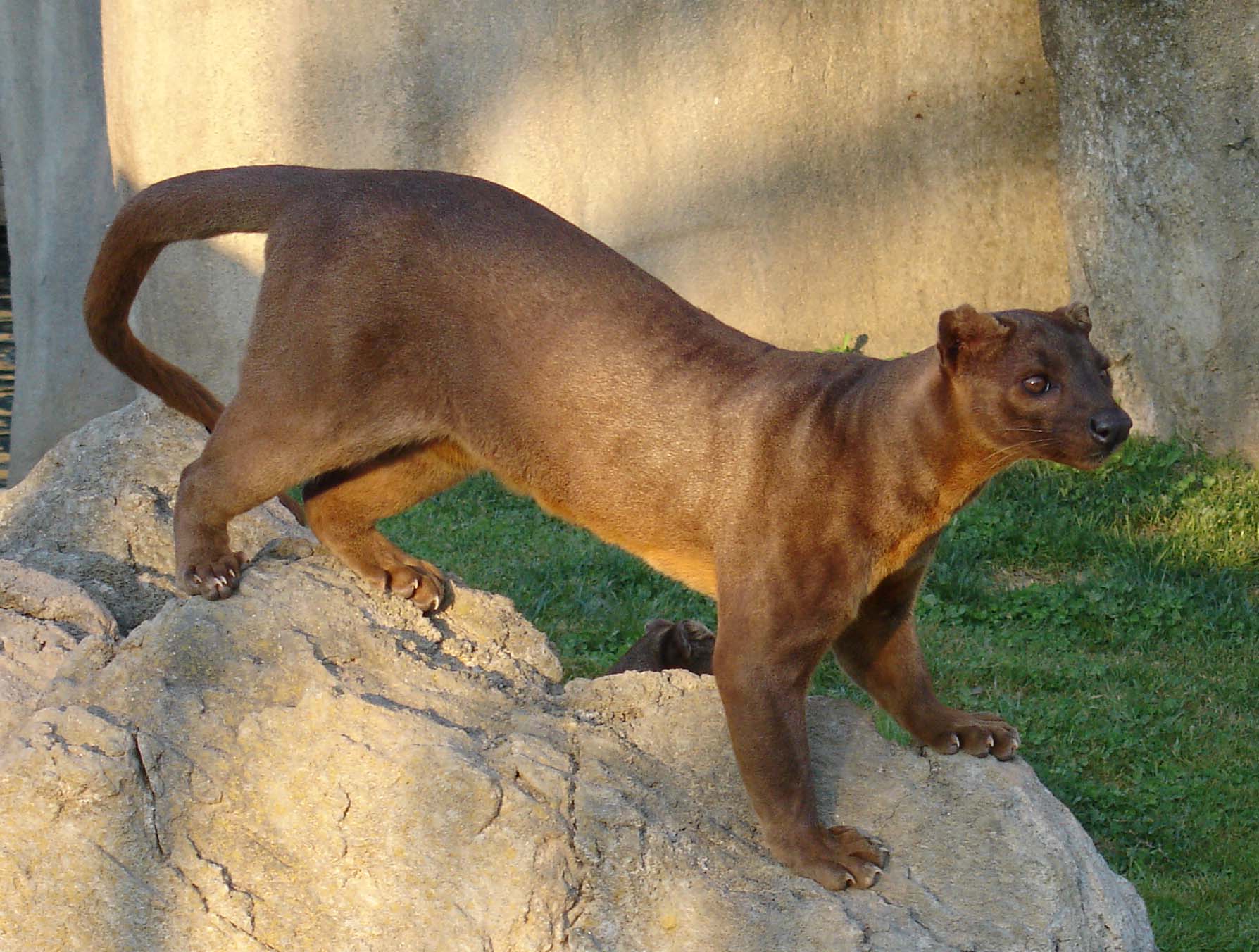
Fossa (Cryptoprocta ferox)
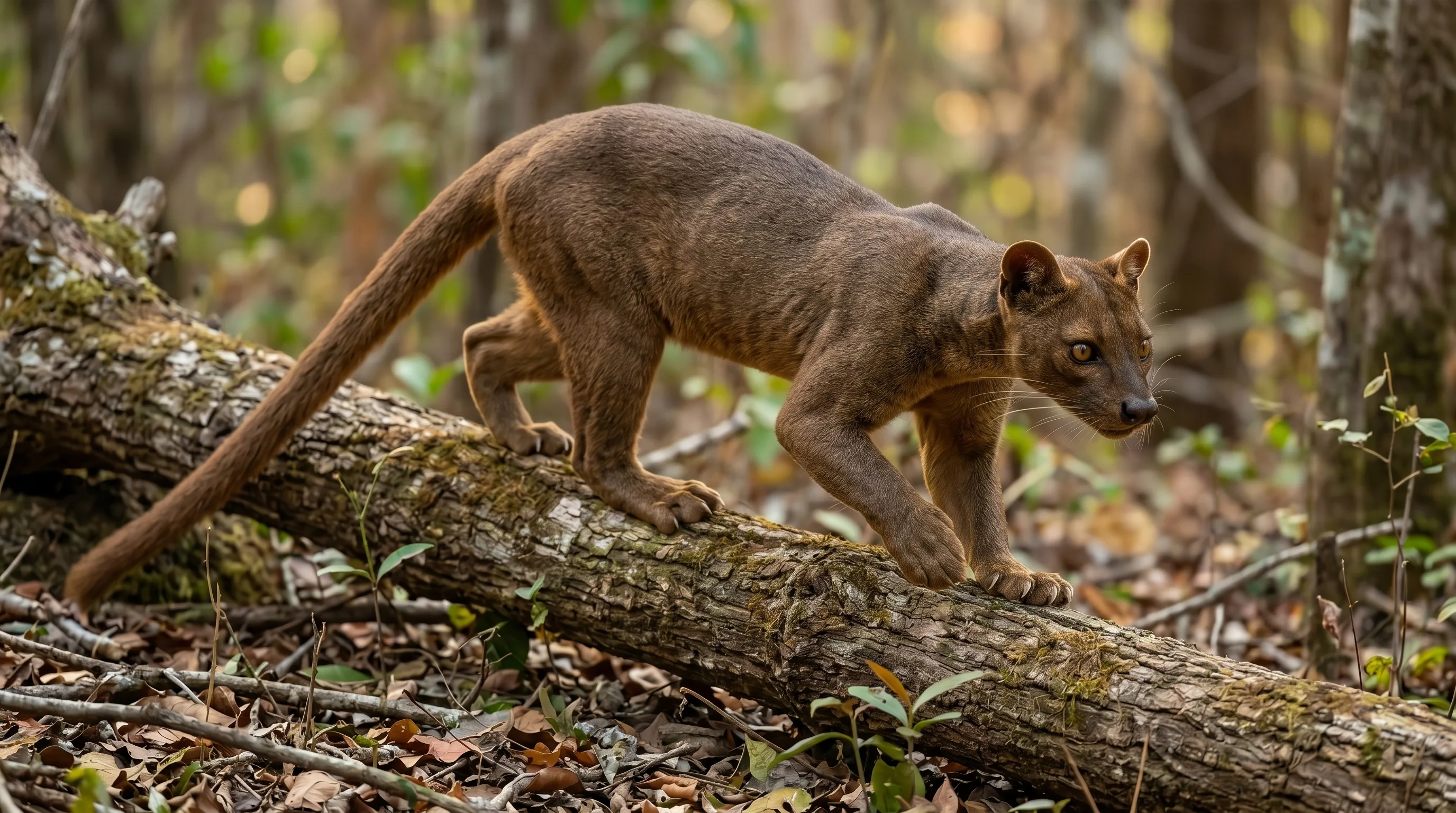
Fossa (Cryptoprocta ferox)
Introduction
The forest floor is silent except for the drip of moisture falling from the canopy a hundred feet above. In the Masoala Peninsula's lowland rainforest, where Madagascar's eastern coastline meets the Indian Ocean, dawn is still an hour away. Then, like a shadow given mass, a long, muscular body flows along a fallen fig tree — fluid, purposeful, entirely without hesitation. It pauses. Amber eyes catch a sliver of pre-dawn light. The animal's nostrils work the damp air with quiet intensity. Somewhere above, a sifaka shifts on its sleeping branch, and the shadow moves again.
This is the fossa — Cryptoprocta ferox — Madagascar's most formidable and enigmatic predator. It is an animal that has confounded zoologists for over a century: too sinuous for a cat, too agile for a civet, and too ecologically dominant for any single label to contain it. Standing as the island continent's largest endemic carnivore, the fossa occupies a predatory niche unlike almost anything else on Earth — a position carved not through gradual competition with other large hunters, but through the slow, isolated evolution of an island cut off from continental predator guilds for over 85 million years.
Madagascar itself is a biological miracle — a landmass roughly the size of Texas that split from the Gondwanan supercontinent and drifted into the Indian Ocean, carrying with it a primordial cargo of life that would evolve along entirely its own trajectory. No lions, no leopards, no large constrictors. Into this predator vacuum stepped the ancestors of Cryptoprocta ferox, and what emerged was an animal of extraordinary convergence — functionally cat-like in almost every meaningful way, yet phylogenetically closer to a mongoose than to any of the great felids it superficially resembles.
Understanding the fossa means understanding Madagascar. The two are inseparable. This animal is a living product of isolation and evolutionary pressure, a keystone of biodiversity health across the island's fragmenting forest systems, and a species whose fortunes are bound directly to the fate of one of the world's most critically threatened ecosystems. To follow the fossa through a single night of hunting is to trace the ecological architecture of an entire island — its pressures, its balances, and its increasingly fragile future.
"In a continent's absence, an island invents its own rules — and its own monsters."
— Paraphrased from David Attenborough's observations on Madagascar's endemic fauna
Scientific Classification
Kingdom: Animalia
Phylum: Chordata
Class: Mammalia
Order: Carnivora
Family: Eupleridae
Genus: Cryptoprocta
Species: Cryptoprocta ferox
Common Name: Fossa
Authority: Bennett, 1833
The fossa is the sole living member of the genus Cryptoprocta, although fossil evidence suggests a larger extinct relative, Cryptoprocta spelea, once shared Madagascar's forests during the Pleistocene — an animal considerably larger than its modern descendant, potentially capable of preying upon the giant lemurs that roamed the island before human arrival.
The family Eupleridae is itself a fascinating product of biogeography. All members are endemic to Madagascar and represent a single ancient colonisation event — a small carnivore ancestor that likely rafted or island-hopped to Madagascar from Africa roughly 18 to 26 million years ago. From this single founding lineage, evolution produced the entire diversity of Madagascar's endemic carnivores: the mongoose-like Galidictis, the striped mongoose relatives, and, at the apex, the fossa. Molecular phylogenetic studies confirmed in the late 1990s and early 2000s that Eupleridae is most closely related to the mongoose family Herpestidae, decisively settling decades of debate about whether the fossa's cat-like anatomy placed it closer to the viverrids or the felids. It does not. The resemblance is entirely convergent.
The genus name Cryptoprocta derives from the Greek for "hidden anus" — a reference to the anal pouch that partially conceals the animal's anal region, a feature shared with other carnivorans but particularly pronounced here. The species epithet ferox is unambiguous Latin: fierce. Both names suit the animal well.
Physical Characteristics
The fossa is a study in elegant functional design. Adults measure between 70 and 80 centimetres from nose to base of tail, with a tail that is nearly equal in length — typically 65 to 70 centimetres — giving the animal a total body length that regularly exceeds 150 centimetres. Males are considerably larger than females, with males weighing between 6 and 8.5 kilograms and females averaging 5 to 6.8 kilograms. This degree of sexual dimorphism is significant in an island predator, and its ecological implications are discussed in later sections.
The body is built for both speed on the ground and extraordinary agility in the canopy. The spine is highly flexible — almost mustelid-like in its suppleness — and the limbs are long and powerful, with particularly well-developed hindquarters that generate explosive acceleration from a standing start. The chest is deep, supporting the cardiovascular demands of active pursuit hunting. The neck is thick relative to body size, housing the powerful jaw musculature needed to deliver killing bites to prey that may weigh close to the predator itself.
The coat is uniformly reddish-brown to tawny on the dorsal surface, fading to a pale cream or buff on the ventral side. The coat is short, dense, and slightly glossy — functional rather than ornate. There are no striking markings, no stripes or spots. This plainness is itself an adaptation: in the dappled, low-contrast light of a forest interior, a uniformly dark-toned animal moving along branches or through undergrowth is harder to resolve visually than one with high-contrast patterning. The muzzle is relatively short compared to a true cat, but similarly shaped, with forward-facing eyes providing excellent binocular vision and depth perception — critical for an arboreal hunter that must judge distances between branches at speed.
The feet are among the most remarkable physical features of the fossa. Like felids, the fossa possesses semi-retractable claws — a trait extremely unusual outside the cat family and one that strongly points to the intensity of natural selection for arboreal hunting. The claws curve sharply and are kept partially sheathed to preserve their sharpness, extended during climbing and gripping prey. The feet are also equipped with naked, friction-pad soles that provide grip on smooth bark surfaces. The hindlimbs can rotate to a degree unusual among carnivorans, allowing the fossa to descend trees headfirst — a capability shared with very few non-primate mammals and one that dramatically expands its hunting range through the forest vertical.
Fun Fact The fossa can descend trees headfirst using highly flexible ankle joints — a trait it shares with only a handful of mammals worldwide, including the North American porcupine and certain squirrels.
The tail serves as a counterbalance during arboreal movement. Long, thick at the base, and tapering toward the tip, it functions as a gyroscopic stabiliser during leaps between branches. Scent glands near the base of the tail produce secretions used in territorial communication — the tail is often dragged across surfaces to deposit scent marks. The ears are large, rounded, and mobile, capable of independently rotating toward sound sources in a manner reminiscent of a cat. The vibrissae — the long tactile whiskers — are prominent and sensitive, assisting navigation in low-light conditions where the forest becomes a maze of textures rather than shapes.
Habitat & Geographic Distribution
The fossa exists nowhere on Earth except Madagascar. This absolute endemism is both a defining fact and a conservation vulnerability: there is no secondary population, no refuge population on another island or continent. The species lives or dies entirely within the boundaries of a single country — one that has lost approximately 90 percent of its original forest cover since human arrival roughly 1,500 to 2,000 years ago.
Within Madagascar, the fossa shows strong preferences for forested habitat, occupying dense lowland rainforests on the eastern coast, dry deciduous forests in the west, and the spiny forests of the south — the latter being perhaps the most extreme environment any large carnivore occupies in Madagascar, characterised by the bizarre succulent Didiereaceae and baobab trees. This ecological breadth is notable: few carnivores of similar size tolerate such a range of forest types, and it suggests significant behavioural and physiological flexibility. However, the fossa is not an open-country animal. It requires forest cover. Even where fragments of degraded forest persist, fossa presence drops sharply if canopy connectivity is broken.
Elevation is less of a barrier than canopy integrity. Fossas have been documented at altitudes above 2,000 metres in the central highlands, though populations here are sparse. The core population density zones are the eastern rainforest corridor — particularly around Masoala, Ranomafana, and Marojejy national parks — and the western dry forests of Kirindy-Mitea, where long-term field research has produced some of the most detailed fossa behavioural data available.
Forest Type | Location | Canopy Cover | Fossa Presence |
|---|---|---|---|
Lowland Rainforest | Eastern coast | Dense, multi-layered | High density |
Dry Deciduous Forest | Western region | Seasonal, moderate | Moderate density |
Montane Forest | Central highlands | Variable, patchy | Low density |
Spiny Forest | Southern region | Open, succulent-dominated | Low-moderate density |
Degraded/Agricultural Land | Island-wide | Absent or fragmented | Rare, transient only |
Home range size varies considerably by sex, season, and habitat quality. Male home ranges can exceed 20 to 26 square kilometres in some studies, while female ranges tend to be smaller — typically 8 to 13 square kilometres — likely reflecting the energetic constraints of reproduction. In higher-quality, prey-rich rainforest, ranges can be compressed significantly. In degraded or fragmented habitats, ranges expand as animals must cover more ground to meet their energetic needs, a pattern common among large carnivores facing habitat loss globally.
Behaviour & Social Structure
The fossa is fundamentally a solitary animal. Adults maintain exclusive or semi-exclusive territories that they defend primarily through scent marking — dragging glands across branches, rocks, and tree trunks to establish a chemical map of ownership that persists long after the animal has moved on. Scent marks from glands around the throat, chest, and anal region communicate sex, reproductive status, individual identity, and the recency of the deposit. A fossa patrolling its territory regularly refreshes these marks, particularly along travel routes and at key signposting locations.
Despite this solitary lifestyle, fossas are not aggressively territorial in the explosive, contact-based way that some carnivores are. Encounters between adults — particularly between males — do occur, but the elaborate scent-communication system appears to function as a spacing mechanism that reduces the need for costly physical confrontations. Resident males with established territories tend to have priority access to females during the mating season, but the nature of territorial overlap and the dynamics of male competition are areas where field research is still developing.
The intelligence of the fossa is difficult to quantify in formal terms given limited captive study, but field observations consistently suggest a cognitively flexible predator. Individuals have been observed modifying hunt strategies in response to prey behaviour — adjusting routes, waiting at known lemur sleeping trees, and exploiting the predictable movement corridors that certain lemur species follow during daily foraging. This adaptive, context-dependent hunting behaviour — rather than purely stereotyped attack sequences — suggests the kind of working memory and situational assessment associated with more commonly studied large carnivores such as big cats and canids.
Communication extends beyond scent. Vocalisations are documented — a range of sounds including growls, mews, purrs, and during the mating season, louder calls that can carry considerable distances through the forest. Juveniles communicate with their mothers through contact calls, and adults produce alarm or threat vocalisations during encounters. The purring behaviour observed in captive animals is particularly striking given the animal's phylogenetic distance from felids — another convergent trait, reflecting the physics of the animal's laryngeal anatomy rather than shared ancestry.
In Kirindy Forest, just after the rains that mark the beginning of Madagascar's wet season, a male fossa — known to researchers by a distinctive notch in his right ear — moves along a route he has followed for three consecutive years. The path curves around a dried riverbed, passes beneath the interlocked crowns of two traveller's palms, and rises sharply toward a rocky outcrop that forms the eastern boundary of his territory.
He pauses at a particular low branch — smooth with use, rubbed pale by repeated scent-marking — and draws his throat slowly along the wood. The glands beneath his chin leave an invisible chemical paragraph: male, sexually active, a resident who was here recently. For any fossa that passes this branch in the next forty-eight hours, that message is unambiguous.
Then he freezes. Thirty metres ahead, a group of Verreaux's sifaka is beginning to stir from a sleeping tree, shaking off the night's torpor with slow, deliberate movements. He lowers his body until his belly nearly brushes the leaf litter. His tail is still. His breathing slows. The calculation playing out behind those amber eyes is not instinct alone — it is something more flexible, more responsive to this specific morning, these specific animals, the particular angle of the light filtering through the canopy above.
He does not rush. He waits. This is the fossa's central hunting philosophy: patience deployed like a precision tool.
Daily Life & Activity Cycle
The fossa breaks from the pattern of most large carnivores by being neither strictly nocturnal nor strictly diurnal. It is cathemeral — active during both day and night, with its activity levels driven primarily by prey availability, temperature, and season. This flexibility is believed to be directly linked to the behaviour of its primary prey: lemurs. Because different lemur species have different activity patterns — some nocturnal, some diurnal, some crepuscular — a predator that can hunt across all light conditions has an enormous advantage on an island where lemurs represent the dominant prey base.
In Kirindy, where most long-term activity studies have been conducted, fossas show elevated activity around dawn and dusk, but maintained significant activity throughout the night during cooler months. During the hot dry season, when temperatures in western Madagascar can exceed 40°C, daytime activity drops sharply and the animal rests in shaded refugia — tree hollows, dense shrub tangles, or rocky overhangs — conserving water and energy until conditions moderate. This behavioural thermoregulation is essential in an environment where dehydration poses a genuine survival threat.
Daily movement distances are substantial for an animal of this size. Radio-tracking data from Kirindy suggest males may cover 5 to 10 kilometres in a single active period, with females typically covering somewhat less. In forest environments with higher prey density, movement requirements decrease as the energy return per unit of travel is higher. In degraded or fragmented habitats, individuals have been recorded covering far greater distances — a concerning indicator of habitat insufficiency rather than robust ecological health.
Rest sites are selected with care. The fossa commonly rests in elevated positions — high in the forest canopy, on rock faces, or within tree hollows — positions that provide protection from any remaining potential threats and a vantage point over the surrounding terrain. This elevated resting behaviour mirrors that of leopards and other forest felids, underscoring the degree to which convergent ecological pressures have shaped convergent behavioural solutions across phylogenetically unrelated lineages.
Diet & Survival Strategies
The fossa is a hypercarnivore — meaning that animal protein constitutes the vast majority, almost certainly more than 70 percent, of its diet. Unlike opportunistic omnivores that supplement meat with fruit or invertebrates as conditions demand, the fossa is committed to animal prey in a way that makes it ecologically dependent on prey population health. When prey species decline, the fossa declines with them.
Lemurs are the cornerstone of the fossa's diet across most of its range. Field studies using scat analysis, direct observation, and prey remains at kill sites have confirmed that lemurs — ranging from small mouse lemurs weighing 30 grams to sifaka and indri that may exceed 6 kilograms — make up the dominant portion of fossa kills where forested habitat is intact. In western dry forests, the ring-tailed lemur and various sportive lemurs are heavily represented. In eastern rainforests, rufous lemurs, bamboo lemurs, and brown lemurs appear frequently in dietary analyses.
Beyond lemurs, the fossa's diet includes tenrecs — the endemic hedgehog-like insectivores of Madagascar — rodents including the endemic giant jumping rat, birds, chameleons, snakes, and small fish in riparian environments. Domestic poultry represents a significant supplementary food source where fossa territories overlap with human settlements, a pattern that drives much of the human-wildlife conflict discussed in later sections. This dietary flexibility serves as a buffer against prey scarcity but is not sufficient to compensate for large-scale lemur population collapse.
Fun Fact A single fossa has been observed killing and consuming a lemur nearly 80% of its own body weight — a testament to the efficiency of its neck bite and its ability to cache and consume large prey over multiple feeding sessions.
Hunting technique varies by prey type and context. For lemurs in the canopy, the fossa employs pursuit hunting — using its exceptional arboreal agility to chase prey through the branches with a speed and flexibility that few prey animals can outmanoeuvre. On the ground, it adopts a more stalking, ambush-oriented approach. The fossa does not have the sustained endurance of a wolf or African wild dog — it is a sprint predator, relying on explosive short-range acceleration and the element of surprise. Kill delivery is typically a bite to the back of the skull or upper neck, rapidly severing the spinal cord or causing massive trauma to the brain stem. This technique is strikingly similar to the killing bites of both felids and large mustelids — convergence operating at the level of individual predatory technique.
Food caching — storing portions of large kills for later consumption — has been observed in some individuals, suggesting the fossa can plan temporally, returning to a site after an initial feeding bout. This behaviour is energetically significant: a large kill may represent several days' worth of caloric intake, and recovering cached food reduces the energy investment in additional hunting.
Interaction with Other Animals
As Madagascar's apex predator, the fossa sits at the top of a food web that has no other large mammalian carnivore competing at the same level. This is a fundamentally different ecological context from continental Africa or Asia, where leopards must navigate competition with lions, hyenas, and wild dogs. The fossa's predatory dominance is uncontested by any native species, and this has shaped its hunting behaviour — there is no need for the intense food-caching paranoia of a leopard threatened by lions, and no kleptoparasitism from larger scavengers.
Interaction with prey species is the most ecologically significant relationship the fossa has. Lemur populations — particularly those of medium-to-large diurnal species — show clear anti-predator adaptations calibrated specifically to fossa predation. Sifaka produce loud warning vocalisations specifically categorised for aerial versus terrestrial threats. Ring-tailed lemurs adjust their sleeping tree selection and group cohesion in response to fossa presence. These adaptations have co-evolved over millions of years, producing behavioural complexity in prey species that cannot be explained without reference to the fossa as the selective pressure behind them. Remove the fossa, and some of these anti-predator behaviours would lose their adaptive value — a phenomenon documented in other island systems where apex predators have been extirpated.
Interactions with Madagascar's other endemic carnivores — the falanoucs, mongooses, and ring-tailed vontsiras — are primarily competitive rather than predatory. The fossa does not typically predate these smaller carnivorans, but it does compete with them for certain prey categories, particularly tenrecs and small rodents. The fossa's larger body size likely confers competitive dominance at shared food sources, though direct interference competition has not been extensively documented. The smaller carnivorans likely partition the prey base through differential microhabitat use and temporal segregation rather than direct confrontation.
Birds of prey — particularly the Madagascar harrier-hawk and the Henst's goshawk — share the predatory pressure on lemurs and other small vertebrates. There is no documented direct competition between the fossa and these raptors, but both respond to prey distribution and density in ways that likely create indirect ecological linkages. The Madagascar ground boa, the island's largest snake, also takes small lemurs and rodents, representing another point of trophic overlap without direct conflict.
Interaction with Environment
The fossa's relationship with its forest environment is layered and dynamic. As a wide-ranging carnivore requiring large home ranges and intact forest connectivity, the fossa functions as an umbrella species — its presence indicating an ecosystem structurally complex enough to support a functioning food web from primary producers to apex predator. Where fossas persist in viable numbers, the forest around them is typically diverse, structurally mature, and ecologically functional. Where they have disappeared, the forest has usually already experienced significant degradation.
The fossa's impact on vegetation is indirect but real. By regulating lemur populations, the fossa influences fruit dispersal, seed predation, and leaf herbivory patterns that shape forest structure. Many of Madagascar's trees depend heavily on lemurs as seed dispersers — the fruit of the traveller's palm, Ravenala madagascariensis, is carried and dispersed almost exclusively by lemurs. If lemur populations become ecologically overabundant in the absence of fossa predation, browsing and fruit consumption rates can increase to levels that alter forest regeneration patterns. This trophic cascade — apex predator regulating herbivore density, which in turn regulates vegetation — is a well-documented ecological dynamic in other systems, from wolves and elk in Yellowstone to sharks and sea turtles in marine environments.
The fossa's own movement through the forest creates ecological connections. As it travels across large home ranges, it deposits scats in concentrated latrine sites. These scats contain the remains of prey — bones, seeds (from frugivorous lemur gut contents), fur, and feathers — contributing to nutrient cycling in a forest where soil nutrient dynamics are often nutrient-poor. Large carnivore scats and carrion function as nutrient hot spots in forest ecosystems, supporting invertebrate communities, fungi, and plant growth at microsites.
The species has adapted behaviourally to Madagascar's extreme seasonality. In the western dry forests, the dry season brings near-complete prey scarcity as many lemur species enter seasonal dormancy. The fossa responds with reduced activity, apparent fasting, and energetic conservation behaviours that allow it to survive months of dramatically reduced food availability without the physiological dormancy seen in the lemurs themselves. This capacity for energetic flexibility reflects the demands of a predator whose prey base disappears seasonally — an ecological challenge without direct parallel in the predator-prey systems of other continents.
Reproduction & Parenting
The reproductive biology of the fossa is one of the most extraordinary aspects of the species — a set of biological phenomena that, even among mammals broadly, is exceptional in both its mechanism and its ecological framing. Mating in the fossa does not occur on the forest floor. It occurs in the trees, at heights of 5 to 20 metres, in a process that can last for several days and involves complex social dynamics not observed in most solitary carnivores.
Mating season occurs during the austral spring — typically September and October in western Madagascar. A specific tree, or a cluster of trees, becomes what researchers describe as a mating site: a location to which a receptive female will go and vocalise loudly, advertising her condition to males across a wide area. What follows is remarkable. Multiple males — sometimes as many as eight — will gather at the base and in the crown of the mating tree, competing for access to the female. The female retains mate choice, soliciting some males and repelling others. Copulation itself is prolonged — individual bouts lasting up to several hours, and the female may mate with multiple males over the several days she remains at the mating site. This multi-male mating system and the female's apparent role in selecting partners suggest sexual selection dynamics of unexpected sophistication in an animal typically categorised as simply solitary.
The gestation period is approximately 90 days. Births occur in tree hollows, dense vegetation tangles, or rock cavities — locations that provide protection from potential threats and insulation for helpless newborns. Litter size ranges from one to four cubs, with two being most commonly reported. At birth, cubs are blind, nearly hairless, and entirely dependent on the mother. They open their eyes at approximately two to three weeks and begin exploring the area around the den at four to five weeks.
Maternal investment is intensive. The mother nurses, guards, and thermoregulates her cubs for the first several months of life, adjusting her own activity patterns to reduce the risk of predation on the vulnerable young. There are no documented cases of male parental investment — fossa paternal care does not exist in any recorded instance. The mother alone carries the full burden of raising offspring to independence.
Cubs begin consuming solid food at around three to four months, as the mother starts introducing prey items to the den. By six months, cubs are capable of accompanying their mother on foraging trips, learning hunting techniques through direct observation and play-hunting. The learning period is long by the standards of similarly sized carnivores — young fossas may remain with or near their mother for up to a year and a half before fully dispersing to establish independent territories. This extended juvenile period reflects the complexity of the hunting skills that must be acquired — skills calibrated specifically to prey species that are themselves behaviourally sophisticated.
One of the most scientifically remarkable reproductive phenomena in the fossa involves what has been termed "transient masculinization" in juvenile females. Young female fossas, between approximately one and three years of age, develop enlarged, orange-stained clitorises and associated structures that superficially resemble male genitalia. This condition — driven by elevated androgen secretion during a specific developmental window — disappears as the female reaches sexual maturity, at which point she develops normal adult female genitalia. The functional significance of this transient masculinization is debated, but hypotheses include social signalling that reduces adult male aggression toward juvenile females in territories, and hormonal effects on juvenile growth and development. Whatever its cause, it is a biological phenomenon unique in the Carnivora and has drawn considerable attention from mammalogists.
Evolutionary Adaptations
Few examples in the natural world illustrate convergent evolution — the independent development of similar traits in unrelated lineages — as vividly as the fossa does when placed alongside the true felids. The functional parallels between Cryptoprocta ferox and a medium-sized wild cat such as a leopard or puma are not coincidental: they are the result of identical ecological pressures — arboreal hunting in a forested environment, pursuit of agile prey, the need to deliver rapid killing bites — acting on entirely different phylogenetic raw material over tens of millions of years of isolation.
The semi-retractable claws are among the most diagnostically convergent features. Outside the true cats (Felidae), semi-retractability is vanishingly rare in carnivores. The mechanism in the fossa involves a modified tendon arrangement that partially sheathes the claw within a skin fold when relaxed, preserving sharpness during locomotion. The evolution of this mechanism in a euplerid — a mongoose relative — requires either an extraordinary coincidence of developmental pathway or a shared ancestral genetic toolkit that can produce similar morphological outcomes when the same selective pressure is applied. Current developmental biology research increasingly points to the latter explanation: conserved genetic modules that can produce similar morphologies across lineages when activated by similar environmental selection pressures.
The rotating ankle joint that permits headfirst tree descent is another adaptation with profound behavioural consequences. Standard mammalian ankle morphology restricts descent to a backing-down posture — energetically costly and dangerously slow. The fossa's ankle allows rotation of approximately 180 degrees, permitting headfirst descent with full visual and gravitational awareness. This is achieved through modifications to the distal tibia-fibula articulation and the calcaneal structure, producing a joint with an unusually broad range of motion. The functional result — rapid, confident headfirst descent from canopy to forest floor — dramatically increases the three-dimensional hunting space available to the animal.
The cathemeral activity pattern, discussed in the daily life section, is itself an adaptation — or, more precisely, a retention of ancestral flexibility that has become adaptive in the specific ecological context of Madagascar. Most large carnivores are constrained to a narrower activity window by their physiology and the behavioural ecology of their prey. The fossa's ability to shift activity timing in response to prey availability and temperature represents a kind of ecological plasticity that is far easier to maintain on an island where there are no competing carnivores forcing temporal niche partitioning.
The fossa's olfactory system is highly developed, with a large rhinarium and extensive olfactory epithelium. In a forest environment where visual range is constrained by vegetation and acoustic signals are absorbed by dense foliage, chemical communication becomes a primary information channel. The suite of scent glands in the fossa — cervical, sternal, and circumanal — and the sophisticated scent-marking behaviour they support represent an investment in a chemical communication infrastructure that effectively extends the animal's social presence far beyond its immediate physical location.
Ecological Importance
A carnivore sitting at the apex of a food web is not merely a top consumer — it is an active force shaping the structure of the ecosystem below it. The fossa's ecological importance operates through several distinct mechanisms, each with consequences that cascade through Madagascar's forest communities in ways that are only beginning to be understood by ecologists working in this system.
The most direct mechanism is the trophic cascade. By predating on lemurs, the fossa regulates herbivore and frugivore pressure on vegetation. Ecosystems with intact apex predator populations consistently show greater plant diversity and structural complexity than those from which top predators have been removed — a pattern documented from temperate forests in North America to coral reef systems in the tropics. In Madagascar's context, where lemurs are the dominant large-bodied frugivores and herbivores, the fossa's regulatory role shapes which tree species regenerate successfully, which seeds are dispersed versus consumed, and where in the forest herbivore pressure is concentrated.
The behavioural effect — sometimes called the "landscape of fear" — is equally important. Even when a predator is not actively killing prey, its presence in a landscape alters where prey animals feed, how long they spend in any given location, and which microhabitats they use. In ecosystems where apex predators have been removed, prey animals frequently show behavioural changes — overusing certain vegetation types, spending more time in riskier but food-rich areas — that have measurable ecological consequences independent of the numerical predator-prey interaction. There is preliminary evidence that lemur foraging behaviour differs detectably in areas with established fossa presence compared to areas from which fossas have been locally extirpated.
The fossa also serves as a focal indicator species for conservation planning. Given its large home range requirements, its sensitivity to habitat fragmentation, and its dependence on structurally complex forest, the fossa's presence effectively marks areas of high conservation value. Protected areas designed around fossa population viability requirements will almost always provide sufficient habitat for the full complement of Madagascar's endemic species — making the fossa a surrogate for broader biodiversity planning in a way that most single-species management targets cannot match.
Fun Fact The fossa's need for a home range of up to 26 square kilometres means that protecting a viable fossa population effectively protects thousands of other endemic Malagasy species that share that same forest space.
Threats & Conservation
The fossa faces a convergence of threats that individually would be manageable but collectively constitute a genuinely existential challenge for a species with a small global population, restricted geographic range, and high sensitivity to habitat quality. The IUCN formally lists the species as Vulnerable, but field researchers working in Madagascar widely consider this classification to understate the urgency of the conservation situation on the ground.
Habitat destruction is the primary and overarching threat. Madagascar has lost an estimated 90 percent of its original forest cover since the arrival of humans — a reduction driven by slash-and-burn agriculture (known locally as tavy), logging for charcoal production, and expanding subsistence cultivation at forest margins. The remaining forest is heavily fragmented, with intact blocks separated by matrices of degraded land that fossas are reluctant to cross. This fragmentation disrupts gene flow between subpopulations, creates population isolation that increases the genetic and demographic risks of inbreeding and local extinction, and reduces the effective range available for territorial establishment by young dispersing animals.
Direct persecution represents the second major threat. The fossa is genuinely feared in many rural Malagasy communities — a fear grounded partly in actual livestock depredation and partly in cultural mythology. Animals that take poultry or young goats are hunted by farmers in retaliatory killings, a pattern that causes mortality disproportionate to the actual economic damage caused. Snares set for other species — bushmeat species such as wild pigs and tenrecs — also catch fossas as bycatch, and some individuals are captured for the bushmeat trade directly, though this is less common than for prey species.
Climate change is emerging as an accelerating threat. Madagascar's climate projections indicate increasing frequency of extreme weather events — cyclones, droughts, and irregular rainfall — that stress both forest ecosystems and the prey communities the fossa depends upon. The eastern rainforest corridor, one of the most important fossa habitats, is particularly vulnerable to cyclone damage, which can cause catastrophic canopy collapse over large areas. Recovery from such events takes decades, during which fossa prey availability is severely reduced.
IUCN Red List Analysis
Current IUCN Status
The fossa (Cryptoprocta ferox) is classified as Vulnerable (VU) on the IUCN Red List of Threatened Species, meeting the criteria under category A2cd — a reduction in population size of at least 30 percent over the past three generations, inferred from the rate of habitat loss and direct exploitation. This classification was last reviewed in 2015, and many field ecologists and Madagascar conservation specialists have argued that the available evidence now points toward an Endangered classification being more appropriate, given the accelerating rates of forest loss documented since that assessment date.
The Vulnerable classification, while an international signal of concern, does not trigger the highest levels of emergency conservation response that an Endangered or Critically Endangered listing would. This gap between formal status and on-the-ground reality is a recurring tension in conservation biology, particularly for species in rapidly changing, under-resourced systems like Madagascar's forests. The fossa's restricted global range — limited to a single country — means that national-level policy changes in Madagascar have immediate and total impact on the species' global population.
Population Trend
The population trend for the fossa is assessed as decreasing. No reliable total population estimate exists — the fossa is cryptic, wide-ranging, and occupies remote forest that makes systematic population survey extremely challenging. Best available estimates from density data collected at study sites suggest a global population likely below 2,500 mature individuals, though some researchers caution that this figure could be lower. The genetic diversity implications of a small, fragmented population are significant: low effective population size across isolated forest fragments increases the rate of inbreeding and reduces the adaptive potential of the species in response to environmental change.
Historical decline is difficult to quantify precisely due to the absence of pre-deforestation baseline data, but the correlation between forest loss and fossa population contraction is well established. The areas of highest historical fossa density — lowland eastern rainforest and western dry forest — have experienced the greatest absolute area of deforestation over the past fifty years. Local extinctions have been documented in areas where forest cover has dropped below thresholds sufficient to support viable home ranges, particularly in the central highlands and parts of the northern peninsula.
Main Threats
Habitat destruction and fragmentation remains the dominant threat. Slash-and-burn agriculture removes both the forest cover that fossas require for movement and concealment, and the prey communities that depend on intact forest. Even where forest fragments survive, edge effects — the degradation of forest quality near boundaries with open land — reduce effective habitat area substantially beyond what simple canopy cover measurements would suggest. A forest fragment with high edge-to-interior ratio supports dramatically lower fossa prey density than an equivalent area of continuous forest interior.
Retaliatory killing by farmers in response to livestock depredation is geographically widespread and likely responsible for significant mortality in populations adjacent to human settlements. The economic impact of a fossa taking a chicken or a small goat can be genuinely significant for subsistence households, making the local incentive to eliminate the predator rational from a human perspective even while ecologically destructive. Without economic alternatives or compensation mechanisms, changing this behaviour is a long-term challenge requiring sustained community engagement.
Climate change exacerbates existing habitat pressures. Projections for Madagascar indicate shifts in rainfall seasonality that may alter forest phenology, lemur seasonal behaviour, and the energy balance of fossa populations dependent on prey predictability. Increased cyclone intensity poses specific risk to the eastern rainforest corridor, where already-stressed forests face the prospect of repeated catastrophic disturbance events with insufficient recovery time between cycles.
Bushmeat hunting and accidental trapping contribute mortality that is difficult to quantify but documented at multiple sites. The social taboo (fady) against hunting the fossa varies regionally in Madagascar — in areas where the fossa is not culturally protected, direct hunting occurs. In areas where the fossa itself is taboo, the animal may still die in snares set for other species, or be killed when encountered near settlements.
Ecological Consequences
The local or regional extinction of the fossa would remove the only top predator from Madagascar's terrestrial food web, producing ecosystem consequences that are likely severe and potentially irreversible on human timescales. The most immediate effect would be the release of lemur populations from predation pressure — a process called mesopredator or prey release. Medium-to-large lemur populations could expand in the short term, increasing herbivore and frugivore pressure on vegetation. Over time, this could alter forest regeneration dynamics: species whose seeds require gut passage through specific lemurs for germination might be selectively disadvantaged if those lemur populations shift in abundance or spatial distribution under reduced predation pressure.
The loss of the fossa would also eliminate the primary regulator of wild prey population dynamics in Madagascar's forests, potentially leading to population cycles of boom and bust in prey species that could in themselves destabilise community composition. The behavioural changes in prey populations — already documented as responding to fossa presence — would reverse, with lemurs becoming bolder, spending more time in riskier foraging areas, and potentially intensifying competition with each other and with other fauna for food resources.
At a broader level, the fossa's extinction would represent the collapse of an evolutionary lineage unique on Earth. There is no equivalent of Cryptoprocta ferox anywhere else in the world. Its evolutionary trajectory — the specific suite of adaptations shaped by 18 to 26 million years of Malagasy evolution — would be permanently lost, along with whatever ecological functions and evolutionary insights it represents.
Conservation Efforts
Madagascar's national park system, managed through Madagascar National Parks (MNP), provides formal protection for fossa populations in key areas including Masoala, Ranomafana, Marojejy, Ankarafantsika, and Kirindy-Mitea national parks. These protected areas provide legal prohibition on habitat destruction and hunting within their boundaries, though enforcement capacity varies considerably and illegal incursion for slash-and-burn agriculture, charcoal production, and bushmeat hunting remains a persistent challenge at most sites.
The Wildlife Conservation Society (WCS), Durrell Wildlife Conservation Trust, and various German and American university research programmes have maintained long-term field research presence in key fossa habitats. The Kirindy study site, operated by the German Primate Center, has produced the most comprehensive long-term dataset on fossa ecology globally — data that now informs habitat management and population viability analysis at a national scale.
Captive breeding programmes exist at a small number of zoological institutions globally, including Duke Lemur Center in the United States. However, captive population management for the fossa is complicated by the species' specific social and reproductive requirements — the arboreal mating system, the need for large territories, and the long juvenile dependency period make ex situ breeding both logistically demanding and costly. Captive breeding is currently viewed as a genetic insurance measure rather than a primary conservation strategy.
Community-based conservation programmes that provide economic alternatives to forest destruction — ecotourism revenue sharing, sustainable livelihood programmes, and community ranger initiatives — are increasingly recognised as essential complements to formal protected area management. Without addressing the human economic drivers of habitat destruction, protected area boundaries alone are insufficient to arrest deforestation at the rates currently documented.
Future Outlook
The long-term survival of the fossa depends on outcomes in three interlocking domains: the rate of deforestation in Madagascar, the effectiveness of anti-poaching enforcement and conflict mitigation in forest-adjacent communities, and the trajectory of climate change as it intersects with Madagascar's already-stressed ecosystems. Of these, deforestation is the most immediately actionable and the most directly tied to national governance capacity and international conservation funding.
There are qualified grounds for cautious optimism. Madagascar's government has made internationally publicised commitments to expand its protected area network and reduce deforestation rates, and international conservation investment in Madagascar remains among the highest per unit area of any developing country globally. If these commitments are sustained and adequately resourced, viable fossa populations in core protected areas could persist for several decades. However, the trajectory of the past decade — continued high deforestation rates, increasing human population pressure at forest margins, and reduced international funding availability — suggests that current efforts, while genuinely valuable, are insufficient to reverse the population's downward trend.
A realistic assessment of the fossa's future is that it will survive the twenty-first century in greatly reduced numbers, confined to a network of protected areas that together constitute a small fraction of its historical range. Whether these populations are large enough and connected enough to maintain long-term genetic viability — and whether the ecosystems within them are intact enough to sustain the prey communities the fossa depends upon — are questions that will be answered by decisions made in the coming two decades. The fossa's future, in other words, is still a story being written.
Human Relationship
In Malagasy culture, the fossa occupies a complex and ambivalent space. It is simultaneously feared, respected, mythologised, and persecuted — a suite of human responses that reflects the animal's real ecological power and the intimacy of life lived at the edge of forests that the fossa shares with millions of rural Malagasy people.
Cultural taboos — fady — around the fossa vary considerably by region and ethnic group. In some areas, the fossa is afforded supernatural significance: it is associated with ancestral spirits, considered a bad omen if seen or heard near a village, or believed to possess malevolent intelligence. These beliefs, while not constituting formal protection, sometimes reduce deliberate hunting in those communities where the fossa is culturally sanctioned as untouchable. In other regions, no such protection exists, and the fossa is treated as a stock-raiding pest to be eliminated on sight.
The fossa's real economic impact on rural communities is difficult to quantify precisely. Poultry depredation is the most frequently documented form of livestock loss attributable to fossas. In subsistence communities where a small flock of chickens represents meaningful economic capital, a single fossa raid can constitute a real loss. Larger livestock — goats, pigs — are less frequently taken, though young animals are occasionally predated. The perception of fossa damage often exceeds documented actual losses, a pattern common in human-carnivore conflict globally where fear and accumulated historical incidents amplify current threat perception.
Ecotourism represents a transformative potential for reframing the fossa's relationship with local communities. In areas where the fossa can be reliably observed — Kirindy Forest is the best-known site globally for fossa sightings — the animal has begun to generate direct economic value for communities through guiding fees, accommodation revenue, and the broader tourism economy that wildlife watching creates. The ability to walk through Kirindy Forest at night with a guide and genuinely encounter a wild fossa is an extraordinary wildlife experience — one that commands the same premium international ecotourism market that lions in East Africa or orangutans in Borneo attract in their respective systems.
Western scientific engagement with Madagascar has been long and productive, but the history of this engagement includes troubling legacies of knowledge extraction without commensurate benefit to Malagasy communities and scientists. Contemporary conservation practice in Madagascar increasingly seeks to centre Malagasy researchers, community rangers, and local ecological knowledge — a shift that is both ethically imperative and practically necessary for the long-term sustainability of conservation programmes in a country where international funding availability will always be uncertain.
"We won't save places we don't love, we can't love places we don't know, and we don't know places we haven't learned."
— Baba Dioum, Senegalese conservationist
Unique & Rare Facts
Convergent evolution made visible: The fossa independently evolved semi-retractable claws, forward-facing eyes, a flexible spine, and a pursuit-hunting style that mirrors felid adaptations — despite being phylogenetically closer to a mongoose than to any cat. It is arguably the most striking example of convergent evolution in any living mammal.
Headfirst tree descent: The fossa can descend trees headfirst through highly specialised ankle rotation — a capability shared with only a handful of non-primate mammals globally and one that dramatically expands its three-dimensional hunting access through the forest.
Transient masculinization: Juvenile female fossas develop temporarily enlarged, male-appearing genitalia during a specific developmental window before reaching sexual maturity. This hormonally driven phenomenon is unique among the Carnivora and remains an active subject of mammalian developmental biology research.
Arboreal mating: Mating occurs in trees at heights of up to 20 metres — a reproductive strategy found in no other large carnivore on Earth — with females capable of mating with multiple males over several days at a single communal mating tree.
Cathemeral activity: The fossa is active across both day and night with roughly equal frequency, adjusting its temporal activity pattern in response to prey behaviour, temperature, and season — a degree of temporal flexibility rare among carnivores of comparable size.
Purring behaviour: Like domestic cats, the fossa can purr — a sound produced through rapid laryngeal muscle contractions. This represents another striking convergence with felid communication, independently derived in an animal phylogenetically distant from all cats.
Larger extinct relative: Cryptoprocta spelea, an extinct congener known from Holocene subfossil remains, was substantially larger than the modern fossa — estimated at two to three times the body mass — and would have been capable of predating on the giant lemurs that inhabited Madagascar before human arrival.
No native competitors: The fossa is the only large native carnivore in Madagascar — it fills the ecological niche occupied elsewhere by leopards, pumas, or wolverines, with no other native species competing at the same trophic level. This competitive release has likely contributed to its broad prey range and flexible activity pattern.
Island-specific immune challenges: Research has documented that fossas in some populations carry retroviral infections including Fossa immunodeficiency virus — a lentivirus related to the family that includes HIV in humans and feline immunodeficiency virus in cats. The health consequences of this infection in wild populations are still under investigation.
Conclusion
To follow the fossa through the forests of Madagascar is to move through one of the most extraordinary evolutionary stories ever written by time and isolation. This animal — cat-like and mongoose-descended, arboreal and ground-dwelling, solitary and complex — is not merely a predator. It is a living argument for the power of selection to find solutions, for the richness that biological isolation produces, and for the irreplaceable value of every evolutionary thread that persists into a world increasingly defined by what has been lost.
The fossa is Madagascar's apex predator in the truest sense: the animal that holds the ecological architecture of an entire island together. When it hunts, it does not merely take a lemur. It shapes the behaviour of every lemur that hears its movement in the canopy. It maintains the pressure that keeps prey populations from overshooting the forest's carrying capacity. It makes the forest what it is, through millions of years of predation, selection, and co-evolution with species that exist nowhere else on Earth.
What happens to the fossa now is not a story about a single endangered animal. It is a question about what kind of world we are willing to maintain — whether Madagascar's forests, and the extraordinary life they contain, will survive the extraordinary pressures being placed upon them by a human population doing what populations do: expanding, consuming, surviving. The fossa asks us to consider whether survival that costs the world its biological complexity is truly survival at all.
In the pre-dawn forests of Kirindy or Masoala, the fossa still moves. Its amber eyes still read the canopy for the silhouette of a sleeping sifaka. Its ankle joints still lock into position for a headfirst descent, its claws still extend with a precision that 26 million years of Malagasy evolution has made perfect. Whether the next generation of fossas will have forest enough to inherit — that is the question now. And the answer belongs not to the fossa, but to us.
Sources & Attribution
Data and ongoing research referenced for this article come from the following authoritative sources — peer-reviewed publishers, official taxonomic registers, and global biodiversity programmes:
- IUCN Red List — Fossa — official IUCN Red List assessment including population trend, threats, and conservation actions.
- Wikipedia — Fossa — taxonomy, distribution, and an overview with onward citations to primary literature.
- GBIF — Fossa — global occurrence and distribution records from the Global Biodiversity Information Facility.
- iNaturalist — Fossa — observation records and field photographs contributed by naturalists worldwide.
- Encyclopedia of Life — Fossa — multilingual species pages aggregating taxonomic and natural-history data.
- WWF — World Wildlife Fund — global wildlife conservation programmes and research summaries.
- Nature — research on Fossa — peer-reviewed studies indexed by Nature on related ecology and behaviour.
- ITIS — Integrated Taxonomic Information System — federal-grade taxonomy and nomenclature.
Frequently Asked Questions
What does a fossa eat?
The fossa is a hypercarnivore whose diet is dominated by lemurs across most of its range. It also hunts tenrecs, native rodents, birds, reptiles including chameleons and snakes, and in areas adjacent to human settlements, domestic poultry. A single fossa can take prey ranging from tiny mouse lemurs weighing 30 grams to large-bodied sifaka approaching 6 kilograms. This dietary breadth is an important ecological buffer, though the fossa remains functionally dependent on intact lemur communities for its primary energetic needs.
Is the fossa dangerous to humans?
The fossa does not pose a meaningful danger to adult humans. There are no documented cases of unprovoked fossa attacks on people. Its primary economic conflict with humans is through poultry predation, which represents genuine but rarely dramatic losses for rural Malagasy households. In Malagasy folklore, the fossa is sometimes portrayed as fearsome and capable of taking children, but this is cultural mythology rather than documented biological reality. Like most wild carnivores, a cornered or injured fossa can bite defensively, but it actively avoids human contact under normal conditions.
Where does the fossa live?
The fossa is endemic to Madagascar — it exists in the wild nowhere else on Earth. Within Madagascar, it occupies a range of forest types including the eastern lowland and montane rainforests, western dry deciduous forests, and the southern spiny forests. It requires intact or substantially intact forest cover and is absent from completely deforested areas. Key strongholds include the protected areas of Masoala, Ranomafana, Marojejy, Kirindy-Mitea, and Ankarafantsika national parks.
How big is a fossa?
The fossa is Madagascar's largest endemic carnivore. Adults measure 70 to 80 centimetres in body length, with a tail of roughly equal length, giving total lengths regularly exceeding 150 centimetres. Males weigh between 6 and 8.5 kilograms; females are smaller, averaging 5 to 6.8 kilograms. Despite these measurements making it a formidable island predator, the fossa would be considered medium-sized by continental carnivore standards — roughly comparable to a large domestic cat or a small puma in overall body mass.
Is the fossa related to cats?
No — despite its cat-like appearance and many convergent adaptations, the fossa is not closely related to any member of the cat family (Felidae). It belongs to the family Eupleridae, which is endemic to Madagascar and most closely related to the mongoose family (Herpestidae). The resemblance between the fossa and cats — semi-retractable claws, forward-facing eyes, flexible spine, stalking hunt style — is a product of convergent evolution: entirely independent development of similar traits in response to similar ecological pressures, not shared ancestry.
How long does a fossa live?
In the wild, fossas are believed to live for approximately 15 to 20 years, though data on wild longevity is limited by the challenges of long-term individual tracking in remote forest environments. In captivity, individuals have been documented surviving beyond 20 years with appropriate care. Sexual maturity is reached at around three to four years of age, making the fossa a relatively slow-reproducing species — a life history trait that increases its vulnerability to population decline since individual losses are not quickly replaced by new reproductive adults.
What is the IUCN conservation status of the fossa?
The fossa is listed as Vulnerable (VU) on the IUCN Red List of Threatened Species, with a decreasing population trend. The primary drivers of this status are habitat destruction through deforestation and retaliatory killing by farmers. Many field researchers working directly in Madagascar consider the available evidence to support an Endangered classification, arguing that deforestation rates since the last formal assessment in 2015 have accelerated the population decline beyond what the Vulnerable threshold captures. The global population is estimated at fewer than 2,500 mature individuals.
How do fossas reproduce?
Fossa reproduction is biologically extraordinary. Mating occurs in trees, at heights of up to 20 metres, typically between September and October. A receptive female establishes herself at a mating tree and vocalises to attract multiple males, mating with several over a period of days — a multi-male mating system unusual among solitary carnivores. After a 90-day gestation, the female gives birth to one to four cubs in a protected den site. She raises offspring entirely alone, with no paternal investment. Cubs remain with or near their mother for up to 18 months, learning hunting techniques before dispersing to establish independent territories.
Why is the fossa important to Madagascar's ecosystem?
The fossa is Madagascar's only apex predator, and its role in maintaining the island's ecological balance is profound. By regulating lemur populations, the fossa controls herbivore and frugivore pressure on forest vegetation, influencing seed dispersal patterns and plant community composition. Its presence creates a "landscape of fear" that shapes where and how prey species forage, which has measurable effects on habitat use and plant community dynamics across large areas. Removing the fossa from this system would trigger trophic cascades whose full consequences are difficult to predict but are likely to include shifts in forest structure, species composition, and regeneration dynamics across Madagascar's remaining forests.
Can you see a fossa in the wild?
Yes, and Kirindy Forest in western Madagascar is globally recognised as the most reliable site for wild fossa encounters. The long-term research presence at Kirindy has habituated certain individuals to non-threatening human presence, making daylight and early-morning sightings possible for visitors accompanied by experienced guides. Ranomafana National Park in the east also offers occasional sightings, though encounters there are less predictable. Seeing a fossa in its natural forest habitat — moving along a branch, resting in the canopy, or emerging in the brief dawn light — is considered one of the most remarkable wildlife experiences Madagascar offers.
Image: Wikipedia/Wikimedia Commons — “Fossa (animal)”
Comments
Post a Comment