
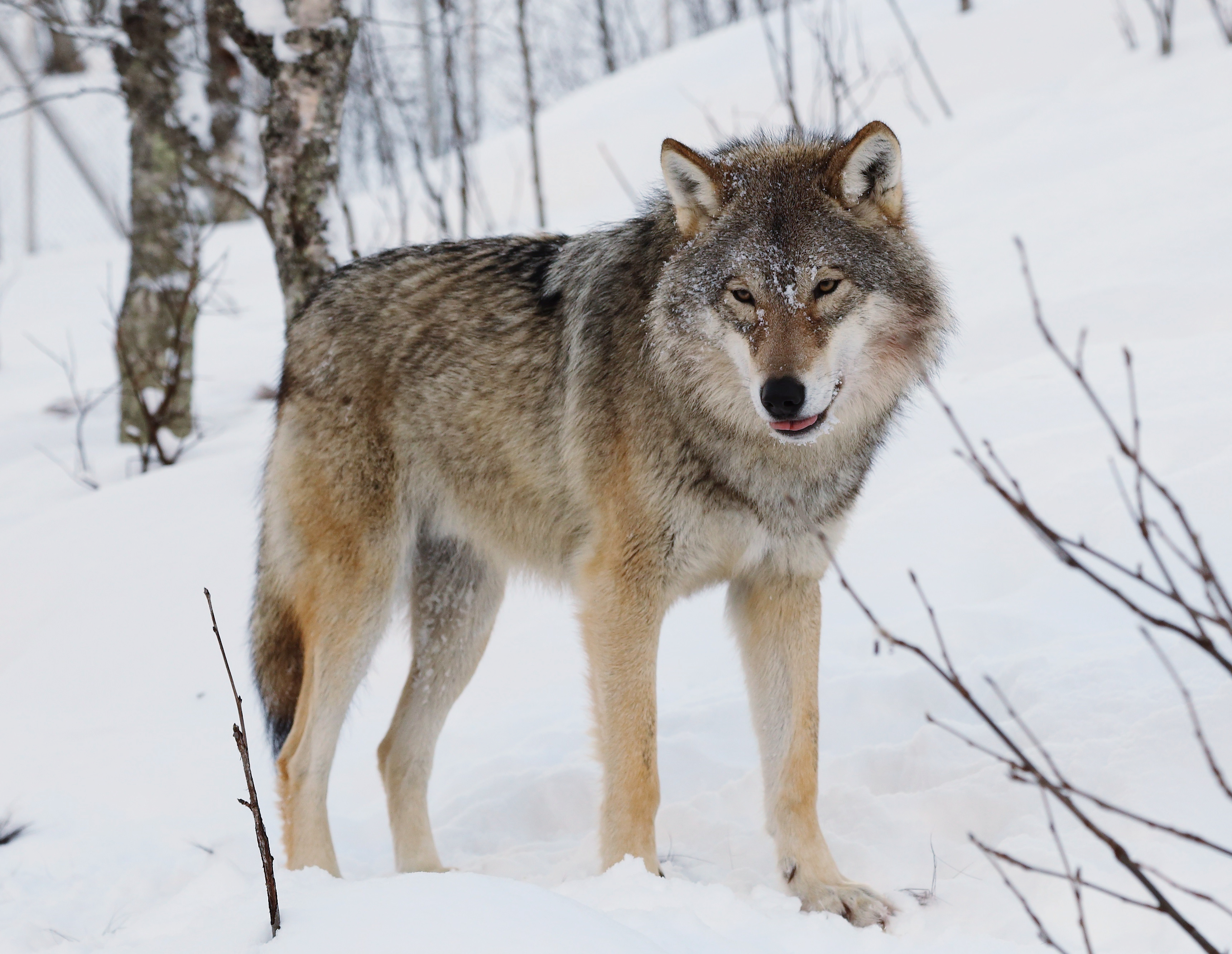
Gray Wolf (Canis lupus)
Introduction
A winter morning in Yellowstone's Lamar Valley. The temperature hovers well below freezing, and a thin mist rises from the Lamar River as it winds through a landscape bleached white and grey. Then, from the treeline, a shape emerges — deliberate, unhurried, scanning. It is followed by another, and another, until a pack of seven wolves moves in loose formation across the valley floor, their dark forms cutting against the snow like ink strokes. They are not hunting. Not yet. They are reading the land, cataloguing scents, communicating in a language built from posture, breath, and sound that predates human language by millions of years.
The gray wolf, Canis lupus, is among the most studied, most persecuted, most misunderstood, and ecologically most important mammals on Earth. It is a creature of contradiction — capable of extraordinary tenderness within its family group, and equally capable of coordinated, strategic pursuit of prey many times its size. It is simultaneously a symbol of wilderness and a lightning rod for human conflict. No other land predator has shaped the ecosystems of the Northern Hemisphere quite so profoundly, and no other large carnivore has had its fate so directly entangled with the arc of human civilisation.
Once distributed across most of the Northern Hemisphere — from the Arctic tundra to the deserts of Arabia, from the forests of Japan to the plains of Mexico — the gray wolf was systematically eliminated from the vast majority of its range over the course of several centuries. Yet it persists. Through reintroduction efforts, legal protection, and the wolf's own extraordinary biological resilience, populations have recovered in parts of North America and Europe, offering ecologists a rare opportunity to witness the cascading effects of a top predator's return.
This is the story of Canis lupus: its biology, its ecology, its social intelligence, and its place in the web of life that it helps hold together.
"The wolves known to science are not the wolves of myth. They are social, intelligent, family-oriented animals whose removal from an ecosystem initiates a cascade of consequences we are only beginning to understand."
— Dr. David Mech, wolf biologist, U.S. Geological Survey
Scientific Classification
Kingdom: Animalia
Phylum: Chordata
Class: Mammalia
Order: Carnivora
Family: Canidae
Genus: Canis
Species: Canis lupus (Linnaeus, 1758)
Common Name: Gray Wolf (also Grey Wolf)
Recognized Subspecies: 38 (contested; includes C. l. lupus, C. l. occidentalis, C. l. arctos, C. l. rufus, and others)
The gray wolf sits within the family Canidae alongside domestic dogs, coyotes, jackals, and foxes. The domestic dog (Canis lupus familiaris) is itself a subspecies of Canis lupus, having diverged from a now-extinct wolf population somewhere between 15,000 and 40,000 years ago. The gray wolf is the largest wild member of the family, and the species represents the ancestral lineage from which all domestic dogs descend — a fact that lends the animal a peculiar intimacy in the human imagination.
Subspecies classifications within Canis lupus remain scientifically contested, complicated by hybridisation, range shifts, and human-mediated population fragmentation. Modern genomic analysis has significantly revised earlier morphological classifications, and the number of recognised subspecies varies between different taxonomic authorities.
Physical Characteristics
The gray wolf is a study in functional elegance. Every anatomical feature of this animal reflects millions of years of refinement for a single purpose: the pursuit and capture of large prey across vast and varied terrain. Its body is built for endurance over speed, for strategy over brute force.
Adult males typically weigh between 30 and 80 kilograms, with the largest individuals recorded in the boreal forests of Canada and Russia occasionally exceeding 90 kilograms. Females are generally 20 percent smaller. Body length from nose to tail tip ranges from 105 to 160 centimetres, with a shoulder height of 60 to 90 centimetres. Despite appearing massive, wolves are surprisingly lean — a combination of deep chest, narrow waist, and long legs gives them a silhouette built for covering ground efficiently.
The coat is one of the most functionally sophisticated elements of the wolf's anatomy. The outer guard hairs are long, coarse, and water-resistant, while the dense underfur provides insulation against temperatures as low as minus 40 degrees Celsius. Coat colour ranges enormously — from pure white in Arctic subspecies to jet black, tawny brown, and every shade of grey. This variation is not merely cosmetic; it may serve thermoregulatory functions and provides camouflage suited to different habitats. Black colouration in North American wolves has been traced to an interbreeding event with domestic dogs thousands of years ago, a remarkable genetic legacy written into the animal's appearance.
The skull is large and powerful, housing a brain roughly double the volume of a similarly sized domestic dog. The jaw can exert a crushing pressure of approximately 1,500 pounds per square inch — sufficient to crack the femur of a moose. The carnassial teeth function as biological shears, slicing through flesh with mechanical precision. Long legs and large, spreading paws act as natural snowshoes, distributing weight effectively across deep snowfields. The eyes are typically amber to yellow in adults, providing excellent low-light vision that supports crepuscular and nocturnal activity.
Physical Trait | Gray Wolf | Coyote | Domestic Dog (average) |
|---|---|---|---|
Average male weight | 40–80 kg | 7–14 kg | 10–40 kg |
Shoulder height | 60–90 cm | 45–58 cm | 30–75 cm |
Bite force (PSI) | ~1,500 | ~700 | ~320 |
Brain-to-body ratio | High | High | Variable |
Coat function | Insulation + waterproofing | Moderate insulation | Variable (selective breeding) |
Habitat & Geographic Distribution
Few mammals have demonstrated a capacity to inhabit such a diverse range of ecosystems as the gray wolf. At the peak of its historical distribution, Canis lupus occupied the widest geographic range of any terrestrial mammal apart from humans. It was found across North America from the Arctic Ocean to central Mexico, throughout Europe and Asia from Scandinavia to the Arabian Peninsula, and in parts of North Africa. Forests, tundra, grasslands, deserts, mountain ranges, wetlands — the wolf adapted to them all.
Today, its range has been dramatically reduced, but the species still maintains populations across a remarkable variety of habitats. In North America, wolves are found in the boreal forests and tundra of Canada and Alaska, with reintroduced populations in the northern Rocky Mountains, the Great Lakes region, and the Pacific Northwest. In Europe, recovering populations exist in the Apennine Mountains of Italy, the Carpathian ranges of Romania, the forests of Poland and the Baltic states, and increasingly in France, Germany, and the Iberian Peninsula. In Asia, wolves persist across large swathes of Russia, Central Asia, the Indian subcontinent, and parts of the Middle East.
The wolf's habitat requirements are less about specific vegetation types and more about the availability of large ungulate prey and sufficient space to establish territories free from overwhelming human pressure. In Yellowstone, wolves thrive in mixed conifer and grassland ecosystems. In the Arctic, they pursue caribou and musk oxen across open tundra. In the forests of Poland's Białowieża, they stalk European bison. In the dry hills of Iran and India, smaller wolves subsist on deer, wild boar, and occasionally domestic livestock.
Territory size is another measure of the wolf's ecological adaptability. Pack territories range from as small as 80 square kilometres in prey-rich areas to over 2,500 square kilometres in low-density prey environments. This flexibility allows packs to survive in a wide range of productivity regimes, provided sufficient prey biomass is available.
Fun FactA gray wolf can travel up to 70 kilometres in a single day while patrolling territory boundaries or pursuing prey — covering distances that would take a human on foot several days to match.
Behaviour & Social Structure
The social architecture of a wolf pack is one of the most sophisticated group-living systems among non-primate mammals. For decades, the popular conception of wolf society was dominated by the idea of a tyrannical alpha male enforcing dominance through constant aggression — a model derived largely from studies of captive, unrelated wolves forced into unnatural groupings. Field research, particularly the long-term work of biologist L. David Mech in Yellowstone and Ellesmere Island, fundamentally revised this picture.
In the wild, a wolf pack is essentially a family unit. The breeding pair — often described as the alpha male and alpha female, though Mech has argued these terms are misleading — are typically the parents of the other pack members. Their authority is not maintained through continuous aggression but through the natural social deference that younger animals show their parents, much as wolf pups defer to their parents in any family group. Leadership is earned through experience, confidence, and decision-making ability, not through raw dominance displays.
Pack size typically ranges from two to fifteen individuals, though larger packs of up to thirty wolves have been documented in prey-rich environments like Yellowstone. The pack is the fundamental unit of gray wolf survival — it enables cooperative hunting of prey far larger than any individual wolf could tackle alone, collective defence of territory, and communal pup-rearing. Lone wolves exist, typically young adults dispersing from their birth packs in search of mates and new territories, but their mortality rates are significantly higher than those of pack members.
Communication within the pack is extraordinarily rich. Howling is the most recognisable form — a sound that carries for kilometres across open terrain and serves multiple functions simultaneously: locating separated pack members, coordinating group activity, reinforcing social bonds, and advertising territorial presence to neighbouring packs. The howl of a wolf is not simply a sound; it is a complex acoustic signal carrying information about individual identity, emotional state, and group cohesion.
Beyond howling, wolves communicate through an intricate system of body postures, facial expressions, tail positions, and scent marking. Urine and faeces deposited at territorial boundaries convey chemical information about the marking animal's identity, reproductive status, and health. A raised tail signals confidence; a tucked tail signals submission. Direct eye contact carries social weight. The vocabulary of wolf communication, when fully accounted for, rivals that of our closest primate relatives in its complexity.
There is mounting evidence that wolves possess a form of emotional intelligence that goes beyond simple social mechanics. Field observations have documented grieving behaviour following the death of pack members, play behaviour that persists well into adulthood, and what appear to be individual personality differences — bold explorers versus cautious observers — that influence pack decision-making. These behaviours suggest a cognitive and emotional depth that complicates any simplistic view of the wolf as a purely instinct-driven predator.
Daily Life & Activity Cycle
The daily rhythm of a wolf's life is shaped primarily by three variables: the location and behaviour of prey, the demands of the pack social structure, and the physical demands of patrolling and maintaining a territory. Unlike many carnivores, wolves are largely crepuscular and nocturnal — most active at dawn and dusk — though they will hunt at any hour when conditions are favourable, particularly in winter when prey is more energetically stressed and vulnerable.
A typical day might begin with a chorus howl at dawn, a social ritual that reinforces pack bonds and checks on the whereabouts of all members. The pack then moves — often covering five to fifteen kilometres during a patrol — investigating scent marks, refreshing territorial boundaries, and actively searching for prey. Movement is not random. Experienced wolves follow well-worn travel routes through their territory, efficiently checking areas where prey has been found before.
When prey is located, the pace of life changes dramatically. The relaxed, trotting patrol becomes a focused, tactical approach. Wolves rarely charge prey immediately; they test it first — watching for signs of weakness, injury, or hesitation. A healthy adult elk or moose will often stand its ground, and wolves frequently abandon these encounters. The energy cost of a prolonged pursuit against a healthy, defensive ungulate can be enormous, and wolves are economically rational hunters. It is the weakened, the young, the old, and the isolated that are most frequently taken.
After a successful kill, the feast is communal, hierarchical, and urgent. The breeding pair typically feeds first. Wolves can consume ten to twelve kilograms of meat in a single feeding, a physiological adaptation to the boom-and-bust nature of large prey hunting. Days or even a week may pass between kills, and the wolf's digestive system is designed to handle extreme feast-famine cycles without lasting harm.
Rest periods are scattered throughout the day and night, often spent in open areas where the pack can monitor its surroundings. Wolves rarely use dens except during pupping season. They sleep in the open, huddled together for warmth in winter, typically choosing elevated positions with good sightlines — a behavioural instinct that reflects millions of years of evolutionary pressure from rival packs and occasional predators.
Diet & Survival Strategies
The gray wolf is a hypercarnivore — an animal that obtains the overwhelming majority of its caloric intake from animal tissue. While wolves will eat berries, grass, and carrion when primary prey is unavailable, their anatomy, physiology, and hunting behaviour are all calibrated for the pursuit and consumption of large ungulates.
Primary prey species vary by geographic region and reflect the dominant herbivore community of each ecosystem. In Yellowstone and the northern Rockies, elk constitute the majority of wolf prey, supplemented by bison, deer, and pronghorn. In the boreal forests of Canada, moose and caribou are primary targets. In Europe, red deer and wild boar dominate the diet of many wolf populations, along with roe deer and reindeer in northern regions. In India, the smaller Indian wolf subspecies preys on blackbuck, chital, and hares.
The hunting strategy of a wolf pack is one of the most sophisticated cooperative behaviours seen in any non-primate predator. Pursuit hunting — running prey to exhaustion — is one common technique. However, wolves also employ relay chasing, in which individual pack members take turns leading the pursuit, allowing others to recover, and converging ambush strategies in broken terrain where topography can be used to channel prey. The decision to press an attack or abandon a chase appears to involve real-time assessment by multiple pack members — an implicit collective intelligence that emerges from the coordination of experienced hunters.
Wolves are also highly opportunistic. They will consume beaver, rabbits, rodents, ground-nesting birds, and fish during salmon runs in coastal ecosystems. During periods of extreme prey scarcity, they will approach livestock — a survival behaviour that brings them into direct conflict with human communities, with consequences that have shaped the species' history as profoundly as any natural force.
Fun FactGray wolves in coastal British Columbia and Southeast Alaska regularly wade into rivers and tidal channels to catch Pacific salmon during the annual spawning runs — a foraging behaviour documented by only a handful of wolf populations globally.
Interaction with Other Animals
The gray wolf does not exist in ecological isolation. As a top predator, it sits at the apex of a web of relationships — some involving direct predation, others competition, and some that are less obviously antagonistic but no less consequential for the broader ecosystem.
The relationship between wolves and bears — both grizzly and black — is one of contested dominance and mutual exploitation. Bears frequently displace wolves from kills, leveraging their superior size and strength to commandeer carcasses. Wolves, in return, will harass solitary bears and occasionally drive them off, particularly when acting as a large coordinated pack. Around a wolf kill in Yellowstone, the sequence of scavengers — ravens, eagles, coyotes, foxes, wolverines — forms a structured community of secondary beneficiaries that would not exist without the wolf's ability to bring down large prey.
The relationship between wolves and coyotes is one of the most ecologically significant inter-species interactions in North American ecosystems. Wolves actively suppress coyote populations through direct killing and behavioural exclusion — a phenomenon documented extensively following wolf reintroduction to Yellowstone. Where wolves are present, coyote densities decline sharply. Since coyotes themselves heavily predate smaller predators, rodents, and ground-nesting birds, the wolf's suppression of coyote populations triggers a cascade of effects felt many trophic levels below.
Ravens have co-evolved a remarkable relationship with wolves. Studies in Yellowstone have found that wolves and ravens interact in ways that appear mutually beneficial — ravens locate prey and wolves provide access to carcasses that ravens cannot open themselves. Individual ravens have been observed following wolf packs over multiple days, an association so consistent that some researchers have described wolves and ravens as ecological partners. The vocalisation of ravens can alert wolves to prey, and wolves learn to interpret raven behaviour as an indicator of food or threat.
The predator-prey relationship between wolves and their ungulate quarry is not simply one of hunter and hunted. It is a dynamic, co-evolutionary arms race in which both parties drive adaptations in the other. Elk in Yellowstone have shown measurable changes in body condition, vigilance behaviour, and habitat use following wolf reintroduction — changes that reflect the prey population's evolutionary memory of predation pressure. The wolf, in turn, preferentially selects prey based on vulnerability, effectively exerting selective pressure that over time favours healthier, more alert, and more physically robust ungulate populations.
It was mid-February in Yellowstone's Hayden Valley when the Wapiti Lake pack, fourteen strong, spread out across a frozen meadow in pursuit of a cow elk that had separated from the main herd. The elk ran hard, churning through knee-deep snow, heading toward a stand of Douglas fir at the valley's edge.
Two younger wolves peeled off to the right, curling wide in a flanking arc that blocked the treeline approach. The cow, registering the threat, turned back into the open valley — directly toward four wolves approaching at a trot. She stopped. For nearly three minutes, nothing moved. The wolves watched her, and she watched them, breath rising in white plumes in the frigid air.
Then the elk lowered her head and charged the nearest wolf, which dodged easily. The cow's movement was stiff on her right foreleg — the small, telling asymmetry that experienced wolves recognise immediately. The pack converged. In the silence of the valley, the only sounds were the soft compression of snow beneath running paws and the distant call of a raven already banking overhead.
By dusk, sixteen ravens and three coyotes had joined the wolves at the carcass. A golden eagle watched from a cottonwood fifty metres away, waiting for its turn. The kill that had sustained the pack would sustain a community of scavengers for days. In a landscape without wolves, that community would not exist.
Interaction with Environment
The gray wolf's relationship with its physical environment is not passive — it is transformative. The concept of the "landscape of fear" captures part of this dynamic. When wolves inhabit a landscape, prey animals do not simply run from them; they reorganise their entire use of that landscape to minimise predation risk. In Yellowstone, following wolf reintroduction in 1995, elk began avoiding river valleys, gullies, and other topographic features where predation risk was highest. This behavioural shift allowed riparian vegetation — willows, aspens, cottonwoods — to recover in areas that had been heavily browsed for decades. Recovering vegetation stabilised stream banks, altered water flow patterns, and created new habitat for beavers, songbirds, and fish. This sequence of ecological effects, triggered by the fear of wolves rather than direct wolf predation, is among the most dramatic examples of a "trophic cascade" documented in modern ecology.
Wolves also function as ecosystem engineers through their role in creating carrion. Large ungulates killed by wolves represent enormous pulses of nutrients that are processed by a cascade of scavengers. Ravens, eagles, magpies, coyotes, foxes, bears, wolverines, and a vast community of insects and micro-organisms all depend on wolf kills as a primary or supplementary food source. Research in Yellowstone found that wolf kills significantly increase the number of scavenger species present in an area and extend scavenging activity across a broader landscape than would be the case without wolves.
Wolves are also significant dispersers of large ungulate populations. By maintaining predation pressure, they prevent prey herds from concentrating in one area long enough to cause severe overgrazing. This distribution effect is subtle but ecologically powerful — it prevents the creation of sacrificial zones of denuded vegetation and promotes more even distribution of grazing pressure across the landscape.
In terms of climate adaptation, wolves have shown a capacity to shift prey selection, range, and pack structure in response to changing prey abundance, which itself tracks environmental variability. In the High Arctic, where sea ice loss is altering caribou migration patterns, wolf packs are already exhibiting shifts in movement behaviour and prey preference that suggest adaptive flexibility in the face of rapid environmental change.
Reproduction & Parenting
Reproduction in gray wolves is a carefully regulated, socially controlled process. Under normal pack conditions, only the dominant breeding pair produces offspring. This reproductive suppression of subordinate adults — enforced through social behaviour rather than aggressive coercion — concentrates the pack's considerable parenting investment in a single litter, maximising pup survival rates. When prey is abundant and pack conditions are stable, this system is extraordinarily effective.
Mating occurs once annually, typically between January and April depending on latitude, with earlier breeding in southerly populations. The female enters oestrus for approximately three weeks, during which pair bonding intensifies markedly. Pair bonds in wolves are among the strongest seen in any carnivore and are typically maintained for life, though re-pairing occurs after the death of a mate.
Gestation lasts approximately 63 days. The female selects a den site — often a modified fox burrow, a natural rock shelter, or an excavated hollow in a river bank — in a sheltered, secluded location. Litter sizes range from one to thirteen pups, with an average of four to six. Pups are born blind, deaf, and helpless, weighing approximately 300 to 500 grams. They open their eyes at around ten days and begin to hear at approximately two weeks.
Pup-rearing is a genuinely cooperative enterprise. All pack members contribute to provisioning the female and later the pups, through regurgitation of partially digested meat — a behaviour that begins when pups are around three weeks old and able to consume solid food. Older siblings from previous litters frequently serve as "babysitters" while the breeding pair hunts, standing guard over the den and playing with the pups in behaviour that simultaneously socialises the pups and reinforces the elder wolves' place in the pack hierarchy.
Pups emerge from the den at three to four weeks and are moved to "rendezvous sites" — open areas near the den where the pack meets and pups begin to socialise — at around six to eight weeks. Weaning occurs at around five to six weeks, but pups continue receiving regurgitated prey until they are capable of joining hunts at six to eight months of age. Full physical and social maturity is reached at two to three years, at which point young adults typically face a choice: remain as a subordinate pack member or disperse to seek a mate and establish a new territory.
Evolutionary Adaptations
The gray wolf's evolutionary history stretches back approximately one million years for the species as currently defined, though the genus Canis has roots dating to the Pliocene epoch around five million years ago. Over this deep time, Canis lupus has been shaped by a remarkably consistent selective pressure: the need to hunt, kill, and eat large prey in cold, seasonal environments, while simultaneously maintaining a complex social structure that amplifies hunting effectiveness.
Thermoregulation is one of the wolf's most impressive adaptive systems. The double-layered coat, the counter-current heat exchange system in the legs that prevents dangerous heat loss through extremities, and behavioural adaptations like sleeping in tight huddles combine to allow wolves to function effectively in temperatures that would be lethal to most mammals of similar size. In the High Arctic, wolves have been observed resting comfortably in minus 30 degree conditions without shelter.
The wolf's locomotory system is optimised for endurance rather than sprint speed. Digitigrade locomotion — walking on the toes rather than the full foot — increases stride length and reduces energy expenditure per kilometre. The deeply fused radius and ulna bones of the foreleg prevent rotational movement that would be structurally wasteful for a straight-line runner. Large, spreading paws function as snowshoes. The wolf's sustained running speed of approximately 55 kilometres per hour can be maintained for extended periods — unlike the explosive but brief top speeds of cursorial cats like cheetahs.
The wolf's sensory adaptations are equally remarkable. Its sense of smell is estimated to be at least 100 times more sensitive than that of a human, capable of detecting prey at distances of up to 2.5 kilometres under favourable wind conditions. The nasal anatomy is architecturally complex, with a large surface area of olfactory epithelium that allows for simultaneous analysis of scent composition and concentration gradients — in effect, allowing a wolf to determine not just what was present at a location but how long ago it left and in which direction it was moving.
Social intelligence represents perhaps the wolf's most powerful adaptation. Cooperative hunting, coordinated pack defence, communal pup-rearing, and the ability to integrate the skills of multiple individuals into a functioning predatory unit represent a form of distributed cognitive capability that no single wolf could replicate alone. The evolution of this social intelligence has made the wolf effective against prey many times its size, across a wider range of terrain and conditions than any solitary carnivore could manage.
Ecological Importance
The ecological importance of the gray wolf is measurable and documented in a body of research that spans decades and multiple continents. As a keystone predator — a species whose impact on an ecosystem is disproportionately large relative to its biomass — the wolf's presence or absence shapes community structure at multiple trophic levels.
The Yellowstone reintroduction programme, initiated in 1995 when 41 wolves were translocated from Canada to the park, has become the most intensively studied natural experiment in predator-prey ecology ever conducted. In the two decades following reintroduction, researchers documented the following: elk populations declined from overabundance to more sustainable levels; riparian vegetation recovered substantially in areas of high predation risk; stream channel morphology improved as bank stabilisation increased; beaver populations recovered after near-disappearance; songbird diversity increased in restored riparian zones; and scavenger communities expanded in diversity and abundance.
These changes are collectively described as a trophic cascade — a chain of ecological consequences triggered by the addition of a top predator that propagates through the food web. The wolf's influence operates through both direct predation (reducing herbivore numbers) and the "ecology of fear" (altering herbivore behaviour and habitat use without necessarily killing individuals). Both mechanisms are real, both are significant, and both require the sustained presence of a functional wolf population to operate.
In Europe, the gradual recovery of wolf populations has been associated with similar effects on deer behaviour and vegetation structure in multiple countries, including Italy, Poland, and Romania. The emerging picture, drawn from sites spread across the wolf's global range, is one of an animal whose presence is not merely a matter of charismatic biodiversity but of active ecosystem maintenance.
Fun FactFollowing wolf reintroduction to Yellowstone, the recovery of riparian willows and aspens led to the return of beavers, whose dams then altered stream hydrology, creating wetlands that supported amphibians, fish, and waterfowl — a chain of ecological consequences that started with a predator and ended in a pond.
Threats & Conservation
The gray wolf's story over the past five centuries is one of the most dramatic documented population collapses of a large mammal in history. Systematic persecution — driven by livestock depredation, cultural fear, government-sponsored bounty programmes, and the European tradition of the wolf as symbolic evil — reduced a species that numbered in the millions across the Northern Hemisphere to isolated fragments clinging to remote wilderness refugia by the mid-twentieth century.
In the contiguous United States, wolves were effectively eliminated from all but a remnant population in northeastern Minnesota by the 1960s. In Western Europe, populations were reduced to small, isolated pockets in Italy, Spain, Poland, and the Balkans. The mechanism was universal: direct killing through shooting, trapping, and poisoning, amplified by the systematic destruction of forest habitat that removed both prey and shelter, and by the aggressive human colonisation of formerly wild landscapes that removed the spatial buffer between wolves and livestock.
Habitat fragmentation remains the gravest contemporary structural threat. Wolves require large, connected landscapes to maintain viable, genetically diverse populations. As human development fragments landscapes into parcels of suitable habitat separated by roads, agricultural land, and urban areas, wolf packs become isolated, inbreeding increases, and genetic diversity collapses over time — reducing population resilience and increasing extinction risk. The iconic highway fatality statistics for wolves in recovery areas like the northern Rockies and the Alps reflect this fragmentation directly: roads are not simply physical barriers but vectors of mortality.
Human-wildlife conflict over livestock predation continues to drive illegal killing in virtually every region where wolves occur. In Europe, retaliatory killing accounts for a substantial fraction of wolf mortality in recovering populations. In parts of Asia and the Middle East, wolves are still legally persecuted or inadequately protected, and populations remain under significant pressure. Climate change introduces a less immediate but potentially more fundamental threat: shifts in prey distribution driven by changing vegetation patterns, reduced snowpack that alters the predator-prey dynamic in winter-adapted ecosystems, and northward range shifts of prey species that may outpace wolves' ability to follow.
The IUCN Red List status and detailed conservation analysis of Canis lupus are addressed in full in the following section.
IUCN Red List Analysis
Current IUCN Status
The gray wolf (Canis lupus) is currently classified as Least Concern (LC) on the IUCN Red List, as assessed by the IUCN SSC Canid Specialist Group. This classification reflects the species' global population, which, despite severe regional depletions, remains large enough in aggregate — particularly in Russia, Canada, and Alaska — to preclude listing under threatened categories at the species level.
It is critical to understand that the Least Concern designation refers to the species as a whole and does not reflect the status of regional or sub-specific populations, several of which are acutely threatened or functionally extinct in their historical ranges. The red wolf (Canis rufus), sometimes considered a distinct species, is classified as Critically Endangered and is effectively extinct in the wild without active management. The Mexican wolf (Canis lupus baileyi), the most genetically distinct and southernmost North American subspecies, was functionally extinct in the wild by the 1970s and survives today only through an intensive recovery programme. The Arabian wolf (Canis lupus arabs) occupies a fraction of its former range and faces severe pressure. The global LC designation thus obscures a picture of significant regional fragility.
Population Trend
Global gray wolf population estimates are imprecise, but reliable assessments place total numbers in the range of 200,000 to 300,000 individuals worldwide. Russia holds the largest single national population, estimated at 25,000 to 60,000 individuals. Canada supports approximately 50,000 to 60,000 wolves. The United States hosts around 6,000 to 8,000 wolves, the majority in Alaska, with smaller but growing populations in the northern Rockies, Great Lakes region, and Pacific Northwest.
In Europe, where wolves were historically eliminated from most of their range, the population trend is strongly positive. Italy's wolf population has grown from fewer than 100 individuals in the 1970s to over 3,300 by recent estimates. France, Germany, Belgium, the Netherlands, Denmark, and several other countries have been recolonised naturally. Poland's Białowieża population serves as a critical source population for the broader Central European recovery. In Scandinavia, a population descended from a single founding pair in the early 1980s has grown to over 450 individuals, though it remains critically inbred. Overall, global population trends are considered stable or increasing, driven principally by recovery in Europe and the maintained populations of Russia and North America.
Main Threats
Habitat loss and fragmentation represent the foundational challenge to wolf conservation worldwide. Large-scale infrastructure development — road networks, agricultural expansion, urban growth — dissects wolf territories and increases the probability of human-wolf encounter that typically ends fatally for the wolf. In Europe, the Trans-European Transport Network poses particular risks to cross-border wolf movement critical for genetic connectivity.
Direct human persecution remains the most immediate cause of mortality in most wolf populations. Legal hunting occurs in the United States (in several states where wolves have been delisted from federal Endangered Species Act protection), Canada, Russia, and parts of Europe. Illegal killing — driven by livestock predation conflicts, fear, and ideological opposition — suppresses populations even in legally protected areas. In France, legal wolf culling under a government quota system has accelerated in recent years despite criticism from conservation groups, and illegal poisoning remains prevalent in parts of southern Europe, Central Asia, and the Middle East.
Livestock conflict drives both legal and illegal killing. As wolf populations recover in agricultural landscapes, the frequency of livestock predation incidents increases, eroding local tolerance and generating political pressure on wildlife management authorities to authorise lethal control. The economic and psychological impact of livestock losses on small-scale pastoralists is real and significant, and conservation strategies that fail to address this impact are consistently unsuccessful.
Climate change affects wolves indirectly through its impact on prey populations and habitat. Reduced snowpack in mountainous regions reduces the competitive advantage that deep snow gives wolves over ungulate prey — a mechanism that has historically been a critical factor in pack hunting success. Changes in caribou migration routes driven by permafrost thaw and vegetation shifts in the Arctic may reduce prey availability for northern wolf populations. Emerging evidence also suggests that warming winters are allowing prey animals to access higher-elevation refugia previously snowbound and inaccessible, altering predator-prey dynamics in complex ways.
Genetic isolation and inbreeding affect small, fragmented populations. The Scandinavian wolf population, founded by a single pair and a single immigrant, exhibits extremely low genetic diversity and associated fitness costs including skeletal abnormalities and elevated pup mortality. Without gene flow from connected populations — which requires landscape connectivity maintained by conservation policy — isolated populations face a slow erosion of adaptive potential.
Ecological Consequences
The removal or suppression of wolf populations from ecosystems has documented ecological consequences that extend far beyond the simple absence of a predator. Where wolves have been eliminated, prey populations typically increase and exhibit changed behaviour — browsing more intensively and over larger areas, damaging vegetation structure, and reducing the structural complexity of habitats that support a wide range of species.
The "mesopredator release" effect is well documented: where wolves are absent, coyote populations expand dramatically and suppress populations of smaller predators and prey species. Fox, raccoon, opossum, and ground-nesting bird populations all decline in coyote-saturated landscapes. The cascading effect of losing the wolf thus passes through coyotes to affect species with no direct interaction with wolves themselves.
Scavenger communities contract significantly without wolves. The reliable provision of large ungulate carcasses that wolf packs create is a critical resource for ravens, eagles, bears, wolverines, and countless invertebrates in boreal and mountain ecosystems. Without this subsidy, scavenger diversity and abundance both fall. Stream ecology degrades when riparian vegetation is overgrazed, reducing bank stability, increasing erosion, warming water temperatures, and reducing habitat quality for cold-water fish including salmon and trout. The consequences of wolf loss are systemic, slow, and difficult to reverse once fully manifested.
Conservation Efforts
The most significant and best-documented wolf conservation initiative in history is the reintroduction programme in Yellowstone National Park and central Idaho, initiated by the U.S. Fish and Wildlife Service in 1995 and 1996. Forty-one wolves captured in Alberta and British Columbia were translocated to Yellowstone and the Frank Church River of No Return Wilderness. By 2023, the Northern Rocky Mountain wolf population had grown to approximately 2,000 individuals across Idaho, Montana, Wyoming, Washington, and Oregon, representing one of the most successful large carnivore recovery programmes ever implemented.
In Europe, the natural recovery of wolf populations from Italian refuge populations — without any formal reintroduction programme — has been facilitated by the protection afforded under the EU Habitats Directive, which classifies the wolf as a priority species requiring strict protection in all member states. National action plans in Italy, France, Germany, Poland, and Sweden provide legal frameworks for coexistence management, including livestock protection support schemes, compensation funds for depredation losses, and population monitoring networks.
The Mexican Wolf Recovery Programme, managed by the U.S. Fish and Wildlife Service in collaboration with Mexican authorities, has operated a captive breeding programme since the late 1970s and continues to release wolves into the Apache-Sitgreaves National Forest in Arizona and New Mexico. The wild population exceeded 200 individuals in 2022, the highest count since reintroduction began, though the population remains critically small and managed.
International frameworks including the Convention on International Trade in Endangered Species (CITES), the Bern Convention, and the Bonn Convention on Migratory Species provide varying levels of protection for wolf populations across different parts of the range. NGOs including the Wolf Conservation Center, Rewilding Europe, the World Wildlife Fund, and the Defenders of Wildlife provide advocacy, legal support, and direct conservation funding that complement government programmes.
Future Outlook
The long-term outlook for Canis lupus as a species is cautiously positive at the global level. Large, robust populations in Russia, Canada, and Alaska are not under immediate threat, and European recovery trends suggest that voluntary natural recolonisation, when legally protected, can be remarkably effective. The reintroduction in Yellowstone has entered the scientific literature as a paradigmatic success, and its results have motivated similar proposals and attempts in other parts of the world, including a controversial planned reintroduction in Scotland.
However, the political trajectory of wolf conservation in the United States is genuinely worrying. The Trump administration's 2020 decision to remove wolves from federal Endangered Species Act protection across the contiguous states, subsequently challenged and partially reversed in courts, exemplifies the fragility of conservation gains in a politically polarised environment. In Europe, the European Commission's 2023 proposal to downgrade wolf protection status under the Habitats Directive — driven by agricultural lobbying and political pressure — threatens the legal foundation of wolf recovery across the continent.
The fundamental challenge for the gray wolf's future is not biological — the species is resilient and capable of recovery when conditions allow — but societal. Whether humanity is willing to share landscapes with a top predator that occasionally kills livestock and challenges the cultural assumption of human dominance over wild nature is ultimately a question about values, not ecology. The scientific case for wolf conservation is overwhelming. The political and cultural case remains deeply contested.
Human Relationship
The relationship between humans and gray wolves is the longest, most complex, and most consequential interspecies relationship in human history. It encompasses domestication, mythology, persecution, conservation, and a continuing negotiation over shared landscapes that shows no sign of resolution. In a very literal sense, every domestic dog on Earth is a monument to this relationship — a wolf that chose, or was chosen, to live with people.
In the cultural imagination of the Indo-European world, the wolf has occupied a position of dual symbolism — simultaneously admired and feared, associated with both warriors and darkness. In Norse mythology, wolves flank Odin and will devour the sun at Ragnarök. In Roman tradition, a she-wolf nursed Romulus and Remus, making the wolf the founding mother of Rome. In Native American and First Nations traditions, the wolf is widely revered as a teacher, a hunter's ally, and a spiritual guide — a perspective starkly at odds with the European settler tradition that drove extermination campaigns across North America.
The history of wolf persecution in Europe and North America is a case study in how cultural fear, amplified by economic interest and institutional power, can drive a species to the edge of extinction. British wolves were extinct by the 15th century. Irish wolves by the 17th. By the 1900s, government-sponsored campaigns using poison, trapping, and aerial shooting had eliminated wolves from all but the most remote corners of the western United States.
The modern conservation relationship with wolves is built on a more ecologically sophisticated foundation, but it is perpetually complicated by the same fundamental conflict: wolves kill livestock, and livestock keepers have legitimate economic and cultural grievances. Studies consistently show that economic compensation schemes, livestock guarding dogs, guardian animals, and improved husbandry practices can substantially reduce depredation losses — but none of these interventions eliminates conflict entirely, and they require sustained commitment from governments and communities that is not always forthcoming.
Wolf tourism is a significant and growing economic force in several regions. In Yellowstone, wolf watching generates an estimated tens of millions of dollars annually in visitor expenditure, concentrated in gateway communities that previously had economies based partly on livestock ranching. This economic argument for wolf presence is important in political negotiations over management but is not uniformly distributed — the economic beneficiaries of wolf tourism are rarely the same individuals bearing the costs of livestock depredation.
Region | Estimated Population | Legal Status | Primary Conflict |
|---|---|---|---|
United States (lower 48) | ~6,000–8,000 | Varies by state | Livestock depredation, political opposition |
Canada | ~50,000–60,000 | Provincially managed | Livestock and hunting allocation |
Russia | ~25,000–60,000 | Hunted, bounty in some regions | Livestock, reindeer herding |
Europe (EU) | ~20,000+ | Protected under Habitats Directive (contested) | Livestock, political opposition |
India | ~3,000 | Protected under Wildlife Protection Act | Livestock, occasional human conflict |
Unique & Rare Facts
Wolves and dogs shared an ancestor, not a lineage: Domestic dogs did not descend from modern gray wolves. Both dogs and modern wolves descend from a now-extinct ancestral wolf population, making them more like cousins than a parent-offspring relationship.
Wolves can detect prey through up to a metre of snow: Their extraordinarily sensitive nose can locate rodents and other small animals buried beneath deep snowpack, allowing them to supplement their diet during periods when large ungulates are unavailable.
A wolf can hear sounds up to 10 kilometres away in open terrain: Their rotating ears and broad hearing frequency range make them sensitive to sounds at distances that far exceed human or domestic dog capability.
Individual wolf howls are as distinctive as human fingerprints: Researchers working with long-term wolf populations can identify individual animals by spectrographic analysis of their vocalisations, without visual identification.
The black coat colour in North American wolves comes from dogs: Genomic research has confirmed that the MC1R gene mutation responsible for black colouration in North American wolves was introgressed from domestic dogs during interbreeding events thousands of years ago — a case of an adaptive trait acquired through hybridisation.
Wolves demonstrate what researchers call "informed leadership": Studies show that pack travel decisions are influenced disproportionately by older, more experienced individuals, whose knowledge of territory, prey location, and danger translates into a form of cultural information transfer between generations.
Wolves have been documented "playing" with ravens: Multiple observers in Yellowstone and elsewhere have recorded wolves and ravens engaging in apparent play behaviour — chasing, mock-diving, and joint movement — with no apparent foraging or competitive function.
Wolf packs in Yellowstone demonstrate cultural variation in hunting tactics: Different pack lineages show consistent differences in hunting strategy, prey selection, and territorial behaviour that persist across generations and cannot be explained purely by ecological differences — suggesting cultural transmission of learned behaviour.
Dispersing wolves have been recorded crossing distances of over 1,000 kilometres: Young adult wolves leaving their birth packs have been tracked covering extraordinary distances in search of mates, including a female known as OR-7 that walked from northeastern Oregon to California and back, covering at least 2,600 kilometres over multiple years.
Conclusion
The gray wolf is not a relic of a wilder past. It is an active, present force in the ecosystems it inhabits — a species whose intelligence, social complexity, and ecological function represent millions of years of evolutionary refinement. When we lose wolves from a landscape, we lose not just a predator but an entire cascade of ecological relationships: the behaviour of prey, the structure of vegetation, the flow of streams, the diversity of scavengers, and the unseen checks and balances that keep an ecosystem from collapsing into a simpler, more degraded state.
The wolf's story over the past century is, at its core, a story about what happens when science confronts culture, when evidence confronts belief, and when the long-term logic of ecological health confronts the short-term logic of economic convenience. The evidence for the wolf's importance is now overwhelming and well-documented. The cultural and political barriers to its protection remain formidable in many parts of its range.
What is remarkable is not that wolves were almost destroyed — human history is full of extinctions driven by fear and economic interest. What is remarkable is that they came back. In Yellowstone, in Italy, in Poland, in the mountains of Germany and the forests of France, wolves have returned to landscapes they had not occupied for generations, and the ecosystems they have returned to are demonstrably richer for their presence. That recovery was not inevitable. It required deliberate choice, scientific commitment, and a willingness by some communities and governments to share space with an animal that asks something genuinely difficult of us: to accept a world in which we are not the only apex predator.
The gray wolf endures. In the pre-dawn silence of a winter valley, somewhere between Yellowstone and the forests of Eastern Europe, a pack howl rises — a sound so old it predates human language, so resonant it seems to emerge from the land itself. It is a declaration of presence. It is also, if we are willing to listen, a measure of ecological health. Where wolves howl, the wild is still functioning. That is worth protecting.
"We reached the old wolf in time to watch a fierce green fire dying in her eyes. I realized then, and have known ever since, that there was something new to me in those eyes — something known only to her and to the mountain. I thought that because fewer wolves meant more deer, no wolves would mean hunters' paradise. But after seeing the green fire die, I sensed that neither the wolf nor the mountain agreed with such a view."
— Aldo Leopold, A Sand County Almanac
Sources & Attribution
Data and ongoing research referenced for this article come from the following authoritative sources — peer-reviewed publishers, official taxonomic registers, and global biodiversity programmes:
- IUCN Red List — Gray Wolf — official IUCN Red List assessment including population trend, threats, and conservation actions.
- Wikipedia — Gray Wolf — taxonomy, distribution, and an overview with onward citations to primary literature.
- GBIF — Gray Wolf — global occurrence and distribution records from the Global Biodiversity Information Facility.
- iNaturalist — Gray Wolf — observation records and field photographs contributed by naturalists worldwide.
- Encyclopedia of Life — Gray Wolf — multilingual species pages aggregating taxonomic and natural-history data.
- WWF — World Wildlife Fund — global wildlife conservation programmes and research summaries.
- Nature — research on Gray Wolf — peer-reviewed studies indexed by Nature on related ecology and behaviour.
- ITIS — Integrated Taxonomic Information System — federal-grade taxonomy and nomenclature.
Frequently Asked Questions
What do gray wolves eat?
Gray wolves are hypercarnivores that primarily prey on large ungulates, including elk, moose, deer, caribou, bison, and wild boar, depending on their geographic range. In prey-scarce conditions, they will also eat smaller animals such as beavers, rabbits, and rodents, and will consume carrion when available. Coastal populations in British Columbia have been documented catching Pacific salmon during spawning runs.
The specific prey composition of a wolf pack's diet is shaped by prey availability in its territory, pack size, and seasonal factors. Wolves select prey opportunistically but not randomly — they typically target the most vulnerable individuals in a prey population, including the old, the young, the injured, and the diseased.
How large are gray wolf territories?
Gray wolf territory sizes vary enormously depending on prey density and pack size. In prey-rich environments like Yellowstone National Park, pack territories typically range from 80 to 500 square kilometres. In low-productivity boreal or Arctic environments, territories can extend to 2,500 square kilometres or more. The territory is patrolled regularly by pack members, who reinforce boundaries through scent marking and howling.
How long do gray wolves live?
In the wild, gray wolves typically live between six and thirteen years, with most mortality occurring in young adults dispersing from birth packs. In protected populations, individuals occasionally reach fourteen to sixteen years. Causes of mortality include starvation, injury from prey (a kicking moose or defending bison is a genuine danger), intraspecific conflict with rival packs, and human causes including shooting, trapping, and vehicle strikes. In captivity, wolves have been recorded living to seventeen years or more.
Are gray wolves dangerous to humans?
Unprovoked attacks by healthy wild wolves on humans are extremely rare. A comprehensive study examining wolf attacks across North America and Europe found only a handful of authenticated cases of unprovoked attacks by healthy wolves in recorded history, and fatalities are extraordinarily uncommon — far rarer than fatalities from domestic dogs. The risk of a wolf attack increases where wolves have been regularly fed or have habituated to human presence, or where rabies is present in the population.
The cultural fear of wolves as human predators, while deeply embedded in European folklore, does not align with the statistical reality of human-wolf encounters. Wolves are typically extremely wary of humans and avoid contact unless cornered, injured, or food-conditioned through human habituation.
How many gray wolves are left in the world?
Global gray wolf population estimates vary due to the difficulty of conducting accurate censuses across vast and remote ranges. Current estimates suggest a global population of approximately 200,000 to 300,000 individuals. Russia holds the largest national population, followed by Canada and the United States (primarily Alaska). European populations are in recovery, with Italy, Poland, Romania, and Spain hosting the largest national populations on the continent.
These aggregate numbers, while reassuring at the global level, obscure significant regional and subspecific variation. Some wolf populations — particularly the Mexican wolf and the Arabian wolf — remain critically small and under active threat.
Why were gray wolves reintroduced to Yellowstone?
Gray wolves were extirpated from Yellowstone National Park by the mid-1920s, primarily through a U.S. government predator eradication programme. In the subsequent seven decades, the absence of a top predator allowed elk populations to grow and to heavily graze riparian areas without predation pressure, causing measurable degradation of vegetation and stream conditions. In 1995, the U.S. Fish and Wildlife Service reintroduced 41 wolves from Canada under the authority of the Endangered Species Act, seeking to restore natural predator-prey dynamics.
The reintroduction has been described as one of the most successful large carnivore conservation interventions in history. It has produced a wealth of ecological data, demonstrated the validity of trophic cascade theory in a real-world setting, and become a major driver of wildlife tourism in the greater Yellowstone ecosystem.
How do gray wolves communicate?
Gray wolves use a sophisticated multi-modal communication system that includes vocalisation (howling, barking, whimpering, growling), body posture and facial expression, tail position, and scent marking through urine, faeces, and glandular secretions. Howling serves to assemble the pack, locate separated members, coordinate group activity, reinforce social bonds, and advertise territorial presence to neighbouring packs. Individual wolves can be identified by the acoustic signature of their howl.
Scent marking is particularly important for territorial communication and for conveying reproductive status. Dominant individuals mark more frequently and at more prominent locations than subordinates, and the chemical composition of urine changes during oestrus, providing information about a female's reproductive state to all wolves within chemical detection range of the mark.
What is the difference between the gray wolf and other wolf species?
The gray wolf (Canis lupus) is the largest and most widely distributed wolf species. Other wolf species include the red wolf (Canis rufus), which is smaller and historically occupied the southeastern United States and is now Critically Endangered; the Ethiopian wolf (Canis simensis), a specialised rodent hunter in the Ethiopian highlands classified as Endangered; and the maned wolf (Chrysocyon brachyurus), a South American canid that is distantly related despite its common name. The gray wolf is the direct ancestor of all domestic dogs.
Within Canis lupus, numerous subspecies are recognised based on geography, morphology, and genetics, ranging from the large northern subspecies of Canada and Russia to the smaller, paler wolves of Arabia and India.
How do wolf packs hunt large prey?
Wolf packs employ cooperative hunting strategies that enable them to take prey many times larger than any individual wolf could handle alone. The hunt typically begins with a locate-and-test phase, in which wolves approach a prey herd or individual and assess potential targets for signs of weakness, injury, or hesitation. Healthy prey that stands its ground is frequently abandoned — the energy cost of pressing such an attack is too high relative to the probability of success.
Once a vulnerable target is identified, the pack pursues it using a combination of direct chase, relay pursuit (pack members taking turns leading to allow others to recover), and convergent approach tactics in broken terrain. Kills are made by gripping the prey's flanks, haunches, and nose to bring it down, with the final killing bite typically aimed at the throat. The entire sequence from identification to kill can take minutes or hours depending on prey response and terrain.
Are gray wolves endangered?
At the global species level, the gray wolf is classified as Least Concern on the IUCN Red List, reflecting large and stable populations in Russia, Canada, and Alaska. However, this global classification does not reflect the status of regional populations, several of which are critically depleted or functionally extinct in their historical ranges. The Mexican wolf subspecies was functionally extinct in the wild by the 1970s and remains one of the most endangered wolf populations on Earth despite active recovery efforts.
In the contiguous United States, wolves were listed as Endangered under the Endangered Species Act for most of the post-1970 period, and this federal protection was instrumental in enabling the recovery documented in Yellowstone and the northern Rockies. The ongoing political and legal disputes over federal protection status mean that the conservation security of U.S. wolf populations remains genuinely uncertain.
What is the gray wolf's role in the ecosystem?
The gray wolf functions as a keystone predator — a species whose presence regulates prey populations, shapes prey behaviour, and triggers cascading ecological effects that improve ecosystem structure and biodiversity at multiple trophic levels. Through direct predation, wolves control ungulate populations and prevent overgrazing. Through the "landscape of fear" they create, they alter where and how prey animals use the landscape, allowing vegetation
Image: Wikipedia/Wikimedia Commons — “Wolf”
Comments
Post a Comment