

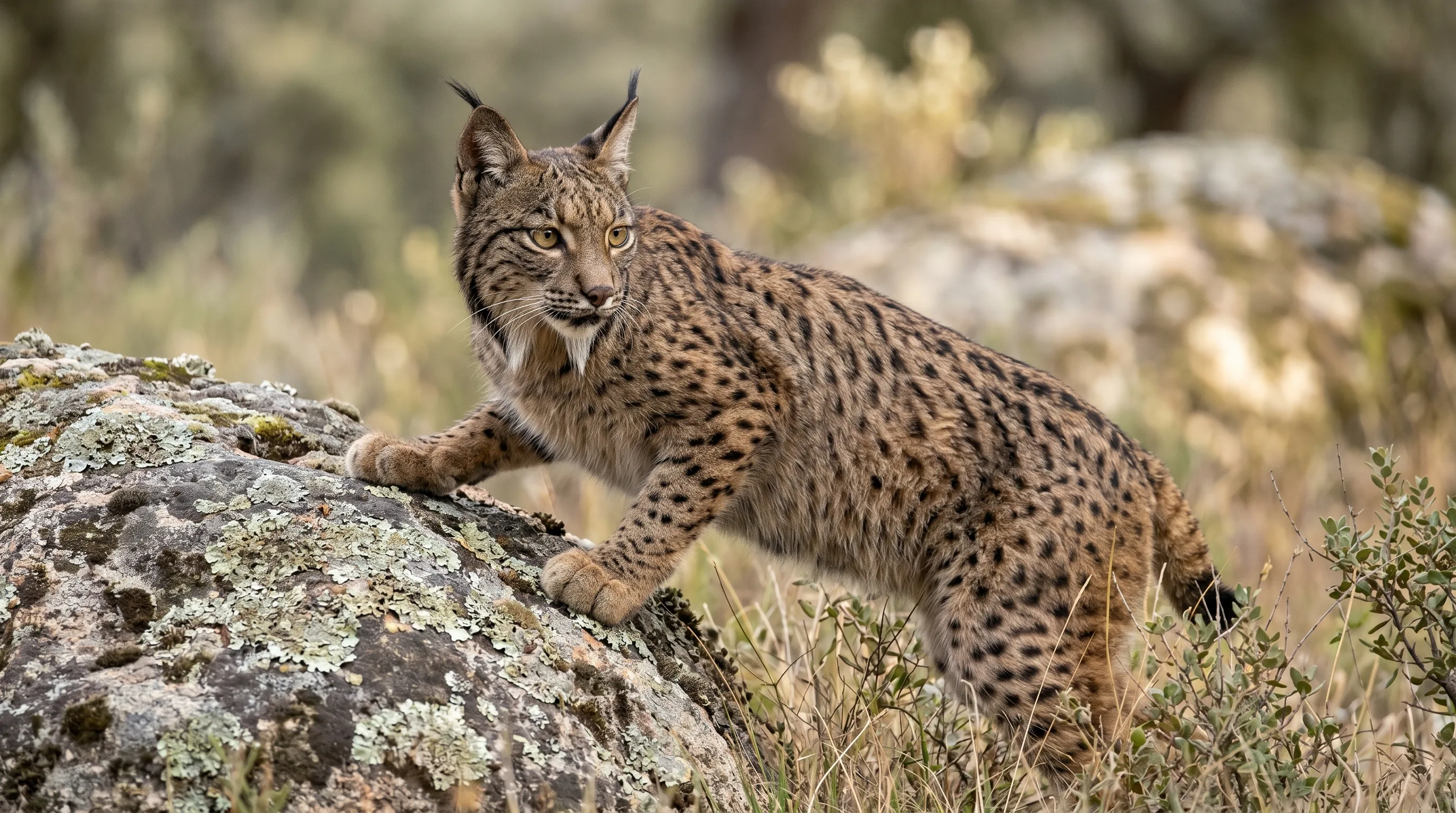
 Lynx pardinus)">
Iberian Lynx (Lynx pardinus)
the species remains classified as Vulnerable and continues to depend on active management to sustain its recovery trajectory.
Where does the Iberian lynx live?
The Iberian lynx is endemic to the Iberian Peninsula and inhabits Mediterranean scrubland ecosystems characterised by dense cistus, rosemary, and lavender scrub interspersed with cork oak woodland, stone pine forest, and open grassland patches. Key populations are established in Andalusia, Extremadura, Castilla-La Mancha, and Murcia in Spain, as well as in the Guadiana Valley region of Portugal — the species' first confirmed return to Portuguese territory in decades.
The species requires structurally heterogeneous habitat mosaics with high European rabbit densities to survive and reproduce. A landscape that offers only dense scrub without open hunting areas, or open terrain without sheltering cover, will not sustain a resident lynx population regardless of how large or legally protected it is.
Is the Iberian lynx dangerous to humans?
The Iberian lynx poses no meaningful threat to human safety. Like virtually all wild felids, it actively avoids human contact wherever possible and will not approach people voluntarily under normal circumstances. There are no documented cases of Iberian lynxes attacking humans in the wild.
The species' body size — typically between 9 and 15 kilograms — combined with its shy, solitary temperament and deep wariness of human presence make conflict with people exceptionally rare. In the context of lynx-human interactions, the lynx is invariably the vulnerable party, most frequently killed through road collisions and illegal trapping rather than any form of aggressive contact.
Why was the Iberian lynx so close to extinction?
The near-extinction of the Iberian lynx resulted from several compounding pressures operating simultaneously over decades. Large-scale conversion of Mediterranean scrubland to olive plantations, cereal agriculture, and eucalyptus monocultures removed the habitat the species requires. The introduction of myxomatosis in the 1950s, followed by Rabbit Haemorrhagic Disease from the late 1980s onward, devastated European rabbit populations across the Iberian Peninsula, collapsing the lynx's prey base over enormous areas. Road construction fragmented remaining populations and caused direct mortality, while decades of active persecution through trapping and shooting removed individuals faster than reproduction could replace them.
No single one of these pressures alone would necessarily have driven the species to the brink. Their combination, operating simultaneously and reinforcing each other across the entire range, produced a population decline that compressed one of Europe's most distinctive wild cats into two tiny, isolated scraps of habitat by the turn of the twenty-first century.
What is the IUCN Red List status of the Iberian lynx?
The Iberian lynx is currently classified as Vulnerable (VU) on the IUCN Red List of Threatened Species, following a 2024 reassessment that downlisted the species from its previous Endangered (EN) status. Before 2015, it was listed as Critically Endangered — the highest threat category before Extinct in the Wild — making the current Vulnerable classification the product of more than two decades of intensive conservation effort.
Vulnerable status means the species still faces a high risk of extinction in the wild if the conditions threatening its survival continue unabated. The classification reflects ongoing habitat fragmentation, prey instability, small total population size relative to historical levels, and the species' continued dependence on active human management rather than entirely self-sustaining wild population dynamics.
How long do Iberian lynxes live?
In the wild, Iberian lynxes typically live between 10 and 13 years, though individuals in high-quality territories with abundant prey and low road mortality risk have been recorded surviving beyond 15 years. The most dangerous phase of life is the dispersal period at 18–24 months of age, when young animals crossing unfamiliar terrain to find territories face significantly elevated risks from roads, established adults defending territories, and prey scarcity in degraded habitat patches.
In captivity, where disease, road mortality, and prey shortages are absent, individuals have lived into their mid-teens and occasionally beyond. Captive longevity data from the breeding programme has been useful in understanding reproductive potential across the full lifespan of the species, informing decisions about the most productive breeding age ranges for ex-situ management.
Do Iberian lynxes live in groups?
No. The Iberian lynx is fundamentally solitary. Adults maintain exclusive territories defended against same-sex conspecifics through scent marking, vocalisation, and occasionally direct confrontation. Males and females interact primarily during the brief mating season in January and February; outside this window, their contact is limited to the spatial overlap of territorial scent marks at shared boundaries.
The only prolonged social grouping in the species is the family unit of a mother and her cubs, which remains intact for up to 20 months before dispersal. Even within this unit, the relationship is asymmetrical and goal-oriented: the mother teaches, the cubs learn, and independence is the endpoint toward which the entire association moves from the first weeks of life.
Can the Iberian lynx interbreed with the Eurasian lynx?
The two species do not overlap geographically in the wild, and natural interbreeding therefore does not occur. In the early 2000s, when the Iberian lynx population was at its lowest ebb, a proposal to supplement the population with Eurasian lynx individuals was debated among conservationists and ultimately rejected. The scientific consensus held that genetic hybridisation would compromise the unique evolutionary identity of Lynx pardinus — a lineage that has evolved separately from its Eurasian relative for approximately two million years.
While the two species are closely enough related that hybridisation might be physically possible under artificial conditions, the ecological, behavioural, and genetic distinctiveness of the Iberian lynx is itself a conservation value. The goal of the recovery programme has always been to preserve and restore Lynx pardinus specifically, not to produce a hybrid population that would blur two irreplaceable evolutionary lineages.
What role does the European rabbit play in Iberian lynx conservation?
The European rabbit is not merely the lynx's primary food source — it is the ecological foundation on which the entire Iberian lynx conservation programme rests. Without sufficient rabbit density across reintroduction and core habitat areas, lynx reproduction fails, body condition deteriorates, and territorial behaviour breaks down as individuals range more widely in search of food, increasing exposure to roads and human infrastructure.
Rabbit population management is therefore an active and resource-intensive component of lynx conservation. This includes warren construction and enhancement, targeted food provisioning during disease outbreaks, and vaccination programmes against Rabbit Haemorrhagic Disease. In practical terms, conserving the Iberian lynx means conserving the rabbit first — a reality that has fundamentally shaped how the entire recovery programme is designed and funded.
Sources & Attribution
Data and ongoing research referenced for this article come from the following authoritative sources — peer-reviewed publishers, official taxonomic registers, and global biodiversity programmes:
- IUCN Red List — Iberian Lynx — official IUCN Red List assessment including population trend, threats, and conservation actions.
- Wikipedia — Iberian Lynx — taxonomy, distribution, and an overview with onward citations to primary literature.
- GBIF — Iberian Lynx — global occurrence and distribution records from the Global Biodiversity Information Facility.
- iNaturalist — Iberian Lynx — observation records and field photographs contributed by naturalists worldwide.
- Encyclopedia of Life — Iberian Lynx — multilingual species pages aggregating taxonomic and natural-history data.
- WWF — World Wildlife Fund — global wildlife conservation programmes and research summaries.
- Nature — research on Iberian Lynx — peer-reviewed studies indexed by Nature on related ecology and behaviour.
- ITIS — Integrated Taxonomic Information System — federal-grade taxonomy and nomenclature.
Image: Wikipedia/Wikimedia Commons — “Iberian lynx”
Comments
Post a Comment