
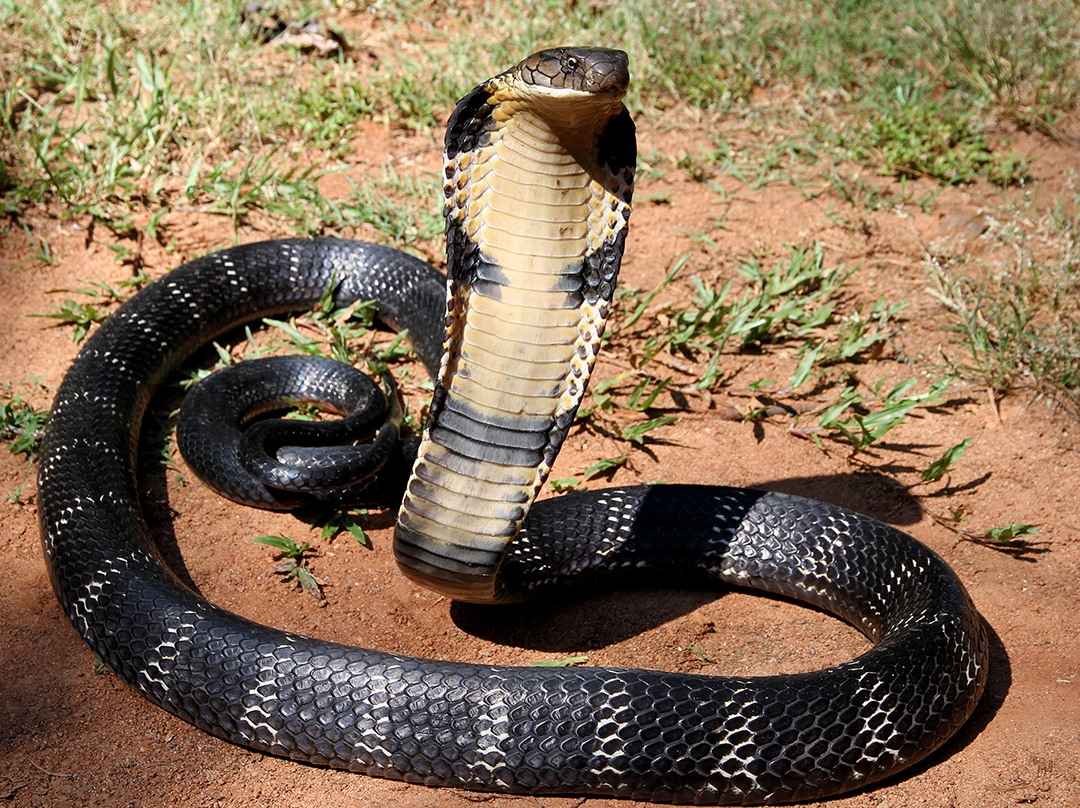
King Cobra (Ophiophagus hannah)

Introduction
Introduction
The forest floor is silent, dappled with shifting light that filters through a canopy of dense tropical trees somewhere in the foothills of the Western Ghats. A rustle moves through the leaf litter — deliberate, measured, unmistakably purposeful. Then it emerges: a serpent of extraordinary length and bearing, its olive-brown scales catching the morning light with an almost metallic sheen. The King Cobra raises its head, spreads its iconic hood, and surveys the world from a height that few snakes on Earth can claim. At over four metres long and weighing more than six kilograms, this animal does not simply inhabit the forest. It commands it.
The King Cobra, Ophiophagus hannah, is the longest venomous snake alive today. Yet its reputation as a merciless predator barely scratches the surface of what this animal truly is. It is a dedicated parent in a family where parental care is almost unheard of. It is an intelligent, observant hunter whose diet is composed almost entirely of other snakes — including highly venomous species that would be lethal to most other predators. It is a creature that has occupied tropical Asia's dense forests for millions of years, playing an ecological role so specific and so significant that its absence would cascade through entire food webs.
This article examines the King Cobra in full — its biology, behaviour, ecological function, and the forces now threatening its survival. From the biomechanics of its venom delivery to the architecture of its nesting behaviour, from the complexity of its predator-prey relationships to the cultural weight it carries in the societies of South and Southeast Asia, the King Cobra is a species that deserves analysis far beyond the fear it so readily inspires.
"The more clearly we can focus our attention on the wonders and realities of the universe about us, the less taste we shall have for destruction."
— Rachel Carson

Scientific Classification
Scientific Classification
Kingdom: Animalia
Phylum: Chordata
Class: Reptilia
Order: Squamata
Suborder: Serpentes
Family: Elapidae
Genus: Ophiophagus
Species: Ophiophagus hannah
Common Name: King Cobra
First Described: Cantor, 1836
The King Cobra holds a unique taxonomic position within the family Elapidae — the family that also includes mambas, taipans, and true cobras. Unlike the roughly 30 species of "true cobras" belonging to the genus Naja, the King Cobra stands alone as the sole member of the genus Ophiophagus. The genus name translates from Greek as "snake-eater," a direct reference to its ophiophagous diet. This singular classification reflects not merely its size but its profound biological distinctiveness from all other venomous snakes.
Molecular phylogenetic studies have confirmed that Ophiophagus diverged from other elapid lineages approximately 30 to 35 million years ago, making it an ancient lineage with deep evolutionary roots in Asia. Recent research has suggested that what we currently recognise as a single species may in fact represent a complex of several distinct cryptic species across its range, with populations in the Western Ghats of India, the islands of Southeast Asia, and mainland Asia showing significant genetic divergence.

Physical Characteristics
Physical Characteristics
The King Cobra is, by every measurable standard, an animal built for dominance. The average adult reaches lengths of 3.5 to 4 metres, though exceptional individuals exceeding 5.5 metres have been documented — the longest confirmed specimen, recorded in 1937 at the London Zoo, measured 5.71 metres. Body mass typically ranges from 6 to 9 kilograms in mature adults, though large males occasionally exceed 12 kilograms. Despite this weight, the King Cobra's body is streamlined and muscular, capable of moving with surprising speed and fluidity across varied terrain.
Colouration varies considerably across the species' geographic range. Indian populations tend toward olive-green or yellowish-brown tones with faint yellowish crossbands that are more pronounced in juveniles. Southeast Asian populations often display darker colouration, sometimes approaching deep olive-black. The ventral surface is typically pale yellow or cream, occasionally marked with black bars. Juvenile King Cobras are strikingly patterned in glossy black with narrow yellow or white crossbands and yellow chevrons on the head — a dramatically different appearance that has historically caused taxonomic confusion.
The iconic hood is formed by elongated ribs and flexible skin that the snake spreads laterally when threatened or displaying. Unlike the hood of Naja cobras, which often carries spectacle or eye markings on the dorsal surface, the King Cobra's hood is plain, its authority derived from sheer scale and the low, resonant growl it produces — a feature we will examine further in the behaviour section.
The head is large and distinctive, with a pair of large fixed fangs at the front of the upper jaw measuring approximately 8 to 10 millimetres in length. Behind these front fangs are three to five smaller teeth. The eyes are round with a dark iris, and the tongue — perpetually flickering — functions as the primary chemosensory organ, picking up volatile molecules from the air and delivering them to the Jacobson's organ in the roof of the mouth.
Characteristic | King Cobra | Indian Cobra (Naja naja) | Black Mamba (Dendroaspis polylepis) |
|---|---|---|---|
Maximum length | 5.7 m | 2.2 m | 4.5 m |
Venom type | Predominantly neurotoxic | Neurotoxic + cytotoxic | Predominantly neurotoxic |
Venom yield per bite | 200–500 mg | 170–250 mg | 100–120 mg |
Hood | Yes (narrow, plain) | Yes (wide, spectacled) | No |
Parental care | Yes (nest building) | No | No |
Primary diet | Snakes | Rodents, frogs, lizards | Small mammals, birds |

Habitat & Geographic Distribution
Habitat & Geographic Distribution
The King Cobra's range spans a broad arc across South and Southeast Asia, from the foothills of the Himalayas in India and Nepal, through Bangladesh, Myanmar, Thailand, Laos, Cambodia, Vietnam, southern China, Malaysia, Indonesia, and into the Philippines. Within this geographic expanse, the species shows clear habitat preferences centred on dense, humid forest environments.
Primary habitat includes tropical and subtropical moist broadleaf forests, bamboo thickets, forest edge habitats, and areas near permanent water sources such as streams, rivers, and lakes. The King Cobra is frequently found in hilly terrain, particularly in areas where dense undergrowth provides both cover for hunting and suitable nesting material. Elevation ranges from sea level up to approximately 2,000 metres in the Himalayan foothills, though core populations are concentrated below 1,000 metres.
The species shows remarkable adaptability across its range. In India, significant populations persist in the Western Ghats — a biodiversity hotspot with high levels of endemic species — and in the forests of the Andaman and Nicobar Islands. In Southeast Asia, populations inhabit not only primary forest but also secondary growth, plantations, and forest margins that border agricultural land, though these edge habitats carry significantly higher human-conflict risks.
Unlike many habitat specialists, the King Cobra is not strictly confined to pristine primary forest, though habitat quality directly influences population density and reproductive success. Water proximity is particularly important: King Cobras are competent swimmers and will readily enter rivers and streams to cross terrain, hunt, or escape threats. During monsoon seasons across much of the Indian subcontinent, rising water levels can temporarily displace snakes, driving them into human-dominated landscapes and increasing conflict encounters.
Fun FactThe King Cobra is one of the very few snakes in the world that builds a nest for its eggs. The female uses her coils and body movements to gather and arrange leaves and forest debris into a structured mound that can stand 30 to 50 centimetres tall.

Behaviour & Social Structure
Behaviour & Social Structure
The King Cobra is fundamentally a solitary animal. Unlike many social vertebrates, it does not form structured groups, maintain long-term partnerships outside the breeding season, or engage in cooperative behaviour. Each individual occupies a home range that it moves through systematically, guided by chemosensory information about prey availability, environmental conditions, and the presence of other snakes.
Home range sizes vary considerably with habitat quality and prey abundance. Studies using radio-telemetry in India and Thailand have tracked adult King Cobras moving across areas ranging from approximately 2 to 10 square kilometres. Males tend to have larger home ranges than females, particularly during the breeding season when they actively search for mates. Individual King Cobras show a degree of site fidelity, returning to familiar areas, water sources, and shelter sites repeatedly over months and even years.
Communication in King Cobras relies primarily on chemosensory and visual signals. The tongue delivers chemical information from the environment to the Jacobson's organ, allowing individuals to detect the scent trails of other snakes, identify conspecifics, and assess the reproductive status of potential mates. Visual communication centres on the hood display — a dramatic postural signal used to intimidate threats, with the anterior third of the body raised vertically and the hood spread to maximum width. This posture makes the animal appear substantially larger and is frequently accompanied by the distinctive low-frequency growl produced by modified tracheal lung tissue.
That growl deserves particular attention. While many snake species produce hissing sounds by forcing air through a narrow glottis, the King Cobra's vocalisation is genuinely different — deeper, more resonant, and sustained in a way that resembles a warning rumble rather than a hiss. Research has shown that the frequency of this sound is approximately 600 Hz, well below that of most snake sounds, and appears to function as an honest signal of the animal's size and defensive potential. Predators and humans alike find the combination of raised hood, direct gaze, and growl profoundly unsettling — which is precisely its evolutionary purpose.
Despite its formidable reputation, the King Cobra displays a complex behavioural repertoire that includes clear escape preferences over confrontation. When encountered at a safe distance, the snake almost invariably attempts to withdraw before escalating to defensive display. Strikes at humans are predominantly defensive responses to close-range surprise or direct physical threat, not predatory attacks. Several field researchers have reported King Cobras that were repeatedly approached during ongoing studies retreating consistently rather than displaying aggression — a pattern that speaks to an animal capable of behavioural assessment rather than reflexive aggression.

Daily Life & Activity Cycle
Daily Life & Activity Cycle
The King Cobra is primarily diurnal, conducting most of its active behaviour during daylight hours. As an ectotherm, its activity patterns are strongly shaped by thermal conditions: mornings typically begin with basking to raise body temperature to the optimal active range of approximately 25 to 32 degrees Celsius, after which the snake becomes highly mobile and begins active foraging behaviour.
During the hottest midday hours, particularly in lowland tropical environments where temperatures can exceed 38 degrees Celsius, King Cobras seek shade and reduce movement, resuming activity in the cooler late afternoon. In cooler highland habitats, active periods may extend more uniformly through the day. Nighttime activity is limited but not absent — individuals have been documented moving after dark, particularly during the warmer months of the breeding season.
Seasonal behaviour shifts markedly across the King Cobra's range. In strongly seasonal environments influenced by the monsoon cycle, the coolest months (November through February across much of India) are associated with reduced activity, limited foraging, and extended periods of inactivity in sheltered retreats. True hibernation does not occur — King Cobras in tropical environments remain capable of activity year-round — but in highland populations, prolonged cold periods can induce brumation-like states lasting several weeks.
Movement patterns during the breeding season, which peaks between January and April across much of the range, are dramatically different from baseline behaviour. Males become highly mobile, covering substantial ground in search of females detected through chemical cues. During this period, males may engage in extended combat rituals with rival males — a spectacular behaviour in which two large King Cobras entwine their forebody sections and attempt to press each other's head to the ground in a test of strength and leverage. These bouts rarely involve biting and appear to be ritualised assessments of relative fighting ability.

Diet & Survival Strategies
Diet & Survival Strategies
The King Cobra's dietary specialisation is one of the most extraordinary features of its biology. The genus name Ophiophagus — snake-eater — defines the animal's ecological niche precisely. While the King Cobra will occasionally consume monitor lizards, small mammals, and even birds, the overwhelming majority of its diet consists of other snakes, including highly venomous species such as kraits (Bungarus spp.), rat snakes (Ptyas spp.), Burmese pythons, and even other King Cobras.
This dietary choice creates a fascinating immunological challenge. The King Cobra requires partial resistance to the venom of the snakes it consumes — and research has confirmed that it does possess elevated serum resistance to several elapid venoms, though this resistance is not absolute. A King Cobra bitten by a large krait or another venomous species can still be killed, meaning that hunting venomous prey carries genuine risk. The snake manages this risk through a combination of attack speed, strike precision, and its own substantial venom delivery capability.
The hunting sequence is a masterclass in sensory integration and patience. A King Cobra locates prey primarily through tongue-flicking, reading the chemical landscape of its habitat with extraordinary sensitivity. Rat snakes and pythons leave distinct chemical trails through the forest floor; the King Cobra follows these trails with methodical persistence, sometimes tracking prey over dozens of metres. When prey is located visually, the King Cobra adopts a rigid, low-profile stalking posture, advancing slowly with its head close to the ground before striking with remarkable speed.
The strike itself delivers venom through the paired front fangs in a stabbing motion, with the King Cobra often maintaining its bite hold on the prey — a behaviour distinct from pit vipers that strike and release. This holding behaviour ensures deep venom injection and prevents prey escape. King Cobra venom is predominantly neurotoxic, containing both postsynaptic neurotoxins (blocking acetylcholine receptors at neuromuscular junctions) and presynaptic phospholipase A2 toxins that destroy nerve terminals. In snakes, this venom acts with remarkable speed — a large rat snake can be immobilised within seconds and dead within minutes.
Fun FactA single King Cobra bite can deliver up to 500 milligrams of venom — enough to kill an Asian elephant, or twenty adult humans. Despite this, the King Cobra's venom is not the most toxic of any snake by concentration; its lethality derives from the sheer volume delivered.
Food scarcity poses a particular challenge for an apex ophiophagous predator. Snake populations in tropical forests can be locally patchy, and the King Cobra's metabolic efficiency as an ectotherm partially buffers against periods of food shortage. A well-fed adult King Cobra may require only one substantial meal every few weeks. Studies have documented individuals fasting for three months or longer without apparent health decline. When prey abundance drops, King Cobras expand their home ranges and increase movement rates, essentially scaling up their search effort rather than compromising on dietary selectivity.
In the Agumbe rainforest of Karnataka, India, a large male King Cobra — tracked by researchers from the Agumbe Rainforest Research Station — had spent the morning motionless beneath the root buttress of a massive fig tree. His tongue flickered at intervals measured in minutes rather than seconds. Then something changed: a rat snake, nearly two metres long, moved through the undergrowth twenty metres distant, following a fallen log toward the stream below.
The King Cobra's entire demeanour shifted without a single dramatic movement. His body began to uncoil with glacial deliberateness, aligning itself along the trajectory of the approaching rat snake. His head, pressed close to the forest floor, became motionless — a fixed point in a world of moving leaf litter. The rat snake continued its course, oblivious to the architecture of ambush being assembled ahead of it.
The strike, when it came, lasted approximately 0.1 seconds. The King Cobra held the rat snake's anterior region in a sustained bite, venom flowing for three to four seconds. The prey's muscular contractions slowed and then stopped within two minutes. The King Cobra began the process of swallowing — always head-first, always methodical — and was finished within forty minutes. He then moved directly to the stream, drank, and retreated to shade for the remainder of the afternoon.
The researchers noted that the King Cobra had not been moving randomly. Chemical analysis of the forest floor later confirmed a clear rat snake scent trail running directly through the ambush site. The King Cobra had positioned himself precisely along a route of maximum probability — a calculation that speaks to a level of environmental reading that we are only beginning to appreciate in reptiles.

Interaction with Other Animals
Interaction with Other Animals
As an apex predator within the reptile community, the King Cobra interacts with the broader forest fauna in layered and ecologically significant ways. Its predator-prey relationships extend across multiple trophic levels, influencing the population dynamics of a wide range of snake species and, through them, the prey communities that those snakes themselves regulate.
The King Cobra's relationship with other venomous snakes is among the most specialised predator-prey dynamics in the herpetological world. Encounters with kraits — nocturnal, highly venomous snakes that occupy similar forest habitats — represent both a dietary opportunity and a genuine risk. Adult King Cobras have been documented consuming large kraits, but juvenile King Cobras are potentially vulnerable to krait predation in return. The chemical recognition of krait scent trails appears to trigger particular alertness in King Cobras, suggesting that the interaction carries long evolutionary history on both sides.
Monitor lizards (Varanus spp.) present a complex interactive relationship with King Cobras. Adult monitors are large, powerful reptiles capable of inflicting serious injury on snakes, but juvenile monitors are known prey items of King Cobras. Adult monitors, conversely, have been documented raiding King Cobra nests to consume eggs — a specific threat that contributes significantly to nest-guarding behaviour in female King Cobras during the incubation period.
Birds of prey, particularly large raptors such as the Crested Serpent Eagle (Spilornis cheela), are documented predators of juvenile and subadult King Cobras. The serpent eagle's specialisation in snake prey means that it is one of the few aerial predators capable of successfully attacking a young King Cobra. Adult King Cobras are rarely threatened by raptors due to their size, defensive capability, and the neurotoxic consequences of a defensive bite to a bird.
Mongooses, celebrated in popular culture as snake killers, represent a predator that adult King Cobras seldom need to fear. While mongooses do prey on many snake species and possess some acetylcholine receptor modifications that confer partial venom resistance, large adult King Cobras are more than capable of killing a mongoose. Observations of mongoose-King Cobra encounters suggest that adult mongooses typically retreat from large King Cobras, reserving predation attempts for smaller, younger individuals.

Interaction with Environment
Interaction with Environment
The King Cobra's relationship with its forest environment is shaped by a combination of physiological requirements and the ecological architecture of its prey communities. As an ectotherm, the snake is acutely dependent on the thermal properties of its habitat: dense forest canopy moderates temperature extremes, maintaining a relatively stable thermal environment that allows the King Cobra to remain active across a broader portion of the day than would be possible in open habitats.
Water availability is a critical environmental factor. King Cobras are closely associated with streams, rivers, and wetlands throughout their range. Research in the Western Ghats has shown that individuals rarely move more than a kilometre from permanent water sources during dry seasons, contracting their activity ranges around these refugia as the landscape dries. During monsoon periods, the expansion of available water bodies temporarily opens up habitat, and snakes move across wider areas, following the availability of prey driven through the forest by seasonal flooding.
Leaf litter depth and forest floor structure influence the King Cobra's hunting effectiveness. Dense, deep leaf litter supports the populations of rodents, frogs, and lizards that in turn support the rat snake and krait populations that are the King Cobra's primary prey. Forests degraded by selective logging or invasive plant species show altered leaf litter dynamics that reduce prey availability across multiple trophic levels — a cascade that ultimately reduces the habitat's carrying capacity for King Cobras.
The King Cobra's nest-building behaviour creates a direct physical impact on its immediate environment. During nesting, females gather and compress substantial volumes of leaf litter into mound structures that can persist for the two to three months of incubation. The decomposition activity within the nest mound generates heat through microbial action, raising nest temperatures above ambient — a passive thermal regulation strategy that accelerates embryo development. This interaction between a reptile's nesting behaviour and microbiological decomposition processes represents a genuine ecological feedback loop, with the King Cobra functioning as a subtle modifier of its forest floor environment.

Reproduction & Parenting
Reproduction & Parenting
King Cobra reproduction stands as one of the most remarkable aspects of the species' biology, distinguished by a level of parental investment that is virtually unique among snakes and exceptional within the broader context of reptile reproduction. The breeding season typically begins between January and March, triggered by cooling temperatures and reduced rainfall across much of the range, and involves a complex sequence of behaviours that begins with male competition.
Male combat in King Cobras is a ritualised but physically demanding affair. When two males detect each other's chemical trail, they follow it to a face-to-face encounter, raise the foreparts of their bodies, and attempt to press each other's head downward in a wrestling contest. These bouts can last from several minutes to over an hour, and the losing individual retreats while the victor continues to search for the female whose chemical scent trail triggered the interaction. Biting during male combat is rare — the contest is one of strength and persistence rather than aggression, and the cost of injury to both parties from the king cobra's neurotoxic venom would be prohibitive.
Courtship involves extended chemical investigation, with the male following the female closely, tongue-flicking her body repeatedly, and eventually aligning his body alongside hers. Copulation can last from several hours to over a day, during which both individuals remain largely stationary. The female stores sperm and fertilisation occurs internally.
Nest construction begins approximately one month before egg-laying. The female selects a site with specific characteristics: partial shade, proximity to a water source, and a substrate that supports decomposition. She uses her body coils to gather vegetation, bamboo leaves, and forest debris, gradually building a mound approximately 30 to 50 centimetres high and up to a metre in diameter. The mound is structured in two chambers — a lower incubation chamber where eggs are laid, and an upper chamber where the female rests during the incubation period.
Clutch sizes range from 20 to 50 eggs, with average clutches of approximately 25 to 30 eggs. The female remains coiled on or near the nest throughout the 60 to 80 day incubation period, defending it actively against all intruders. This is where the King Cobra's reputation for aggression is most thoroughly earned: a nesting female will attack humans, monitor lizards, large mammals, and any other perceived threat without hesitation. The defensive posture adopted during nest guarding is maximally threat-displaying — full hood spread, raised forebody, vocalisation — and will escalate to immediate strikes if the intruder persists.
Remarkably, the female abandons the nest shortly before the eggs begin to hatch — approximately one to two weeks before hatching, when she presumably detects chemical changes in the nest indicating imminent hatching. This departure prevents her from consuming the hatchlings, which she would otherwise recognise as prey through the same chemical cues she uses for foraging. Hatchlings emerge at approximately 45 to 55 centimetres in length, fully venomous and immediately independent. Juvenile survival rates are low, with predation from raptors, monitors, and other snakes exerting significant mortality pressure in the first year.

Evolutionary Adaptations
Evolutionary Adaptations
The evolutionary history of Ophiophagus hannah has produced a suite of adaptations that make it one of the most specialised and effective predators in the reptile world. These adaptations span multiple biological systems — venom biochemistry, sensory physiology, thermoregulation, and behaviour — and reflect tens of millions of years of selective pressure in the complex ecological theatre of Asian tropical forests.
The venom system of the King Cobra represents a particularly sophisticated evolutionary solution to the challenge of subduing large, muscular snake prey. The venom contains a mixture of three-finger toxins (3FTx) including alpha-neurotoxins that block postsynaptic nicotinic acetylcholine receptors, and phospholipase A2 (PLA2) presynaptic neurotoxins that destroy presynaptic nerve terminals at neuromuscular junctions, preventing the release of acetylcholine. This dual-action neurotoxic system produces rapid, progressive paralysis in prey. Ophiophagus venom also contains unique peptides called ohanin, which produce hyperalgesia (increased pain sensitivity) in mammals, and King Cobra-specific cytotoxins that contribute to local tissue damage.
Perhaps the most extraordinary venom adaptation is the partial immunity the King Cobra has evolved to its own venom. Serum proteins in King Cobra blood, including haemachatus protein analogues, bind to certain venom components and reduce their systemic effect. This self-resistance is not absolute — a King Cobra can be killed by a large enough dose of its own venom — but it provides a meaningful buffer against accidental self-envenomation during prey capture, particularly when handling venomous prey that may defensively bite.
The chemosensory system of the King Cobra has evolved to exceptional sensitivity for detecting snake-specific chemical signals. Research has shown that the Jacobson's organ receptor proteins in King Cobras show particular responsiveness to squalene and certain lipid compounds found in the skin secretions of other snakes — compounds that are absent or present only in low concentrations in the skin of mammals and birds. This chemosensory specialisation is the foundation of the King Cobra's ophiophagous lifestyle, allowing it to track snake prey across the complex chemical environment of a tropical forest floor.
The low-frequency growl produced by the King Cobra is generated by a tracheal lung modification unique among snakes. Modified tracheal tissue acts as a resonating chamber, producing sounds in the range of 600 to 2,500 Hz — well within the low frequency range that carries effectively through dense forest vegetation and is more likely to be detected by the low-frequency hearing capabilities of large mammalian predators. This is a genuine acoustic adaptation for threat communication.

Ecological Importance
Ecological Importance
The King Cobra occupies a position of profound ecological significance that extends far beyond its status as an apex predator. As the primary regulatory force on snake populations across its range, it functions as a top-down controller of secondary and tertiary predator communities — a role with cascading consequences through entire forest food webs.
Snake species that the King Cobra preys upon — rat snakes, pythons, and kraits — are themselves significant predators of rodents, birds, frogs, and lizards. By regulating the populations of these mid-level predators, the King Cobra indirectly influences the abundance and behaviour of the prey communities that those snakes consume. The removal of King Cobras from an ecosystem does not simply leave a predator vacancy at the top of the reptile food web; it triggers a sequence of population responses that percolates downward through multiple trophic levels.
In agricultural landscapes at the forest edge, this regulatory function has direct economic significance. Rat snakes and pythons consume the rodents that damage crops and stored grain. A robust King Cobra population maintains rat snake and python populations, which in turn suppress rodent numbers. The degradation of King Cobra populations through habitat loss and persecution therefore contributes, counterintuitively, to increased rodent damage in agricultural communities near forest margins.
The King Cobra also contributes to the cycling of energy and nutrients through the forest ecosystem. As an ectotherm, its metabolic rate is considerably lower than that of a comparable mammalian predator, meaning that it converts a high proportion of ingested energy into growth rather than metabolic heat. Large snakes consumed by the King Cobra are rapidly digested and nutrients returned to the system through waste deposition, while the King Cobra itself becomes a prey item for its own predators upon death, contributing biomass to scavengers and decomposers.
Fun FactThe King Cobra is one of only two snake species in the world known to build a nest for its eggs — the other being the African rock python. This behaviour, rare enough to be notable in any reptile, reflects a level of reproductive investment that places the King Cobra in exceptional company among cold-blooded vertebrates.

Threats & Conservation
Threats & Conservation
The King Cobra faces a convergence of threats that, taken individually, would be serious concerns; taken together, they represent an accelerating crisis for populations across much of the species' range. Habitat destruction is the primary driver of population decline, operating through both direct loss of forest cover and the fragmentation of remaining habitat into isolated patches that cannot sustain viable breeding populations.
Deforestation rates across Southeast Asia remain among the highest in the world. In countries such as Indonesia, Malaysia, Vietnam, and the Philippines, primary forest loss driven by palm oil agriculture, logging, and smallholder farming has eliminated vast areas of King Cobra habitat over the past four decades. In India, forest fragmentation in the Western Ghats — a globally recognised biodiversity hotspot — has created isolated forest patches surrounded by agricultural land, limiting dispersal between populations and creating genetic bottlenecks.
Direct persecution by humans represents a significant mortality driver. The King Cobra's large size and venomous nature make it a target for killing on sight across much of its range, regardless of legal protection status. In many rural communities, any large snake encountered near a village or agricultural field is killed immediately, with cultural fear and genuine safety concerns driving this response. King Cobras are also killed for their skin, meat, bile, and blood — which are used in traditional medicine systems across East and Southeast Asia — and for the international exotic pet trade.
Road mortality has emerged as an increasingly significant threat as road networks expand into previously remote forest areas. King Cobras, which move across substantial areas and regularly cross open ground, are vulnerable to vehicle strikes, particularly when thermoregulating on road surfaces during cooler periods. In areas where roads bisect continuous forest, road mortality can function as a significant population sink for local King Cobra populations.
The IUCN has assessed the King Cobra as Vulnerable, reflecting real and ongoing population declines across multiple parts of its range. Detailed discussion of conservation status, population trends, and ongoing conservation efforts follows in the next section.

IUCN Red List Analysis
IUCN Red List Analysis
Current IUCN Status
The King Cobra (Ophiophagus hannah) is currently listed as Vulnerable (VU) on the IUCN Red List, assessed under criterion A2cd. The Vulnerable classification indicates that the species faces a high risk of extinction in the wild, with population reductions of at least 30 percent projected over a ten-year period or three generations. The A2cd designation specifies that this decline is inferred from observed reduction in the extent of occurrence (criterion c) and actual and potential levels of exploitation (criterion d).
This listing reflects a scientific consensus that while the King Cobra remains present across a broad geographic range, population densities have declined significantly in most parts of that range, and the threats driving those declines are ongoing and, in many areas, intensifying. The Vulnerable listing is not a declaration that the species is on the immediate brink of extinction, but a formal recognition that current trajectory, if unchanged, leads toward significantly higher extinction risk categories.
Population Trend
The population trend for the King Cobra is assessed as decreasing across the species' range. Precise global population estimates are not available due to the cryptic nature of the species and the methodological challenges of surveying large, secretive snakes across vast tropical landscapes. However, field surveys, expert assessments, and occupancy modelling suggest that population densities have declined by 30 to 50 percent across large portions of the range over the past twenty years.
In Southeast Asia, population declines have been most severe in areas experiencing rapid deforestation. Surveys in Sumatra, Borneo, and parts of peninsular Malaysia have documented substantially reduced encounter rates compared to historical baselines. In India, the Western Ghats populations appear relatively more stable due to the protection afforded by several large national parks and wildlife sanctuaries, though connectivity between protected areas is limited and populations are increasingly isolated.
Some island populations, particularly in parts of the Philippines, show signs of particularly acute decline, with habitat loss and exploitation rates that local experts consider unsustainable for long-term population viability. China's southern populations have been heavily impacted by collection for traditional medicine markets, and remaining populations in Guangdong and Yunnan provinces are believed to be a fraction of historical abundances.
Main Threats
Habitat destruction and fragmentation is the primary threat to King Cobra populations globally. Conversion of tropical forest to oil palm plantations, rubber cultivation, rice paddies, and other agricultural uses eliminates the prey communities and structural habitat that King Cobras depend on. Even where patches of forest remain, fragmentation reduces landscape connectivity, preventing gene flow between populations and exposing dispersing individuals to increased road mortality and human persecution.
Exploitation for trade and traditional medicine represents a direct mortality driver of considerable scale. In China and Vietnam, King Cobra bile, blood, meat, and skin are used in traditional pharmacopoeia, and demand from these markets drives collection — both legal and illegal — across the species' range. The international exotic pet trade also contributes to collection pressure, particularly for juveniles and hatchlings, which are more easily captured and transported than adults.
Killing by humans, motivated by fear and safety concerns, occurs at a scale that is difficult to quantify but is believed to be substantial. In many rural communities across South and Southeast Asia, King Cobras encountered near human habitation are routinely killed, a practice that is deeply culturally embedded and not easily addressed through regulatory approaches alone.
Climate change poses longer-term structural threats to King Cobra populations. Shifts in monsoon rainfall patterns alter the water body dynamics that King Cobras depend on, while changes in temperature regimes affect the thermal suitability of habitats and the phenology of reproduction. Forest fire frequency is increasing in parts of Southeast Asia due to drying climate trends associated with El Niño events and regional deforestation, directly destroying habitat and killing individuals.
Ecological Consequences
The decline of the King Cobra carries ecological consequences that extend well beyond the loss of a single charismatic predator. As the primary predator regulating snake populations across its range, the removal or reduction of the King Cobra triggers a mesopredator release effect — the unchecked population growth of mid-level predators, particularly rat snakes and pythons, in the absence of top-down control.
In the short term, rat snake population increases driven by King Cobra decline may initially suppress rodent populations, creating a transient positive agricultural effect. However, the longer-term dynamics are more complex: without King Cobra regulation, rat snake populations can overshoot their prey base, leading to cyclic boom-bust population dynamics that destabilise rodent and bird communities alike. The loss of the King Cobra also removes a regulatory pressure on krait populations — a significant public health concern, since kraits are responsible for substantial numbers of snakebite deaths across South and Southeast Asia.
The loss of King Cobra nest structures from the forest floor eliminates a specific microhabitat that other forest floor species utilise. Decomposing nest mounds support communities of invertebrates that contribute to nutrient cycling, and the elevated temperature profiles of active nest mounds create thermal refugia used by smaller reptiles. These microhabitat contributions, while individually modest, represent a real component of the King Cobra's environmental footprint.
Conservation Efforts
Legal protection for the King Cobra exists across much of its range. In India, it is listed under Schedule II of the Wildlife Protection Act, 1972, prohibiting hunting, trade, and capture without special permit. It is listed in CITES Appendix II, meaning that international trade in King Cobras or their products requires documentation of legal acquisition and sustainability. Similar protections exist in Thailand, Vietnam, Indonesia, and the Philippines, though enforcement capacity varies enormously across these jurisdictions.
Protected areas represent the most important tool for King Cobra conservation in practice. Large, well-managed reserves such as the Agumbe Rainforest Research Station in Karnataka, India — where long-term King Cobra research has been conducted since the early 2000s — provide refugia for populations and generate the scientific knowledge base needed for evidence-based management. In Thailand, the King Cobra is a subject of active research and educational outreach programmes that work with local communities to reduce persecution.
Captive breeding programmes for King Cobras exist in several zoological institutions, and these programmes contribute to both conservation education and the maintenance of genetic insurance populations. However, captive breeding for wild release faces significant challenges related to the large home ranges, specialised prey requirements, and complex behavioural ecology of the species. Community-based conservation initiatives that directly engage rural communities in King Cobra protection — by demonstrating the economic and ecological value of living snakes through ecotourism or payment for ecosystem services frameworks — are increasingly recognised as important complements to formal legal protections.
Future Outlook
The future trajectory of the King Cobra population depends primarily on the rate at which tropical forest loss continues across South and Southeast Asia, and on the effectiveness of efforts to reduce exploitation and change human attitudes toward the species. Under current deforestation trends in key parts of its range, ongoing population decline is the most probable near-term trajectory, with the risk of future uplisting to Endangered if declines continue at their current pace.
Reasons for cautious optimism exist. The King Cobra's relatively broad geographic range means that it is unlikely to face rapid global extinction in the near term. Several stronghold populations in well-protected areas appear stable or even recovering. Growing scientific knowledge of the species' ecology, combined with increasing conservation awareness among regional governments and local communities, creates opportunities for more effective intervention than have been possible in previous decades.
The possibility that the King Cobra represents a complex of multiple cryptic species introduces additional conservation concern: if distinct genetic lineages exist within what is currently treated as a single species, some of these lineages — particularly island endemics with small geographic ranges — may face extinction risks far higher than the species aggregate assessment suggests. Resolving this taxonomic uncertainty through expanded genetic sampling is a priority conservation research need.

Human Relationship
Human Relationship
The relationship between humans and the King Cobra spans millennia and encompasses a spectrum from reverence to terror, from spiritual symbolism to deadly conflict. Across South and Southeast Asia, the King Cobra occupies a culturally central position that no other snake approaches in terms of depth of significance or breadth of representation.
In Hindu tradition, the King Cobra is closely associated with Lord Shiva, who is depicted wearing snakes — often interpreted as King Cobras — around his neck as symbols of death, transformation, and time's cyclical nature. The Nag Panchami festival, celebrated across India and Nepal, involves ritual worship of snakes including cobras, with milk offerings and prayers that reflect both reverence and a desire to propitiate potentially dangerous animals. In Buddhist iconography, the Naga — a divine serpent being based in part on the King Cobra — appears as a protective figure, most famously as the seven-headed serpent sheltering the meditating Buddha from a storm.
The art of snake charming, historically associated with itinerant performers in South Asia, has traditionally featured cobras as the central animals, though King Cobras have also been used in performances across Thailand, India, and Myanmar. This practice, which has declined significantly due to wildlife protection legislation, represents both cultural continuity and a complex welfare issue, as captive performance animals experience significant stress and are frequently subjected to defanging or venom removal procedures that compromise their health.
Human-King Cobra conflict is a genuine public safety issue in rural forest-edge communities across the species' range. Snakebite from King Cobras is rare compared to bites from more abundant species such as Russell's vipers and kraits, but when it does occur, the consequences can be severe. A full envenomation from a large King Cobra can cause death within fifteen minutes to one hour through respiratory failure driven by neuromuscular paralysis. Access to appropriate antivenom and supportive medical care is limited in many rural areas where conflicts are most likely to occur, meaning that King Cobra bites carry a higher case fatality rate in practice than their relatively uncommon occurrence might suggest.
Ecotourism centred on the King Cobra is emerging as an economic incentive for conservation in several locations. At Agumbe in Karnataka, India, the King Cobra has become a flagship species that attracts wildlife photographers, naturalists, and documentary filmmakers — generating revenue for local communities and creating economic arguments for forest protection that complement the ethical arguments. This transition from persecuted predator to tourism asset represents a critical shift in the human-King Cobra relationship in those communities where it has taken hold.
"Until we extend our circle of compassion to include all living things, humanity will not find peace."
— Albert Schweitzer

Unique & Rare Facts
Unique & Rare Facts
The only snake that builds a nest: The King Cobra is one of only two snake species in the world known to construct a nest for its eggs. The female actively gathers and arranges vegetation into a structured mound with distinct upper and lower chambers — a level of reproductive engineering unparalleled among snakes.
A predator of the world's most venomous snakes: The King Cobra regularly hunts and consumes kraits, which are among the most potently venomous snakes on Earth. It can detect, track, subdue, and swallow these animals that would be lethal to most other predators.
The only snake with a true growl: The King Cobra produces a low-frequency growl through a modified tracheal structure — a vocalisation type unique among snakes. The sound is fundamentally different from the hissing of other snake species and operates at frequencies more likely to be heard and responded to by large mammalian predators.
A possible species complex: Recent genetic research suggests that what is currently described as a single species, Ophiophagus hannah, may actually represent four or more distinct cryptic species, with populations in the Western Ghats, mainland Southeast Asia, the Malay Archipelago, and Luzon Island showing significant genetic divergence.
Self-generated nest heat: The King Cobra nest mound generates its own heat through the decomposition of leaf litter by microorganisms, raising internal nest temperatures 2 to 4 degrees above ambient. This thermal boost accelerates embryo development and represents a passive but effective form of incubation temperature control.
Longer than many pythons in some ranges: While pythons are generally considered the longest snakes, the King Cobra's maximum recorded length of 5.71 metres exceeds the typical maximum for several python species, including the Burmese python in many wild populations.
Maternal desertion as adaptive strategy: The female King Cobra abandons her nest approximately one week before hatching — a behaviour that prevents her from instinctively consuming her own offspring, which would register as prey through chemosensory detection. This paradoxical "desertion" is in fact a form of parental care.
Venom with a pain-amplifying protein: King Cobra venom contains ohanin, a protein that produces hyperalgesia — an amplified pain response — in mammals bitten by the snake. This compound, unique to King Cobra venom, has attracted pharmaceutical research interest as a potential model for novel pain pathway modulation compounds.
Environmental DNA detection: A recent advance in King Cobra monitoring involves detecting the species' presence through environmental DNA (eDNA) sampling of water bodies. Because King Cobras drink from and move through streams and pools, they deposit genetic material that can be detected and identified from water samples, allowing non-invasive population surveys in dense habitat.
One of the few reptiles demonstrating site fidelity across years: Radio-telemetry studies have documented individual King Cobras returning to the same nesting sites, basking spots, and water sources across multiple consecutive years — evidence of spatial memory and habitat learning that challenges the traditional view of reptile cognition as purely instinctive.

Conclusion
Conclusion
To reduce the King Cobra to a symbol of danger is to misrepresent one of the most complex, ecologically important, and biologically extraordinary animals alive on Earth today. This is a creature of exceptional intelligence by reptile standards — one that builds structures, guards its young, tracks prey across intricate chemical landscapes, and navigates the social complexities of competition, courtship, and territorial maintenance with a sophistication that continues to reveal new layers under scientific scrutiny.
The ecological function of Ophiophagus hannah reaches far beyond the forest floor where it hunts. Through its regulation of snake communities, it shapes the dynamics of rodent, bird, and amphibian populations. Through its nest-building behaviour, it modifies the physical and thermal properties of the forest floor. Through its presence alone, it exerts behavioural effects on the animals that must share its habitat. Remove the King Cobra from its ecosystem, and the reverberations reach further than most people would expect from a single species.
The forces bearing down on King Cobra populations — deforestation, exploitation, persecution, climate disruption — are not abstract future risks. They are active, present realities producing measurable population declines across significant portions of the species' range right now. The Vulnerable classification on the IUCN Red List is not alarmism; it is a calibrated scientific assessment of a trajectory that leads to significantly worse outcomes if the current direction is not changed.
There is something irreplaceable in the sight of a large King Cobra raised in the morning light of a tropical forest — the hood spread, the eyes attentive, the ancient body coiled in a posture that has not changed in its essentials for thirty million years. It is a living link to a biological past that shaped the ecosystems of an entire continent. Losing it would be an impoverishment not just of biodiversity statistics but of the living world's capacity to sustain itself — one less thread in a web that none of us can afford to see come apart.

Frequently Asked Questions
Sources & Attribution
Data and ongoing research referenced for this article come from the following authoritative sources — peer-reviewed publishers, official taxonomic registers, and global biodiversity programmes:
- IUCN Red List — King Cobra — official IUCN Red List assessment including population trend, threats, and conservation actions.
- Wikipedia — King Cobra — taxonomy, distribution, and an overview with onward citations to primary literature.
- GBIF — King Cobra — global occurrence and distribution records from the Global Biodiversity Information Facility.
- iNaturalist — King Cobra — observation records and field photographs contributed by naturalists worldwide.
- Encyclopedia of Life — King Cobra — multilingual species pages aggregating taxonomic and natural-history data.
- WWF — World Wildlife Fund — global wildlife conservation programmes and research summaries.
- Nature — research on King Cobra — peer-reviewed studies indexed by Nature on related ecology and behaviour.
- ITIS — Integrated Taxonomic Information System — federal-grade taxonomy and nomenclature.
Frequently Asked Questions
How long can a King Cobra grow?
The King Cobra is the longest venomous snake in the world. Adults typically reach 3.5 to 4 metres in length, though large individuals can exceed 5 metres. The longest reliably recorded specimen measured 5.71 metres and was kept at the London Zoo. This exceptional length distinguishes the King Cobra from all other venomous snakes, including the largest members of the genus Naja, which rarely exceed 2.5 metres.
What does the King Cobra eat?
The King Cobra feeds primarily on other snakes — a dietary specialisation reflected in its genus name, Ophiophagus, meaning "snake-eater." Common prey species include rat snakes, pythons, kraits, and occasionally other King Cobras. The species will also consume monitor lizards and occasionally small mammals or birds, but snakes make up the overwhelming majority of its diet across all studied populations.
This ophiophagous diet requires sophisticated chemosensory tracking abilities, as the King Cobra locates and follows scent trails left by other snakes across the forest floor before ambushing or pursuing prey.
Is the King Cobra the most venomous snake in the world?
No. The King Cobra is not the most potent venom by toxicity concentration — that distinction belongs to species such as the inland taipan (Oxyuranus microlepidotus) of Australia, whose venom is significantly more toxic per unit volume. However, the King Cobra is extremely dangerous due to the large volume of venom it delivers per bite — up to 500 milligrams — combined with its large fang size and the fast-acting neurotoxic composition of its venom. Death from respiratory failure can occur within fifteen minutes to an hour in a worst-case full envenomation without medical treatment.
Do King Cobras really build nests?
Yes. The King Cobra is one of only two snake species known to build a genuine nest for its eggs. The female uses her body coils to gather and arrange leaf litter, bamboo leaves, and forest debris into a structured mound with separate upper and lower chambers. She deposits her eggs — typically 25 to 40 per clutch — in the lower chamber and guards the nest actively throughout the 60 to 80 day incubation period.
This nesting behaviour is extraordinary in the reptile world. The decomposing vegetation within the nest generates microbial heat that helps regulate incubation temperature, adding a passive but effective thermal management dimension to the nest's function. The female abandons the nest approximately one week before hatching, preventing her from consuming the hatchlings that her chemosensory system would otherwise identify as prey.
What is the IUCN conservation status of the King Cobra?
The King Cobra is listed as Vulnerable (VU) on the IUCN Red List. This status reflects documented and ongoing population declines driven primarily by tropical forest destruction and fragmentation, direct exploitation for trade and traditional medicine, and killing by humans motivated by fear and safety concerns. The population trend is assessed as decreasing across most of the species' range.
The Vulnerable listing indicates that the King Cobra faces a high risk of extinction in the wild if the drivers of decline are not addressed. There is particular concern about island populations and those in areas of rapid deforestation such as Sumatra, Borneo, and parts of the Philippines.
Can a King Cobra kill an elephant?
This claim, widely cited in popular accounts, refers to the theoretical lethal dose calculation: the venom from a single King Cobra bite, if fully injected and reaching circulation, contains enough neurotoxin to kill a large Asian elephant based on estimated lethal dose extrapolations. Whether a King Cobra could physically deliver enough venom through the thick hide of an elephant's foot — the body part most likely to be bitten — to achieve systemic envenomation is a separate and debated question. In practice, no documented case of an elephant being killed by a King Cobra bite exists. The claim is most accurately understood as an illustration of venom volume rather than a realistic predatory scenario.
Are King Cobras aggressive toward humans?
King Cobras are not inherently aggressive animals and will generally attempt to escape when encountered by humans. Their threat displays — hood spreading, raised forebody, growling — are defensive behaviours intended to deter a perceived threat, not offensive attacks. Strikes at humans are almost always defensive responses to close-range surprise, entrapment, or deliberate provocation.
The significant exception is nesting females, which are genuinely aggressive in defence of their eggs and will strike with little warning at anything that approaches the nest too closely. This defensive aggression during the nesting period accounts for a disproportionate share of serious King Cobra bites to humans in parts of its range where nesting females are encountered in forest edge habitats.
How long do King Cobras live?
King Cobras in the wild have estimated lifespans of approximately 20 years, though rigorous long-term field data on individual animals remains limited by the challenges of tracking large, wide-ranging snakes over extended periods. In captivity, individuals have lived beyond 20 years under good conditions. Growth is continuous throughout life in snakes, meaning that the largest individuals are typically also the oldest.
Where is the best place to find King Cobras in the wild?
King Cobras are most reliably encountered in dense, humid tropical forest habitats near permanent water sources. In India, the Agumbe rainforest in Karnataka's Western Ghats is considered one of the best locations in the world for observing King Cobras, and is home to the long-running Agumbe Rainforest Research Station where the species has been studied intensively since the early 2000s. In Thailand, forested areas of the north and south, including national parks such as Khao Yai and Doi Inthanon, support King Cobra populations.
Encountering a King Cobra in the wild requires patience, local knowledge, and often considerable luck. Early mornings and the period immediately after rain are most productive, as snakes are more active under these conditions. Hiring experienced local naturalists and researchers significantly increases the chances of a successful sighting while minimising disturbance to the animals.
What should you do if you encounter a King Cobra?
The single most important response to a King Cobra encounter is to maintain or increase distance. The snake's threat display — raised body, spread hood, growling — indicates that it is aware of your presence and is warning you to retreat. Do not attempt to catch, handle, harass, or corner the animal. Back away slowly and calmly, giving the snake room to escape. King Cobras, when given space, will almost always choose to retreat rather than escalate to a strike.
If a King Cobra is inside a building or other enclosed space, contact local wildlife authorities or trained snake handlers. Attempting to remove it without training and proper equipment is extremely dangerous. In the event of a bite, immobilise the affected limb, keep the patient calm and as still as possible, and seek emergency medical care immediately. King Cobra envenomation requires antivenom and potentially respiratory support and should always be treated as a life-threatening emergency.
What is the King Cobra's role in its ecosystem?
The King Cobra functions as an apex predator within the reptile community, specifically regulating the populations of other snake species including rat snakes, pythons, and kraits. This regulation has cascading effects through the food web, indirectly influencing the populations of the rodents, birds, and amphibians that snake prey species themselves consume. Without King Cobras, mid-level snake predators can increase unchecked, potentially disrupting the balance of prey communities below them.
Beyond direct predation, the King Cobra contributes to nutrient cycling through its waste deposition and through the physical modification of the forest floor during nest construction. Its presence in an ecosystem is an indicator of forest quality and biodiversity health, making it a valuable flagship and umbrella species for conservation planning across tropical Asia.
Image: Wikipedia/Wikimedia Commons — “King cobra”
Comments
Post a Comment