
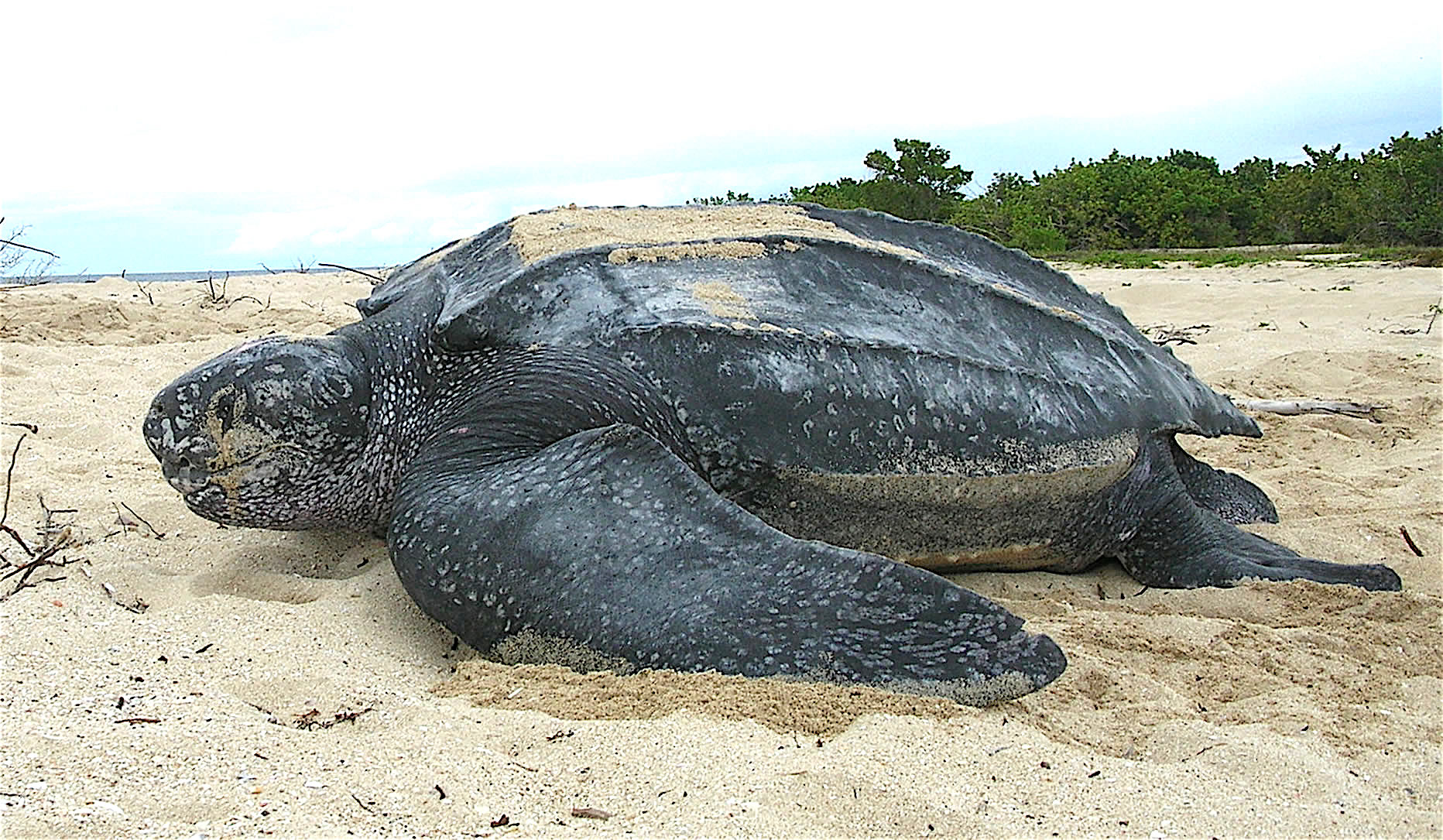
Leatherback Sea Turtle (Dermochelys coriacea)
Introduction
The ocean surface breaks apart in the darkness before dawn somewhere off the coast of Trinidad. A vast, dark shape emerges from the surf — silent, purposeful, impossibly ancient. It moves with the slow, unstoppable rhythm of something that has been performing this act for longer than our species has existed. The leatherback sea turtle, the largest living reptile on Earth, has returned to shore to nest, just as her ancestors did when dinosaurs still walked the land.
Watching a leatherback emerge from the ocean and haul herself up a nesting beach is one of the most extraordinary experiences in the natural world. At over two metres in length and weighing close to a tonne, she moves with a gravity-defying grace in water that transforms into slow, effortful determination on land. Her body, unlike any other turtle alive, carries no hard shell. Instead, a mosaic of cartilaginous ridges and tessellated bone fragments is wrapped in thick, oil-saturated, rubber-like skin — an evolutionary solution so efficient it has remained essentially unchanged for more than 100 million years.
Dermochelys coriacea is not simply the largest sea turtle; it is one of the most deeply specialised marine animals on the planet. It dives to depths that crush the lungs of most mammals. It maintains a body temperature markedly warmer than the surrounding seawater through a form of metabolic heat retention unique among living reptiles. It migrates distances of over 10,000 kilometres between feeding and nesting grounds, navigating open ocean with a precision that still eludes full scientific understanding. And it feeds almost exclusively on jellyfish — one of the least nutritious prey items in the ocean — sustaining a body of extraordinary size on a diet that would starve most predators.
This is an animal of extremes. And yet, despite its evolutionary success, the leatherback sea turtle is in profound trouble. Pacific populations have collapsed by more than 90 percent over the past two decades. Fishing gear, plastic pollution, egg poaching, and climate change are dismantling the ancient framework that sustains this species. Understanding the leatherback in full — its biology, behaviour, ecological role, and conservation status — is not merely a matter of scientific interest. It is a matter of urgency.
"The sea turtle is not a creature of our time. It is a creature of geological time, and in watching it, we watch time itself move."
— Dr. Archie Carr, marine biologist and sea turtle conservation pioneer
Scientific Classification
Kingdom: Animalia
Phylum: Chordata
Class: Reptilia
Order: Testudines
Suborder: Cryptodira
Family: Dermochelyidae
Genus: Dermochelys
Species: Dermochelys coriacea (Vandelli, 1761)
The leatherback sea turtle is the sole living member of the family Dermochelyidae, a lineage that diverged from all other sea turtles more than 100 million years ago. It stands entirely alone — a monotypic genus and family, with no surviving close relatives. All other living sea turtles belong to the family Cheloniidae, which separated from the dermochelyid line early in the Cretaceous period. The closest fossil relatives, such as Archelon and Protostega, reveal a long evolutionary trajectory toward extreme ocean specialisation.
The species name coriacea derives from the Latin word for leather, a reference to the animal's distinctively flexible, leathery integument. The genus name Dermochelys translates to "skin turtle," distinguishing it further from its hard-shelled relatives. There are no currently recognised subspecies, though some researchers have proposed that Pacific and Atlantic populations show sufficient genetic divergence to warrant distinct classifications — a debate that carries significant conservation implications.
Physical Characteristics
The leatherback sea turtle is an animal of superlatives. Adult males and females both reach extraordinary sizes, with typical adults measuring between 1.4 and 1.8 metres in straight carapace length and weighing between 300 and 700 kilograms. The largest authenticated specimen, recovered in Wales in 1988, measured 2.56 metres in total length and weighed approximately 916 kilograms — placing it among the largest reptiles ever recorded in the modern era.
The carapace, or upper shell surface, is the leatherback's most distinctive feature. Unlike the keratinised scutes and fused bony plates of other sea turtles, the leatherback's carapace is composed of a mosaic of thousands of tiny bone fragments embedded in a matrix of tough, fibrous, cartilaginous tissue saturated with lipids. Seven prominent longitudinal ridges run the length of the dorsal surface, providing structural rigidity while allowing the carapace to flex slightly under pressure — an essential feature for deep-water diving, where the pressure would fracture a rigid shell.
The skin colour is predominantly black or very dark blue-grey, frecked with white or pink spots. The ventral surface is lighter, often white or pink with dark patches. The pink spot visible on the top of the head — overlying the frontal bone — is unique to each individual and functions similarly to a fingerprint, allowing researchers to identify individual turtles from above-water photographs.
The fore flippers are disproportionately large — spanning up to 2.7 metres tip-to-tip in large adults — and are among the most powerful appendages of any living reptile. They drive the turtle through water with long, sweeping strokes, enabling sustained swimming speeds of 1 to 2 knots during migration and short bursts of up to 35 kilometres per hour when pursued. The rear flippers are relatively small and are used primarily for steering and for excavating nests during egg-laying.
The jaw structure is highly adapted for jellyfish predation. Both the upper and lower jaws are lined with sharp, backward-pointing papillae — keratinised spines that line the throat and oesophagus all the way to the stomach. These structures prevent slippery jellyfish from escaping once engulfed, functioning like a one-way valve. There are no true teeth.
Fun FactThe leatherback's oesophagus is lined with backward-pointing spines stretching from throat to stomach — a 30-centimetre gauntlet that ensures no jellyfish escapes once swallowed.
Trait | Leatherback Sea Turtle | Loggerhead Sea Turtle | Green Sea Turtle |
|---|---|---|---|
Average adult weight | 300–700 kg | 80–200 kg | 110–190 kg |
Carapace type | Leathery, flexible | Hard, scuted | Hard, scuted |
Maximum dive depth | ~1,280 m | ~230 m | ~100 m |
Primary diet | Jellyfish | Crustaceans, molluscs | Seagrass, algae |
Global IUCN status | Vulnerable | Vulnerable | Endangered |
Nesting beach fidelity | High (natal beach return) | High | High |
Habitat & Geographic Distribution
The leatherback sea turtle occupies the widest geographic range of any reptile on Earth. It is a pelagic species — built for open water — and is recorded in tropical, temperate, and even subarctic seas. Leatherbacks have been documented from the beaches of Trinidad and Costa Rica in the tropics to the cold waters of the North Atlantic, Norwegian fjords, and the coasts of Alaska. They are found across all major ocean basins: the Atlantic, Pacific, Indian, and to a lesser extent the Arctic and Southern Oceans.
This astonishing range is made possible by the leatherback's thermoregulatory ability. Unlike other reptiles, which are entirely ectothermic (cold-blooded), leatherbacks maintain a body temperature that can be up to 18°C warmer than the surrounding seawater. This endothermy-like capacity is achieved through a combination of metabolic heat production, counter-current heat exchange systems in the flippers, and the insulating properties of the thick subcutaneous fat layer. It allows leatherbacks to function in water temperatures as low as 0.4°C — cold enough to incapacitate most marine reptiles within minutes.
Nesting occurs on tropical and subtropical beaches, typically between latitudes 30°N and 30°S. Major nesting sites include Paramin and Grande Riviere in Trinidad, Playa Grande in Costa Rica, Sandy Point National Wildlife Refuge in the US Virgin Islands, and beaches in Gabon, Malaysia, and Indonesia. The Western Pacific population — primarily nesting in Papua and the Bird's Head Peninsula of Indonesia — represents one of the last significant Pacific nesting aggregations, as nesting beaches in Malaysia, which once hosted thousands of leatherbacks annually, have been effectively destroyed through egg collection.
Between nesting seasons, leatherbacks migrate extraordinary distances to reach high-latitude feeding grounds where jellyfish blooms are concentrated. Atlantic leatherbacks tracked from Caribbean nesting beaches have been recorded reaching the cold waters off Nova Scotia, Newfoundland, and even Ireland and Norway during summer months. Pacific leatherbacks nesting in Indonesia have been tracked crossing the entire Pacific Ocean to feed off the coasts of California and Oregon — a journey of more than 15,000 kilometres, one of the longest migrations recorded in any vertebrate.
The leatherback's habitat selection during feeding migrations is primarily governed by jellyfish abundance rather than water temperature, salinity, or bathymetry. They congregate in areas of oceanographic complexity — shelf edges, convergence zones, and upwelling regions — where gelatinous zooplankton biomass is high. Temperature and current boundaries also appear to guide navigation during migration, with turtles consistently tracking thermal fronts across ocean basins.
Behaviour & Social Structure
Leatherback sea turtles are fundamentally solitary animals. Unlike the schooling fish they occasionally pass through, or the aggregating seabirds that share their feeding grounds, leatherbacks spend the vast majority of their lives alone in open water. There is no stable social group, no long-term pair bond, and no enduring family unit. Each individual navigates its own path across thousands of kilometres of ocean, guided by sensory systems and navigational capacities that science is still working to fully decode.
During the nesting season, however, interactions do occur. Males and females congregate near nesting beaches, and mating takes place in the waters offshore — typically in the weeks before females begin coming ashore to lay eggs. Males will actively pursue females, and copulation has been observed both at the surface and at depth. Competition between males for mating access is evident, though serious physical combat appears rare. Because females can store sperm for extended periods, a single clutch may be fertilised by multiple males, increasing the genetic diversity of a nest.
On the nesting beach itself, females display a focused, almost meditative determination. They select nest sites through a combination of olfactory cues and substrate assessment, avoiding areas with compacted sand or vegetation encroachment. The entire nesting process — from emergence to return to the sea — can take between 60 and 90 minutes. Females are largely indifferent to the presence of other nesting females nearby, though direct encounters on the beach sometimes result in displacement as one individual inadvertently excavates the nest of another.
Communication between leatherbacks remains poorly understood. They lack the elaborate vocalisation systems of marine mammals, but research has identified low-frequency sounds produced during nesting — groans, sighs, and belch-like vocalisations — whose purpose is unclear. Olfaction likely plays a significant role in locating nesting beaches and potentially in mate identification, though the mechanisms are not yet fully characterised. Magnetic field sensitivity, common across sea turtle species, is thought to be a primary navigational tool, with turtles able to detect both the intensity and inclination of Earth's magnetic field — effectively reading coordinates encoded in geomagnetic signatures.
Cognitive studies of leatherbacks are limited by the difficulty of keeping them in captivity — they do not survive long in tanks and are studied almost exclusively in the wild. What is clear is that their navigational abilities imply a degree of spatial memory and environmental recognition that goes well beyond simple instinct. Females return repeatedly to the same beaches, often within metres of their previous nesting sites, across intervals of years. How they achieve this — integrating magnetic maps, olfactory signatures, and possibly visual cues — represents one of the most compelling unsolved questions in sea turtle biology.
Daily Life & Activity Cycle
A leatherback's day is structured almost entirely around food acquisition during the feeding season, and around the energy-intensive demands of reproduction during the nesting season. The two phases are geographically and temporally distinct, separated by transoceanic migrations that can themselves take months.
In feeding areas, leatherbacks are primarily diurnal foragers, though they dive at all hours. Their prey — jellyfish and other gelatinous organisms — undergoes a diel vertical migration, rising toward the surface at night and retreating to depth during the day. Leatherbacks track this movement with their own diving behaviour, making shallow dives near the surface in the early morning and evening when jellyfish are concentrated in the upper water column, and deeper dives during the day when prey has descended. Dive depths typically range from 50 to 200 metres during foraging, with brief surface intervals of a few minutes between dives.
The deepest leatherback dive on record reached 1,280 metres — a depth that most submarines are not rated for. At such depths, the pressure would compress the lungs of an air-breathing mammal to the point of injury. The leatherback avoids this through a flexible thoracic cage and collapsible lungs that yield to external pressure rather than resisting it, combined with an extraordinary capacity for oxygen storage in the blood and muscles and a high tolerance for anaerobic metabolism during prolonged submersion.
During migration, leatherbacks swim continuously, rarely stopping to rest. Satellite tracking data shows that migrating individuals maintain consistent directional headings across thousands of kilometres of featureless open ocean, adjusting course around major current systems with apparent precision. Swimming speeds during migration average 1 to 2 knots but can reach considerably higher during sustained bursts.
Nesting females follow a predictable cycle of approximately 9 to 10 days between clutches, with most individuals laying 5 to 7 clutches per season. Between nesting events, females remain in the relatively shallow waters offshore, resting at depth and conserving energy. A full nesting season — from first emergence to final return migration — occupies roughly three to four months, after which the female departs for the open ocean.
Diet & Survival Strategies
To feed an animal of the leatherback's size on jellyfish is a counterintuitive ecological feat. Jellyfish are composed of approximately 95 percent water. Their caloric density is extraordinarily low — roughly 5 calories per 100 grams, compared to over 200 calories per 100 grams for fish. To sustain a body mass that can exceed 600 kilograms, a leatherback must consume enormous volumes of prey. Estimates suggest that feeding leatherbacks in productive zones consume their own body weight in jellyfish every day during peak foraging periods — meaning a 500-kilogram turtle may process 500 kilograms of jellyfish in 24 hours.
This is made possible by the extreme efficiency of the leatherback's feeding apparatus. The backward-pointing papillae lining the oesophagus allow rapid ingestion of large, slippery prey, while the jaw tips form a distinctive cusped bite that can puncture and secure even large, fast-moving medusae. The digestive system processes gelatinous material with remarkable speed, extracting what little protein and lipid is available and passing the water fraction rapidly.
The prey base is broad but gelatinous. Lion's mane jellyfish (Cyanea capillata), moon jellyfish (Aurelia aurita), Portuguese man o' war (Physalia physalis), salps, pyrosomes, and other gelatinous zooplankton are all consumed. Leatherbacks show no apparent ill effects from the potent nematocysts of even highly venomous species — the thick mucus lining of the papillated oesophagus appears to neutralise or physically block the firing of stinging cells.
Fun FactLeatherbacks are immune to jellyfish venom — they routinely consume Portuguese man o' war, one of the ocean's most venomous organisms, without apparent injury, thanks to a thick mucus lining in their throat.
Plastic bags represent the most dangerous confusion in the leatherback's diet. Translucent plastic bags drifting in the water column are visually and behaviourally indistinguishable from jellyfish to a leatherback — and once ingested, they cannot be expelled. Plastic accumulates in the gastrointestinal tract, blocking digestion, causing false satiation, and ultimately leading to starvation or toxic accumulation. This single factor is now considered one of the most significant mortality sources for the species.
During the nesting season, females stop feeding entirely. The energetic demands of producing multiple large clutches — each containing 60 to 80 fertilised eggs — are met almost entirely by fat reserves accumulated during months of intensive foraging. A nesting female's body fat acts as both fuel tank and egg factory, mobilised progressively across the nesting season. By the time she returns to the ocean after her final clutch, a female may have lost 30 to 40 percent of her pre-nesting body mass.
Interaction with Other Animals
The leatherback's position in the marine food web is complex. As a consumer of gelatinous zooplankton, it occupies a trophic level that few large vertebrates exploit, effectively converting low-quality biomass into high-quality protein available to other predators in the form of its own body. As prey, mature leatherbacks face few direct threats in open water — their size makes them unattractive targets for most predators — but they are not invulnerable.
White sharks (Carcharodon carcharias) and tiger sharks (Galeocerdo cuvier) are the primary predators of adult and sub-adult leatherbacks. Attack scars on nesting females — bite marks on the trailing edges of flippers and along the carapace margins — reveal that shark encounters are not uncommon. The leatherback's response to predatory attack appears to be primarily flight rather than defence; its flexible carapace and body offer little of the armoured protection available to other sea turtles. However, an animal approaching 700 kilograms is a formidable target even for large sharks, and attacks on healthy adults are rarely fatal.
On nesting beaches, eggs and hatchlings face intensive predation from a wide range of terrestrial and avian predators. Ghost crabs (Ocypode spp.) are highly efficient at locating and excavating nests within the first 24 hours of egg deposition. Coatis, raccoons, feral dogs, pigs, and mongooses excavate nests on beaches where they are present. Once hatchlings emerge and make their dash to the sea, frigatebirds, black vultures, grey herons, and numerous gull species take a heavy toll. In the water, hatchlings face further predation from fish, including snook, jack, and small sharks.
Leatherbacks also interact with organisms that travel with them. Remora fish frequently attach themselves to leatherbacks, feeding on parasites, shed skin, and food scraps — a loosely commensal relationship in which the remora benefits and the turtle is generally neither helped nor harmed. Barnacles colonise the carapace surface, though less extensively than on hard-shelled turtles. Various copepod parasites infest the skin folds around the head and eyes of nesting females, sometimes in significant densities.
Off the coast of St. Croix one May evening, a research team sat in near silence on the dark beach. The sea was flat and the air smelled of salt and decomposing weed. Then, just after 10 pm, the surface broke perhaps 30 metres offshore — a slow eruption of water, a vast dark shape rising through the luminescent shallows.
The female moved like a boulder given sentient purpose, dragging herself through the surf with her great fore flippers, her bulk leaving a broad track in the sand. She was massive — the researchers later measured her at 172 centimetres carapace length, estimated at nearly 450 kilograms. She had been tagged eight years earlier on this same beach, one kilometre to the north.
She selected her site with methodical patience, probing the sand with her rear flippers, shifting position twice before beginning to excavate. The nest chamber took 30 minutes to complete. The eggs fell in clusters — white, round, the size of billiard balls — silent and steady, 78 in total. Then, covering the nest with her rear flippers while her body rocked from side to side, she disguised the site with a scattering of loose sand thrown in wide arcs by her fore flippers.
She returned to the sea without ceremony, sliding into the surf with the same ancient indifference with which she had arrived. The beach was empty again, the track in the sand the only evidence that something extraordinary had occurred. In nine days, she would do it again.
Interaction with Environment
The leatherback sea turtle's relationship with its environment operates on scales that are easy to underestimate. Individually, each turtle is a mobile vector of nutrients across oceanic and coastal boundaries. A female that feeds for months in the cold productive waters of the North Atlantic, then migrates to nest in tropical Trinidad, is effectively transporting nitrogen, phosphorus, and other nutrients from a pelagic system to a coastal terrestrial one — nutrients that fertilise beach vegetation, support insect communities, and enter the local food web through the activities of predators and scavengers that access eggs and hatchlings.
At a broader scale, leatherbacks are significant regulators of jellyfish populations. Jellyfish blooms have intensified globally in recent decades, driven by overfishing, eutrophication, and warming seas. Blooms of sufficient density can devastate fish recruitment by consuming larval fish and fish eggs, degrade water quality, and collapse local fisheries. Leatherbacks, as specialist jellyfish consumers, provide a natural check on bloom development that is increasingly disrupted as leatherback populations decline. The feedback loop is alarming: fewer leatherbacks means larger jellyfish blooms, which means further disruption to marine food webs.
Nesting beach ecology is also directly shaped by leatherback activity. Eggs that fail to hatch — infertile eggs, eggs damaged by flooding, eggs consumed by bacteria — contribute nutrients to the beach sand as they decompose. Hatchlings that die on the beach before reaching the sea are consumed by scavengers, redistributing marine-derived nutrients into the terrestrial ecosystem. The physical disturbance of nest excavation — particularly in high-density nesting areas — aerates compacted sand, improving drainage and creating microhabitats used by invertebrates and small vertebrates.
The leatherback's extreme diving capacity also connects surface and deep-ocean systems. As it dives to depth consuming prey, then surfaces to breathe and defecate, it contributes to the biological pump — the movement of carbon and nutrients from the surface to depth and back — in ways that mirror the contributions of other large marine vertebrates. Though quantifying this contribution precisely is challenging, the ecological principle is sound: large-bodied, vertically mobile consumers play a disproportionate role in ocean biogeochemical cycling.
Reproduction & Parenting
The leatherback's reproductive strategy is characterised by high investment per breeding event, extended inter-nesting intervals, and a complete absence of post-hatching parental care — a pattern that makes the species acutely vulnerable to any disruption of the nesting process or early hatchling survival.
Females reach sexual maturity between 10 and 15 years of age, though some estimates suggest Pacific populations may mature later. Males likely mature at a similar age. Once mature, females typically reproduce every 2 to 5 years. This low reproductive frequency is partly compensated by the large number of eggs produced per season — a single female may lay 6 to 9 clutches across a single season, with each clutch containing 60 to 85 fertilised eggs and a variable number of smaller, unfertilised "spacer eggs" that appear to serve an aeration function within the nest chamber.
Mating occurs offshore from nesting beaches, typically in the weeks preceding the first nest of the season. Males approach females with persistent intent — copulation is sometimes preceded by biting of the female's flippers and neck, leaving visible scars. Females can and do mate with multiple males, and genetic analysis of nest contents confirms that multiple paternity within a single clutch is common. Stored sperm allows a female to fertilise eggs across an entire nesting season without repeated mating.
The nest chamber is excavated by the female's rear flippers to a depth of approximately 75 to 100 centimetres — deep enough to buffer temperature extremes and deter most surface predators. Incubation lasts 60 to 70 days, with temperature determining both the pace of development and, critically, the sex of the emerging hatchlings. Temperatures above approximately 29.5°C produce predominantly female hatchlings; cooler temperatures produce males. This temperature-dependent sex determination mechanism is now a significant conservation concern, as warming sand temperatures in the tropics are pushing sex ratios increasingly toward female-dominated populations.
When the eggs hatch, the hatchlings must excavate upward through 75 to 100 centimetres of sand — a process that can take several days and requires the coordinated effort of the entire brood. Hatchlings typically emerge synchronously and at night, when the risk of desiccation and visual predation is lowest. They use the relative brightness of the sea horizon to orient toward the water, an instinct that makes artificial lighting near nesting beaches profoundly disorienting and deadly.
Once in the ocean, hatchlings enter a "lost years" phase — a period of oceanic drifting and development lasting years, during which they associate with floating sargassum and other drifting material. Juvenile leatherbacks have been recorded in Atlantic and Pacific waters, but little is known about the duration of this phase, the mortality rates experienced, or the ecological dynamics of juvenile life history. By the time a leatherback returns to coastal waters as a sub-adult, it has already survived the most dangerous chapter of its existence.
Evolutionary Adaptations
The leatherback sea turtle represents the product of more than 100 million years of refinement for life in open water. The suite of adaptations it carries is extraordinary — each one the product of relentless selective pressure across geological time.
The leathery carapace is arguably the most dramatic departure from the chelonian body plan seen in any living turtle. The rigid shell that protects most tortoises and turtles is a liability for a deep-diving pelagic species. Pressure increases by approximately one atmosphere every 10 metres of depth — at 300 metres, a rigid shell would experience pressures equivalent to 30 times that at the surface. The leatherback's flexible, mosaic carapace compresses under this pressure without fracturing, while the collapsible ribcage and compressible lungs allow the thoracic cavity to yield rather than resist. This hydrostatic adaptability is a convergent solution paralleling those seen in sperm whales and Weddell seals.
Counter-current heat exchange — a physiological mechanism also seen in bluefin tuna and some sharks — is central to the leatherback's ability to survive in cold water. The arteries and veins in the flippers are arranged in a retia mirabilia (wonderful nets) configuration, where warm arterial blood flowing out to the flippers transfers heat to cold venous blood returning to the body core. The result is that the extremities may be cold while the body core remains warm — effectively a biological radiator system that retains metabolic heat with extraordinary efficiency.
The papillated oesophagus is a feeding adaptation found in similar form across gelatinous-prey specialists — from certain seabirds to whale sharks — but in the leatherback it reaches its most extreme expression. The backward-pointing spines extend from the lips all the way to the stomach, ensuring that once a jellyfish is contacted by the mouth, it cannot escape regardless of how the turtle orients during the swallowing process.
The fore flippers represent a masterpiece of evolutionary engineering. Composed of greatly elongated metacarpal and phalangeal bones embedded in dense connective tissue, they function as rigid hydrofoils during cruising and as sculling oars during acceleration. The total surface area of both flippers in a large adult may exceed four square metres, providing enormous propulsive force. The musculature powering these flippers is dense and highly vascularised — capable of sustained high-output activity across hours of continuous swimming.
Finally, the magnetic sense of leatherbacks — shared by other sea turtles but apparently highly refined in this species — represents an evolutionary adaptation of remarkable precision. Evidence suggests that leatherbacks can detect both the intensity and the inclination angle of Earth's magnetic field, essentially reading a two-coordinate geomagnetic map that allows position determination even in the absence of visual landmarks. This ability, encoded in the brain's magnetite-rich tissue, is the probable basis for the natal homing behaviour that brings females back to their birth beach decades after first leaving it as hatchlings.
Ecological Importance
The leatherback's ecological importance extends far beyond its role as a jellyfish consumer, though that role alone is substantial. In ocean systems where jellyfish have proliferated explosively — driven by overfishing, ocean warming, and coastal eutrophication — leatherbacks represent one of the few natural regulators capable of operating at the scale of blooms. A study of Atlantic leatherback feeding behaviour estimated that a single adult could consume more than 73 kilograms of jellyfish per day in productive feeding grounds. When multiplied across a population, this represents a significant top-down control on gelatinous zooplankton biomass.
The nutrient cycling role of leatherbacks connects marine and terrestrial systems in ways that are rarely appreciated. Nesting beaches that receive high volumes of turtle activity over thousands of years develop distinctive soil chemistry, vegetation structure, and invertebrate communities shaped by the continuous input of marine-derived nutrients. Beaches that lose their turtle populations experience measurable declines in beach vegetation productivity — a subtle but real ecological consequence of the loss of this connection between ocean and land.
Leatherbacks are also important in the context of ocean carbon cycling. By consuming jellyfish — which themselves consume phytoplankton and zooplankton that have fixed atmospheric carbon — and defecating at depth during their deep dives, leatherbacks contribute to the biological pump that sequesters carbon in the deep ocean. This is a relatively small contribution compared to that of phytoplankton, but it is part of the complex web of biological processes that regulate atmospheric carbon dioxide concentrations over geological time.
The species also holds a sentinel function for ocean health. As a long-lived, wide-ranging, high-trophic integrator, the leatherback bioaccumulates environmental contaminants and reflects the health of the ocean systems it passes through. Declining leatherback populations are a signal of ocean-wide dysfunction — overfishing, plastic pollution, warming temperatures — that affects not just turtles but entire marine communities.
Threats & Conservation
The leatherback sea turtle faces a suite of anthropogenic threats that collectively represent one of the most serious conservation crises among large marine vertebrates. While the species was once abundant across all tropical and subtropical ocean systems, its populations have declined catastrophically over the past 50 years, driven by forces that are not independent of each other but rather mutually reinforcing.
Bycatch in commercial fishing gear is the single most significant source of adult mortality. Leatherbacks are caught in longlines targeting tuna and swordfish, in gillnets targeting various coastal fish species, and in trawl nets. Because leatherbacks must surface to breathe, entanglement in any of these gear types results in drowning within minutes to hours. The eastern Pacific stock, which nests primarily in Mexico and Costa Rica, was devastated by longline fishing mortality in the 1980s and 1990s. Atlantic populations face significant mortality from gillnet fisheries along the US East Coast and in the Caribbean.
Egg poaching has historically been catastrophic on many nesting beaches. On some beaches in Southeast Asia — particularly in Malaysia, where leatherbacks once nested in globally significant numbers — egg collection was so thorough and so sustained that nesting populations have been functionally extirpated. The Rantau Abang beach in Malaysia hosted several thousand leatherback nests annually in the 1950s; by the 2000s, the number had fallen to fewer than five per year. Decades of egg poaching, combined with incidental catch in fishing gear, had simply removed the entire nesting population.
Plastic pollution has emerged as a pervasive threat independent of fishing gear. Leatherbacks cannot distinguish plastic bags and packaging from jellyfish, and plastic ingestion is now found in the majority of leatherbacks examined post-mortem. Plastic blocks digestion, causes intestinal perforation, and leaches toxic chemicals into tissues. Light pollution on and near nesting beaches disrupts both female nest site selection and hatchling orientation, drawing hatchlings inland toward artificial lights rather than seaward toward the ocean horizon.
Climate change presents the most complex and long-term threat to the species. Rising sand temperatures on nesting beaches are skewing hatchling sex ratios toward near-total female production, potentially compromising future breeding success. Rising sea levels threaten low-lying beaches with inundation — particularly critical nesting sites in the Caribbean and Pacific. Changes in jellyfish distribution patterns driven by ocean warming may decouple leatherback migration routes from their prey base, forcing longer and more costly migrations or reducing foraging efficiency.
IUCN Red List Analysis
Current IUCN Status
The leatherback sea turtle (Dermochelys coriacea) is currently classified as Vulnerable (VU) on the IUCN Red List of Threatened Species, under criterion A2bcd — indicating that the species has experienced a past population reduction of 30 percent or more over the previous three generations (estimated at approximately 30 years for this species), based on observed declines in nesting populations, and that the causes of decline have not necessarily ceased.
It is critical to note that this global classification masks profound variation between ocean basin subpopulations. The Pacific leatherback population — assessed separately — meets the criteria for Critically Endangered (CR), having experienced population declines exceeding 80 percent over three generations at index nesting sites. Atlantic populations, by contrast, show relative stability or even modest recovery in some areas, which moderates the global assessment. The global Vulnerable listing should therefore not be interpreted as an indication that the species is secure — it reflects the averaging of a catastrophically declining Pacific population with more stable Atlantic figures.
Population Trend
Global leatherback population trends are assessed as decreasing, with marked regional variation. The Pacific population has undergone the most severe documented decline of any sea turtle subpopulation in history. Nesting counts at Playa Grande, Costa Rica — once the world's largest Pacific leatherback rookery — fell from approximately 1,400 nests per season in the late 1980s to fewer than 100 nests by the early 2000s. Indonesian nesting beaches (Bird's Head Peninsula, Papua) now represent the primary remaining Pacific nesting aggregation, with several thousand nests per season, but these too show declining trends.
Atlantic and Caribbean populations are comparatively more stable. The beach at Grande Riviere, Trinidad, hosts several thousand nests per season, and beaches in Gabon (West Africa) — identified as a major nesting aggregation site only in the early 2000s — are estimated to host between 15,000 and 41,000 nests annually, making Gabon potentially the most important leatherback nesting region in the world by volume. The discovery of the Gabon population represents both an important conservation finding and a reminder of how incomplete our knowledge of leatherback distribution remains.
Global nesting population estimates are inherently uncertain, but the most recent assessments suggest that between 26,000 and 43,000 adult females nest annually worldwide, down from estimated historical levels that may have exceeded 100,000 females. The overall trajectory is downward, with Pacific populations at grave risk of functionally extirpated status within decades if current trends continue.
Main Threats
Bycatch in commercial fisheries remains the dominant threat to adult leatherbacks globally. Longline, gillnet, and trawl fisheries across all ocean basins interact with leatherbacks at rates that current population sizes cannot sustain. The adoption of circle hooks in some longline fisheries has reduced leatherback bycatch rates substantially compared to traditional J-hooks, but compliance is uneven and the scale of the problem remains enormous. Artisanal coastal fisheries using gillnets in developing nations represent a growing and largely unquantified threat.
Egg poaching and nesting beach disturbance continue to threaten recruitment across much of the species' tropical nesting range. In areas where law enforcement is weak or where economic incentives for egg collection are high, nest protection is difficult to sustain. Development of coastal areas for tourism and residential purposes destroys nesting habitat, increases light pollution, introduces dogs and other egg predators, and compacts beach sand to depths that prevent successful nest excavation.
Plastic pollution kills leatherbacks through blockage of the digestive system, false satiation leading to starvation, physical damage to internal organs, and exposure to toxic chemicals leached from degrading plastic. The scale of plastic pollution in the world's oceans — estimated at over 170 trillion pieces of plastic floating on the surface — ensures that leatherbacks encounter plastic in virtually every ocean basin they traverse.
Climate change threatens through multiple pathways: temperature-dependent sex determination disruption, nesting beach erosion and inundation, prey distribution shifts, coral reef degradation (which affects nesting beach integrity in some locations), and changes in ocean productivity. The long generation time of leatherbacks — meaning that evolutionary responses to environmental change operate on century timescales — makes rapid climate-driven habitat shift particularly dangerous for the species.
Ecological Consequences
The functional loss of leatherbacks from ocean systems would propagate consequences across multiple trophic levels and geographic boundaries. Most immediately, the removal of this major jellyfish predator would accelerate the already-documented global trend of jellyfish bloom intensification. Jellyfish blooms are destructive to fisheries, clog power station cooling intakes, clog fishing nets, sting and kill farmed fish in aquaculture systems, and reduce water quality in coastal zones. The economic costs of bloom events already run into hundreds of millions of dollars annually in some regions — costs that would increase substantially without the regulatory pressure of large jellyfish predators.
The loss of the nutrient transfer function — marine nutrients carried from open ocean to nesting beaches across thousands of kilometres — would impoverish tropical nesting beach ecosystems in subtle but measurable ways. The reduction of nutrient inputs from turtle eggs, hatchlings, and the activities of nesting females would gradually reduce the productivity and biodiversity of beach invertebrate and plant communities, with downstream effects on the insectivorous birds and small mammals that depend on them.
At a broader scale, leatherback loss would remove an important ocean health indicator, masking the ongoing deterioration of marine systems until more dramatic collapses occur in higher-profile species. The leatherback's role as a sentinel species means that its population trends carry information about the health of open-ocean and coastal ecosystems far beyond what the turtle itself represents in biomass.
Conservation Efforts
A range of conservation measures have been implemented across the leatherback's range, with varying degrees of effectiveness. Nest protection programmes — involving beach patrols, relocation of nests threatened by erosion or poaching, predator control, and hatchling release monitoring — are operational at most major nesting sites in the Caribbean, Central America, and increasingly in West Africa. Programmes in Trinidad (Nature Seekers), Costa Rica (PRETOMA, Leatherback Trust), St. Croix (Sandy Point NWR), and Gabon (Panthera, WCS) have established long-term datasets and demonstrated measurable protection benefits at local scales.
Regulatory measures targeting bycatch include the listing of the leatherback under Appendix I of the Convention on International Trade in Endangered Species (CITES), which prohibits commercial trade in the species and its products. The Endangered Species Act (ESA) of the United States designates leatherbacks as Endangered, triggering legal requirements for bycatch reduction in fisheries operating in US waters. The Inter-American Convention for the Protection and Conservation of Sea Turtles (IAC) provides a regional legal framework for range states across the Americas. Turtle excluder devices (TEDs) are mandatory in some trawl fisheries, and circle hook requirements apply in some US longline fisheries.
Satellite telemetry programmes — tracking the ocean migrations of individual turtles fitted with transmitters — have transformed our understanding of leatherback movement ecology and identified previously unknown feeding aggregation sites, allowing targeted fishing restrictions. The Wider Caribbean Sea Turtle Conservation Network (WIDECAST) coordinates conservation efforts across the Caribbean basin. The Pacific Leatherback Conservation Fund supports protection of Indonesian nesting beaches. The IUCN Marine Turtle Specialist Group provides coordination and assessment at the global level.
Future Outlook
The future of the leatherback sea turtle is genuinely uncertain — and the window for effective intervention is narrowing, particularly for Pacific populations. If current bycatch levels, egg poaching rates, and plastic pollution trends continue unmodified, Pacific leatherbacks may be functionally extinct as a nesting population within 20 to 30 years. Recovery from such a bottleneck — if it remained biologically possible — would require centuries given the species' long generation time and low reproductive rate.
Atlantic and West African populations offer greater grounds for cautious optimism. If the Gabon rookery proves as large as current estimates suggest, and if effective protection can be maintained there, Atlantic leatherbacks may sustain a viable global population even if Pacific numbers continue to fall. However, this represents a worst-case triage scenario rather than a conservation success.
Technological developments — real-time fishing vessel monitoring, AI-assisted bycatch prediction, biodegradable fishing gear, improved plastic waste management — offer tools that did not exist a decade ago. Political will and international cooperation remain the binding constraints. The species has survived more than 100 million years of planetary change. Whether it can survive the concentrated anthropogenic pressures of the next 50 years will depend entirely on decisions made by human societies in the immediate future.
Fun FactA female leatherback tracked via satellite from her nesting beach in Indonesia was recorded swimming across the entire Pacific Ocean to feeding grounds off the Oregon coast — a journey of more than 20,000 kilometres round trip, one of the longest migrations of any vertebrate on Earth.
Human Relationship
The relationship between humans and leatherback sea turtles is one of the most ambivalent in the natural world — simultaneously characterised by reverence and exploitation, scientific fascination and lethal carelessness. For coastal communities across the tropics, the arrival of nesting leatherbacks has held cultural significance for generations, intertwined with beliefs about fertility, ocean abundance, and the rhythms of the natural world.
In Trinidad, the annual arrival of leatherbacks at Grande Riviere and Matura beaches has become deeply embedded in national identity. Community-based ecotourism operations — established over decades with the support of NGOs and government agencies — have transformed the economic calculus of nesting beach management. Local communities that once sold leatherback eggs now earn livelihoods guiding tourists to witness nesting events. The same transformation has occurred, with varying degrees of success, in Costa Rica, St. Croix, Malaysia (where it came too late to save the local population), and parts of West Africa.
Leatherback meat and eggs have been consumed by coastal communities across their range for centuries — practices that, at low population densities and with limited fishing technology, were sustainable. The intensification of commercial egg collection and the expansion of coastal fishing effort transformed these subsistence practices into population-level threats. In some communities, leatherback eggs remain commercially important despite legal protections, sold at markets in Southeast Asia and the Caribbean as aphrodisiacs and luxury foods.
The scientific relationship with leatherbacks has evolved dramatically over the past 50 years. From basic natural history observation, sea turtle science has grown into a sophisticated interdisciplinary field drawing on satellite tracking, genetic analysis, isotope ecology, physiology, oceanography, and behavioural biology. Leatherbacks have been central to this intellectual evolution, serving as model organisms for understanding deep-diving physiology, magnetoreception, ocean migration, and conservation genetics.
The tourism value of leatherback nesting events is now well-documented. Where properly managed — with strictly controlled viewing numbers, no artificial lighting, and trained guides — turtle tourism generates substantial income for coastal communities while providing conservation benefits through local stakeholder engagement. Poorly managed turtle tourism, conversely, can stress nesting females, disrupt hatchling orientation, and trample nests — turning conservation opportunity into conservation threat.
Unique & Rare Facts
Deepest reptile dive: The leatherback holds the record for the deepest dive by any living reptile, reaching 1,280 metres — deeper than most military submarines are rated to operate.
Temperature regulation: Leatherbacks can maintain a body core temperature up to 18°C warmer than the surrounding seawater, a feat unmatched by any other living reptile and convergent with the thermoregulation strategies of warm-bodied fish like bluefin tuna.
Oldest lineage: The family Dermochelyidae diverged from other sea turtles more than 100 million years ago, making the leatherback's body plan older than the extinction of the non-avian dinosaurs.
Flipper span: Large adults can have a fore flipper tip-to-tip span exceeding 2.7 metres — wider than the wingspan of many albatrosses, and among the largest limb spans of any living reptile.
Sex determination sensitivity: A temperature difference of just 1.5°C at the pivotal temperature threshold (approximately 29.5°C) can shift a nest's sex ratio from predominantly male to predominantly female — making climate change a direct threat to population sex balance.
Jellyfish volume consumption: Leatherbacks may consume their entire body weight in jellyfish per day during peak foraging — a 500-kilogram turtle processing half a tonne of gelatinous prey in 24 hours.
Navigation precision: Satellite tracking has revealed that migrating leatherbacks crossing the open Pacific maintain compass headings accurate to within a few degrees across thousands of kilometres of featureless water, correcting for current drift in real time.
Pink spot individuality: The pink pigmentation on the top of a leatherback's head is individually unique — effectively a fingerprint that can be used to identify individual animals from drone photography alone.
The "lost years" mystery: Almost nothing is known about juvenile leatherback ecology during the years between hatching and first return to coastal waters — one of the largest gaps in knowledge of any large vertebrate's life history.
Gabon surprise: The beaches of Gabon in West Africa — largely unknown to sea turtle scientists until surveys conducted in 2001–2002 — turned out to host potentially the world's largest leatherback nesting aggregation, rewriting global population estimates for the species.
Conclusion
There is a particular quality of time that comes with watching a leatherback sea turtle. It is not the time of a human life, or even of recorded human history. It is the time of geology — of mass extinctions overcome, of continental drift observed across generations, of ice ages endured and equatorial seas navigated without instruction or map. The animal before you has a lineage older than most mountain ranges. It carries in its body the solutions to problems that took millions of years to solve.
And yet this ancient, self-sufficient masterpiece — capable of crossing entire ocean basins, diving to depths that crush mechanical instruments, surviving on a diet that would starve most predators, returning unerringly to the beach of its birth after decades at sea — is being undone in decades by forces it has no evolutionary history of encountering. Plastic bags. Longline hooks. Beach development. Warming sand. These are not geological pressures that evolution can answer in the time available. They are immediate, intense, and human-made.
The leatherback's ecological importance is not abstract. It regulates jellyfish populations that, unchecked, collapse fisheries and devastate marine food webs. It transfers nutrients across ocean and land boundaries that sustain ecosystems far from the ocean surface. It moves as a sensor through ocean systems, reflecting in its health and its numbers the integrity of the marine world. Losing this species would be to lose not only an extraordinary organism, but an entire category of ecological function — one that nothing else alive is positioned to replace.
The story of the leatherback sea turtle is still being written. Pacific populations hang by a thread. Atlantic populations offer the fragile possibility of a different ending. The science is clear. The tools exist. What remains uncertain is the quality of human decision-making over the next two or three generations — the same span of time it takes a single leatherback to reach adulthood and begin to replenish what has been lost.
"We do not inherit the Earth from our ancestors; we borrow it from our children."
— Antoine de Saint-Exupéry (attributed)
The leatherback has kept its side of that bargain for a hundred million years. The question now belongs entirely to us.
Sources & Attribution
Data and ongoing research referenced for this article come from the following authoritative sources — peer-reviewed publishers, official taxonomic registers, and global biodiversity programmes:
- IUCN Red List — Leatherback Sea Turtle — official IUCN Red List assessment including population trend, threats, and conservation actions.
- Wikipedia — Leatherback Sea Turtle — taxonomy, distribution, and an overview with onward citations to primary literature.
- GBIF — Leatherback Sea Turtle — global occurrence and distribution records from the Global Biodiversity Information Facility.
- iNaturalist — Leatherback Sea Turtle — observation records and field photographs contributed by naturalists worldwide.
- Encyclopedia of Life — Leatherback Sea Turtle — multilingual species pages aggregating taxonomic and natural-history data.
- WWF — World Wildlife Fund — global wildlife conservation programmes and research summaries.
- Nature — research on Leatherback Sea Turtle — peer-reviewed studies indexed by Nature on related ecology and behaviour.
- ITIS — Integrated Taxonomic Information System — federal-grade taxonomy and nomenclature.
Frequently Asked Questions
What does the leatherback sea turtle eat?
The leatherback sea turtle feeds almost exclusively on jellyfish and other gelatinous zooplankton, including moon jellyfish, lion's mane jellyfish, Portuguese man o' war, salps, and pyrosomes. Its jaw is equipped with backward-pointing spines that prevent slippery prey from escaping, and its throat and oesophagus are lined with similar papillae all the way to the stomach. To sustain its enormous body mass, a leatherback may consume its own body weight in jellyfish per day during peak foraging periods.
The species does not consume fish, crustaceans, or vegetation. This extreme dietary specialisation makes it uniquely vulnerable to plastic bag ingestion, as translucent plastic floating in the water column is visually indistinguishable from jellyfish to a foraging leatherback.
How large does the leatherback sea turtle get?
The leatherback is the largest living sea turtle and the largest living reptile by mass. Adults typically measure 1.4 to 1.8 metres in straight carapace length and weigh between 300 and 700 kilograms. The largest authenticated specimen, a male recovered in Wales in 1988, measured 2.56 metres in total length and weighed approximately 916 kilograms.
Where does the leatherback sea turtle live?
The leatherback sea turtle has the widest geographic range of any reptile on Earth, occurring across all major ocean basins from the tropics to subarctic latitudes. It nests on tropical and subtropical beaches in the Caribbean, Central America, West Africa, and Southeast Asia. Between nesting seasons, it migrates to cold, productive feeding grounds as far north as Norway, Canada, and Alaska, and as far south as the coasts of Argentina and New Zealand.
This extraordinary range is possible because of the leatherback's ability to maintain body temperatures significantly warmer than the surrounding water — a thermoregulatory capacity unique among living reptiles.
How long do leatherback sea turtles live?
The lifespan of leatherback sea turtles in the wild is not precisely known, partly because they are difficult to study continuously and partly because individual mark-recapture programmes rarely span the full life of a single animal. Current best estimates, based on growth rates, age at maturity, and population modelling, suggest that leatherbacks can live for 30 to 50 years in the wild, and potentially longer in the absence of anthropogenic mortality. Females are known to return to the same nesting beaches over periods of at least 20 to 25 years.
How deep can the leatherback sea turtle dive?
The leatherback sea turtle is the deepest-diving living reptile, with a recorded maximum dive depth of 1,280 metres. This is made possible by a flexible carapace that yields to external pressure rather than resisting it, collapsible lungs, a highly oxygen-storing blood and muscle system, and a high tolerance for anaerobic metabolism. Most foraging dives are shallower — typically 50 to 200 metres — with brief surface intervals of a few minutes between dives.
How far do leatherback sea turtles migrate?
Leatherback sea turtles undertake some of the longest migrations recorded in any vertebrate. Atlantic leatherbacks nesting in the Caribbean regularly migrate to feeding grounds off Canada, Greenland, and Europe. Pacific leatherbacks nesting in Indonesia have been tracked crossing the entire Pacific Ocean to feeding grounds off California and Oregon — a round-trip journey exceeding 20,000 kilometres. These migrations are navigated using magnetic field sensitivity, olfactory cues, and oceanographic features including thermal fronts and current boundaries.
What is the conservation status of the leatherback sea turtle?
The leatherback sea turtle is classified as Vulnerable on the IUCN Red List at the global level. However, this designation masks severe regional variation: Pacific leatherback populations are considered Critically Endangered, having declined by more than 80 percent over three generations at major nesting sites. Atlantic populations are relatively more stable but still face significant threats from bycatch, plastic pollution, egg poaching, and climate change.
The species is listed on Appendix I of CITES, prohibiting commercial trade in the species and its products. It is also protected under the US Endangered Species Act and various regional treaties.
Why are leatherback sea turtles important to the ocean ecosystem?
Leatherbacks play a critical role in regulating jellyfish populations, which without top-down control can bloom explosively and devastate fish recruitment, aquaculture operations, and coastal water quality. They also transport marine nutrients from open ocean to coastal and terrestrial systems via nesting activity, contributing to beach ecosystem productivity. Their long-distance migrations connect ocean basins, and their role as biological pumps moving nutrients between the surface and deep water contributes to ocean biogeochemical cycling.
As long-lived, wide-ranging ocean apex consumers, leatherbacks function as indicators of overall ocean health. Their population trends carry information about the state of marine systems across ocean basins.
How many eggs does a leatherback sea turtle lay?
A female leatherback lays multiple clutches per nesting season, typically 5 to 9, at intervals of approximately 9 to 10 days. Each clutch contains 60 to 85 fertilised eggs, roughly the size of billiard balls, plus a variable number of smaller unfertilised "spacer eggs" that help aerate the nest chamber. Incubation lasts 60 to 70 days, with nest temperature determining the sex of hatchlings.
Do leatherback sea turtles have a hard shell?
Image: Wikipedia/Wikimedia Commons — “Leatherback sea turtle”
Comments
Post a Comment