

 Monodon monoceros)">
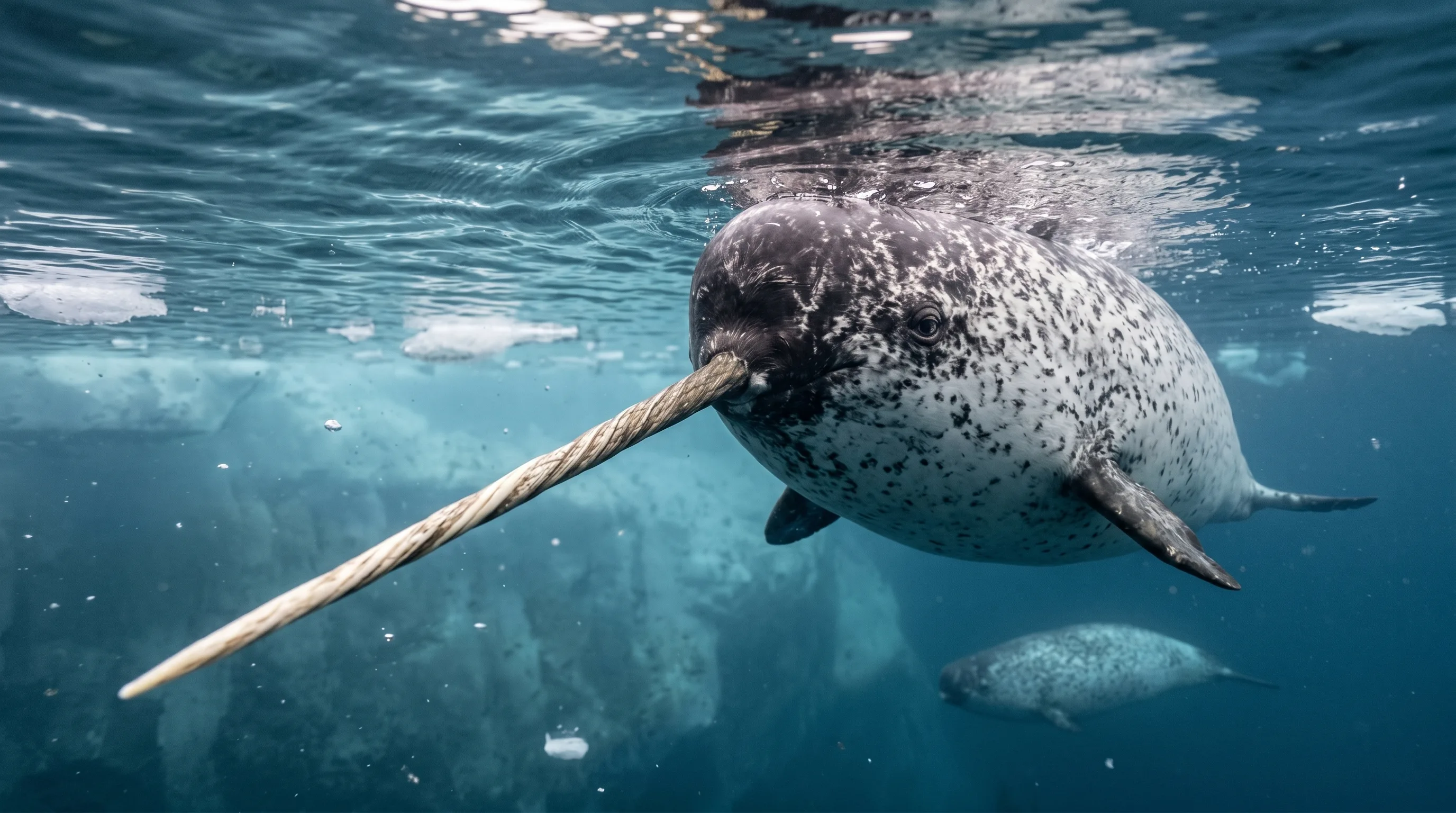
Narwhal (Monodon monoceros)
, and similar community-based hunting occurs in Nunavut, Canada. While total harvest is modest at the species level, the impact on smaller subpopulations — particularly in East Greenland — may be disproportionately significant and requires population-specific management rather than aggregate quota consideration alone.
Acoustic disturbance and industrial encroachment intensify as the opening Arctic invites expanded shipping, resource extraction, and military activity. The narwhal's documented stress response to vessel noise — including sustained heart rate elevation, energetically costly flight behaviour, and potential entrapment events — makes every new shipping route through its habitat a physiological cost imposed on a species already under cumulative pressure. Seismic surveys for oil and gas deposits produce low-frequency impulses that propagate hundreds of kilometres through Arctic waters, potentially masking echolocation returns and disrupting foraging efficiency across entire regional populations.
Chemical pollution, particularly mercury and polychlorinated biphenyls (PCBs), accumulates through the Arctic marine food chain and concentrates in the blubber and organs of long-lived, high-trophic-level predators. Narwhal tissue from harvested animals in Greenland has documented some of the highest mercury concentrations recorded in any Arctic marine mammal, with potential consequences for neurological function, immune response, and reproductive success across the entire exposed population.
Ecological Consequences
A significant decline in narwhal populations would structurally alter the Arctic marine food web in ways that reverberate across multiple species and trophic levels. The reduction of narwhal predation pressure on Arctic cod would allow that prey population to shift in age structure and abundance, with downstream effects on ringed seals, bearded seals, seabirds, and belugas that all compete with narwhals for the same resource base. The ecological principle of competitive release suggests that narwhal disappearance would advantage competing predators in the short term before destabilising prey populations in less predictable ways as the simplified Arctic food web absorbs the disturbance.
For polar bears and killer whales, loss of narwhals as a seasonal prey source increases pressure on already stressed alternatives. Ringed seals — the polar bear's primary prey — are themselves declining in some regions due to reduced sea ice habitat. Removing narwhals from the equation concentrates both bear and orca foraging pressure on a narrower prey base, increasing the probability of local prey depletion cascades. In a food web with lower biodiversity than temperate or tropical marine systems, the removal of any component species carries proportionally greater systemic risk.
The loss of the narwhal as a climate indicator would also impair the scientific community's ability to detect and interpret ecosystem change in the High Arctic in real time. Without this living instrument — whose movement patterns, dive depths, body condition, and reproductive rates reflect the integrated state of the Arctic Ocean — researchers lose one of their most sensitive tools for tracking the biological consequences of ongoing environmental transformation.
Conservation Efforts
The narwhal is protected under Canadian federal law through the Species at Risk Act (SARA), which designates it as a species of Special Concern — a status that triggers management planning and population monitoring obligations. In Greenland, narwhal hunting is managed through a quota system administered by the Greenland Self-Government, with allowable catch levels set in consultation with scientific advisors from the North Atlantic Marine Mammals Commission (NAMMCO).
Internationally, the narwhal is listed in Appendix II of the Convention on International Trade in Endangered Species (CITES), requiring export permits and documentation for narwhal products — principally tusks — traded across international borders. This listing has substantially reduced the commercial tusk trade that historically posed a significant extractive pressure on narwhal populations.
Research programmes operated by Fisheries and Oceans Canada, the Greenland Institute of Natural Resources, WWF's Arctic Programme, and university research groups across North America and Europe deploy satellite-linked tags, acoustic recording devices, and biopsy sampling to track narwhal movements, health, and population dynamics across seasons. Crucially, Indigenous community-based monitoring programmes — particularly in Nunavut — integrate Inuit Qaujimajatuqangit (traditional ecological knowledge) with scientific data collection, producing assessments of narwhal population health that are richer and more spatially extensive than remote survey methods alone can achieve.
Future Outlook
The narwhal's long-term survival is deeply tied to the trajectory of Arctic climate change — a factor largely beyond the reach of species-specific conservation measures. Under optimistic emissions scenarios limiting warming to 1.5–2°C above pre-industrial levels, the narwhal's core habitat in the Canadian High Arctic and northern Greenland retains sufficient seasonal sea ice to sustain populations, though with altered dynamics and increasing killer whale pressure. Under higher emissions pathways, the systematic loss of summer sea ice and the fundamental restructuring of Arctic marine prey communities would challenge even the most adaptable subpopulations.
The species has demonstrated resilience across millions of years of Arctic climate variability, including past interglacial periods with substantially reduced ice coverage. However, the speed of current warming is without geological precedent on human-relevant timescales, and the additional stressors of industrial noise, chemical pollution, and hunting create a compound threat profile that historical resilience alone cannot guarantee will be overcome. The narwhal's fate, more than almost any other species on Earth, is a direct function of whether humanity stabilises the Arctic climate system — a sobering reality that places its conservation firmly within the larger context of global emissions policy.
Human Relationship
Few animals have been as profoundly entangled in human imagination — and human commerce — as the narwhal. For the Inuit peoples of the Canadian Arctic and Greenland, the narwhal has been central to culture, diet, and material life for thousands of years. For medieval Europeans who never saw the living animal, its tusk was one of the most valuable commodities in the known world. The gap between these two relationships — one ecological and deeply respectful, the other mythological and extractive — captures the remarkable duality of the human-narwhal story across centuries.
Inuit hunters have pursued narwhals for at least several thousand years, using the animals as a source of food, oil, and material. The maktaaq — the outer skin and thin blubber layer consumed raw or fermented — is not merely a cultural food but a nutritionally critical resource in an environment where plant food is seasonally absent or inaccessible for months. Maktaaq is exceptionally rich in vitamin C, making it an indispensable antiscorbutic in a high-latitude diet otherwise severely deficient in that nutrient. Narwhal meat provides high-quality protein; the blubber yields oil for heating and light; the bones and tusks have historically served as tools, structural materials, and trade goods. The ecological knowledge embedded in Inuit narwhal hunting practices — encompassing migration routes, seasonal behaviour, group structure, ice reading, and weather interpretation — represents one of the world's most sophisticated bodies of applied environmental understanding, accumulated through centuries of direct, consequential observation.
In medieval and Renaissance Europe, the narwhal tusk occupied an entirely different cultural space. Traded by Norse seafarers from at least the ninth century and marketed as the horn of the legendary unicorn, narwhal tusks commanded prices that could exceed ten times the equivalent weight in gold. Powdered and dissolved, the "alicorn" was believed to detect and neutralise poison — an invaluable property in royal courts where assassination by poisoning was a constant political reality. The Danish throne, famously, was constructed of narwhal tusks. Queen Elizabeth I of England paid a sum equivalent to the value of an entire castle for a single specimen. The eventual European recognition of the tusk's true zoological origin — accelerated by Danish scientist Ole Worm's public identification of the narwhal as its source in 1638 — gradually collapsed this mythological market, though narwhal tusks circulated as curiosities and collector's items through the colonial period.
In contemporary human relations, the narwhal sits at the intersection of subsistence rights, scientific research, ecotourism, and climate advocacy. Narwhal-watching expeditions to the Canadian Arctic and Greenland attract growing numbers of wildlife tourists, generating economic value for Indigenous communities that offers a complement or alternative to direct harvest. The narwhal has simultaneously become a powerful symbol of Arctic conservation — its unmistakable silhouette deployed across environmental campaigns focused on sea ice loss, ocean protection, and the biological consequences of warming. Its continued study represents a scientific priority for polar researchers globally.
"We do not inherit the earth from our ancestors; we borrow it from our children."
— Often attributed to Antoine de Saint-Exupéry; widely adopted by conservation movements worldwide
Unique & Rare Facts
The tusk always spirals counterclockwise. Without a single documented exception, the narwhal's left upper canine grows in a left-handed (sinistral) helix. No narwhal with a right-spiralling tusk has ever been confirmed in the scientific literature.
Double-tusked narwhals are exceptionally rare. Fewer than one in several hundred males grows both upper canines into full tusks. These individuals carry two parallel spiral tusks of approximately equal length — a striking morphological departure from the single-tusk norm.
Female tusks represent the rarest form of all. Approximately one in 500 females develops a tusk — typically shorter, less spiralled, and straighter than the male's — yet structurally equivalent, with the same sensory dentine tubule architecture confirmed histologically.
A narwhal-beluga hybrid has been genetically confirmed. Genomic analysis of a skull collected in West Greenland verified it belonged to a first-generation hybrid — a "narluga" — with clear contributions from both a narwhal mother and a beluga father. The individual survived to adulthood and developed a foraging strategy intermediate between the two parent species.
Narwhals dive deeper than most military submarines operate. With depth records exceeding 1,800 metres, narwhals descend into zones of the Arctic Ocean that remain almost entirely beyond the reach of routine human technology.
Narwhal tusks were historically worth more than gold. In medieval Europe, a single tusk could fetch ten times its weight in gold on the open market, driven by widespread belief in the alicorn's ability to detect and cure poison.
Drone footage confirmed tusks are used to stun prey. Video captured during research in Nunavut waters and subsequently analysed showed male narwhals using rapid lateral tusk strikes to immobilise Arctic cod before consumption — a feeding behaviour entirely unknown to science before that footage was reviewed.
Narwhals vocalise at frequencies up to 100 kHz. This extends deep into the ultrasonic range — more than four times the upper limit of normal human hearing — placing narwhal vocalisations among the highest-frequency sounds produced by any large cetacean.
Their stress response to vessel noise is physiologically severe. Biologging studies have measured heart rate increases of up to 300% in narwhals disturbed by boat engines, accompanied by energetically costly flight responses that can exceed the caloric value of an entire day's successful foraging in a single event.
Narwhal skin is a genuine source of vitamin C. Maktaaq contains measurable levels of vitamin C — a nutrient nearly absent from the traditional high-latitude diet — making it nutritionally essential in an Arctic food system with no access to fresh plant material for most of the year.
Conclusion
The narwhal is an animal operating at the boundary of what biology permits. It dives to pressure-crushing depths, breathes through cracks in solid ocean, carries a sensory antenna on its face, and navigates the most extreme marine environment on Earth with an ease that speaks to millions of years of unhurried evolutionary refinement. It is not a myth, but it is genuinely extraordinary — and that distinction matters in an era when the extraordinary is disappearing faster than it can be documented.
What the narwhal represents ecologically is a system in working balance: ice, depth, temperature, prey, predator, and climate co-evolved into a functioning whole, with the narwhal sitting precisely at its centre. It feeds from the deep, breathes at the surface, flees into the ice, nourishes bears and orcas, and connects the biological productivity of Arctic coastal waters to the cold darkness of the benthic deep. Reduce it significantly, and that balance shifts in ways that are difficult to predict and harder to reverse in any timescale meaningful to human civilisation.
What the narwhal represents to people — to the Inuit communities who have hunted it with respect and ecological literacy for thousands of years, to the scientists who track it through Arctic winters, to those who simply find the knowledge of its existence grounding in an increasingly disorienting world — is something harder to quantify but no less real. It is evidence that the world still contains forms of life so specifically shaped by their environment, so perfectly strange, that no human imagination could have invented them from scratch. The narwhal exists. The Arctic that made it exists. And both, in the years ahead, will require the full weight of human intelligence, restraint, and political will if they are to continue doing so.
Sources & Attribution
Data and ongoing research referenced for this article come from the following authoritative sources — peer-reviewed publishers, official taxonomic registers, and global biodiversity programmes:
- IUCN Red List — Narwhal — official IUCN Red List assessment including population trend, threats, and conservation actions.
- Wikipedia — Narwhal — taxonomy, distribution, and an overview with onward citations to primary literature.
- GBIF — Narwhal — global occurrence and distribution records from the Global Biodiversity Information Facility.
- iNaturalist — Narwhal — observation records and field photographs contributed by naturalists worldwide.
- Encyclopedia of Life — Narwhal — multilingual species pages aggregating taxonomic and natural-history data.
- WWF — World Wildlife Fund — global wildlife conservation programmes and research summaries.
- Nature — research on Narwhal — peer-reviewed studies indexed by Nature on related ecology and behaviour.
- ITIS — Integrated Taxonomic Information System — federal-grade taxonomy and nomenclature.
Frequently Asked Questions
What is a narwhal tusk made of?
The narwhal's tusk is a modified tooth — specifically the elongated left upper canine — composed primarily of dentine, the same calcified tissue that forms the inner layer of all mammalian teeth. Unlike elephant ivory, which is solid throughout, the narwhal's tusk is semi-hollow, with a central pulp cavity running through its length and millions of microscopic tubules extending from the pulp outward to the tusk's surface. These tubules allow water and dissolved substances to interact with nerve fibres in the pulp, giving the tusk its remarkable sensory function in addition to its familiar visual profile.
The tusk grows throughout the male narwhal's life, adding length and girth each year — though growth rate slows with age. In the largest males, tusks can reach three metres in length and weigh up to ten kilograms. The counterclockwise spiral is invariant across all known individuals, making any clockwise-spiralling tusk an anatomical impossibility confirmed by every specimen ever examined.
Why do narwhals have tusks?
The narwhal tusk serves multiple simultaneous functions, and scientific understanding of its purpose has changed substantially over recent decades. For most of the twentieth century it was assumed to be primarily a male combat weapon, but this explanation was always incomplete: females survive and reproduce successfully without one, and the structure is poorly designed for direct impact. The more complete picture identifies the tusk as primarily a sensory organ, its dentine tubule architecture transmitting environmental information — water temperature, salinity, and potentially pressure gradients — directly to the pulp's nerve fibres. This sensory function may help narwhals locate prey and navigate the Arctic's ice-covered, optically opaque environment.
A third function, confirmed by drone footage reviewed in recent years, is as a hunting tool. Males have been filmed using rapid lateral tusk strikes to stun Arctic cod before consuming them — a feeding behaviour entirely unsuspected before direct video observation. Social functions, including dominance assessment through tusk-crossing behaviour and signalling of competitive status through tusk length and scarring, complete the picture of a structure serving ecological, sensory, and social roles simultaneously rather than any single purpose.
How deep can narwhals dive?
Narwhals are among the deepest-diving cetaceans on Earth. Satellite-linked depth recorders attached to tagged animals during winter foraging have documented dives exceeding 1,800 metres — deeper than many military submarines routinely operate. Typical winter foraging dives range from 800 to 1,500 metres, with the animal spending several minutes at depth locating and capturing Greenland halibut on or near the Arctic seafloor before ascending to breathe at a crack or lead in the overlying ice. A single dive can last up to 25 minutes.
Summer dives are considerably shallower, usually between 30 and 300 metres, reflecting the different prey distribution in coastal waters where Arctic cod concentrate near the surface. The extreme winter dives are supported by high muscle myoglobin concentrations, cardiovascular oxygen conservation, splenic oxygen storage, and a flexible ribcage that compresses safely under pressure — a complete physiological system shaped by millions of years of selection for exactly this performance.
What do narwhals eat?
Narwhals are carnivorous predators with a diet that shifts significantly between seasons. In summer, when they concentrate in coastal fjords and bays, their primary prey is Arctic cod (Boreogadus saida), the keystone fish of the entire Arctic marine food web. They also take polar cod, squid, cuttlefish, and various shrimp species. In winter, the diet shifts predominantly toward Greenland halibut (Reinhardtius hippoglossoides), a deep-water flatfish that requires the narwhal's extreme diving capability to access on the Arctic seafloor.
All feeding is accomplished by suction rather than biting. Adult narwhals have no functional teeth — the right upper canine remains embedded in the skull, and neither jaw carries biting structures — so the animal draws prey into the mouth through powerful muscular contraction of the throat and hyoid apparatus. This limits prey size to fish and invertebrates that can be engulfed whole, generally items up to roughly 30 centimetres in length.
How long do narwhals live?
Narwhals are long-lived animals. Age estimation using annual growth layers deposited in the vestigial right canine tooth — which remains embedded in the skull throughout life — has confirmed individuals reaching at least 50 years of age. Some research applying aspartic acid racemization to eye lenses has suggested maximum lifespans potentially exceeding this figure, though the methodology carries its own analytical uncertainties and the question remains open.
The long lifespan carries significant conservation implications. Narwhals reproduce slowly — females bear a single calf every three or more years after a gestation of 14 to 16 months — meaning population recovery from any significant decline is inherently gradual. Sustained hunting or mortality pressure can reduce a population faster than reproduction can compensate, making the species particularly sensitive to any human or environmental disturbance that elevates adult mortality rates beyond natural background levels.
Are narwhals endangered?
Narwhals are currently listed as Least Concern on the IUCN Red List, meaning the species does not presently qualify as threatened at the global level. The estimated global population is approximately 123,000 to 170,000 individuals, with the largest concentrations in the Canadian Arctic and West Greenland. However, the overall population trend is decreasing, and several subpopulations — particularly in East Greenland and Svalbard — face pressures more serious than the global assessment reflects.
Least Concern should not be conflated with "no conservation concern." Climate change, which is systematically dismantling the sea ice environment that narwhals depend upon, represents an existential long-term challenge that standard population assessments are poorly designed to capture in advance. The species' extreme habitat specialisation makes it acutely vulnerable to ecosystem-level transformation, and conservation scientists regard it as one of the Arctic's most climate-sensitive marine mammals.
Where do narwhals live?
Narwhals are found exclusively in the High Arctic. Their primary range encompasses the Canadian Arctic Archipelago, Baffin Bay, Hudson Bay, Hudson Strait, Davis Strait, and the fjords and coastal waters of Greenland. A smaller population inhabits waters around Svalbard and Franz Josef Land in the Norwegian and Russian Arctic. The species does not occur in the Pacific Ocean and has no presence in Antarctic waters.
Seasonal migration takes narwhals from shallow coastal fjords and bays in summer — where they feed intensively on Arctic cod — to deep offshore waters beneath pack ice in winter, where they dive to the seafloor for Greenland halibut. This dual-world existence, divided between ice-free coastal summer habitat and ice-covered deep-ocean winter habitat, is unique among Arctic cetaceans and defines the narwhal's ecological identity across every phase of its annual cycle.
Can narwhals survive in captivity?
No narwhal has ever survived in captivity for a significant period. Attempts made primarily during the 1960s and 1970s to maintain narwhals in aquarium facilities all resulted in the animals' deaths within days to weeks. The species' extreme physiological specialisation for deep, cold water — combined with its sensitivity to noise, its complex social requirements, and the impossibility of replicating Arctic pressure, temperature, and prey conditions artificially — makes it fundamentally incompatible with any captive environment currently achievable.
This reality has shaped all narwhal research: every scientific study of living narwhals is conducted in the field, using satellite tags, acoustic biologgers, video recorders, and biopsy sampling from free-ranging animals in their natural Arctic habitat. The logistical challenges of this work are significant, which partly explains why many aspects of narwhal behaviour and physiology remain less well understood than those of cetaceans that can be maintained or regularly observed in accessible coastal environments.
How do narwhals communicate?
Narwhals communicate through a repertoire of sounds produced in the nasal passage and directed forward through the melon. Their vocalisations include three broad functional categories: echolocation clicks used for prey detection and navigation; pulsed social calls exchanged between pod members; and whistles that appear to carry identity and contextual information, analogous to the signature whistles documented in dolphins. Click frequencies can reach up to 100 kHz — well into the ultrasonic range — providing exceptional spatial resolution in the optically opaque Arctic environment.
Social calls in narwhals show complex internal structure, with sequences of pulsed sounds varying in repetition rate, duration, and frequency content in ways likely to convey specific social information. The full communicative repertoire has not been decoded, in part because accessing vocalising animals in their Arctic winter habitat remains extraordinarily challenging. What is clear is that narwhals are highly vocal — particularly during summer aggregations — and that acoustic communication is central to maintaining pod cohesion in an environment where visual range is effectively zero for much of the year.
What is the relationship between narwhals and Inuit people?
The relationship between narwhals and Inuit communities is one of the oldest and most substantive human-wildlife relationships in the Arctic. For thousands of years, Inuit hunters have pursued narwhals using traditional kayaks and hand-thrown harpoons, developing ecological knowledge of narwhal migration routes, seasonal behaviour, pod structure, and ice conditions that constitutes one of the most sophisticated bodies of applied wildlife science maintained by any human community anywhere on Earth.
Narwhals provide maktaaq — skin and blubber consumed raw or fermented — which is nutritionally important as a source of vitamin C, healthy fats, and protein. Contemporary Inuit communities in Nunavut and Greenland continue to hunt narwhals under regulated quota systems, and Indigenous knowledge holders actively participate in scientific monitoring programmes, contributing movement observations and ecological assessments that complement and often extend what satellite tracking and aerial surveys can capture alone. The narwhal remains both a food source and a cultural touchstone whose significance in Inuit tradition extends far beyond the calories it provides — it is woven into the oral history, art, and identity of Arctic peoples in ways that no quota system or conservation framework fully captures.
Image: Wikipedia/Wikimedia Commons — “Narwhal”
Comments
Post a Comment