
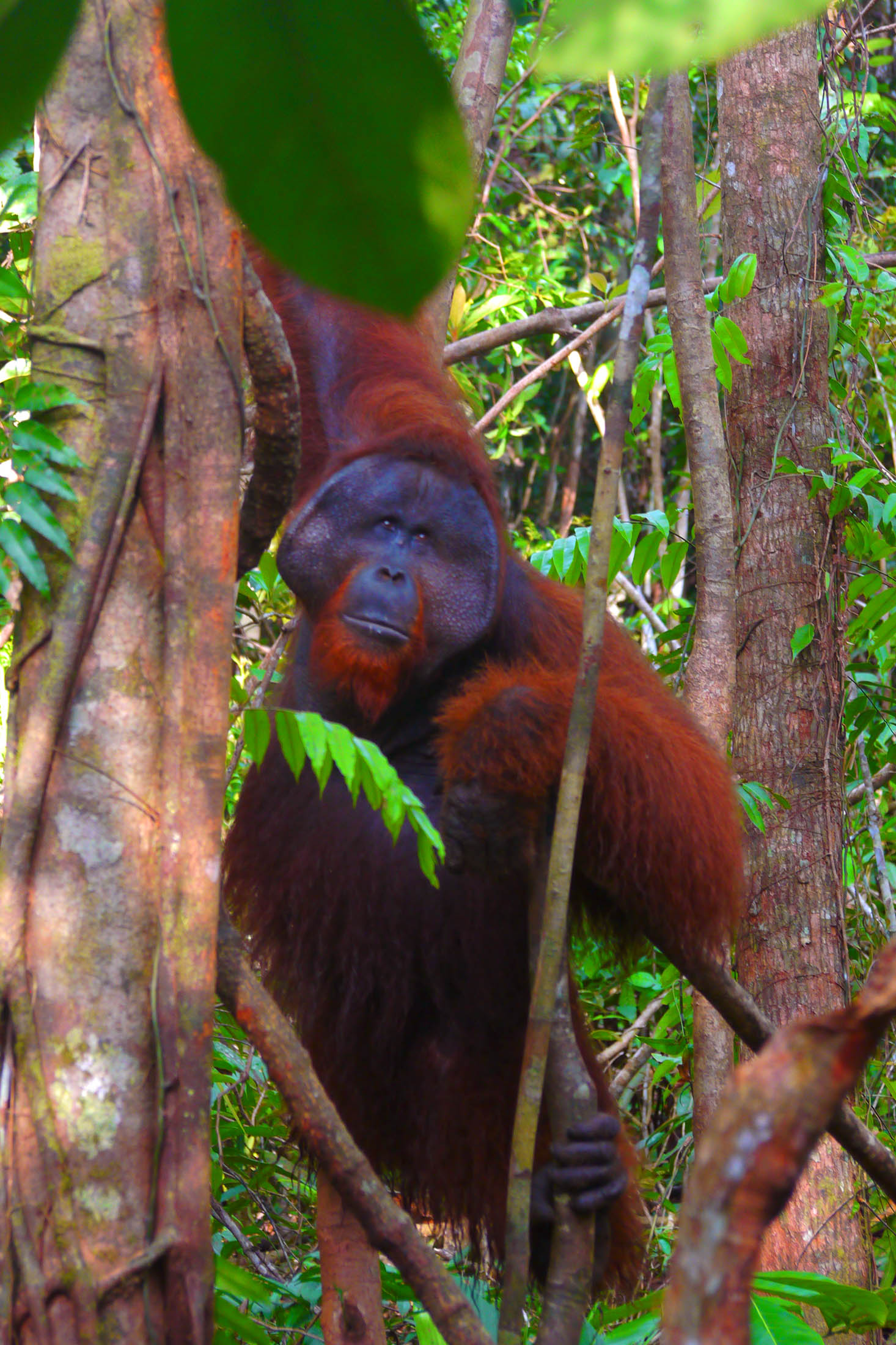
Orangutan (Pongo pygmaeus)
Introduction
High in the forest canopy of Borneo, a large, rust-coloured silhouette moves with unhurried deliberation through the upper storey of one of Earth's oldest rainforests. The animal pauses, one massive hand wrapped around a strangler fig branch with casual strength, and turns a broad, expressive face toward the distant sound of rainfall approaching through the trees. There is something arresting in that gaze — a quality of patient, considered awareness that feels less like instinct and more like contemplation.
The Bornean orangutan, Pongo pygmaeus, is Asia's only great ape. It is a creature that carries immense evolutionary weight — a lineage stretching back millions of years, a mind capable of sophisticated problem-solving, and a body exquisitely tuned to life in the forest canopy. Yet today, that ancient lineage survives against a backdrop of chainsaw and fire, oil palm and plantation, as the island of Borneo undergoes one of the most dramatic ecological transformations in modern history.
To understand the Bornean orangutan is to understand something profound about the nature of intelligence, the architecture of tropical ecosystems, and the consequences of human appetite. These apes are not peripheral curiosities in Borneo's wildlife tapestry — they are architectural forces in the forest, seed dispersers of irreplaceable scale, and emotional beings whose inner lives research continues to reveal with humbling depth.
"The orangutan is not just a species in peril. It is a mirror — showing us what we stand to lose when we treat ancient forests as obstacles rather than inheritances."
— Dr. Biruté Mary Galdikas, primatologist and orangutan researcher
This article examines every dimension of the Bornean orangutan's existence: its physical form, behavioural complexity, ecological role, evolutionary history, and the fragile future it now navigates. The story of Pongo pygmaeus is ultimately a story about the relationship between intelligence and survival — in the animal, and in ourselves.
Scientific Classification
Kingdom: Animalia
Phylum: Chordata
Class: Mammalia
Order: Primates
Family: Hominidae
Genus: Pongo
Species: Pongo pygmaeus
Common Name: Bornean Orangutan
Subspecies: P. p. pygmaeus (Northwest Bornean), P. p. morio (Northeast Bornean), P. p. wurmbii (Central Bornean)
IUCN Status: Critically Endangered
The genus Pongo contains three recognised species: the Bornean orangutan (Pongo pygmaeus), the Sumatran orangutan (Pongo abelii), and the Tapanuli orangutan (Pongo tapanuliensis), the last of which was only formally described as a distinct species in 2017. All three species are members of the family Hominidae — the great apes — placing them among humanity's closest relatives. Orangutans share approximately 96.9% of their DNA with modern humans, a fact that makes their continued decline all the more stark.
The three subspecies of Pongo pygmaeus differ subtly in skull morphology, body size, and geographic range. The Central Bornean subspecies, P. p. wurmbii, is the largest and most studied. All three face overlapping threats, though the Northwest Bornean population is considered the most critically reduced.
Physical Characteristics
The Bornean orangutan is the largest arboreal mammal on Earth. Adult males are considerably larger than females — a degree of sexual dimorphism rarely seen in great apes. Fully flanged adult males can reach 75 to 100 kilograms in body weight, with standing heights between 1.2 and 1.5 metres. Females are more gracile, typically weighing between 30 and 50 kilograms. The arms of an adult male, when spread, can span up to 2.2 metres — nearly twice the body height — a proportional reach that reflects an evolutionary commitment to arboreal locomotion.
The coat is long, shaggy, and unmistakably red-orange, though coloration varies considerably between individuals and populations. Juveniles tend toward brighter orange, while older males often develop darker, almost chocolate-brown patches on the face and flanks. The hair grows in irregular directions, giving adults a wild, unkempt silhouette against the forest canopy. This reddish coloration is thought to provide camouflage within the dappled light of tropical forest interiors.
One of the most distinctive physical traits of Pongo pygmaeus is the development of cheek pads — large, fleshy flanges that form on either side of the face in fully mature, dominant males. These flanges are composed of fatty and fibrous tissue and are unique to flanged males. They serve as visual signals of dominance and sexual maturity, and they frame the face in a way that dramatically amplifies the animal's long-range call, known as the long call. Not all males develop flanges — a biological phenomenon known as bimaturism means some males remain in an unflanged state for years, or even indefinitely.
Fun Fact Male orangutans possess a large throat sac, or laryngeal air sac, that can expand to the size of a football. This resonating chamber amplifies the long call — a booming vocalisation that can travel over a kilometre through dense rainforest.
The hands and feet of orangutans are hook-shaped, with long, curved fingers and a reduced thumb — adaptations that prioritise grip strength over precision dexterity when moving through the canopy. Their skin is dark grey-black beneath the hair. The face is bare, expressive, and mobile, capable of conveying a wide range of emotional states. Large, widely spaced eyes sit beneath a prominent brow ridge, giving the face its characteristic contemplative quality.
Trait | Bornean Orangutan (Pongo pygmaeus) | Sumatran Orangutan (Pongo abelii) |
|---|---|---|
Average male weight | 75–100 kg | 60–90 kg |
Coat colour | Darker red-brown | Brighter orange |
Cheek flanges | Rounder, more pronounced | Flatter, less prominent |
Beard / facial hair | Less pronounced | More prominent beard |
Social tolerance | More solitary | Slightly more social |
IUCN Status | Critically Endangered | Critically Endangered |
Habitat & Geographic Distribution
The Bornean orangutan is endemic to the island of Borneo, the world's third-largest island, shared between Malaysia, Indonesia, and the small sovereign nation of Brunei. Their historical range once covered much of the island's lowland and hill forest, but today's populations are fragmented into isolated pockets — concentrated primarily in the Malaysian states of Sabah and Sarawak, and the Indonesian provinces of Kalimantan.
Orangutans are fundamentally creatures of lowland tropical rainforest, though they can inhabit a range of forest types. Their preferred habitat is dipterocarp rainforest — the ancient, towering forests dominated by trees of the family Dipterocarpaceae — where the canopy reaches 40 to 60 metres in height and the structure offers an interconnected world of branches, lianas, and fruiting trees. They also use peat swamp forests, riverine forests, and montane forests up to altitudes of approximately 1,500 metres, though density and behaviour shift with elevation.
The quality of habitat matters enormously to orangutan survival. These animals require large, continuous tracts of forest to sustain themselves, particularly given the patchy, seasonal nature of fruit availability. Estimated home ranges for adult males can extend from 10 to over 30 square kilometres, while females tend to maintain smaller, overlapping ranges of 3 to 10 square kilometres. In heavily degraded or fragmented landscapes, these ranges can expand dramatically as animals travel further to find sufficient food.
Peat swamp forests — once considered marginal orangutan habitat — are now recognised as significant refugia. These waterlogged, carbon-rich ecosystems host resident orangutan populations even in areas where surrounding forests have been heavily degraded. However, peat swamps are also among the most threatened habitats in Southeast Asia, targeted for drainage and conversion to agricultural land.
Fun Fact Borneo's lowland dipterocarp forests are among the most biodiverse ecosystems on Earth, and some of the oldest — with geological stability stretching back over 140 million years. Orangutans have inhabited these forests for millions of years.
Behaviour & Social Structure
Orangutans are the most solitary of the great apes — a social strategy so unusual among our closest relatives that it demands explanation. Unlike gorillas and chimpanzees, which live in tight social groups with complex hierarchies, adult orangutans — particularly males — spend the vast majority of their lives alone. This is not social failure or evolutionary limitation. It is a precise adaptive response to the ecology of tropical island forests.
The key lies in food. Borneo's rainforests are characterised by irregular, unpredictable mast fruiting events — periods of intense synchronised fruit production that occur erratically, sometimes separated by years. In between these events, ripe fruit is dispersed thinly across vast areas. For a large-bodied animal that depends heavily on calorie-dense fruit, sharing a territory with others of the same species would be energetically catastrophic. Solitary life is a direct product of the forest's nutritional landscape.
Adult males are particularly exclusive. Flanged males patrol large home ranges, actively avoiding each other and competing for access to females. The acoustic signal of dominance — the long call — serves as a spacing mechanism, announcing presence and location to rivals. When two flanged males do meet, interactions can escalate into dramatic, prolonged confrontations involving chasing, branch-breaking, and physical grappling, though serious injury is relatively uncommon.
Females and their offspring represent the most stable social unit. A mother and her dependent offspring may travel together for up to eight years — one of the longest periods of maternal dependence in any non-human animal. Outside of this dyad, females maintain semi-overlapping home ranges and sometimes tolerate the proximity of other females, particularly in areas of high food density. Brief, non-competitive associations can form around fruiting trees.
Orangutan intelligence is extraordinary. Research has documented their use of tools in the wild — fashioning sticks to probe insect nests, using leaves as cups or umbrellas, and employing branches as handholds when crossing thorny vegetation. Their problem-solving capacity is comparable to that of chimpanzees in many laboratory settings, and field research suggests sophisticated planning behaviour, including the anticipation of future travel routes through the forest. They possess theory of mind, the ability to understand that others have beliefs and intentions distinct from their own, and they learn complex behaviours through observation and imitation over years of social exposure with their mothers.
Communication in orangutans spans vocalisations, facial expressions, gestural signals, and body postures. The long call of the flanged male is the most dramatic — a series of low, resonant booms that build in intensity before fading into a series of deep bubbling sighs. This call serves multiple simultaneous functions: advertising reproductive status to females, warning rival males, and orientating individuals across a fragmented landscape. Females produce kisssqueak vocalisations — a sharp sound made by pressing the lips together — often as a signal of alarm or mild distress.
Daily Life & Activity Cycle
An orangutan's day begins at first light. Before descending from its sleeping nest — a freshly constructed platform of bent and woven branches high in the canopy — the animal often sits quietly, scanning the surrounding forest. This early period of watchfulness is not idle: the animal is processing information about the forest around it, listening for the movements of other orangutans, and perhaps planning its route for the day.
Movement through the canopy is slow, deliberate, and energy-conservative. Orangutans practice quadrumanous locomotion — using all four limbs simultaneously as gripping appendages, distributing weight carefully across multiple supports. They avoid unnecessary leaping. Instead, they sway trees toward each other, transferring their weight gradually between trunks. This cautious approach reflects both the physical reality of supporting a 70-kilogram body in the treetops and a deep cognitive mapping of structural risk.
Feeding occupies the majority of active hours — often six to eight hours per day during periods of fruit availability. When fruit is scarce, orangutans shift to fallback foods: bark, leaves, fungi, and insects. This dietary flexibility demands constant adjustment of movement patterns. Periods of fruit abundance allow animals to spend time in relatively small areas, moving little. Periods of scarcity trigger longer daily travel distances and wider ranging behaviour.
Rest is taken frequently and strategically. Midday heat and the energetic demands of digestion drive long rest periods in which animals recline in the canopy, sometimes building temporary day nests. Social resting — when individuals share the same tree during this midday quiet — represents one of the more relaxed forms of orangutan interaction.
As evening approaches, the construction of a sleeping nest begins. This is not a trivial behaviour. Orangutans select specific tree species for nest construction, often choosing those with dense, flexible branching structures. The nest is built by bending branches across each other and weaving them into a stable platform that distributes body weight evenly. Blankets of leafy branches are added for insulation and cushioning. Construction takes five to ten minutes and the completed nest is structurally sound enough to withstand a full night of movement. Most animals build a fresh nest each evening, rarely reusing an old one.
Diet & Survival Strategies
The Bornean orangutan is overwhelmingly frugivorous — fruit, when available, forms the cornerstone of its diet. Ripe, fleshy fruits of hundreds of species are consumed, with figs (Ficus spp.) being particularly important as a reliable, abundant, year-round resource. During mast fruiting events, when dipterocarps and dozens of other tree species fruit simultaneously, orangutans enter a state of hyperphagia — consuming extraordinary quantities of high-energy food and accumulating significant subcutaneous fat reserves. These fat stores serve as a critical energy buffer during the lean months that follow.
When fruit is scarce — which can last for months between mast events — orangutans switch to a range of fallback foods. Cambium, the soft inner bark of certain tree species, provides calories and structural carbohydrates. Young leaves offer protein. Termite mounds and ant nests are excavated for insects, providing fat and protein. Certain fungi are consumed selectively. Even soil may be consumed to supplement mineral intake. This dietary breadth — spanning dozens of food categories — demonstrates a sophisticated nutritional awareness that reflects years of learning from the mother.
The capacity for dietary memory is remarkable. Studies using GPS tracking have shown that orangutans navigate directly toward trees that they remember bearing fruit in previous seasons — sometimes travelling several kilometres without deviation toward a specific tree in a specific location. This spatial memory for food resources across large territories is cognitively demanding and represents one of the clearest expressions of orangutan intelligence in an ecological context.
In the forests of Tanjung Puting National Park in Central Kalimantan, a researcher tracking a flanged male named Leo observed something that has stayed with her for years. Leo had been resting for most of the morning, seemingly inactive, when he suddenly descended from his perch and began moving with unusual directness — no hesitation, no exploratory pausing — through nearly four kilometres of secondary forest.
He arrived at a cluster of Duabanga trees at the forest edge. These trees were just beginning to set fruit — barely visible to a human eye at ground level, the faintest orange tinge detectable only with binoculars from directly below. Leo had not been near these trees for over three weeks. Yet he had moved toward them with the confidence of a creature that knew precisely what was there and when it would be ready.
He fed for nearly two hours, moving methodically from tree to tree, consuming the early-set fruits with deliberate selectivity — bypassing unripe clusters, returning to others. When he was done, he built a day nest in an adjacent tree and lay down in the early afternoon heat, the forest settling around him with the sound of cicadas and distant hornbills.
It was a quiet scene, unremarkable in any dramatic sense. But it illustrated with precision what decades of orangutan research continue to confirm: that within the mind of this solitary red ape is a detailed, living map of the forest — spatial, temporal, nutritional — constructed over decades of experience and updated moment to moment through sensory attention to the world around it.
Competition for food resources is managed primarily through spacing and avoidance. Flanged males use their long calls partly to broadcast location, which allows rivals to avoid costly direct confrontation. Females are more tolerant of each other near food sources but will displace juveniles or subordinate individuals when resources are limited. Energetic efficiency — moving as little as possible while consuming as much as possible — is the underlying logic of most orangutan foraging behaviour.
Interaction with Other Animals
For such large-bodied, intelligent animals, Bornean orangutans have surprisingly few direct predators. Their arboreal lifestyle places them above the reach of most terrestrial threats. However, certain large predators do represent a genuine risk, particularly to juveniles and smaller females. The Sunda clouded leopard (Neofelis diardi), an agile, heavily built cat capable of pursuing prey through the canopy, is the primary non-human predator of orangutans in Borneo. Crocodiles (Crocodylus spp.) pose a danger when orangutans descend to cross rivers, which they do terrestrially, moving awkwardly but with surprising speed when motivated.
Reticulated pythons (Malayopython reticulatus), the world's longest snake species, are known to inhabit Borneo's forests and have the physical capacity to kill juvenile orangutans, though documented predation events are rare. Historical records suggest that tigers once inhabited Borneo and would have represented a significant predatory pressure, but the Bornean tiger has been extinct since the Pleistocene or early Holocene, leaving the clouded leopard as the apex feline threat.
Orangutan interactions with other primate species are primarily passive. They share the forest with gibbons, proboscis monkeys, long-tailed macaques, and pig-tailed macaques, but direct competition is limited by dietary and spatial niche differences. Orangutans occasionally tolerate macaque presence near fruiting trees, though they will displace smaller primates when the resource is limited. Bearded pigs (Sus barbatus) frequently forage below fruiting trees, consuming dropped or rejected fruits — a form of opportunistic commensalism that benefits the pig without significantly harming the orangutan.
Hornbills — particularly the helmeted hornbill (Rhinoplax vigil) and rhinoceros hornbill (Buceros rhinoceros) — share many of the same fruiting tree species and occasionally compete with orangutans for fruit. Observations of orangutans and hornbills feeding simultaneously in the same fig tree are common in old-growth forests, representing a form of exploitative competition in which neither species systematically excludes the other.
Interaction with Environment
The Bornean orangutan's relationship with its forest habitat is not merely one of dependence — it is one of active ecological participation. As one of the largest and most wide-ranging frugivores in Borneo's forests, orangutans function as major seed dispersers for hundreds of plant species. Large-seeded fruits that cannot be dispersed by birds or smaller mammals are consumed by orangutans and transported across the forest floor and canopy, with seeds deposited in dung far from the parent tree. This service is irreplaceable at the scale that orangutans provide it.
Research has documented seed dispersal distances of up to several kilometres for certain plant species via orangutan gut passage. The gut retention time for many seeds is long enough to ensure that seeds are deposited in a different microhabitat from where they were consumed, increasing the probability of germination success away from the competitive shadow of the parent plant. For large-seeded canopy trees, orangutans may represent the only effective long-distance dispersal vector remaining in Borneo's increasingly defaunated forests.
Orangutans also interact with the forest structure through nest construction. The annual creation of thousands of nests across their range creates small disturbances in the canopy that increase light penetration to the understorey, facilitating the growth of pioneer plant species. Old, abandoned nests provide elevated microhabitats for epiphytic plants and invertebrate communities. Over long time scales, the cumulative effect of nest building on forest structure and species composition is measurable.
The species also responds as a biological indicator to changes in habitat quality. Research using orangutan population density as a proxy for forest health has shown strong correlations between orangutan presence and the integrity of forest structure, canopy cover, and tree species diversity. Forests from which orangutans have disappeared tend to show altered seed rain composition, reduced regeneration of large-seeded canopy species, and simplification of forest structure over time — a demonstration of the cascading effects of megafaunal loss.
Reproduction & Parenting
The reproductive biology of the Bornean orangutan is characterised by exceptional investment in each individual offspring — a strategy that produces highly capable young but renders the population extremely vulnerable to elevated adult mortality. Females typically give birth for the first time between 12 and 15 years of age, and the interval between successive births is the longest of any land mammal: seven to nine years on average, occasionally extending to ten years or more. A female orangutan may produce only four or five offspring in her entire lifetime.
Mating in orangutans is complex and sometimes coercive. Flanged males actively court females, engaging in prolonged close association, grooming interactions, and gentle physical contact. However, forced copulation by unflanged males is also documented — a disturbing behaviour that has been studied extensively and appears to be a reproductive strategy employed by males that have not yet achieved the flanged state. Females demonstrate clear mate preferences for flanged males, and offspring sired by flanged males may have developmental advantages, though the full genetic and behavioural implications remain an active area of research.
Gestation lasts approximately 245 days — close to human gestation. The newborn orangutan is completely dependent, weighing around 1.5 to 2 kilograms. It clings to its mother continuously and is carried at all times during the first year of life. Nursing continues for up to six or seven years, representing one of the longest lactation periods in any mammal. The nutritional and immunological benefits of prolonged nursing are significant, but the more important function appears to be social learning — the infant remains in constant contact with its mother throughout the critical period in which it learns the forest's complex geography, seasonality, food species, processing techniques, and social landscape.
The education a young orangutan receives from its mother is encyclopaedic. Over eight or more years, the juvenile learns to identify hundreds of edible plant species, understand seasonal fruit availability, navigate the three-dimensional forest architecture, construct sleeping nests, process difficult foods like bark and hard-shelled fruits, and manage social encounters. Much of this knowledge is not innate — it must be observed, practised, and remembered. The unusually long period of maternal dependence in orangutans is therefore not a developmental weakness but the mechanism by which cultural knowledge is transmitted across generations.
After weaning, sub-adult orangutans enter a period of semi-independence, sometimes associating loosely with the mother or other sub-adults before establishing their own home ranges. Males may spend years as wandering sub-adults before beginning to show flanging, depending on social and environmental conditions. The development of flanges appears to be suppressed in the presence of dominant flanged males, a fascinating endocrine-mediated social mechanism that regulates competitive dynamics within a population.
Evolutionary Adaptations
The orangutan lineage diverged from the lineage leading to African great apes and humans approximately 10 to 14 million years ago, based on molecular clock estimates and fossil evidence. The genus Pongo itself has existed in its current form for several million years, adapting progressively to the conditions of island Southeast Asia. This long evolutionary history has produced a suite of adaptations that are collectively unmatched among the great apes.
Bimaturism — the existence of two distinct adult male phenotypes — is one of the most unusual reproductive adaptations in any primate. Flanged males, with their cheek pads, throat sacs, and full body size, represent the dominant reproductive phenotype. Unflanged males retain a juvenile body form well into adulthood, suppressing secondary sexual characteristics in a way that allows them to move more covertly through female home ranges. This dual strategy is an evolved response to high intrasexual competition and the patchy distribution of females across a large landscape.
The hook-like hand morphology of orangutans is a direct adaptation to life in the canopy. The long, curved fingers generate enormous grip force with minimal muscular effort — critical for an animal that must support its entire body weight on a single branch during locomotion. Reduced thumbs increase reach and speed during branch-to-branch movement, while the opposable hallux (big toe) of the foot provides a secondary grip point, allowing the animal to effectively use all four limbs as independent prehensile tools.
Energy conservation is a physiological and behavioural adaptation of striking importance. Bornean orangutans have among the lowest field metabolic rates ever recorded for a mammal of their size — approximately half that predicted by standard allometric equations. This metabolic frugality allows them to survive extended periods of food scarcity that would be energetically devastating for other species. It manifests behaviourally as long rest periods, slow movement, and avoidance of unnecessary energy expenditure — the calm, deliberate quality that observers often describe as contemplative is, in part, a metabolic strategy.
Cognitive adaptations in orangutans include exceptional spatial memory, causal reasoning, tool use, and cultural transmission of learned behaviours. Populations in different parts of Borneo and Sumatra demonstrate different tool-using traditions — equivalent to the cultural variation observed in chimpanzee populations — suggesting that social learning and cultural transmission are fundamental features of orangutan cognition, not peripheral abilities.
Ecological Importance
The Bornean orangutan occupies a position in Borneo's ecological hierarchy that extends far beyond its role as a single species. As a mega-frugivore — one of the largest fruit-consuming animals in the forest — it performs seed dispersal functions of extraordinary scale and diversity. Studies have identified over 300 plant species whose seeds are dispersed by orangutans, a number that places this ape among the most ecologically active seed dispersers in any Asian ecosystem.
The importance of this role becomes clear when considering the regeneration dynamics of old-growth dipterocarp forest. Many of the dominant canopy species produce large, heavy seeds that fall directly below the parent tree and have poor natural dispersal ability beyond this immediate vicinity. Without the gut-passage dispersal that orangutans and other large frugivores provide, these seeds accumulate in competitive, high-density clusters that dramatically reduce germination success and seedling survival. Orangutan dispersal effectively redistributes genetic diversity across the forest, maintains spatial heterogeneity of tree species, and facilitates the regeneration of large canopy trees in gaps created by storms or fallen trees.
The loss of orangutans from a forest segment triggers a measurable shift in the composition of forest regeneration. Defaunation studies — examining forests before and after the removal of large frugivores — consistently show that the proportion of large-seeded tree species in the seedling community declines significantly in the absence of megafrugivore dispersal. Over decades, this compositional shift alters canopy structure, changes the light environment of the understorey, and reduces the biomass potential of the forest — with consequences for carbon storage, water cycling, and the survival of other species dependent on specific tree architectures.
Fun Fact A single adult orangutan can disperse the seeds of more than 300 plant species across its lifetime — making it one of the most ecologically significant individual organisms in any Bornean forest ecosystem.
Beyond direct ecological function, orangutans serve as an umbrella species — a flagship whose conservation drives protection for entire forest ecosystems and the thousands of species that depend on them. Protecting orangutan habitat means protecting the habitat of pygmy elephants, proboscis monkeys, sun bears, Sunda clouded leopards, and an extraordinary diversity of birds, reptiles, invertebrates, and plants. The orangutan, in this sense, functions as an ecological proxy for an entire biome.
Threats & Conservation
The Bornean orangutan faces an existential crisis driven by overlapping and mutually reinforcing threats, most of which trace their origin to human economic activity. The severity of these threats and the slow reproductive rate of the species combine to create a conservation challenge of unusual urgency. A species that produces fewer than five offspring per female lifetime cannot absorb sustained population losses and recover on any human-relevant timescale.
Deforestation is the dominant threat. Borneo has lost over 40% of its forest cover in the past half-century — one of the fastest rates of tropical deforestation recorded anywhere on Earth. The primary drivers are conversion to oil palm plantations and pulpwood plantations, logging (both legal and illegal), and agricultural expansion. The Indonesian and Malaysian portions of Borneo have both experienced intense pressure from the palm oil industry, which has converted vast tracts of lowland forest — the core orangutan habitat — into monoculture landscapes from which virtually all wildlife has been excluded.
Fires — often set deliberately to clear land for planting — represent a catastrophic seasonal threat. During El Niño years, when drought conditions intensify across Southeast Asia, peat swamp forests become extremely vulnerable to fire. The 1997–1998 fires in Borneo and Sumatra destroyed an estimated three million hectares of forest and killed thousands of orangutans. The 2015 fires were similarly devastating. Peat fires are uniquely destructive because they burn below the surface, consuming the peat layer itself and leaving landscapes incapable of forest regeneration for years or decades.
Hunting and the pet trade continue to reduce populations directly. Orangutans are killed for bushmeat, though this is less prevalent in Borneo than in parts of Africa where great ape hunting is more culturally entrenched. More significantly, infant orangutans are captured for the illegal pet trade — a process that invariably involves killing the mother, since an adult female will not surrender her infant without lethal force. A single infant entering the pet trade therefore represents the death of at least one adult female and the loss of her remaining reproductive potential.
IUCN Red List status is addressed in full in the following section, which examines the population data, threat mechanisms, and conservation response in detail.
IUCN Red List Analysis
Current IUCN Status
The Bornean orangutan (Pongo pygmaeus) is classified as Critically Endangered on the IUCN Red List — the highest threat category applied to a species before Extinct in the Wild. This classification, last assessed and confirmed in 2016 with ongoing validity, reflects the species' rapid population decline, severe habitat loss, and the combination of threats that together place the species at very high risk of extinction in the wild.
The Critically Endangered classification under IUCN criteria is triggered when a species meets at least one of five threshold conditions. In the case of Pongo pygmaeus, the primary qualifying criteria relate to population reduction: an estimated population decline of over 50% within the past three generations (approximately 75 years, given an orangutan generation length of roughly 25 years), with the decline driven by ongoing processes that have not been halted. The species satisfies multiple criteria simultaneously, underlining the severity of its situation.
Population Trend
The population trend for Pongo pygmaeus is decreasing. Current estimates suggest a total Bornean orangutan population of between 70,000 and 100,000 individuals, though methodological variability between surveys makes precise estimation difficult. Earlier assessments placed the total population as high as 120,000 individuals, but refined modelling and satellite-based habitat analysis have revised figures downward.
Historical decline has been dramatic. Palaeontological and genetic evidence suggests that orangutans were once distributed across much of mainland Southeast Asia, the Malay Peninsula, and surrounding islands. Even within the 20th century, population estimates for Borneo alone ran as high as 300,000 to 500,000 individuals as recently as the 1950s and 1960s. The trajectory from those figures to current estimates represents a loss of over 50% of the population within a single century — a decline driven overwhelmingly by habitat destruction rather than natural mortality.
Certain subpopulations have fared worse than others. The Northwest Bornean subspecies (P. p. pygmaeus) is believed to number fewer than 1,500 individuals and faces the most acute conservation situation. The Central Bornean subspecies (P. p. wurmbii), the most numerous, accounts for the majority of the total population estimate.
Main Threats
Habitat destruction remains the primary driver of population decline. The conversion of lowland forest to oil palm and pulpwood plantation has eliminated millions of hectares of orangutan habitat since the 1970s. The rate of deforestation in Kalimantan — the Indonesian portion of Borneo — accelerated sharply following economic liberalisation policies in the 1990s and continues at a significant rate despite regulatory reforms. Forests cleared for plantation do not recover on any biologically meaningful timescale for orangutans; the structural complexity, fruit diversity, and canopy architecture of mature rainforest cannot be replicated within decades.
Forest fires compound the effect of deforestation by degrading forests that logging has made vulnerable. Selective logging opens the canopy, introduces a dense understorey of fast-growing vegetation, and increases the risk of fire during drought years. The interaction between logging, drought, and fire creates a positive feedback loop of forest degradation that has affected millions of hectares of potential orangutan habitat across Borneo.
Hunting and the illegal wildlife trade impose direct mortality that a species with such a slow reproductive rate cannot absorb. Orangutans displaced from forest fragments by land clearing are often killed as agricultural pests when they enter plantations or gardens in search of food. This human-wildlife conflict results in hundreds of orangutan deaths annually. The pet trade, while smaller in scale than direct habitat loss, removes breeding females from populations with disproportionate demographic impact.
Infrastructure development — roads, dams, and mining operations — fragments remaining forest into isolated patches, severing population connectivity and preventing the genetic exchange and individual dispersal that sustain long-term population health. Road networks that penetrate previously inaccessible forest also increase hunting pressure and facilitate further agricultural encroachment.
Ecological Consequences
The continued decline of Pongo pygmaeus carries ecological consequences that extend far beyond the loss of a single charismatic species. As the analysis of ecological importance above demonstrates, orangutans are functionally irreplaceable seed dispersers for hundreds of plant species. Their removal from a forest ecosystem initiates a slow-motion transformation of forest composition — a process sometimes called defaunation-driven vegetation change — that reduces the dominance of large-seeded canopy trees, alters forest structure, and diminishes the capacity of the forest to store carbon, regulate water, and maintain biodiversity.
Population fragmentation poses its own ecological threat. As orangutans become concentrated in isolated forest patches, local genetic diversity decreases, inbreeding increases, and the population becomes more vulnerable to disease outbreaks and demographic stochasticity. Small, isolated populations are particularly vulnerable to local extinction following environmental perturbations such as drought, disease, or fire — events that a larger, connected population could absorb.
The cascading effects of orangutan loss on other species include reduced seed germination success for plant species dependent on gut-passage scarification, altered competitive dynamics between plant species with different dispersal strategies, and changes in the food resource base for other frugivores that benefit from orangutan nest construction and foraging activities. Borneo without viable orangutan populations would be measurably less complex, less diverse, and less resilient — a forest diminished at its ecological foundation.
Conservation Efforts
A range of conservation measures are in place across Borneo, though their collective impact remains insufficient to reverse the population trajectory. Protected areas form the backbone of orangutan conservation. Tanjung Puting National Park in Central Kalimantan — where Dr. Biruté Galdikas has maintained a research presence since 1971 — is one of the most important sites for orangutan protection and rehabilitation. Danum Valley Conservation Area and Kinabatangan Wildlife Sanctuary in Sabah, Malaysia, protect significant orangutan populations in a heavily pressured landscape. Sebangau National Park in Central Kalimantan protects one of the largest remaining peat swamp forest orangutan populations.
Rehabilitation and release programmes, operated by organisations including the Borneo Orangutan Survival Foundation (BOS), the Orangutan Foundation International (OFI), and International Animal Rescue, care for orphaned and confiscated orangutans, preparing them for reintroduction into suitable forest. These programmes rehabilitate hundreds of individuals, though their role in population recovery is debated — the limiting factor for orangutan population growth is habitat availability, not the number of rehabilitated individuals. Without sufficient protected forest into which rehabilitated animals can be released, the conservation benefit is limited.
Corridor programmes — efforts to re-establish forest connectivity between isolated fragments — represent one of the most promising strategic directions. The Heart of Borneo initiative, a transboundary conservation agreement between Malaysia, Indonesia, and Brunei, aims to maintain a connected forest landscape of over 220,000 square kilometres across the island's interior. Sustainable certification schemes for palm oil, such as the Roundtable on Sustainable Palm Oil (RSPO), seek to raise the environmental standards of a major deforestation driver, though implementation and enforcement remain inconsistent.
Scientific research programmes — particularly long-term field studies at sites like Camp Leakey in Tanjung Puting, the Sabangau Research and Training Centre, and Danum Valley — generate the population data, behavioural knowledge, and ecological understanding that underpin effective conservation policy. These programmes also develop local scientific capacity and contribute to the broader engagement of Indonesian and Malaysian scientists in orangutan conservation.
Future Outlook
The future of the Bornean orangutan depends on outcomes that remain genuinely uncertain. If current deforestation trends continue at their recent pace, modelling by the IUCN Species Survival Commission projects that Pongo pygmaeus could lose an additional 25 to 30% of its remaining population by 2025, declining toward the threshold below which recovery becomes demographically implausible without intensive intervention.
There are, however, reasons for qualified optimism in specific contexts. Sabah, Malaysia, has shown that orangutan populations in degraded and logged forest can maintain higher densities than previously assumed, suggesting that selectively logged habitat — if protected from fire, hunting, and further conversion — retains real conservation value. The discovery of orangutan populations persisting in degraded forest matrices has expanded the perceived range of habitable environments and created new opportunities for community-based conservation that includes economic incentives for local stakeholders.
The long-term survival of this species depends on the resolution of several fundamental challenges: a significant reduction in deforestation rates, enforcement of existing protected area boundaries, the development of sustainable land-use models that provide economic alternatives to forest conversion, and the elimination of orangutan hunting and the pet trade. None of these are trivial objectives, and all require sustained political will and international cooperation. The biological reality is stark: the Bornean orangutan cannot survive another half-century of habitat loss at the rates experienced in the second half of the 20th century.
Human Relationship
The word "orangutan" derives from the Malay and Indonesian words orang (person) and hutan (forest) — "person of the forest." This etymology reflects a recognition, embedded in local cultures for centuries, that these animals occupy a space somewhere between the wild and the familiar. In the traditional worldviews of many Bornean indigenous groups — including the Dayak peoples — orangutans were regarded with a mixture of respect, kinship, and spiritual significance. Some traditions held that orangutans were humans who had retreated into the forest to avoid work, a folk story that captures something genuine about the uncanny human-likeness of these animals.
The modern human relationship with orangutans is characterised by profound contradiction. On one side lies an active and passionate global conservation community, an industry of ecotourism centred on wildlife observation, decades of scientific research that have illuminated orangutan intelligence and ecological importance, and genuine cultural affection for these animals across much of Southeast Asia. On the other side lies the economic machinery of palm oil, timber, and agricultural expansion — industries that have destroyed the habitat of millions of orangutans over the past century, supported in part by global consumer demand for the products they generate.
Ecotourism offers a partial bridge between conservation and economic development. In Sabah, wildlife-watching tourism along the Kinabatangan River generates significant local revenue and creates economic incentives for forest protection that can influence land-use decisions. The Sepilok Orangutan Rehabilitation Centre receives hundreds of thousands of visitors annually, functioning simultaneously as a rehabilitation facility and as a wildlife tourism destination that connects international audiences with conservation in a tangible, emotionally engaging way.
Human-wildlife conflict remains a daily reality along the edges of remaining forest. Orangutans displaced by deforestation enter oil palm plantations in search of food, where they are considered pests. Plantation workers and managers sometimes kill or capture these animals. The economic logic of the plantation worker who kills an orangutan destroying palm fruit is different from that of the conservation biologist documenting population decline, and any conservation strategy that ignores this reality — the lived experience of people whose livelihoods intersect with orangutan survival — will ultimately fail.
Unique & Rare Facts
Orangutans are the only great apes found outside of Africa, representing the Asian branch of the great ape family tree. Their nearest living relatives outside the genus Pongo are gorillas, chimpanzees, bonobos, and humans.
The Bornean orangutan has one of the lowest field metabolic rates ever measured for a primate — allowing it to survive food scarcity events that would be physiologically catastrophic for other large mammals.
Female orangutans have been documented entering post-reproductive lifespan years — living well past the age at which they can produce offspring, in a manner that superficially parallels human menopause. Elder females appear to function as knowledge resources within their social networks.
Different orangutan populations show distinct cultural traditions in tool use, food processing, and nest construction — behaviours that vary geographically but are transmitted socially from mother to offspring, meeting the scientific criteria for animal culture.
Orangutan long calls function as individual acoustic signatures — researchers can identify individual flanged males by the unique acoustic characteristics of their calls, much as humans identify each other by voice.
Male orangutans are capable of remaining in an unflanged state for their entire lives if a dominant flanged male is present — an endocrine suppression phenomenon regulated by social cues, not genetic programming.
Orangutans have been observed in the wild applying chewed plant material to wounds on their skin, in behaviour that researchers interpret as self-medication using plants with known anti-inflammatory properties — a possible precursor to medicinal behaviour.
A study of a Sumatran orangutan population documented the spontaneous fabrication and use of a hook tool to retrieve an out-of-reach object — a level of causal tool construction previously considered uniquely human or limited to captive great apes.
Orangutans construct their sleeping nests with measurable engineering precision. Structural analysis of nest architecture has shown that orangutans consistently select branch configurations that maximise load-bearing capacity and minimise material — results comparable to basic structural engineering principles.
The genome of Pongo pygmaeus, sequenced in 2011, revealed a genetic history markedly different from that of African great apes. Orangutan chromosomes show lower rates of large-scale genomic rearrangement than chimpanzees or humans — suggesting greater genome stability over evolutionary time, despite the divergent environmental pressures of island Southeast Asia.
Conclusion
The Bornean orangutan is not simply a species fighting for survival at the edge of extinction. It is a window into the architecture of a world that existed before human economies reshaped it — a world of ancient forests, seasonal abundances, and slow-burning intelligence accumulated across millions of years. In the deliberate movement of a flanged male through a forest canopy, in the tender patience of a mother teaching her infant to open a thorny fruit, in the long, resonant boom of a call that travels kilometres through old-growth forest, there is something that transcends taxonomy and enters the domain of the profound.
What the science tells us — clearly, consistently, and with increasing urgency — is that these animals are not replaceable. Not ecologically, because the seed dispersal functions they perform are not redundant in any meaningful way. Not cognitively, because the cultural knowledge they carry — forest geography, seasonal patterns, food-processing techniques — is accumulated over decades and transmitted across generations in ways that cannot simply restart. And not ethically, because the biological and behavioural evidence for their rich inner lives, their capacity for suffering, memory, and attachment, places them in a moral category that demands genuine responsibility.
"When we save the orangutans, we are also saving ourselves — because we are saving the forests, the climate, and the future that sustains all life."
— Dr. Biruté Mary Galdikas, Orangutan Foundation International
Borneo stands at a crossroads. The economic pressures that have driven deforestation are real and will not simply evaporate under the pressure of conservation idealism. But so too are the ecological consequences of continued loss — consequences measured not in abstract scientific units but in the silence of forests where long calls no longer travel, in the absence of seedlings from trees that can no longer complete their life cycles, in the structural simplification of one of Earth's most complex and ancient ecosystems.
The story of Pongo pygmaeus is still being written. Its ending will be determined by decisions being made now — in plantation boardrooms and government ministries, in consumer choices and international trade policies, in the actions of field conservationists and the communities who live alongside remaining forest. The forest person of Borneo has inhabited its ancient home for millions of years. Whether it will inhabit it for millions more depends, with uncomfortable directness, on us.
Sources & Attribution
Data and ongoing research referenced for this article come from the following authoritative sources — peer-reviewed publishers, official taxonomic registers, and global biodiversity programmes:
- IUCN Red List — Orangutan — official IUCN Red List assessment including population trend, threats, and conservation actions.
- Wikipedia — Orangutan — taxonomy, distribution, and an overview with onward citations to primary literature.
- GBIF — Orangutan — global occurrence and distribution records from the Global Biodiversity Information Facility.
- iNaturalist — Orangutan — observation records and field photographs contributed by naturalists worldwide.
- Encyclopedia of Life — Orangutan — multilingual species pages aggregating taxonomic and natural-history data.
- WWF — World Wildlife Fund — global wildlife conservation programmes and research summaries.
- Nature — research on Orangutan — peer-reviewed studies indexed by Nature on related ecology and behaviour.
- ITIS — Integrated Taxonomic Information System — federal-grade taxonomy and nomenclature.
Frequently Asked Questions
What is the Bornean orangutan's scientific name?
The Bornean orangutan's scientific name is Pongo pygmaeus. It belongs to the family Hominidae — the great apes — and is classified in the genus Pongo alongside the Sumatran orangutan (Pongo abelii) and the recently described Tapanuli orangutan (Pongo tapanuliensis). The species is divided into three subspecies: P. p. pygmaeus, P. p. morio, and P. p. wurmbii.
How endangered are Bornean orangutans?
Bornean orangutans are classified as Critically Endangered on the IUCN Red List — the highest threat level before Extinct in the Wild. The current population is estimated at between 70,000 and 100,000 individuals, down from several hundred thousand in the mid-20th century. Primary threats include deforestation driven by palm oil expansion, forest fires, and the illegal pet trade.
What do Bornean orangutans eat?
Bornean orangutans are predominantly frugivorous, with ripe fruit — especially figs — forming the core of their diet when available. During periods of food scarcity, they consume bark (cambium), young leaves, insects, fungi, and occasionally soil for minerals. Their nutritional flexibility and extraordinary spatial memory for fruiting tree locations are critical survival adaptations in an ecosystem characterised by unpredictable food availability.
How long do orangutans live?
In the wild, Bornean orangutans are estimated to live 40 to 50 years, though precise data from fully wild populations are limited by the difficulty of long-term individual monitoring. In managed care, individuals have reached their mid-50s. Their slow life history — late sexual maturity, long inter-birth intervals, and extended juvenile dependence — means that each individual's survival carries disproportionate demographic weight for the population.
Are orangutans solitary animals?
Yes — the Bornean orangutan is the most solitary of the great apes. Adult males in particular spend the vast majority of their time alone, a social strategy driven by the patchy, unpredictable distribution of food resources in Borneo's rainforests. The most stable social unit is a mother and her dependent offspring, who remain together for seven to nine years. Females may tolerate loose proximity to other females near abundant food sources, but cohesive social groups in the chimpanzee or gorilla sense do not exist.
How do orangutans communicate?
Orangutans communicate through a combination of vocalisations, facial expressions, gestures, and body postures. The most dramatic vocalisation is the long call of flanged males — a booming, far-carrying call amplified by the laryngeal air sac that functions simultaneously as a male spacing mechanism and a female attraction signal. Other vocalisations include the kisssqueak — a sharp alarm call produced by pressing the lips together — and various softer grumbles, squeals, and raspberry sounds used in close-range social interactions. Facial expressions convey fear, submission, interest, and playfulness with considerable nuance.
What is the role of orangutans in the rainforest ecosystem?
Orangutans are ecologically critical as mega-frugivores and seed dispersers. They consume the fruits of over 300 plant species and transport seeds across large distances through gut passage, facilitating the regeneration and genetic mixing of plant populations across the forest. Their removal from a forest ecosystem initiates measurable changes in plant community composition, canopy structure, and the capacity of the forest to store carbon and sustain biodiversity. They also function as an umbrella species — their habitat requirements encompass those of thousands of other species.
How do orangutans build their nests?
Orangutans construct a fresh sleeping nest almost every night, typically in the upper or middle canopy. Nest construction involves selecting a tree with suitable branching architecture, bending large branches across each other to form a platform, and weaving smaller leafy branches over the top for cushioning and insulation. The process takes five to ten minutes and the resulting structure is capable of supporting the animal's full body weight throughout the night. Nest site selection and construction technique improve with age and experience — juveniles practice nest building years before they sleep independently.
How many babies do orangutans have?
Orangutans have one of the slowest reproductive rates of any mammal. Females give birth to a single infant after a gestation of approximately 245 days, and the interval between births is seven to nine years — sometimes longer. A female may produce only four or five offspring in her entire lifetime. This extremely low reproductive rate means that the species has almost no capacity to compensate for elevated mortality through increased reproduction, making adult survival the critical factor in population viability.
Can orangutans use tools?
Yes, orangutans are skilled tool users in both wild and managed settings. In the wild, they have been documented using sticks to probe insect nests for honey or larvae, using leaves as cups to drink water and as gloves to handle spiny fruits, and employing branches as handholds or probes during exploration. Different wild populations show distinct tool-using traditions that are transmitted socially from mother to offspring — meeting scientific criteria for animal culture. In managed settings, orangutans have demonstrated complex causal reasoning in tool manufacturing tasks, including the construction of hook tools to retrieve out-of-reach objects.
Where can Bornean orangutans be seen in the wild?
Bornean orangutans can be observed in several protected areas across Malaysian and Indonesian Borneo. Key sites include Tanjung Puting National Park and Sebangau National Park in Central Kalimantan (Indonesia), and Danum Valley Conservation Area, Kinabatangan Wildlife Sanctuary, and the Sepilok area in Sabah (Malaysia). Responsible wildlife tourism at these locations supports conservation funding and provides local economic incentives for forest protection, though visitor numbers and behaviour should be carefully managed to minimise disturbance to wild individuals.
What is the difference between Bornean and Sumatran orangutans?
The Bornean orangutan (Pongo pygmaeus) and Sumatran orangutan (Pongo abelii) are distinct species that diverged approximately 400,000 years ago. Bornean orangutans are generally heavier, with darker, less uniform fur and rounder, more prominent cheek flanges in males. Sumatran orangutans are slightly more slender, have brighter orange coats, and males develop flatter, more angular flanges with a more pronounced beard. Behaviourally, Sumatran orangutans tend to be slightly more social and demonstrate somewhat higher rates of tool use in wild populations. Both species are Critically Endangered, though the Sumatran species has a smaller total population and is considered marginally more at risk.
Image: Wikipedia/Wikimedia Commons — “Bornean orangutan”
Comments
Post a Comment