
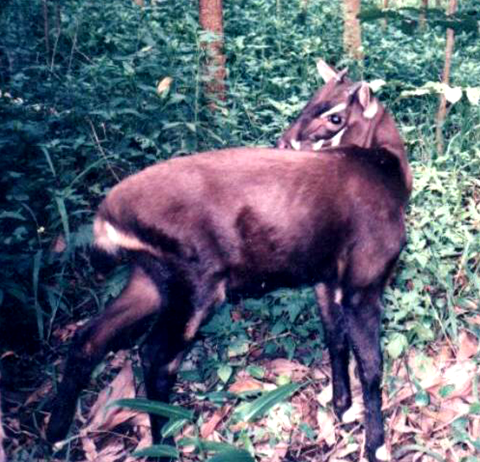
Saola (Pseudoryx nghetinhensis)
Introduction
Deep within the mist-draped Annamite Mountains, where the borders of Vietnam and Laos blur beneath a canopy of ancient mixed evergreen forest, one of the most elusive large mammals on Earth moves in near-total silence. The Saola — a bovid so cryptic, so impossibly rare that the scientific world did not even know it existed until 1992 — remains one of the most urgent conservation emergencies the modern world has produced. It belongs to no other genus, no related clade of living ungulates. It is, in the most precise biological sense, alone.
When biologists from the Ministry of Forestry of Vietnam and the World Wildlife Fund stumbled upon a skull with unusual parallel horns in a hunter's house in Vũ Quang Nature Reserve, the discovery sent shockwaves through zoology. A large, entirely new genus and species of wild bovid had evaded scientific documentation until the final decade of the twentieth century. The Saola — named from the Vietnamese for the spinning posts of a traditional weaving loom, a reference to its long, straight horns — was described formally in 1993. It was the first large mammal new to science discovered in over fifty years.
Decades later, the species has never been observed in the wild by a professional scientist. What we know comes from camera trap photographs, local hunter accounts, a handful of captive animals that each died within weeks of capture, and the painful silence of forests that grow emptier every year. The Saola conservation status sits at the most extreme end of the IUCN Red List — Critically Endangered — and population estimates range from under a hundred individuals to the grim possibility that the number is already far lower. This is not a species in decline. This is a species in freefall, and time is not neutral.
This analysis examines the Saola not as a curiosity of zoological discovery but as a living system embedded in one of Southeast Asia's most biologically rich and most threatened forest landscapes. Understanding what the Saola requires, what it provides to its ecosystem, and what forces are dismantling its survival requires the full weight of ecological analysis, conservation engineering, and honest confrontation with the inadequacies of current governance.
"The greatest threat to our planet is the belief that someone else will save it."
— Robert Swan, explorer and conservationist
Population Dynamics
The population of the Saola is, in scientific terms, functionally unknown — and that uncertainty is itself a critical conservation problem. There has been no verified live sighting by a researcher in the wild. The last confirmed camera trap image was captured in 2013 in Laos, near the Xe Sap National Protected Area. Since then, cameras deployed across the Annamites have returned thousands of images of wildlife — but no Saola. This absence is not definitive proof of extinction, but it is deeply alarming.
Estimates published by the IUCN Saola Working Group suggest the global population is almost certainly below 100 individuals, and some expert assessments suggest the figure may be closer to 20–50. These estimates are extrapolated from habitat modelling, camera trap absence data, and interview surveys with local hunters who report sharply declining encounter rates over recent decades. The population is almost certainly not a single unit. It is fragmented across isolated forest patches, meaning each subpopulation may be too small to sustain demographic stability independently.
Breeding biology in the Saola is poorly understood due to the complete absence of long-term field observations. What is inferred from morphology, fecal DNA sampling, and hunter testimony suggests they are likely slow-reproducing, with females probably producing a single calf per year at most, and sexual maturity reached at two to three years of age. This life-history strategy — common among forest-dwelling ungulates in stable environments — becomes catastrophically fragile when population numbers drop below critical thresholds. Low reproductive rates mean that any adult mortality above natural background levels cannot be replaced fast enough to offset the losses.
The primary driver of population decline is not habitat loss alone — though that accelerates the problem — but the catastrophic pressure of mass snare deployment throughout the Annamites. Saola are being killed not as the primary target, but as bycatch of a snaring culture aimed at capturing wild boar, deer, sambar, and other bushmeat species. Every snare line left in the forest — and there are hundreds of thousands of them — represents a lottery of death for any Saola that moves through that patch of terrain. Population modelling based on snare density and estimated ranging behaviour suggests the probability of a Saola encountering a snare at least once in its lifetime is extremely high. The question is not whether they are being caught; the question is how many are left.
Remarkable DiscoveryThe Saola was the first large mammal new to science discovered anywhere in the world in over 50 years when formally described in 1993 — a reminder that even large vertebrates can remain hidden when forests are intact and remote enough.
Habitat Stability & Ecological Pressure
The Annamite Mountain range — a spine of forested ridges and river valleys running approximately 1,100 kilometres north to south along the Vietnam-Laos border — is the Saola's entire world. The species has never been confirmed outside this range. Within it, Saola appear to prefer lower and mid-elevation moist evergreen and mixed deciduous forest, particularly areas near small streams and rivers within steep, rugged terrain. The dependence on specific valley and stream habitats within the Annamites means the Saola's available ecological niche is geographically constrained even before human pressure is applied.
Deforestation within the Annamites has been substantial. Vietnam lost approximately 43% of its primary forest cover over the latter half of the twentieth century, and while legal deforestation rates have declined since the implementation of a national logging ban in 1992, illegal logging and agricultural encroachment continue to fragment core forest blocks. In Laos, forest loss has accelerated dramatically since 2000 due to plantation expansion, road construction linked to Chinese infrastructure investment, and hydropower development. The forests that Saola depend upon are being eroded at their edges and cut through with roads that fragment remaining interior habitat.
Road construction is particularly damaging for Saola ecology because roads function as ecological barriers to secretive, forest-dependent ungulates, and simultaneously as access corridors for hunters. Every new road built into previously inaccessible forest is a double blow: it reduces the area of truly undisturbed forest and dramatically increases the reach of hunting pressure. The Ho Chi Minh Highway, completed in the early 2000s, bisected critical Annamite forest habitat and opened landscapes that had previously been difficult for outsiders to access.
Watershed degradation and loss of riparian forest further compound the pressure. Saola are strongly associated with stream habitats, likely because these zones provide salt and mineral sources as well as denser, cooler vegetation. When riparian buffers are cleared for agriculture — particularly wet rice cultivation in valley floors — the vegetative corridors that Saola use for movement are destroyed. A species that depends on specific landscape features within an already narrow geographic range cannot simply relocate when those features disappear.
| Habitat Feature | Historical Condition (pre-1990) | Current Condition (2020s) |
|---|---|---|
| Forest cover in Annamites | Largely intact contiguous forest | Fragmented, with plantation and road incursion |
| Riparian corridors | Dense valley forest along waterways | Cleared or degraded in many lowland areas |
| Human access to core forest | Limited by terrain and road absence | Significantly increased via new road networks |
| Snare density | Low — traditional subsistence hunting | Extremely high — commercial bushmeat trade |
| Large mammal prey species | Abundant ungulate diversity | Severely depleted across much of the range |
The concept of the ecological tipping point is directly applicable here. Forest ecosystems can absorb incremental loss up to a threshold, beyond which the internal dynamics of the ecosystem begin to unravel faster than degradation can be halted. The Annamites are approaching — and in some areas have likely crossed — this threshold for large mammal persistence. The wider "empty forest syndrome," in which structurally intact forest loses its large fauna to hunting before the trees themselves fall, is well documented across Southeast Asia and applies forcefully to Saola habitat.
Ecological Role (Keystone Analysis)
Classifying the Saola's ecological role is complicated by how little is known about its behaviour, diet, and interactions. What can be inferred from its anatomy, closely related bovid ecology, and the forest systems it inhabits paints a picture of a medium-large forest ungulate functioning as a browser and grazer of riverine and forest understory vegetation. With a body weight estimated at 80–100 kg and a presumed home range within forested valley systems, the Saola almost certainly plays a role in seed dispersal, vegetation browsing control, and as prey for the large predators that share its range.
As a herbivore operating in dense evergreen and semi-evergreen forest, the Saola likely influences the structure of understory vegetation through selective browsing. Forest ungulates that browse specific plant species prevent any single plant from monopolising understory resources, maintaining the species diversity that makes tropical forest floors ecologically complex. Remove a browser of this size and habit, and the vegetation community may shift — certain fast-growing, less palatable species may expand at the cost of the structural diversity the ecosystem depends upon.
The Saola also functions as a prey base for large predators. The Annamite Mountains support populations of tiger (Panthera tigris corbetti), clouded leopard (Neofelis nebulosa), and the Indochinese leopard (Panthera pardus delacouri), all of which face their own severe conservation pressures. These apex predators require a prey community that includes medium-large ungulates. As the Saola disappears, and as other ungulates such as the large-antlered muntjac (Muntiacus vuquangensis) and Annamite striped rabbit (Nesolagus timminsi) are similarly depleted, the prey biomass available to top carnivores declines. This drives a trophic cascade — predators that cannot sustain themselves on forest prey begin raiding livestock, intensifying human-carnivore conflict, and creating conditions that may lead to retaliatory killing.
Perhaps the most important consideration in the Saola's ecological role is not what we know it does, but what we know it represents. The Saola is a phylogenetically unique lineage with no close living relatives. Its closest evolutionary neighbours are cattle and buffalo (tribe Bovini), but it is the sole member of the genus Pseudoryx, a lineage that diverged approximately 8–12 million years ago. Its extinction would remove not just a species but an entire evolutionary branch, erasing millions of years of unique adaptation that cannot be replicated by any surviving relative.
If the Saola disappears, the Annamite ecosystem loses a component that shaped its evolution. The consequences may be subtle but are structurally real: a forest without its unique medium-sized browser is not the same forest. The ecological vacancy created by extinction is not automatically filled. Other species do not simply step in to perform the exact same functions. Over time, ecosystem composition drifts in ways that progressively reduce its capacity to support other specialist species.
Human-Wildlife Conflict
The relationship between human communities in the Annamites and the Saola is complex, rooted in centuries of coexistence, and now critically disrupted by economic forces that have fundamentally changed how forest resources are exploited. Traditional subsistence hunting by ethnic minority communities — including the Bru, Pacoh, Tà Ôi, and other groups along the Vietnam-Laos border — was for millennia part of an ecological equilibrium. Small-scale hunting with traditional methods, conducted within customary tenure systems that included de facto exclusion zones and seasonal restrictions, did not produce the extinction pressure the Saola now faces.
The transformation began in earnest with the expansion of cash economies into rural Annamite communities, the construction of infrastructure that connected remote villages to urban wildlife markets, and the explosion of commercial demand for bushmeat and wildlife products across Vietnam and to a lesser extent Laos. The snare — a cheap, passive, scalable hunting technology requiring no skill, no time in the field, and no firearm — became the primary hunting tool across the landscape. A single hunter can set hundreds of snares across a large area of forest, check them infrequently, and sell the catch to intermediaries who move product to urban centres.
The Saola is not hunted specifically. No significant evidence suggests that hunters seek Saola intentionally. But non-selective snaring does not discriminate. A snare set for wild boar or sambar will equally kill a Saola passing through the same terrain. This indiscriminate nature makes the threat qualitatively different from targeted poaching — it cannot be resolved simply by removing the market for Saola products. As long as snares are deployed at the current density for any wildlife, Saola will continue to be killed as bycatch.
Agricultural expansion into forest margins has further constrained Saola movement. As communities expand cultivation into valley floors and lower slopes, the riparian forest that Saola depend upon for movement and nutrition is progressively cleared. This does not typically produce direct conflict in the way that elephant crop raiding or tiger livestock depredation does. The conflict with Saola is spatial and existential — not a confrontation but a displacement that leaves the animal with less and less viable habitat in which to survive.
In 1996, a Saola was brought alive to a village in the Bolikhamxai Province of central Laos. Local hunters had found it trapped in a snare and, recognising it as unusual, brought it to the village. Wildlife officials were notified, and photographs were taken — images that provided some of the first photographic documentation of a live Saola. The animal survived for less than two weeks in captivity before dying, as every other Saola brought into captivity has done.
What the photographs revealed was extraordinary: a muscular, upright bovid with two perfectly parallel horns sweeping straight back from the crown, large facial glands flanking a muzzle that appeared almost deer-like in its delicacy, and a coat of deep chestnut brown with white facial markings. There was nothing in zoology quite like it.
The village elders who saw the photographs recognised it immediately. In the Lao and Vietnamese communities of the Annamites, the Saola was known — hunters had encountered it occasionally for generations, and it featured in local oral traditions as a ghost of the forest, rarely seen, difficult to trap, vanishing before it could be properly observed. It was not mysterious to the people who lived alongside it. It was simply part of the forest they had always known.
That forest is now a fragment of what it was in those elders' childhoods. The snares that caught that 1996 Saola were not set by a commercial poaching ring — they were set by men trying to feed their families in a landscape where wild protein had always been part of the diet. The tragedy of the Saola is not a story of greed alone. It is a story of systems — economic, ecological, and political — that converged on the wrong forest at the wrong time.
Climate Change Vulnerability
The Annamite Mountains sit within a region experiencing measurable and accelerating climate change. Mean annual temperatures across the Greater Mekong Subregion have increased by approximately 0.5–1.3°C since the mid-twentieth century, and projections under moderate emissions scenarios suggest a further 1.5–2.5°C increase by 2100. Rainfall patterns are shifting, with more variable monsoon timing, increased drought frequency during dry season, and intensification of extreme rainfall events. These shifts affect every component of Annamite forest ecology.
For the Saola specifically, the most critical climate-linked vulnerability is the compound effect of thermal stress, vegetation change, and altered hydrology on the riverine and moist forest habitats the species depends upon. Higher temperatures increase evapotranspiration, drying out the understory environments and stream margins that Saola appear to prefer. Phenological shifts — changes in the timing of flowering, fruiting, and leaf flush in forest plants — may disrupt the seasonal nutritional resources that guide movement and influence body condition.
The Saola's adaptability capacity is, in honest assessment, very limited. There are no data on behavioural plasticity in response to environmental change, and given the already desperate population situation, there is likely insufficient population size to express or select for adaptive traits even if genetic variation existed. Unlike generalist species that can shift diets, expand into degraded habitat, or adjust breeding timing in response to environmental cues, the Saola is a forest specialist with a tiny, fragmented population and no demonstrated capacity to occupy alternative habitats.
Range-shift potential — the ability of a species to track its preferred climate envelope by moving to higher elevations or different latitudes — is theoretically available in the Annamites, where elevational gradients exist. However, the landscape fragmentation caused by roads, agriculture, and settlement means that movement corridors between elevational zones are blocked. Even if climatically suitable forest remains at higher elevations, a Saola cannot reach it if the corridor has been severed. Climate change thus interacts with habitat fragmentation to produce a compounding vulnerability that neither pressure alone would generate.
Wildfire risk is an emerging and underappreciated threat. Prolonged dry seasons and higher temperatures increase fuel load ignition risk in forest margins, particularly in areas where logging debris and agricultural burning create ignition hazards adjacent to intact forest. Unlike fire-adapted savanna species, the Saola is a closed-canopy specialist with no evolutionary relationship to periodic fire regimes. Even low-intensity fires at the forest edge destroy the structural complexity of the habitat at precisely the interface zones where human-forest boundaries already stress the population.
Genetic Diversity Concerns
The genetic dimensions of the Saola's crisis are, if anything, even more alarming than the population size figures suggest. With an estimated population potentially below fifty individuals, distributed across fragmented subpopulations that cannot freely interbreed, the Saola may already be experiencing the early stages of a genetic bottleneck that will progressively erode its evolutionary resilience regardless of what happens to snaring pressure or habitat quality.
Genetic diversity in wild populations is maintained through gene flow — the movement of individuals between populations that introduces new alleles and prevents the accumulation of harmful mutations through inbreeding. When populations are fragmented and individual groups become isolated, gene flow ceases. Each isolated subpopulation begins to diverge genetically, losing heterozygosity through random genetic drift and increasing the frequency of deleterious recessive alleles. The smaller the isolated group, the faster this process operates.
Analysis of Saola fecal DNA and tissue samples collected from dead or captive-held individuals has revealed that the species already shows lower genetic diversity than would be expected for a large bovid — a legacy, potentially, of a historical bottleneck during the Pleistocene or simply the natural consequence of specialisation in a restricted mountain range. Starting from a position of reduced genetic diversity and then fragmenting an already small population accelerates the timeline to inbreeding depression — reduced fertility, increased calf mortality, elevated disease susceptibility, and immune system impairment.
The absence of a captive population further closes off the conservation options typically available for genetically at-risk species. For most Critically Endangered mammals, captive breeding programmes serve as a genetic reservoir, allowing managers to preserve alleles and plan breeding between genetically distinct individuals to maintain heterozygosity. Every Saola brought into captivity has died within weeks, and no breeding programme has ever been successfully established. This means there is no genetic safety net. Whatever genetic diversity remains in the wild population is all that exists, and it is being eroded every year.
Genetic IsolationThe Saola is the sole living member of the genus Pseudoryx, representing an evolutionary lineage that diverged from its nearest bovid relatives approximately 8–12 million years ago. Its extinction would erase this entire evolutionary branch from the tree of life.
Conservation Engineering Solutions
The conservation of the Saola presents an engineering challenge unlike almost any other in wildlife management, precisely because the standard toolkit of conservation interventions must be adapted to a species that cannot be handled, cannot be monitored directly, and exists in such low numbers that any intervention that disrupts or stresses individuals risks directly hastening extinction. The conservation engineering framework must therefore prioritise passive habitat security over direct species management.
The single most impactful and immediate conservation action available is snare removal at massive, sustained, and professionally coordinated scale. The Saola Working Group, operating through the WWF and Wildlife Conservation Society, has supported ranger teams conducting snare removal patrols across critical Annamite protected areas in both Vietnam and Laos. In documented operations, individual teams have removed tens of thousands of snares per year from target areas. The challenge is scale and persistence: the snare density across the Annamites is so high that removal operations must be continuous — a forest cleared of snares in one season will be reset within months without sustained law enforcement presence.
Camera trap arrays represent the primary monitoring technology for a species that cannot be approached, tracked by collar, or sampled through direct capture. Strategically deployed camera trap networks across stream valleys and forest corridors provide the only systematic evidence of Saola presence or absence. The challenge is the signal-to-noise problem: camera traps cover a tiny fraction of potential Saola habitat, and the species' extreme rarity means that absence of detection cannot be interpreted as absence of the animal. Machine learning-based image classification is now being integrated into camera trap programmes, allowing rapid sorting of millions of images and detection of events that manual review might miss. AI-assisted monitoring has improved efficiency but has not yet solved the fundamental coverage problem.
Environmental DNA (eDNA) sampling from waterways represents one of the most promising technological advances for Saola monitoring. Saola shed genetic material into the streams they visit through urine, feces, and skin cells. Water samples collected downstream can be analysed for Saola-specific DNA sequences, providing evidence of recent presence across a much larger geographic footprint than camera traps can cover. The Saola Working Group and partner laboratories have been developing and validating eDNA protocols for the species. Initial field deployment in priority stream systems has occurred, and while results remain preliminary, this method could transform understanding of where the species persists.
Wildlife corridors connecting the fragmented protected area network across the Annamites are a critical medium-term conservation engineering priority. The existing protected area mosaic — including Pu Mat National Park and Vũ Quang National Park in Vietnam, and Nakai-Nam Theun and Xe Sap NPAs in Laos — contains significant forest but is broken by roads, agricultural settlements, and degraded matrix. Establishing and maintaining functional landscape corridors requires not just physical habitat restoration but negotiated land-use agreements with local communities, buffer zone management, and long-term patrols to prevent snaring within corridor zones.
The development of a captive assurance population remains a long-term conservation engineering goal, despite the complete failure of every previous captivity attempt. A dedicated Saola sanctuary — not a conventional zoo enclosure but a large, carefully managed semi-wild enclosure in appropriate habitat — has been proposed by the Saola Working Group. The facility concept calls for a large forested area managed to provide appropriate habitat conditions, with minimal human contact protocols and veterinary capability developed specifically for the species. Whether such a facility can be built, whether Saola can be safely captured and transported, and whether they will survive long enough to breed under managed conditions are questions that cannot be answered without attempting the attempt — and the risk of accelerating extinction through the attempt itself is real.
Ecosystem Interdependence
The Annamite Mountains are biologically one of the most remarkable regions in Asia. Described by conservation biologists as a biodiversity hotspot within a hotspot, they have produced a disproportionate number of species new to science relative to their geographic extent. In addition to the Saola, the Annamites have yielded the large-antlered muntjac (Muntiacus vuquangensis), the Annamite striped rabbit (Nesolagus timminsi), the Truong Son muntjac (Muntiacus truongsonensis), and the Annamite dark muntjac (Muntiacus rooseveltorum) — all discovered within the last three decades. This is not coincidence. These are old forests with deep evolutionary histories, and the species they contain are part of an integrated ecological web that has been assembling for millions of years.
The Saola's position within this web is interconnected with predator-prey dynamics, herbivore guild structure, and nutrient cycling in ways that cascade through the system. As a medium-large herbivore browsing riverine and forest understory vegetation, the Saola contributes to the shaping of plant community composition. Selective browsing pressure applied across a forest landscape over evolutionary time influences which plant species dominate understory layers, affecting light availability, regeneration dynamics, and structural complexity at the ground level. These structural effects propagate up the food web — more complex understory structures support more diverse invertebrate communities, which in turn support insectivorous bird and bat populations.
Nutrient cycling through ungulate dung and urine in riparian forest zones is a well-documented ecological mechanism. Forest ungulates that concentrate around waterways deposit nitrogen and phosphorus in a biogeochemical feedback that fertilises riparian vegetation and indirectly supports aquatic invertebrate communities through leaf litter quality. The loss of medium-large ungulates from stream-associated habitats creates a measurable reduction in riparian nutrient input — a subtle but real degradation of ecosystem function that accumulates over decades.
The interdependence of the Saola with the wider Annamite mammal community is also a function of shared habitat requirements. The same forest patches, stream systems, and ecological conditions that Saola require are also the habitats in which the large-antlered muntjac, Owston's civet (Chrotogale owstoni), and Annamite striped rabbit persist. Conservation engineering that protects Saola habitat thereby creates a conservation umbrella — securing conditions that benefit the entire suite of Annamite endemic and near-endemic species simultaneously. The Saola is, in this sense, a biodiversity flagship: its protection is the protection of an entire ecosystem.
Species DiscoveryThe Annamite Mountains have yielded more new large mammal species in the last 30 years than any other region on Earth, including the Saola, large-antlered muntjac, and Annamite striped rabbit — all discovered after 1990 in the same forest system.
Future Extinction Risk Modelling
Quantitative extinction risk modelling for the Saola is severely constrained by the absence of reliable population size data, the lack of demographic parameters from field studies, and the impossibility of conducting standard mark-recapture population assessments. What exists instead are expert-informed probabilistic models that attempt to translate qualitative information about population size ranges, mortality rates, and reproductive potential into extinction probability estimates across defined time horizons.
A Population Viability Analysis (PVA) framework applied to plausible Saola scenarios consistently produces alarming outputs. Under assumptions of a current population of 50 individuals with current snaring mortality rates and no significant conservation intervention, modelled extinction probability within fifty years exceeds 70%. Under scenarios assuming a population of 25 individuals — which some experts consider likely — the fifty-year extinction probability under unmitigated threat exceeds 90%. The most optimistic models, incorporating aggressive snare removal and effective ranger patrols across core protected areas, reduce extinction probability substantially but do not eliminate it even with sustained intervention, due to the genetic erosion already accumulated and the demographic fragility of tiny populations.
The concept of the minimum viable population (MVP) — the smallest population size at which a species has a statistically acceptable probability of long-term persistence — is theoretically relevant here. For most large mammal species, MVP estimates fall between 500 and 5,000 individuals, depending on life history, spatial structure, and environmental variation. The Saola, at any realistic current population estimate, is operating at a fraction of its MVP. This means that even in the absence of ongoing hunting pressure, the population may be too small to sustain itself without active genetic management and demographic support.
Recovery modelling is, in the current context, contingent on assumptions that are not yet met. A scenario in which the Saola population recovers to a viable size requires: (1) near-elimination of snaring mortality across core habitat; (2) functional habitat connectivity maintained across the Annamite range; (3) successful captive breeding and potential population supplementation; and (4) sustained genetic diversity management. No single one of these conditions is currently in place. The probability of all four being achieved simultaneously within the next decade is assessed by most experts as very low.
The extinction risk for the Saola is not a distant theoretical concern. It is a near-term probability that some researchers believe may already be an ecological reality — the species may have already crossed a demographic threshold from which recovery is impossible without heroic intervention. The 2013 camera trap image remains the last confirmed evidence of a living Saola in the wild. Thirteen years of silence from a landscape under camera trap surveillance is a data point that deserves to be treated with the seriousness it represents.
| Scenario | Assumed Population | Threat Status | 50-Year Extinction Probability |
|---|---|---|---|
| Baseline (no intervention) | ~50 individuals | Current snaring rates continue | >70% |
| Low population, no intervention | ~25 individuals | Current snaring rates continue | >90% |
| Aggressive intervention | ~50–80 individuals | 80% snare reduction, corridor protection | ~30–45% |
| Optimistic intervention + captive supplement | ~100+ individuals | Full protection, genetic management | <15% |
Conservation Policy & Governance
The governance framework for Saola conservation spans two countries — Vietnam and Laos — with different legal systems, different institutional capacities, and different relationships between central government and local communities. Effective conservation requires synchronised, binational management across a landscape that does not recognise borders, and achieving that synchronisation has been one of the persistent challenges of Annamite conservation.
In Vietnam, the Saola is legally protected under the Law on Biodiversity (2008) and the Penal Code, which criminalises the hunting, trading, and possession of endangered species. The species is listed in Vietnam's Red Data Book at the highest protection level. On paper, this legal framework is strong. In practice, enforcement capacity across the remote forested landscape of the central Annamites is limited. Ranger services in protected areas are chronically underfunded, understaffed, and outpaced by the scale and persistence of snaring activity. Corruption at local enforcement levels further undermines legal protections.
In Laos, wildlife protection legislation has been strengthened in recent years, with amendments to the Wildlife and Aquatic Law increasing penalties for wildlife trafficking. However, enforcement capacity remains weaker than in Vietnam, and the Lao protected area system — while large in geographic extent — is not adequately staffed or funded for active management. Large protected areas that exist primarily on paper without active ranger presence provide limited real-world protection for the species within them.
International mechanisms supporting Saola conservation include CITES, under which the species is listed on Appendix I, prohibiting commercial international trade. The Convention on Biological Diversity (CBD) provides a framework for transboundary conservation cooperation, and both Vietnam and Laos are signatories. Bilateral cooperation between the two governments on transboundary protected area management has developed, including the establishment of the proposed Annamite Transboundary Protected Area complex, though formal joint management structures remain incomplete.
The role of international NGOs — primarily WWF and Wildlife Conservation Society — has been critical in bridging governance gaps. These organisations provide technical support, training, equipment, and funding to ranger services, operate the Saola Working Group as a scientific and coordination body, and maintain advocacy pressure on national governments. Their involvement has ensured that Saola conservation remains on the institutional agenda despite the absence of visible results in terms of population recovery.
Indigenous and local community governance systems represent an underutilised resource in Saola conservation. Ethnic minority communities in the Annamites maintain traditional relationships with forest ecosystems that include customary tenure, seasonal use restrictions, and ecological knowledge accumulated over generations. Conservation approaches that engage these communities as partners — providing economic alternatives to snaring, integrating local knowledge into monitoring, and recognising community rights over forest resources — are more likely to achieve durable outcomes than externally imposed enforcement alone. The experience of community forestry models elsewhere in Southeast Asia demonstrates that conservation and local livelihoods can be aligned, but this requires genuine investment in community relationships and benefit-sharing mechanisms.
"Conservation is a state of harmony between men and land."
— Aldo Leopold, A Sand County Almanac
IUCN Red List Analysis
Current IUCN Status
The Saola (Pseudoryx nghetinhensis) is classified as Critically Endangered (CR) on the IUCN Red List of Threatened Species. This classification — the highest threat category applied to a species still believed to exist in the wild — reflects a population estimated to have declined by more than 80% over the last three generations, with ongoing declines continuing under current conditions. The Critically Endangered designation under IUCN criteria A2cd + C2a(i) captures both the rate of population reduction attributed to exploitation and habitat degradation, and the extremely small estimated population size combined with continuing decline and population fragmentation.
The CR classification for the Saola is not a precautionary designation. It reflects a genuine and scientifically-grounded assessment that the species faces an extremely high probability of extinction in the wild in the near future unless the circumstances threatening its survival and reproduction cease. The IUCN Saola Working Group, which coordinates the scientific assessment and drives the conservation response, has consistently maintained this status since the species was first assessed, and there is no basis in current population data to suggest reclassification to a less threatened category.
Population Trend
The population trend for the Saola is assessed as decreasing. The exact population size is unknown, but expert consensus places the figure below 100 individuals, with many assessments suggesting a much lower number — potentially 20–50 individuals across the entire Annamite range in both Vietnam and Laos. Historical population estimates are unavailable because the species was not known to science until 1992, making it impossible to establish a pre-decline baseline in the conventional sense.
What can be inferred from hunter encounter rate data, camera trap detection frequency, and habitat modelling is that the Saola was already rare when first discovered and has declined further since. The pattern of camera trap detections — increasingly sparse, geographically restricted, and temporally distant — is consistent with ongoing population decline. The most recent confirmed camera trap image was obtained in 2013 in Laos. No verified sighting has been recorded since, across more than a decade of systematic camera trap surveys covering portions of the species' range.
The downward trend is driven primarily by snaring mortality, which removes individuals faster than the population can reproduce. Without a reversal of this mortality source, the trend will continue. The population may also be subject to Allee effects at current densities — the difficulty of finding mates at very low population densities can suppress reproductive rates even in the absence of additional mortality, creating a positive feedback loop that accelerates decline.
Main Threats
Non-selective snaring is the primary and most immediate threat to Saola survival. Tens to hundreds of thousands of wire snares are estimated to be active across Annamite forests at any given time, set primarily for commercial bushmeat hunting of common ungulates. Saola are captured incidentally but regularly. With a population in the tens of individuals, even a single snare death per year represents a demographically significant loss.
Habitat loss and fragmentation operate as a compounding pressure that reduces available range, severs connectivity between subpopulations, and increases the proportion of the landscape accessible to hunters. Deforestation for agriculture, logging, plantation development, and infrastructure construction within and adjacent to the Annamite protected area system continues to reduce and fragment Saola habitat. Roads are particularly damaging because they function simultaneously as habitat barriers and access corridors for hunters.
Climate change exacerbates both of these pressures by altering the hydrology and vegetation composition of Saola's preferred stream-associated habitats, potentially reducing the quality and extent of suitable habitat even within currently forested areas. Increased drought frequency and temperature stress on montane forest communities will over time restructure the vegetation assemblages the Saola depends upon.
Very small population size itself constitutes a threat through demographic stochasticity, inbreeding depression, and Allee effects. Below a critical population threshold, random variation in births and deaths, and the loss of genetic diversity from inbreeding, can drive extinction independent of any external threat. The Saola may be at or below this threshold.
Ecological Consequences
The extinction of the Saola would represent a disproportionate loss relative to its individual population size, because of its unique phylogenetic position and the cascading effects its disappearance would trigger in the Annamite ecosystem. As the sole member of the genus Pseudoryx — an evolutionary lineage 8–12 million years old — its extinction erases an irreplaceable branch of the bovid family tree with no analogue among surviving species.
Ecologically, the loss of Saola from Annamite forest systems would reduce ungulate herbivore diversity, weakening the redundancy of ecological functions performed by the forest herbivore guild. Forest plant communities that evolved in the context of Saola browsing pressure would be released from that pressure, potentially shifting in composition in ways that reduce structural complexity and reduce habitat quality for other specialist species. Apex predators — already under pressure — would lose another prey species from an increasingly depleted community.
Beyond the Annamites, the Saola's extinction would signal the failure of conservation governance across one of Asia's most biodiversity-rich landscapes. The species has functioned for over three decades as a conservation flagship and fundraising catalyst for the broader Annamite ecosystem. Its loss would reduce political and financial will for continued conservation investment in a region that contains dozens of other endemic and threatened species equally deserving of protection but less charismatic.
Conservation Efforts
The IUCN Saola Working Group coordinates international conservation efforts and maintains scientific oversight of the species. It has published strategic action plans, supported field research, and advocated for specific policy and management interventions. The Working Group's most recent priority framework emphasises snare removal as the immediate action most likely to prevent extinction, followed by habitat protection, monitoring, and eventual captive assurance population development.
WWF and Wildlife Conservation Society have supported ranger patrol programmes, snare removal operations, and community engagement in both Vietnam and Laos. Protected area rangers equipped and trained through these partnerships conduct regular anti-poaching patrols in priority Saola habitat areas. Camera trap networks co-managed by NGOs and government agencies provide the monitoring infrastructure needed to detect any remaining Saola populations.
The Vietnamese government has established several protected areas within the known Saola range — including Vũ Quang National Park (the site of the original 1992 discovery), Pu Mat National Park, and Phong Nha-Kẻ Bàng National Park. In Laos, Nakai-Nam Theun National Protected Area represents one of the largest protected areas in mainland Southeast Asia and contains significant habitat with confirmed historical Saola presence. Protected area expansion and improved management are ongoing priorities under both national biodiversity strategies.
A dedicated Saola sanctuary concept — a large semi-wild enclosure where a small founder population could be maintained under specialised management — remains in development. Its realisation would require unprecedented coordination between governments, NGOs, scientists, and local communities, but it represents the most viable pathway to an insurance population that does not rely on conventional captivity.
Future Outlook
The future of the Saola is genuinely uncertain in a way that few species' futures can be honestly described. It is possible that the species no longer survives in meaningful numbers — that the 2013 camera image represents the last confirmed sighting of a species now functionally extinct. It is equally possible that individuals persist in unmonitored forest patches across the Annamite range, surviving in the ecological shadows of a landscape too large and too remote for comprehensive camera trap coverage.
If individuals do remain, their survival prospects depend entirely on the speed and scale of conservation intervention. Snare removal must achieve landscape-scale intensity and consistency that has not yet been achieved. Habitat connectivity must be maintained and improved. And the governance systems of Vietnam and Laos must allocate the sustained institutional and financial resources that remote-area biodiversity protection demands. None of these conditions is assured.
The window for preventing extinction is narrow and closing. Conservation scientists working on the Saola operate with an acute awareness that any year could be the last in which intervention can make a difference. The species has no known stable subpopulation, no captive safety net, and a wild population that may already be below any conventional threshold of viability. The future outlook is guarded at best, and the scientific community's honest assessment is that without a step-change in the quality and scale of conservation response in the next five to ten years, extinction is the most likely outcome.
Conclusion
The Saola arrived in scientific consciousness as a revelation — proof that the natural world still held secrets large enough to change the maps of zoology. It departs, potentially, as a warning: that discovery without protection is a footnote, not a triumph. In the three decades between the finding of that skull in a hunter's house in Vũ Quang and the silence of camera traps that have returned no image in over a decade, the Saola has moved from wonder to emergency without the world quite registering the transition.
What the Saola's story makes undeniable is the speed at which forest ecosystems can be stripped of their most vulnerable components — not through the kind of dramatic, visible destruction that generates media coverage, but through the quiet and exponential proliferation of wire snares in unpatrolled forest, through roads that creep deeper into formerly inaccessible mountains, and through the economic systems that convert biodiversity into cash before governance can respond.
The Annamite Mountains are not a depleted landscape. They remain ecologically rich, structurally complex, and biologically extraordinary. The forest is still there. What is missing from it, increasingly, are the animals that made it complete. The Saola is the most extreme example of this emptying — a species that survived the last ice age, survived millennia of human presence in its forest, and may not survive the particular economic and ecological pressures of the last fifty years.
Conservation engineering can and should attempt everything available: snare removal at scale, camera trap networks, eDNA monitoring, community-based protection, and the eventual development of a captive assurance population if the technology and diplomacy can be assembled in time. But the honest ecological assessment is that the probability of success is low unless resources and political will are committed at a level that has not yet materialised. The Saola is not a species that will benefit from incremental progress. It requires urgent, transformative intervention — or it will not exist for the next generation of biologists to discover.
In a world where extinction is increasingly normalised as a statistical outcome of development, the Saola demands to be treated as the anomaly it is: a unique evolutionary lineage, the sole representative of a deep branch of mammalian history, caught in the last critical years of its possible survival. The choice to act, or not to act, is not a bureaucratic abstraction. It is a decision being made, in real time, in forests that have no voice of their own.
Sources & Attribution
Data and ongoing research referenced for this article come from the following authoritative sources — peer-reviewed publishers, official taxonomic registers, and global biodiversity programmes:
- IUCN Red List — Saola — official IUCN Red List assessment including population trend, threats, and conservation actions.
- Wikipedia — Saola — taxonomy, distribution, and an overview with onward citations to primary literature.
- GBIF — Saola — global occurrence and distribution records from the Global Biodiversity Information Facility.
- iNaturalist — Saola — observation records and field photographs contributed by naturalists worldwide.
- Encyclopedia of Life — Saola — multilingual species pages aggregating taxonomic and natural-history data.
- WWF — World Wildlife Fund — global wildlife conservation programmes and research summaries.
- Nature — research on Saola — peer-reviewed studies indexed by Nature on related ecology and behaviour.
- ITIS — Integrated Taxonomic Information System — federal-grade taxonomy and nomenclature.
Frequently Asked Questions
What is the Saola and why is it so rare?
The Saola (Pseudoryx nghetinhensis) is a forest-dwelling bovid — a member of the cattle family — found only in the Annamite Mountains along the Vietnam-Laos border. It is one of the world's rarest large mammals, with a population estimated at fewer than 100 individuals and possibly far lower. Its rarity stems from a combination of extremely limited geographic range, extreme sensitivity to hunting pressure, low reproductive rates, and decades of escalating snare deployment across its habitat.
The Saola is sometimes called the "Asian unicorn" because of its elusive nature and the near-impossibility of observing it in the wild. No professional scientist has ever seen one in its natural habitat. All knowledge comes from camera traps, fecal samples, local testimony, and the handful of animals that were briefly held in captivity before dying.
What is the Saola's IUCN conservation status?
The Saola is classified as Critically Endangered (CR) on the IUCN Red List — the highest threat category applied to a species still believed to be extant. This reflects a population that is extremely small, declining, and facing a very high probability of extinction in the wild without urgent conservation intervention. The IUCN Saola Working Group monitors the species and coordinates the international conservation response.
When was the Saola discovered, and how?
The Saola was first discovered in May 1992, when a joint survey team from the Vietnamese Ministry of Forestry and WWF found a skull with two unusual parallel horns in a hunter's house in the Vũ Quang Nature Reserve in Hà Tĩnh Province, Vietnam. The discovery was formally published in the scientific literature in 1993. It was the first large mammal new to science identified anywhere in the world in over fifty years, and the first entirely new genus of large mammal discovered in decades.
Why are snares such a critical threat to the Saola conservation status?
Wire snares are set throughout Annamite forests in enormous numbers — estimates suggest hundreds of thousands of active snares at any given time — primarily to catch wild boar, deer, and other bushmeat species for the commercial wildlife trade. The Saola is not targeted specifically, but it is caught incidentally as bycatch. Because the total population may number fewer than fifty individuals, even one or two snare deaths per year represent a statistically significant loss that the population cannot replace through its natural reproductive rate.
Snares are also an insidious threat because they are cheap, easy to deploy across large areas, and do not require the hunter to be present. A single person can set hundreds of snares that kill continuously for months. Removing them requires intensive, sustained ranger patrols — a resource-demanding operation that has not yet achieved the scale needed to neutralise the threat across the full Saola range.
Has a Saola ever been kept in captivity?
Yes, a small number of Saola have been held in captivity over the years — primarily animals brought in by local hunters who caught them in snares. All of these animals died within days to weeks of captivity, and none survived long enough to breed. No captive breeding programme has ever been established. This means there is no insurance population outside the wild.
The failure of past captivity attempts is attributed to extreme stress responses, the impossibility of replicating the specific dietary and environmental conditions the Saola requires, and veterinary challenges in treating a species whose basic physiology and health parameters were unknown. Future captive management proposals focus on large, semi-wild sanctuary enclosures rather than conventional zoo settings.
Where does the Saola live?
The Saola is known only from the Annamite Mountain range, a north-south running chain of forested ridges and valleys along the Vietnam-Laos border. Within this range, the species appears to prefer moist evergreen and mixed deciduous forest at lower to mid elevations, with a strong association with stream valleys and riparian forest zones. The species has never been confirmed outside the Annamites.
The total area of potentially suitable habitat is relatively small — the Annamites cover approximately 150,000 square kilometres in total, but the area of intact, connected forest within the species' elevational and habitat preference range is considerably less. Fragmentation by roads and agriculture further reduces the functionally available habitat below what raw forest cover figures suggest.
What is being done to protect the Saola?
Conservation efforts focus primarily on large-scale snare removal by trained ranger teams operating within priority protected areas in Vietnam and Laos. Camera trap networks and eDNA sampling from waterways are being used to monitor for remaining populations. NGOs including WWF and Wildlife Conservation Society provide technical and financial support, while the IUCN Saola Working Group coordinates the global scientific response.
Habitat protection through the existing system of national parks and protected areas in both countries provides a legal framework, though enforcement capacity remains limited. Long-term plans include the development of a specialised Saola sanctuary for an eventual captive assurance population, transboundary protected area coordination between Vietnam and Laos, and community-based conservation programmes with local ethnic minority communities.
Could the Saola already be extinct?
This is a question that the scientific community takes seriously. The last confirmed camera trap image of a Saola was taken in 2013 in Laos. Over a decade of subsequent camera trap surveys across portions of the Annamite range has produced no further confirmed sightings. However, the absence of detection cannot be equated with extinction — camera trap coverage of the total potential Saola range remains incomplete, and the species' extreme rarity and secretive behaviour mean that even a small surviving population could plausibly go undetected.
Expert opinion is divided. Some researchers believe individuals almost certainly persist in unmonitored forest areas. Others acknowledge the statistical possibility that the population has already crossed a demographic threshold from which recovery is not feasible. The development and deployment of eDNA water sampling may provide the most sensitive and geographically broad method to resolve this uncertainty in the coming years.
What does the Saola eat?
The precise diet of the Saola in the wild is not well documented, but based on its dentition, body structure, and the habitat it occupies, it is believed to be primarily a herbivore browsing on broadleaved vegetation, potentially including fig leaves, stems, and other riverine plant material. Saltlick visits — observed in related bovids — are likely important for obtaining minerals. Some accounts from local communities mention the Saola feeding near streams on aquatic and streamside vegetation.
The lack of direct observational data on Saola feeding behaviour is a reflection of how rarely the animal has ever been observed in the wild. Captive animals were offered vegetation but typically ate little before dying, making captive dietary observations unreliable indicators of wild dietary ecology.
How does climate change threaten the Saola?
Climate change poses multiple compounding threats to the Saola. Rising temperatures and shifting rainfall patterns are altering the hydrology and vegetation composition of the stream-associated forest habitats the species depends upon. Increased drought frequency during dry seasons reduces the availability of water and the quality of riparian vegetation. Phenological shifts — changes in the seasonal timing of plant growth — may disrupt the nutritional resources that the Saola depends on at critical times of year.
The Saola's capacity to respond to climate change by shifting its range is severely limited by habitat fragmentation. The corridors needed to allow range shifts to higher elevations or alternative areas of suitable habitat have been blocked by roads, agriculture, and human settlement. Climate change thus interacts with existing fragmentation to produce a compounding vulnerability that neither pressure alone would generate.
Why is the Saola considered so evolutionarily important?
The Saola is the sole living member of the genus Pseudoryx, representing an evolutionary lineage that diverged from its nearest bovid relatives approximately 8–12 million years ago. Its extinction would erase this entire branch from the tree of life — a loss of irreplaceable evolutionary history with no surviving relative to preserve any part of the genetic and biological diversity it represents.
In conservation biology, species with this kind of deep phylogenetic isolation are described as having high "evolutionary distinctiveness" — a measure that weighs both how threatened a species is and how genetically unique it is relative to all other living species. On combined threat and distinctiveness rankings, the Saola scores among the highest of any mammal on Earth. Losing it would not just be the loss of an individual species — it would be the equivalent of removing an entire family from the mammalian family tree.
What can individuals do to support Saola conservation?
Supporting the organisations actively working on Saola conservation is the most direct individual action available. The WWF Saola programme and Wildlife Conservation Society both accept donations that fund ranger patrols, snare removal operations, and community engagement. The IUCN Saola Working Group publishes updates and conservation priorities that can inform advocacy efforts.
Beyond financial support, reducing consumer demand for wildlife products and wild-caught bushmeat — which drives the commercial hunting that threatens the Saola indirectly — is a meaningful systemic action. Advocating for stronger enforcement of wildlife trade laws, supporting policies that fund protected area management in Southeast Asia, and raising awareness of the Saola's situation among broader audiences all contribute to building the political and financial will that transformative conservation requires.
Image: Wikipedia/Wikimedia Commons — “Saola”
Comments
Post a Comment