

Thorny Devil (Moloch horridus)
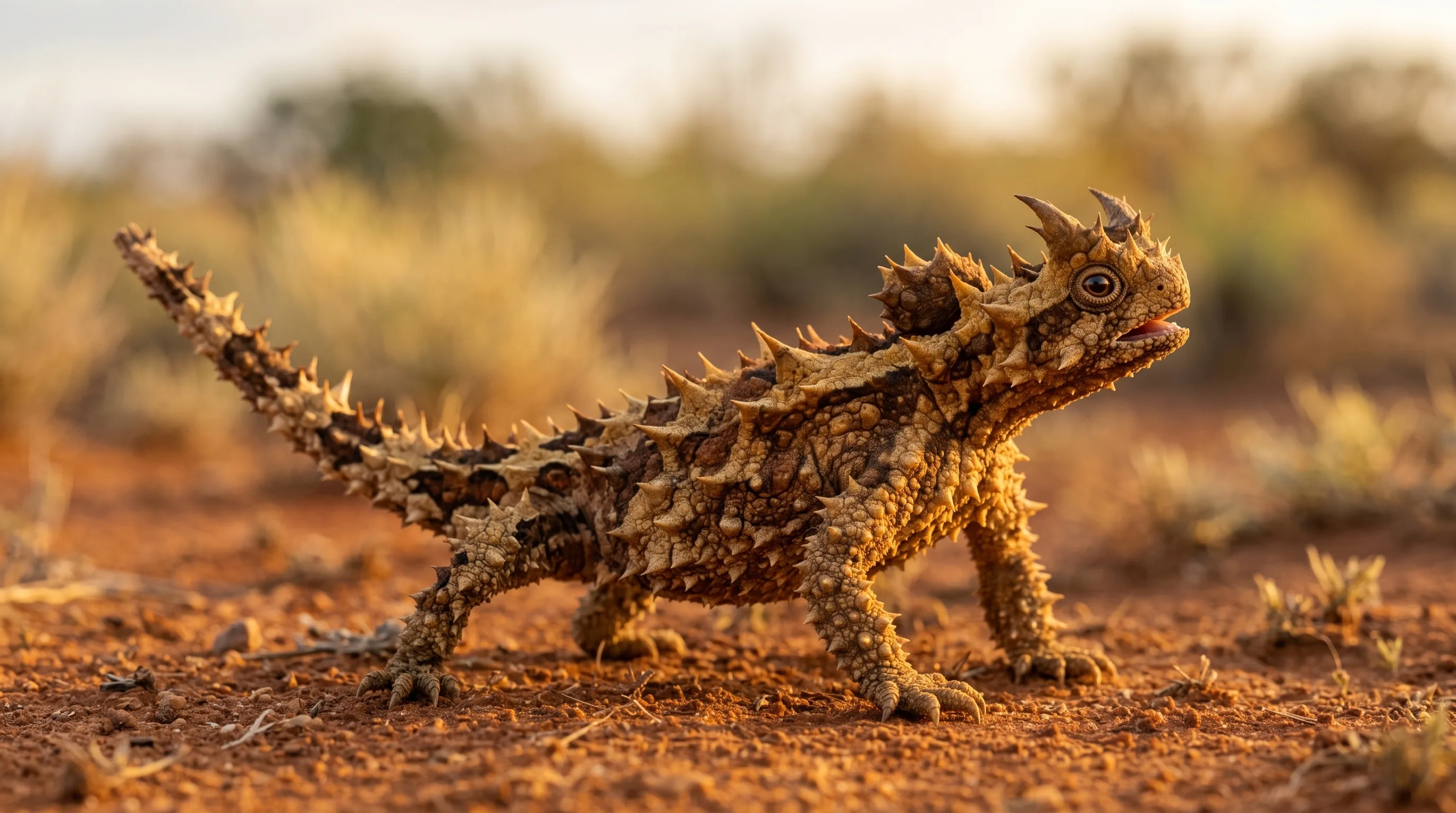
Thorny Devil (Moloch horridus)
Introduction
The red sand stretches to the horizon in every direction. Heat shimmers off the surface of the Gibson Desert, distorting the sparse mulga scrub into liquid mirages. Nothing appears to move. Then, almost imperceptibly, a small angular shape shifts across the open ground — a deliberate, jerking gait, like a mechanical toy winding down between each step. It freezes. Rotates an eye independently of the other. Resumes. What looks, at first glance, like a fragment of the desert itself — ochre, ridged, thorned — is one of Australia's most remarkable and ecologically specialised reptiles: the Thorny Devil.
Moloch horridus is a lizard that appears to have been assembled from the desert itself. Every surface of its small body is armoured in conical spines and keeled scales. Its colouration shifts across a palette of tans, browns, and oranges, matching the exact substrate beneath its feet with eerie precision. It carries a false head on the back of its neck — a silently deceptive knob of flesh that it presents to predators when threatened. And perhaps most extraordinarily, it drinks through its skin, harvesting moisture from wet sand and overnight dew through a network of microscopic capillary channels that channel water passively toward its mouth.
This is not a large or dramatic animal. An adult Thorny Devil weighs less than a handful of almonds. It eats nothing but tiny black ants. It lives in some of the driest, most brutal terrain on Earth. Yet it has survived these conditions for millions of years, evolving a suite of adaptations so precise, so elegantly engineered, that it reads as a masterclass in evolutionary problem-solving. Few reptiles on the planet provoke as much scientific fascination relative to their modest size.
This article explores the full ecological, behavioural, and evolutionary story of the Thorny Devil — its life in the Australian arid interior, its place within a fragile desert ecosystem, and the conservation realities it faces in an era of accelerating environmental change.
"The more clearly we can focus our attention on the wonders and realities of the universe about us, the less taste we shall have for destruction."
— Rachel Carson
Scientific Classification
Kingdom: Animalia
Phylum: Chordata
Class: Reptilia
Order: Squamata
Suborder: Lacertilia
Family: Agamidae
Genus: Moloch
Species: Moloch horridus
First described by: John Edward Gray, 1841
Common names: Thorny Devil, Thorny Dragon, Mountain Devil, Moloch
The genus Moloch is monotypic — meaning the Thorny Devil is the sole species within it. John Edward Gray, the British zoologist who first described the species in 1841, chose the genus name Moloch in reference to the biblical deity associated with sacrifice, presumably reflecting the lizard's formidably spined appearance. The species epithet horridus derives from Latin, meaning "rough" or "bristling" — a fitting descriptor for an animal that appears to bristle from every angle.
Despite its superficial resemblance to certain North American horned lizards (genus Phrynosoma), the Thorny Devil is not closely related to them. This is one of evolutionary biology's most celebrated examples of convergent evolution — two entirely unrelated lineages, separated by continental drift and tens of millions of years, arriving at near-identical morphological solutions to the same ecological pressures. Both occupy arid environments, both consume ants almost exclusively, and both use spines as primary defence. Yet they branched from entirely separate parts of the reptilian family tree.
Within the family Agamidae — the dragon lizards — the Thorny Devil represents a highly derived and specialised lineage. Its closest relatives include the water dragons, frilled-neck lizards, and bearded dragons, though the Thorny Devil's evolutionary trajectory diverged dramatically from these more generalised agamids as it adapted to hyper-arid, ant-dominated desert ecosystems.
Physical Characteristics
An adult Thorny Devil typically measures between 15 and 20 centimetres from snout to tail tip. Females are consistently larger than males — an unusual pattern known as female-biased sexual size dimorphism — with females commonly reaching 18–20 cm while males average closer to 15–17 cm. Body mass varies seasonally and with hydration status, but generally falls between 25 and 95 grams. Despite this modest size, every square centimetre of the animal commands attention.
The most immediately striking feature is the armature. The entire dorsal and lateral surface is covered in conical, keeled scales that grade from small granular scales on the flanks to prominent, multi-spined projections along the spine, limbs, and tail. These are not true spines in the mammalian sense — they are modified osteoderms, scales reinforced with bony dermal deposits. The largest spines sit above the eyes and along the dorsal midline, where they can reach 5–8 millimetres in height. The tail is similarly armoured, terminating in a blunt, spined club. Even the undersurface of the body carries smaller keeled scales, leaving almost no soft tissue accessible to a predator's tooth or bill.
Colouration in the Thorny Devil is not fixed. It shifts dynamically with temperature and the substrate the animal is traversing. In warm conditions, individuals display a pale tawny yellow or sandy orange, often with irregular lines of darker brown running dorsally — a pattern that breaks up the body outline against open sand. In cool morning temperatures, or when stressed, the colouration darkens significantly toward deep brown or olive, making the lizard almost invisible against leaf litter or shaded soil. This thermal-chromatic shift is driven by changes in melanophore activity within the skin and serves double duty as both thermoregulation assistance and cryptic camouflage.
One of the most anatomically curious features is the "false head" — a rounded, spiny knob located on the back of the neck, between the shoulder blades. When threatened, the Thorny Devil tucks its true head downward between its forelegs, presenting this knob in place of its actual face. The false head closely mimics the profile of the real head, potentially confusing a predator long enough for the lizard to escape. The true head, meanwhile, is protected between the forelegs and surrounded by the armoured neck and shoulders.
The eyes are large and highly mobile, set on either side of the broad, flattened skull. Like most lizards, the Thorny Devil can move each eye independently, giving it a nearly 360-degree field of view without moving its head — a critical advantage for detecting aerial predators while keeping the body motionless. The tongue is short and fleshy, designed not for fly-catching but for the precise, methodical collection of tiny ants from sandy surfaces. The limbs are slender but strong, the feet broad and well-developed for walking on loose sand.
Fun FactThe Thorny Devil can change colour within minutes based on body temperature — darker shades in the cold morning absorb heat more efficiently, while pale tones in midday heat reflect solar radiation.
Habitat & Geographic Distribution
The Thorny Devil is endemic to Australia. It is found nowhere else on Earth, and within Australia its distribution is restricted almost entirely to the arid and semi-arid interior — a vast tract of the continent spanning the western two-thirds of the landmass. Its range covers parts of Western Australia (including the Gibson Desert, Great Sandy Desert, Pilbara, and southern goldfields regions), the Northern Territory, South Australia, and the western fringes of Queensland and New South Wales. It is notably absent from the wetter coastal regions, tropical north, and the densely vegetated southeast.
Within this broad territory, the Thorny Devil shows strong habitat preferences. It favours open sandy desert with sparse spinifex grass (Triodia spp.) or low shrubland, particularly areas with stable sandy substrates rather than hard stony plains. The species is strongly associated with sand plains and sand dunes where loose substrate is available — both for its foraging behaviour and for its burrowing requirements during reproduction. Mulga (Acacia aneura) scrubland and mallee eucalypt communities are also frequently occupied, provided the ground layer includes exposed sandy soil.
The species tolerates extreme temperatures. Summer surface temperatures in the Australian interior routinely exceed 60°C, while winter nights can drop below freezing. The Thorny Devil navigates these thermal extremes not by avoiding them but by precisely managing its activity windows and micro-habitat use. Rocky outcrops, shaded rock crevices, spinifex clumps, and animal burrows all serve as thermal refugia during temperature extremes. The lizard's preferred thermal body temperature for active foraging sits between 28°C and 38°C — a range it achieves through careful behavioural thermoregulation.
Altitude is not a significant constraint. The Thorny Devil occupies habitat from near sea level on the Nullarbor Plain to over 600 metres in parts of South Australia's arid ranges. The unifying ecological thread across all occupied habitats is aridity, open substrate, and the presence of small ant colonies — particularly species of Iridomyrmex and related genera that forage in trails across open ground.
Feature | Thorny Devil (Moloch horridus) | Texas Horned Lizard (Phrynosoma cornutum) |
|---|---|---|
Family | Agamidae | Phrynosomatidae |
Distribution | Arid interior Australia | Southern USA and Mexico |
Adult body length | 15–20 cm | 9–14 cm |
Primary diet | Small black ants (Iridomyrmex spp.) | Harvester ants (Pogonomyrmex spp.) |
False head | Yes (prominent nuchal knob) | No |
Blood-squirting defence | No | Yes (ocular autohemorrhage) |
Water harvesting via skin | Yes (hygroscopic capillary system) | No |
IUCN status | Least Concern | Least Concern |
Behaviour & Social Structure
The Thorny Devil is a solitary reptile. Unlike many of its agamid relatives — which form loose aggregations around basking sites or engage in conspicuous territorial displays — the Thorny Devil leads a largely isolated existence. Individuals maintain home ranges that vary considerably in size depending on habitat quality, season, and individual size, but research in Western Australia has documented ranges from 0.5 to over 20 hectares. These ranges are not rigidly defended territories in the conventional sense; overlap between individuals does occur, particularly in areas of high ant density.
That said, the Thorny Devil is not indifferent to conspecifics. Males encountering other males during the breeding season display heightened vigilance and may engage in lateral body flattening — a behaviour that simultaneously makes the animal appear larger and presents its spined flanks toward the rival. Females are generally more tolerant of overlap but will displace smaller individuals from prime foraging patches. Communication between individuals, where it occurs, relies primarily on visual signals — body posture, colour intensity, and the characteristic rocking gait, which may serve as both a movement cue and a social signal in contexts that researchers are still working to understand fully.
The rocking gait itself deserves attention. The Thorny Devil moves in a distinctive stop-start pattern — advancing a few steps, then freezing, then advancing again — often with a subtle rocking motion of the entire body during each freeze phase. This motion is widely interpreted as mimicking the movement of dry leaves or windblown debris, a behavioural supplement to its cryptic colouration. In the still, shimmer-heated air of the desert, this movement pattern is highly effective at breaking up the lizard's visual profile against a shifting, textured background.
Intelligence in the Thorny Devil, as measured by adaptive learning and behavioural flexibility, is modest relative to more socially complex lizards. It is, fundamentally, a highly specialised organism whose cognitive resources are invested in sensory acuity rather than problem-solving. Its eyes — capable of independent movement and precise depth perception — are exceptionally well-tuned to detecting the movement of small ants across sandy surfaces at distances of several metres. The lizard does not cache food, does not cooperate with conspecifics, and does not appear to engage in play behaviour. It is, in ecological terms, a remarkably focused animal: built to do one thing — survive in extreme heat on a diet of tiny ants — with extraordinary efficiency.
Daily Life & Activity Cycle
The Thorny Devil is strictly diurnal — active only during daylight hours — and its daily routine is governed almost entirely by thermal constraints. In summer, the pattern is bimodal: brief activity in the mid-morning as temperatures rise toward the preferred range, followed by a midday retreat to shade, then a second activity window in the late afternoon before evening temperatures drop below useful thresholds. In winter, the pattern shifts to a single midday activity peak, with the lizard spending the cooler morning hours basking on exposed soil or rock to elevate body temperature before foraging.
The morning warm-up ritual is methodical. A Thorny Devil emerging from its overnight shelter — a spinifex clump base, a shallow scrape beneath a shrub, or simply a hollow in the sand — will orient its body perpendicular to the sun's rays and flatten its flanks to maximise solar absorption. Its dark morning colouration, produced by melanophore concentration in the skin, accelerates this process. Within 20–40 minutes of sunrise, in adequate conditions, the animal reaches its preferred activity temperature and begins foraging.
Foraging follows established routes. Individual Thorny Devils often use the same trails day after day, moving between known ant trails with a spatial memory that, while not sophisticated by vertebrate standards, is sufficient to maintain efficient harvesting circuits across their home range. These trails may cross open ground, traverse spinifex hummocks, and pass between shrubs in sequences that remain consistent across multiple observation days.
Seasonal behaviour is strongly influenced by temperature and reproductive cycles. Activity levels peak in spring (September–November) when both temperatures and ant abundance are optimal. Through December and January, the most intense heat suppresses activity windows. By late summer and early autumn, activity gradually recovers. Winter months — June and July — see sharply reduced activity, particularly in the southern parts of the range where temperatures can fall to near zero overnight. During the coldest spells, individuals may remain sheltered for days at a time, essentially entering a state of torpor until conditions improve.
Fun FactA single Thorny Devil can consume between 600 and 3,000 tiny ants in a single feeding session — picking them up one by one with a flick of the tongue at a rate of up to 45 ants per minute.
Diet & Survival Strategies
Few vertebrates on Earth are as narrowly specialised in diet as the Thorny Devil. Its feeding ecology is built almost entirely on a single taxonomic group: small, slow-moving ants of the genus Iridomyrmex — commonly known as meat ants or gravel ants — and closely related species in the subfamily Dolichoderinae. These ants are typically 1–3 millimetres in length, dark-coloured, and forage in dense surface trails across open ground. It is precisely this foraging behaviour — predictable, linear, and conducted in the open — that makes them accessible to a sit-and-wait predator like the Thorny Devil.
The feeding technique itself is remarkable in its economy of motion. The Thorny Devil settles beside an active ant trail and, with minimal body movement, extends its short, fleshy tongue to collect individual ants as they pass. Each tongue strike is accurate to within a millimetre, and the lizard can maintain this activity for extended periods — 20 to 40 minutes of continuous feeding is common. The ant's formic acid and exoskeletal chitin appear to pose no digestive difficulty; the lizard's stomach is adapted to process large volumes of these hard-bodied insects efficiently.
The apparent narrowness of this diet might seem like an ecological vulnerability, but in the Australian arid interior it represents a strategy of extraordinary reliability. Iridomyrmex species are among the most abundant and ecologically dominant invertebrates in Australian desert ecosystems. Their colonies are large, their foraging activity predictable, and their surface trails dense enough that a Thorny Devil can harvest thousands of individuals per day while remaining in a relatively small area. In a landscape where more generalised predators face feast-or-famine conditions, the Thorny Devil's dietary specialisation provides a remarkably stable resource base.
Coping with food scarcity during winter or drought presents a genuine physiological challenge. The Thorny Devil's metabolic rate is low even by reptilian standards, and its fat reserves — stored primarily in the tail and around the viscera — provide a buffer during periods of reduced foraging. An animal in good condition entering winter can sustain itself for several weeks on stored reserves alone. There is also evidence that the lizard prioritises water balance over caloric intake during extreme drought, reducing activity to minimum levels and relying almost entirely on its remarkable hygroscopic skin system to maintain hydration.
Competition for ant resources is real but manageable. Several other lizard species in the Australian desert, including various skinks and small dragons, take ants opportunistically, but none rival the Thorny Devil's degree of dietary specialisation on small dolichoderine ants. The lizard's primary feeding competition comes not from other vertebrates but from other invertebrate predators — particularly other ant species that compete with Iridomyrmex for territory and food — which affects the density and activity patterns of the Thorny Devil's prey base.
The morning was still cool when the Thorny Devil emerged from the base of a spinifex clump in the Gibson Desert's red dune country. It moved slowly at first, its colouration still the dark brown of cold reptile skin, pausing every few steps to absorb the low-angle sunlight. By the time it had crossed the open sand between two shrubs — a journey of perhaps four metres, accomplished in a series of frozen lurches and starts — the surface temperature had already climbed past 30°C and the lizard's flanks were beginning to shift back toward their midday yellow-ochre.
At the edge of a low compacted pan between dunes, it found what it was looking for: a river of tiny dark shapes moving in both directions across the pale grey soil. An Iridomyrmex trail, perhaps two centimetres wide, carrying workers back and forth between a nest entrance 15 metres to the north and a patch of invertebrate carrion near a dead shrub to the south. The lizard settled beside the trail, its body motionless, and began to feed.
For the next 35 minutes it barely moved — only the tongue, striking in rapid sequence, each strike lifting a single ant cleanly from the stream. The workers continued their columns on either side, seemingly indifferent to the toll being extracted. By the time the Thorny Devil finally lifted its head and surveyed the surroundings with one independently rotating eye, the sun had risen higher and the shadows had shortened. It turned and walked — in its peculiar rocking shuffle — back toward the shade of the nearest mulga, having consumed just over 1,400 ants.
This unremarkable scene, repeated daily across thousands of square kilometres of Australian desert, is the beating heart of the Thorny Devil's existence: patient, precise, unhurried, and perfectly matched to the rhythms of the land it inhabits.
Interaction with Other Animals
The Thorny Devil sits at a specific ecological intersection — predator of small ants, prey of larger vertebrates — and its interactions with other species are shaped almost entirely by these two roles. Its suite of defensive adaptations reflects the reality that in the Australian arid interior, threats come from multiple directions and multiple taxa simultaneously.
Predators of the Thorny Devil include a range of aerial and terrestrial hunters. Birds of prey represent a significant threat — particularly the Brown Falcon (Falco berigora), Nankeen Kestrel (Falco cenchroides), and Australian Kestrel, which hunt by hovering or perching over open ground and stooping on small reptiles. The Wedge-tailed Eagle (Aquila audax), while typically targeting larger prey, has been observed taking Thorny Devils. Terrestrial predators include several species of goanna (monitor lizards, Varanus spp.) — particularly the Pygmy Mulga Monitor (Varanus gilleni) and Sand Goanna (Varanus gouldii), both of which are fast, active hunters capable of pursuing and overtaking a Thorny Devil on open ground. Snakes — particularly the larger elapids and pythons — are also potential predators, though the Thorny Devil's spines make swallowing difficult.
Against this predation pressure, the Thorny Devil deploys a multi-layered defence. The primary line is cryptic colouration — remaining undetected is always preferable to confrontation. If detected and approached, the lizard will attempt to escape into spinifex or beneath shrubs. If cornered, it employs the false head display, tucking its real head between its forelegs and presenting the spiny nuchal knob. Whether this consistently deceives experienced predators is debated, but the secondary effect — presenting an entirely armoured, spined surface — is clear. A goanna attempting to seize a Thorny Devil receives a mouthful of sharp keeled scales and conical spines rather than soft tissue.
Interactions with other lizard species are primarily competitive rather than predatory. Several agamids share the Thorny Devil's habitat, including the Centralian Bluetongue (Tiliqua multifasciata), various ctenotus skinks, and dragon lizards of the genus Ctenophorus. These species compete for basking sites and, to a lesser degree, for certain food resources. The Thorny Devil's ant specialisation largely removes it from direct dietary competition with more generalist lizards, but competition for optimal thermal microhabitats — the best sun-exposed rocks and open sandy patches — is real and occasionally leads to displacement of smaller species.
The relationship between Thorny Devils and the ant colonies they consume is ecologically one-sided but not catastrophic. An individual Thorny Devil consumes thousands of ants per day, but the colonies it raids — each comprising hundreds of thousands of workers — absorb these losses without meaningful disruption. The lizard's impact on any single colony is minimal; it is the cumulative effect across an ant community that creates a modest but measurable thinning of surface foraging activity in the immediate vicinity of an active Thorny Devil territory.
Interaction with Environment
The Thorny Devil's relationship with its physical environment is intimate and deeply functional. The sandy substrate of the Australian desert interior is not merely a backdrop to the lizard's life — it is an active participant in the animal's survival, providing food (via ant trails that track across open sand), water (via moisture-laden sand after rain or dew), shelter (via burrowing capacity during reproduction), and thermoregulation opportunity (via the precise thermal gradient from surface to several centimetres depth).
The water-harvesting behaviour of the Thorny Devil represents one of the most sophisticated moisture-acquisition systems known in any terrestrial vertebrate. The skin surface is covered with microscopic hygroscopic channels — grooves between scales that, through capillary action, draw liquid water across the skin's surface toward the corners of the mouth. When the lizard stands on wet sand after rain, or on surface dew deposited on cool morning sand, this system activates automatically. Water is drawn up through the feet and along the body, and the lizard assists the process by performing swallowing movements that draw moisture into the mouth. The system does not require immersion — even brief contact with damp sand is sufficient to initiate capillary flow across a significant portion of the body surface.
Studies have demonstrated that a dehydrated Thorny Devil placed on wet sand can absorb a volume of water equal to 3–4% of its body mass within minutes, achieving partial rehydration without drinking in any conventional sense. This adaptation is critical in an environment where standing water is virtually non-existent and rainfall unpredictable. It also partially explains the lizard's strong fidelity to sandy desert habitats over harder substrates, where this moisture-harvesting mechanism is less effective.
The Thorny Devil's movement through its habitat leaves a subtle but real ecological footprint. Its foraging trails, maintained across seasons, create narrow linear disturbances in the surface crust of desert soil — microhabitats that may influence seed germination and invertebrate microhabitat use. Its egg-laying burrows, dug to depths of 30 centimetres or more in firm sandy soil, contribute to soil aeration and create structures subsequently used by small invertebrates. These contributions are modest relative to the engineering impact of species like bilbies or burrowing bettongs, but in the hyperarid desert where ecological complexity is reduced, even small contributions to habitat heterogeneity carry disproportionate ecological significance.
The lizard's dependence on spinifex grasslands is also ecologically meaningful. Spinifex hummock grasses (Triodia spp.) are critical fire-shaping plants in the Australian interior — they accumulate large fuel loads between fires and burn intensely when ignited. The Thorny Devil's preference for habitats with healthy spinifex cover ties its welfare directly to the fire regime of its habitat. Post-fire landscapes, stripped of spinifex cover, are hostile to Thorny Devils — they lose both shade/shelter and the structural complexity that supports the ant trails they depend on. Recovery of spinifex after fire takes years, during which Thorny Devil density in affected areas falls sharply.
Reproduction & Parenting
The Thorny Devil's reproductive cycle is tightly synchronised with the seasonal temperature and resource patterns of the Australian desert. Courtship and mating occur primarily from September through December — the southern spring and early summer — when temperatures are rising steadily and ant activity is near its annual peak. This timing ensures that females are well-nourished and in positive energy balance during the energetically demanding process of egg production.
Courtship behaviour in the Thorny Devil is subtle by reptile standards. Males approach females with a characteristic head-bobbing display, combined with lateral flattening of the body — presenting the spined flanks in a way that may signal size and vigour to the female. Females assess approaching males and can reject advances by moving away or adopting a defensive posture. Physical combat between rival males for access to females does occur but is rarely prolonged — the spined armature of both animals makes close-contact fighting genuinely dangerous, creating an incentive toward ritualised display over direct combat.
Following successful mating, females enter a pre-nesting phase of elevated feeding intensity, building fat reserves and vitellogenin for egg development. Nest site selection is careful and specific. Females seek firm sandy soil with a southern aspect — in the Southern Hemisphere context of Australia, this means the nest site receives less direct solar radiation, preventing temperature spikes that could kill developing embryos. The female excavates a vertical burrow, typically 30–40 centimetres deep, using her forelimbs in a digging behaviour that is energetically costly but well-adapted to the substrate.
Clutch size ranges from 3 to 10 eggs, with most clutches containing 4–8. The eggs are white, oval, and leathery-shelled — typical of reptile eggs that manage moisture exchange through the shell rather than the semi-crystalline structure of bird eggs. After depositing the clutch at the base of the burrow, the female fills the shaft with sand and departs, providing no further parental investment. Incubation is entirely passive, relying on soil temperature and moisture to drive embryonic development.
Incubation period ranges from approximately 90 to 132 days, depending on soil temperature. Warmer incubation temperatures accelerate development but may increase embryo mortality if temperatures exceed tolerable maxima. Hatchlings emerge from late summer through autumn — typically January to April — and must immediately fend for themselves. They are fully formed miniatures of the adults, averaging 6–7 centimetres in total length and weighing just 1–2 grams. Despite this tiny size, they bear fully developed spines and the same cryptic colouration as adults.
Juvenile survival rates are poorly documented in the wild but likely low during the first months of life. Hatchlings face the same suite of predators as adults but with less effective armature, smaller spines, and no experience navigating predator encounters. Growth is relatively slow — reaching sexual maturity takes approximately two to three years — and individuals in good conditions can live 15 to 20 years in the wild.
Evolutionary Adaptations
The Thorny Devil's evolutionary history reads as a tightly integrated response to the twin pressures of predation and aridity. Each major adaptation serves multiple functions simultaneously, reflecting the economy of natural selection operating over millions of years in one of Earth's most demanding environments.
The spined armature is the most obvious adaptation, but its functions extend beyond simple predator deterrence. The multi-spined body surface dramatically increases the animal's apparent size to a predator. It makes swallowing difficult or impossible for most snakes, lizards, and small raptors. And — critically — the spaces between the conical scales form part of the hygroscopic channel network that harvests water from environmental moisture. The spines and scale ridges are not merely defensive structures; they are integral components of the animal's hydration system.
The hygroscopic skin represents one of the most sophisticated passive moisture-harvesting systems documented in any vertebrate. Scanning electron microscopy of the skin surface reveals a complex microstructure of interlocking scale margins and microscopic channels that generate capillary pressure sufficient to move water against gravity across the skin's entire surface. This system does not require active pumping — it operates entirely through surface tension and capillary force. The water is directed toward grooves at the corners of the mouth, where swallowing movements complete the ingestion process. This mechanism has evolved independently in certain other desert reptiles, but the Thorny Devil's version is among the most fully developed.
Thermoregulatory colour change — the dynamic shifting between dark morning colouration and pale midday colouration — provides genuine physiological benefit. The darker melanin pigmentation during cold morning periods absorbs solar radiation more efficiently, allowing the lizard to reach activity temperature faster than if it maintained a pale colouration. The shift to pale tones during peak heat hours reduces solar load on the body surface. This is not merely cosmetic — experimental studies have demonstrated measurable differences in heating and cooling rates between colour phases, translating directly into extended activity windows at both ends of the day.
The false head — the nuchal knob between the shoulder blades — is a behavioural and morphological co-adaptation. It works only because the animal simultaneously tucks its real head downward, presenting the knob as the apparent leading end of the body. The knob itself resembles the lizard's actual head in profile and is similarly spined, reinforcing the deception. Whether predators are genuinely fooled by this substitution, or whether the benefit is simply in presenting an entirely armoured dorsal surface, remains a subject of ongoing research.
The rocking stop-start gait, while partly interpreted as movement camouflage, may also serve a hydrodynamic function in the context of skin moisture harvesting. Experiments have suggested that the flexion of the body during movement may assist in directing moisture collected on the skin toward the mouth grooves, functioning as a mechanical pump supplement to passive capillary flow. If confirmed, this would make the characteristic gait a simultaneous behavioural camouflage strategy and hydration behaviour — a remarkable degree of evolutionary multitasking.
"Look deep into nature, and then you will understand everything better."
— Albert Einstein
Ecological Importance
The Thorny Devil occupies a specific and non-trivial node in the ecological network of the Australian arid interior. Its role as an ant predator places it as a significant consumer within the soil-surface invertebrate community, and its position as prey for multiple larger vertebrates links it upward through the food web in ways that matter to the broader ecosystem.
In terms of ant predation, an individual Thorny Devil consuming 1,000–3,000 Iridomyrmex workers per day exerts meaningful pressure on local ant colony dynamics. Across a population of Thorny Devils in high-density habitat — potentially 15–30 individuals per square kilometre in prime conditions — the aggregate consumption of ants per square kilometre per day is substantial. This chronic predation pressure likely contributes to the spatial heterogeneity of ant colony distributions, influencing where colonies establish and the density of foraging trails in the vicinity of Thorny Devil activity zones. Ant communities, in turn, exert enormous influence on desert soil structure, seed dispersal, and decomposition — so any factor influencing ant distributions has cascading indirect effects across the ecosystem.
As prey, the Thorny Devil transfers energy from the ant-invertebrate community to larger vertebrate predators — goannas, falcons, snakes — that would otherwise have less access to this energy pool. The lizard effectively functions as a biological bridge between the hyperabundant ant community and the less abundant but ecologically important predators that consume reptiles. In ecosystems where large mammals are scarce, the ecological function performed by mid-sized reptiles like monitor lizards and falcons — population regulation, energy transport, behavioural modification of prey communities — becomes proportionally more important, and the species that fuel those predators accordingly so.
The Thorny Devil's burrowing behaviour during nesting contributes modestly to soil bioturbation — the physical mixing and aeration of desert soils by animal activity. In the Australian arid interior, where mammalian burrowers have been severely depleted by invasive species, the residual burrowing activity of reptiles and invertebrates represents an increasingly important ecological service. The nest burrows of Thorny Devils, while narrow, penetrate below the surface crust and create pathways for water infiltration and seed burial.
Finally, as a visually striking, ecologically specialised, and range-restricted endemic species, the Thorny Devil functions as an umbrella and indicator species for the health of Australia's arid interior ecosystems. Population declines or distributional shifts in Thorny Devils reflect broader changes in habitat quality, fire regimes, and invertebrate communities that are less easily monitored directly. Monitoring Thorny Devil population status provides a tractable proxy for ecosystem health across a vast and difficult-to-survey landscape.
Threats & Conservation
The Thorny Devil faces a suite of threats common to many Australian arid-zone reptiles, though its current situation is less dire than many of its co-inhabitants. The species remains relatively widespread across its core range, but localised declines and range contraction at the periphery of its distribution have been documented, and the trajectory of several key threats is worsening.
Habitat modification is the most pervasive long-term threat. The conversion of spinifex grassland and mulga shrubland to pastoral grazing land — particularly through cattle and sheep grazing — degrades the sandy substrate structure that Thorny Devils depend on, compacts soils, reduces spinifex cover, and disrupts ant trail networks. Heavily grazed land supports far lower densities of Thorny Devils than ungrazed comparable habitat, and repeated heavy grazing cycles can effectively eliminate the species from large areas.
Road mortality is a significant and growing threat, particularly along the unsealed roads that cross the Australian interior. The Thorny Devil's slow movement speed, cryptic colouration, and habit of basking on road surfaces — which absorb heat rapidly and provide ideal morning warming substrate — make it highly vulnerable to vehicle strike. Road surveys in parts of Western Australia and South Australia have documented Thorny Devil mortality rates that, while not catastrophic for regional populations, represent a consistent drain on local numbers, particularly in habitat where roads cross at high density.
Invasive species represent an increasing concern. Feral cats (Felis catus) and red foxes (Vulpes vulpes) are not primary predators of Thorny Devils — the lizard's armature makes it a low-value prey item for most mammalian predators — but both species exert heavy predation pressure on the small mammals that co-inhabit Thorny Devil habitat, potentially driving ecological changes that indirectly affect the lizard community. More directly threatening is the invasion of buffel grass (Cenchrus ciliaris), an African pasture grass now widespread across central Australia that displaces native spinifex grasslands and radically alters fire regimes. Areas invaded by buffel grass experience more frequent, hotter fires that eliminate spinifex, reduce soil crust complexity, and fundamentally change ant community composition — removing the ecological substrate on which Thorny Devils depend.
Climate change is emerging as a background multiplier of all these threats. Increasing frequency and severity of drought, rising maximum temperatures, and altered rainfall seasonality in the Australian interior are already detectable in weather records, and projected further changes over the next 50–100 years will likely push Thorny Devil thermal tolerances in parts of the range and reduce the predictability of the ant resources the species depends on. The species' restricted distribution within Australia — already limited to the arid interior — leaves limited room for latitudinal or altitudinal range shift in response to warming.
IUCN Red List Analysis
Current IUCN Status
The Thorny Devil (Moloch horridus) is currently assessed as Least Concern (LC) on the IUCN Red List of Threatened Species. This classification, based on the most recent available assessment, reflects the species' relatively large geographic range across the Australian arid interior, its apparently stable populations across much of that range, and the absence of documented population declines of sufficient magnitude or rate to trigger a more threatened category under IUCN criteria.
Least Concern does not mean absence of threat — it means that current evidence does not indicate the species meets the thresholds for Vulnerable, Endangered, or Critically Endangered status under IUCN criteria (A–E). These thresholds include rates of population decline, geographic range size and fragmentation, and quantitative probability of extinction. The Thorny Devil's broad range and apparent persistence across much of it currently prevents elevation to a threatened category, but this assessment is contingent on the continuation of current population monitoring and the absence of sudden large-scale habitat change.
Population Trend
The population trend for the Thorny Devil is assessed as stable across most of its core range, though localised declines have been documented at range peripheries and in areas subject to intensive pastoral use, buffel grass invasion, or high road density. Precise global population estimates are not available — the species' cryptic colouration, low density, and the vastness and inaccessibility of its habitat make accurate census profoundly difficult.
Survey-based density estimates from well-studied sites in Western Australia suggest populations of 5–25 individuals per square kilometre in prime habitat, declining to near absence in heavily degraded or recently burned areas. Extrapolation across the species' total range — estimated at over 1.5 million square kilometres — suggests a total wild population likely in the hundreds of thousands to low millions, though this figure carries enormous uncertainty. Historical decline data is limited, largely because systematic monitoring of the species across its range began only in the late 20th century.
There are credible indications that Thorny Devil populations have declined in the eastern and southern margins of the historic range — parts of New South Wales, southern Queensland, and the agricultural-pastoral transition zones of South Australia — where habitat conversion has been most extensive. In these areas, the species may have been locally extirpated from suitable habitat patches that no longer support viable populations.
Main Threats
The principal threat to the Thorny Devil's long-term viability is habitat degradation through exotic pasture grass invasion, particularly buffel grass (Cenchrus ciliaris). Buffel grass has now spread across enormous areas of central Australia, displacing native spinifex and altering fire regimes in ways that strip the desert landscape of the structural complexity on which Thorny Devils depend. Under a high-buffel-grass scenario, the fire cycle accelerates, spinifex is eliminated from vast tracts of country, and the ant community composition shifts toward species less suitable for Thorny Devil predation.
Overgrazing by livestock — cattle and sheep — remains a persistent threat across the pastoral zone that overlaps much of the Thorny Devil's range. Grazing compacts soils, reduces native vegetation cover, and disrupts the surface ant trail networks that Thorny Devils forage on. Long-term heavy grazing can reduce Thorny Devil density by an order of magnitude compared to adjacent ungrazed country.
Road mortality is a localised but structurally chronic threat, particularly significant in the vicinity of tourist routes through the Australian interior (including roads in the vicinity of Uluru-Kata Tjuta and Kings Canyon, where Thorny Devils are relatively common and well-known). The species' habit of using road surfaces as basking sites, combined with its slow movement speed, creates consistently elevated mortality relative to undisturbed surrounding habitat.
Climate change represents a long-term, accumulating risk. Projected increases in arid-zone temperature maxima, coupled with increased drought frequency and altered rainfall distribution, will likely reduce the length and predictability of the Thorny Devil's thermal activity window, decrease ant abundance during drought periods, and reduce the efficiency of the skin moisture-harvesting system during drier years. These effects are not yet driving measurable population changes but are expected to become significant over the next 50–100 years.
Off-road vehicle traffic in remote desert areas — increasingly associated with tourism, mining exploration, and recreational 4WD use — disrupts soil crust structure, destroys spinifex hummocks, and creates direct mortality risk. The long-recovery time of desert soils and spinifex communities after vehicle disturbance means that the effects of even occasional off-road traffic can persist for decades.
Ecological Consequences
Should Thorny Devil populations decline significantly — particularly across their core range in Western and Central Australia — the ecological consequences would ripple through the arid desert food web in several measurable ways. The most immediate effect would be a reduction in predation pressure on small dolichoderine and iridomyrmex ants, potentially allowing surface foraging densities of these ants to increase in areas where Thorny Devils had previously been keeping them in check. Elevated ant densities at the soil surface can, in turn, increase predation pressure on small invertebrates, seeds, and soil microorganisms that ant colonies consume, creating secondary effects on plant germination, decomposition, and soil microbiology.
At the level of vertebrate predators, decline of the Thorny Devil would remove a dietary contribution to small raptors and generalist predators that currently take Thorny Devils as occasional prey items. This would not catastrophically affect any predator species — Thorny Devils are supplementary prey for most of their predators — but in the context of an arid ecosystem already stressed by declining biodiversity, the removal of any energy transfer pathway has proportionally larger consequences than it would in a more species-rich environment.
The loss of the Thorny Devil as an indicator species would also represent a significant setback for biodiversity monitoring across the Australian interior. As a tractable, observable, and ecologically sensitive species, Thorny Devil population surveys provide information about habitat quality, fire recovery, and invertebrate community health that would otherwise require far more resource-intensive direct measurement.
Conservation Efforts
Active conservation management for the Thorny Devil specifically is limited — the species' Least Concern status and the sheer scale of its habitat make targeted management challenging. Conservation effort is largely directed at the broader arid-zone ecosystem health within which the Thorny Devil sits.
The most impactful conservation measures relevant to the species include buffel grass control programs operated by Parks Australia and various state conservation agencies. Mechanical and herbicide-based removal of buffel grass from key areas of the Australian interior — including significant efforts within Uluru-Kata Tjuta National Park and Watarrka National Park — directly benefit Thorny Devil habitat by maintaining spinifex-dominated grassland structure and traditional fire regimes.
Pastoral management reform — through grazing licence conditions, stock exclusion zones around key conservation sites, and incentive programs for pastoralists adopting more ecologically sensitive grazing regimes — has contributed to habitat improvement in parts of the Thorny Devil's range. The Australian Government's National Landcare Program and various state-based landholder incentive schemes support these efforts.
Protected areas covering much of the Thorny Devil's core range — including the Gibson Desert Nature Reserve, Great Victoria Desert Nature Reserve, Nullarbor Regional Reserve, and multiple national parks in Western Australia, South Australia, and the Northern Territory — provide refugia where the species is protected from direct habitat conversion. These reserves collectively cover several hundred thousand square kilometres of high-quality Thorny Devil habitat.
Captive breeding and holding programs exist at a small number of Australian zoos and wildlife parks — primarily for educational and research purposes rather than reintroduction programs. Thorny Devils can be maintained successfully in captivity with correct thermal management and access to small live ants, and captive individuals have contributed to research into the water-harvesting skin mechanism and thermal biology of the species.
Scientific research programs — including long-term monitoring plots in Western Australia's goldfields region and ecological studies through Australian universities — continue to build the knowledge base for Thorny Devil conservation. This research is critical for detecting early signs of population decline and understanding the species' responses to changing fire regimes and climate.
Future Outlook
The Thorny Devil's short-to-medium term future across its core range in central and western Australia appears reasonably secure. Its large total range, persistence across millions of hectares of protected and pastoral land, and the absence of commercially driven exploitation mean it is unlikely to face imminent population collapse under current conditions. The Least Concern assessment is likely to hold for the next one to two decades provided current conservation efforts continue.
The longer-term outlook — across the 50-to-100-year horizon — is considerably more uncertain. Projected climate change trajectories for the Australian interior include temperature increases of 2–4°C above current means, more frequent extreme heat events, and significant reduction in cool-season rainfall in southern parts of the range. These changes will progressively squeeze the Thorny Devil's thermal activity window, reduce moisture availability for skin-based water harvesting, and likely alter the ant community composition in ways difficult to predict. If buffel grass invasion continues unchecked — which current trajectories suggest it will across much of the unprotected pastoral zone — the loss of spinifex-dominated habitat could drive significant range contraction within this century.
A precautionary reclassification to Near Threatened status is conceivable within the next 20–30 years if population monitoring detects declining trends consistent with IUCN criteria. For now, early and aggressive management of buffel grass, support for ecologically sensitive pastoral management, and maintenance of adequate protected areas across the core range represent the most important pillars of the species' long-term security.
Human Relationship
The Thorny Devil holds a distinctive place in Australian cultural life, functioning simultaneously as an emblem of outback resilience, a star of natural history tourism, and a figure of deep significance within the cultural traditions of Aboriginal Australians whose country the lizard inhabits.
For many Aboriginal language groups of the central and western desert, the Thorny Devil — known by various names including ngarlu in some Western Desert languages — is a figure in traditional ecological knowledge, songlines, and Dreaming narratives. Detailed traditional knowledge of the lizard's habits, habitat preferences, and behaviour accumulated over tens of thousands of years of inhabiting the same landscape. This indigenous ecological knowledge, where it has been shared and recorded, has in some cases provided insights into Thorny Devil behaviour and distribution that formal scientific survey missed — a reminder of the conservation value embedded in traditional knowledge systems.
In contemporary Australian culture, the Thorny Devil is one of the most recognisable reptile species on the continent and features heavily in natural history tourism, particularly along routes through the Australian interior such as the Stuart Highway, the Red Centre, and the Murchison region of Western Australia. The species' dramatic appearance, fearless demeanour toward humans (it rarely attempts to flee when approached carefully), and fascinating behaviours make it a compelling wildlife encounter for visitors. This tourism value creates a constituency of interest in the species' conservation among non-specialist Australians and international visitors.
In the scientific community, the Thorny Devil has occupied an outsized position relative to its size. The hygroscopic skin-based water-harvesting mechanism, first described in detail in the 1980s and subsequently investigated with increasing physiological precision, has attracted international interest from biophysicists and materials scientists as well as biologists. The structural principles underlying the capillary water-transport system are now informing the design of bio-inspired water collection surfaces for applications in arid-zone engineering, fog harvesting, and medical device design.
Human-wildlife conflict involving the Thorny Devil is negligible. The lizard poses no danger to humans — it cannot inflict any meaningful injury, it carries no significant zoonotic disease risk, and it does not compete with human economic interests. The primary negative human impact on the species is inadvertent: road mortality, habitat modification through pastoral activities, and the indirect effects of land use change and climate policy.
Fun FactEngineers and materials scientists are actively studying the Thorny Devil's capillary moisture-harvesting skin microstructure as a template for designing bio-inspired fog-collecting surfaces and passive water-collection technologies for arid regions.
Unique & Rare Facts
A living water harvester: The Thorny Devil can absorb water through its feet by standing on damp sand, channelling moisture via capillary action through micro-grooves between its scales directly to the corners of its mouth — one of the most sophisticated passive hydration systems in the vertebrate world.
Eating by the thousands: A single adult Thorny Devil can consume between 600 and 3,000 small ants in a single sitting, picking them up one at a time with precise tongue strikes at rates approaching 45 ants per minute.
The ultimate dietary specialist: Despite the enormous variety of invertebrates available in its habitat, the Thorny Devil voluntarily ignores almost all of them, eating almost exclusively tiny ants of specific genera — a degree of dietary specialisation so extreme that it has no parallel among Australian lizards.
Dynamic colour-change: The lizard can shift its skin colouration from dark chocolate brown to pale tawny yellow within minutes, driven by temperature changes — a physiological transformation that serves both thermoregulation and camouflage simultaneously.
Convergent with a continent away: The Thorny Devil and the North American horned lizards (Phrynosoma spp.) independently evolved near-identical body plans, spined armature, ant-specialist diets, and desert-dwelling habits — a textbook case of convergent evolution across 10,000 kilometres of separated continents.
The false head: When threatened, the Thorny Devil tucks its real head between its forelegs and presents a spiny rounded knob on the back of its neck — a biological decoy designed to confuse predators about which end of the animal is the vulnerable head.
Engineering inspiration: The microstructure of the Thorny Devil's skin is being actively studied by materials engineers seeking to design passive water-collection surfaces, fog harvesters, and microfluidic devices inspired by the capillary channel architecture.
Slow-motion longevity: Despite its tiny size and demanding desert environment, a well-fed Thorny Devil in the wild can live up to 20 years — a remarkable lifespan for a small lizard in extreme conditions.
Monotypic genus: Moloch horridus is the only species in its genus — there is no close living relative. The Thorny Devil stands alone, evolutionarily, as the sole surviving member of its lineage.
Temperature-sex determination: Like many reptiles, incubation temperature during embryonic development influences the sex ratio of Thorny Devil hatchlings, with warmer nests tending to produce a higher proportion of females — a reproductive characteristic with implications for how climate warming may alter future population sex ratios.
Conclusion
In a continent that has evolved more than its share of biological extremists, the Thorny Devil stands apart. It occupies a space between the animate and the geological, between the living and the landscape — an animal so perfectly calibrated to its environment that the boundary between organism and habitat seems to dissolve. It is armed like medieval armour, coloured like the desert floor, nourished by rivers of ants too small for most eyes to follow, and hydrated by the very ground it walks on.
What makes the Thorny Devil significant is not any single spectacular adaptation but the integration of all of them. The spines that deter predators channel water. The skin that camouflages also harvests moisture. The gait that mimics windblown debris may simultaneously assist in moving that moisture toward the mouth. The dietary specialisation that seems dangerously narrow is actually a masterclass in exploiting the single most reliable, abundant resource the Australian desert interior offers. Every system connects to every other system, and the result is an animal of extraordinary ecological coherence.
The Thorny Devil also reminds us that evolutionary success is not synonymous with visibility or charisma. The species does not roar, does not migrate across continents, does not hunt in coordinated packs. It walks slowly across hot sand, eats tiny ants with methodical patience, and harvests water from the desert floor. It has been doing this, essentially unchanged, for millions of years. In the context of an Earth that has seen five mass extinctions, the quiet persistence of this small, spined, desert-walking lizard is more eloquent than almost any other statement biology can make about the power of precise ecological fit.
The Australian desert interior, for all its apparent emptiness, is a repository of evolutionary ingenuity. The Thorny Devil is one of its most finely wrought expressions — a reminder that complexity and wonder do not require size, speed, or spectacle. Sometimes they require only patience, precision, and the willingness to look very carefully at a small, thorned creature walking slowly across hot red sand.
Sources & Attribution
Data and ongoing research referenced for this article come from the following authoritative sources — peer-reviewed publishers, official taxonomic registers, and global biodiversity programmes:
- IUCN Red List — Thorny Devil — official IUCN Red List assessment including population trend, threats, and conservation actions.
- Wikipedia — Thorny Devil — taxonomy, distribution, and an overview with onward citations to primary literature.
- GBIF — Thorny Devil — global occurrence and distribution records from the Global Biodiversity Information Facility.
- iNaturalist — Thorny Devil — observation records and field photographs contributed by naturalists worldwide.
- Encyclopedia of Life — Thorny Devil — multilingual species pages aggregating taxonomic and natural-history data.
- WWF — World Wildlife Fund — global wildlife conservation programmes and research summaries.
- Nature — research on Thorny Devil — peer-reviewed studies indexed by Nature on related ecology and behaviour.
- ITIS — Integrated Taxonomic Information System — federal-grade taxonomy and nomenclature.
Frequently Asked Questions
What does a Thorny Devil eat?
The Thorny Devil is one of the most extreme dietary specialists among all Australian lizards. Its diet consists almost exclusively of small, slow-moving ants — primarily species of Iridomyrmex and related dolichoderine ants that forage in surface trails across open sandy ground. Unlike most lizards, which take a variety of insects and invertebrates, the Thorny Devil routinely ignores all other invertebrate prey and has not been recorded consuming any vertebrates or plant material in the wild.
A single feeding session can last 20–40 minutes, during which the lizard collects individual ants one at a time with precise tongue strikes at rates of up to 45 per minute. Total daily intake is estimated at 600–3,000 ants, depending on ant trail density, lizard size, and season. In winter or during drought, feeding frequency drops sharply and the lizard relies on fat reserves stored in the tail and body cavity to maintain basal metabolic functions.
How does the Thorny Devil drink water?
The Thorny Devil does not drink water in the conventional sense of immersing its head and swallowing from a pool or puddle. Instead, it harvests moisture through its skin via a remarkable capillary action system built into the microstructure of its scale surfaces. Microscopic hygroscopic channels between the scales draw water from damp sand, morning dew, or even rain falling directly on the body surface, directing it passively toward grooves at the corners of the mouth.
When the lizard stands on wet sand after rain, water is absorbed upward through the feet and across the body within minutes. The lizard assists the process by performing swallowing movements. A dehydrated Thorny Devil can absorb water equal to several percent of its body mass through this system in a single brief contact with moist substrate — a critical adaptation in an environment where standing water is virtually non-existent. This mechanism has attracted significant attention from engineers developing bio-inspired water-collection surfaces for arid environments.
Is the Thorny Devil dangerous or venomous?
The Thorny Devil is completely harmless to humans. It carries no venom, has no significant biting capability, and its spines — while sharply keeled — are too small to penetrate human skin effectively. It poses no meaningful threat to people and does not attempt to bite or scratch when handled by experienced researchers or careful observers.
The lizard's primary defence is its armoured body surface and its cryptic camouflage, not aggressive behaviour. When approached by a potential threat, a Thorny Devil is far more likely to freeze and rely on its colouration, tuck its head and present the false head, or attempt a slow escape into nearby vegetation than to stand its ground and display aggressively. In the context of wildlife tourism in central Australia, where encounters with Thorny Devils occur regularly, the species is considered entirely safe to observe closely.
Where does the Thorny Devil live?
The Thorny Devil is endemic to Australia and is found only in the arid and semi-arid interior of the continent. Its range covers much of Western Australia (particularly the Gibson Desert, Great Sandy Desert, Pilbara, and southern goldfields), the Northern Territory, South Australia, and the western margins of Queensland and New South Wales. It is absent from the coastal regions, the tropical north, and the more densely vegetated southeast.
Within this range, the species strongly prefers open sandy desert with spinifex grassland or sparse shrubland, where loose sandy substrate supports both its burrowing behaviour and its moisture-harvesting skin system. It avoids heavily compacted soils, stony gibber plains, and areas with dense vegetation cover. Healthy spinifex grassland in red sand dune country represents optimal habitat.
What is the Thorny Devil's IUCN conservation status?
The Thorny Devil is currently classified as Least Concern on the IUCN Red List, reflecting its relatively wide geographic range across the Australian interior and the absence of documented rapid population decline across that range. It is not considered immediately threatened with extinction under current conditions.
However, this classification does not mean the species is without risk. Threats including buffel grass invasion of spinifex habitat, overgrazing by livestock, road mortality, and projected climate change impacts are real and worsening. Localised declines have been documented at range margins, and long-term projections suggest that if current land management trajectories continue — particularly the spread of buffel grass — the species may face a more concerning status within future decades.
How does the Thorny Devil defend itself from predators?
The Thorny Devil relies on a layered defence strategy. The first and most important line of defence is its cryptic camouflage — its colouration closely matches the sandy desert soil of its habitat, and its stop-start rocking gait mimics the movement of windblown debris, making it extremely difficult to spot when stationary or moving slowly across open ground. Being overlooked is always the preferred outcome.
If detected and approached, the lizard will attempt to retreat to cover — spinifex hummocks, shrubs, or rock crevices. If cornered, it employs its most dramatic defence: tucking the real head downward between its forelegs and raising the false head — the rounded spiny knob on the back of the neck — toward the predator. The entire dorsal surface, now presented toward the threat, is covered in conical spines and keeled scales that make swallowing extremely difficult for most predators. The combination of apparent size increase (through body flattening), spined armature, and head deception provides effective deterrence against the majority of predators it encounters.
How long does a Thorny Devil live?
In the wild, Thorny Devils can live up to approximately 15–20 years under favourable conditions — a remarkably long lifespan for a small reptile inhabiting an extremely harsh environment. Growth to sexual maturity takes two to three years, after which the animal's slow metabolism and dietary specialisation support a gradual, long-lived existence. In captivity, with reliable temperature management and a consistent supply of live ants, similar lifespans have been recorded.
Juvenile survival rates are believed to be relatively low, as newly hatched lizards — tiny and less effectively armoured than adults — face the same suite of predators as their parents but with fewer of the defensive advantages that full body size and developed spines provide. Survival rates likely improve significantly once individuals reach sub-adult size, and animals that survive their first one to two years have a reasonable prospect of reaching advanced age.
What is the "false head" of the Thorny Devil?
The false head of the Thorny Devil is a rounded, spiny protuberance located on the dorsal surface of the neck — between the shoulder blades — that closely resembles the profile of the lizard's actual head. When the Thorny Devil feels threatened, it tucks its real head downward between its forelegs and tilts the body to present the nuchal knob toward the predator, creating the illusion that the knob is the animal's head.
The adaptive benefit of this structure is debated among herpetologists. It may genuinely deceive some predators about which end of the lizard is the head — directing any initial strike toward the armoured knob rather than the actual skull and neck. Alternatively, or additionally, the behaviour may function simply by presenting an entirely armoured dorsal surface to the predator, making the animal maximally difficult to seize and swallow regardless of whether the head substitution is actually convincing. The strategy is unusual among lizards globally and represents a unique evolutionary solution to the problem of predation in a small, slow-moving, visually exposed desert species.
Can a Thorny Devil be kept as a pet?
The Thorny Devil is a protected species under Australian law and cannot be legally captured from the wild or kept as a private pet within Australia. Export from Australia is also illegal without specific scientific permits. Captive individuals in zoos and wildlife facilities are maintained under licence conditions, and these animals are not available for private ownership.
Beyond the legal restriction, the Thorny Devil presents extraordinary care challenges that make it essentially unsuitable for private captivity in any case. Its dietary requirement — live, small Iridomyrmex ants in daily quantities of hundreds to thousands — is essentially impossible to meet in most parts of the world outside its native range. The species is also highly sensitive to suboptimal temperature ranges, substrate type, and hydration conditions, meaning even experienced reptile keepers would face significant difficulty maintaining a Thorny Devil in good health. The species is best appreciated in the wild or in specialist zoological settings with access to appropriate dietary and environmental resources.
How does the Thorny Devil reproduce?
Thorny Devils reproduce sexually, with mating occurring primarily during the Australian spring — September through December — when temperatures are rising and ant resources are plentiful. After mating, females excavate a burrow up to 30–40 centimetres deep in firm sandy soil with a southern aspect (to reduce incubation temperature extremes), where they deposit a clutch of 3–10 leathery-shelled eggs. The female then fills the burrow shaft and provides no further parental care.
Eggs incubate for approximately 90 to 132 days, with timing depending on soil temperature. Hatchlings emerge from late summer through autumn — roughly January to April — as fully formed miniatures of the adults, approximately 6–7 centimetres long and weighing 1–2 grams. They must immediately locate food independently, navigating the same thermal and predation challenges as adults from their very first hours above ground. Sexual maturity is reached at approximately 2–3 years of age.
What is the difference between the Thorny Devil and a horned lizard?
The Thorny Devil (Moloch horridus) and the North American horned lizards (genus Phrynosoma) are two entirely unrelated groups of lizards that have independently evolved remarkably similar body forms through convergent evolution. The Thorny Devil belongs to the family Agamidae (dragon lizards), while horned lizards belong to the family Phrynosomatidae — the two groups are separated by hundreds of millions of years of independent evolutionary history.
Both groups are small, flattened, spined desert lizards that eat ants almost exclusively and rely on cryptic colouration and body armature as primary defences. However, key differences exist: horned lizards have a unique defence absent in the Thorny Devil — autohaemorrhage, in which blood is squirted from the eyes as a chemical deterrent. The Thorny Devil, conversely, possesses the false head and the extraordinary hygroscopic skin water-harvesting system, neither of which are present in horned lizards. These shared traits arising from separate lineages make the Thorny Devil–horned lizard comparison one of evolutionary biology's most cited examples of convergent adaptation.
Image: Wikipedia/Wikimedia Commons — “Thorny devil”
Comments
Post a Comment