
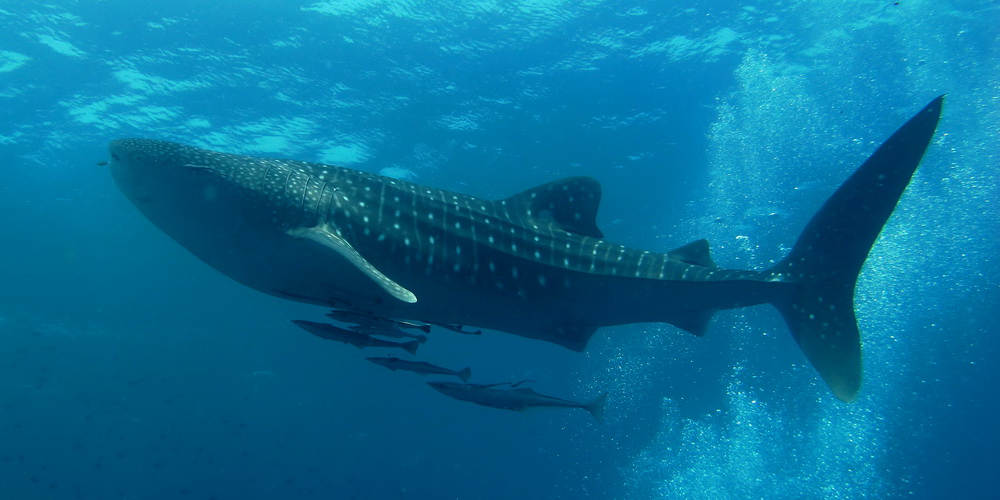
Whale Shark (Rhincodon typus)
Introduction
The ocean surface off Ningaloo Reef is glass-flat in the early morning light, the water a translucent cobalt that deepens to indigo at the edge of the continental shelf. A research diver floats motionless at five metres depth, watching the mid-water column for any shift in shadow. Then it arrives — not with the explosive urgency of a predator, but with the unhurried, tidal authority of something that has never needed to rush. A shape resolves from the blue: first a broad, pale-spotted caudal fin sweeping in slow, metronomic strokes, then the vast and flattened head, the mouth agape at nearly one and a half metres wide, scooping the plankton-rich water in an act of feeding that looks less like hunting and more like the ocean breathing through an animal.
This is Rhincodon typus — the whale shark, the largest fish on Earth, and one of the most extraordinary animals alive. At up to twelve metres in average adult length, and reliably recorded at lengths exceeding eighteen metres, the whale shark occupies a biological category nearly to itself. It is not a whale — it is a shark, a genuine elasmobranch, a cartilaginous fish that shares its ancestry with great whites and hammerheads. Yet in its way of living, in its vast oceanic circuits, in its gentle indifference to the diver hovering inches from its flank, it seems to belong to a different evolutionary philosophy entirely.
Whale sharks are found in every tropical and warm-temperate ocean on the planet. They aggregate in predictable pulses wherever upwellings or coral-spawning events concentrate food in the upper water column, drawing researchers, tourism operators, and awestruck snorkellers to places like Ningaloo in Western Australia, the Yucatán Peninsula, the Maldives, and the waters off Djibouti. These aggregations represent only a fraction of the species' range and only a sliver of its total population. The deep, open ocean swallows most whale shark lives entirely.
Science has only recently begun to unpack how complex those lives truly are. Satellite telemetry tags, photographic identification databases containing tens of thousands of individual sharks, and genetic sampling have revealed a species with immense migratory range, surprisingly sophisticated sensory biology, and a reproductive strategy so unusual it was not confirmed until a single pregnant female was caught off Taiwan in 1995. What scientists have learned since then has deepened both admiration and concern. The whale shark is listed as Endangered on the IUCN Red List. Its populations are declining. Understanding this animal — its biology, its ecological role, its vulnerabilities — matters for the future of the ocean itself.
"The sea is everything. It covers seven-tenths of the terrestrial globe. Its breath is pure and healthy. It is an immense desert where man is never lonely, for he can feel life stirring on all sides."
— Jules Verne, Twenty Thousand Leagues Under the Sea
Scientific Classification
- Kingdom: Animalia
- Phylum: Chordata
- Class: Chondrichthyes
- Order: Orectolobiformes
- Family: Rhincodontidae
- Genus: Rhincodon
- Species: Rhincodon typus (A. Smith, 1828)
The whale shark is the sole living member of both the genus Rhincodon and the family Rhincodontidae, making it an evolutionary singleton — a lineage that diverged from its closest relatives long enough ago that no other surviving species shares its family. The order Orectolobiformes includes the wobbegongs, nurse sharks, and bamboo sharks, a mostly slow-moving, bottom-associated group. The whale shark's adoption of open-ocean, pelagic filter-feeding represents a profound departure from the ecological template common to its order.
The genus name Rhincodon derives from the Greek roots meaning "rasp-tooth" — a reference to its hundreds of tiny, non-functional teeth arranged in rows. The species name typus simply means "type specimen," reflecting the fact that it is the defining species of its taxonomic group. Molecularly, whale sharks are most closely related to carpet sharks, a kinship that may surprise anyone accustomed to imagining sharks as uniformly torpedo-shaped predators.
Physical Characteristics
No measurement prepares a person for their first encounter with a whale shark. The largest reliably measured individual stretched 18.8 metres and was estimated at roughly 21,500 kilograms — approximately the mass of three adult African elephants. Mean adult length in well-studied populations typically falls between nine and twelve metres, with females growing larger than males. This sexual dimorphism in size is common among sharks and reflects the energetic demands of reproduction in females.
The body plan is unmistakable. The head is enormous, dorsoventrally flattened, and distinctly blunt — a profile that bears no resemblance to the pointed rostrum of pelagic predators. The mouth spans nearly the full width of the head and opens at the terminal position, facing directly forward rather than ventrally as in most shark species. This forward-facing orientation is a direct adaptation for ram-filter feeding in the upper water column. The eyes are small relative to the head and positioned laterally on the sides, equipped with a protective layer of dermal denticles — effectively a hard shell of tiny tooth-like structures that can be drawn over the eye surface when needed.
The colouration is among the most recognisable patterns in the animal kingdom. The dorsal surface is a deep grey-blue to dark grey, overlaid with a constellation of pale yellow or white spots and horizontal and vertical stripes arranged in a checkerboard-like grid. This pattern is unique to every individual, much as a fingerprint is unique to a human, and it forms the basis of photographic identification systems used by researchers worldwide. The ventral surface is uniformly white or pale cream.
The skin itself is among the thickest of any animal — up to fifteen centimetres in some areas — and is covered in dermal denticles that give it a texture resembling coarse sandpaper. This thickness provides physical protection and also plays a hydrodynamic role in reducing drag. The caudal fin is lunate in juveniles but becomes increasingly asymmetrical in large adults, with the upper lobe substantially longer than the lower. Five gill slits on each side of the body are enlarged and modified to work in concert with the pharyngeal filter pads, through which water passes during feeding while prey items are trapped.
Fun FactEach whale shark carries a unique spot pattern on its body — researchers use these patterns with the same photographic identification software originally designed for mapping star constellations.
| Characteristic | Whale Shark | Basking Shark | Megamouth Shark |
|---|---|---|---|
| Maximum length | ~18.8 m | ~12.3 m | ~5.5 m |
| Feeding method | Ram & suction filter feeding | Ram filter feeding | Suction filter feeding |
| Habitat zone | Pelagic, coastal, epipelagic | Temperate pelagic | Deep mesopelagic |
| IUCN Status | Endangered | Endangered | Least Concern |
| Geographic range | Global tropical/warm-temperate | Cool temperate globally | Deep ocean, globally patchy |
Habitat & Geographic Distribution
The whale shark is a creature of warm, sunlit water. It inhabits the epipelagic zone — the uppermost layer of the ocean, from the surface down to roughly 200 metres — across all tropical and warm-temperate seas between approximately 30°N and 35°S latitude. Its range is genuinely global, documented in the Indo-Pacific, the Indian Ocean, the Atlantic Ocean, the Red Sea, and the Gulf of Mexico. Historically, its range may have extended into cooler waters during warm-phase climate periods, and individual animals do occasionally appear outside typical boundaries, but these are anomalous excursions.
Within this vast latitudinal band, whale sharks show strong preferences for specific oceanographic conditions. They concentrate wherever surface productivity is high — upwelling zones where cold, nutrient-rich water rises to the surface, coral spawning aggregations, fish spawning events, and coastal areas where river outflows create productive mixing zones. The predictability of these aggregation sites is what has made whale shark tourism economically significant in places like Oslob in the Philippines, La Paz in Mexico, and the South Ari Atoll in the Maldives.
Satellite tagging data has overturned the earlier assumption that whale sharks are primarily shallow-water, coastal animals. Large adults — particularly mature males and females — spend considerable time far from land, in the open ocean, diving to remarkable depths. Dives exceeding 1,900 metres have been recorded, making the whale shark a genuinely mesopelagic animal when conditions require. These deep dives may serve thermoregulatory functions, allowing the animal to cool down after feeding at the warm surface, or may represent foraging in the deep scattering layer — a zone of concentrated invertebrates and small fish that rises toward the surface at night.
The Indian Ocean represents perhaps the most important whale shark habitat globally, with massive aggregations documented off the Maldives, along the coast of Mozambique, and in the seas off Pakistan and India. In the Indo-Pacific, Ningaloo Reef in Western Australia hosts one of the most studied aggregations, occurring reliably between March and July each year in synchrony with coral spawning. The Caribbean Sea and Gulf of Mexico support a significant Atlantic population, with the Gladden Spit aggregation in Belize and the Yucatán aggregation near Isla Holbox among the best-documented in the Western Hemisphere.
Behaviour & Social Structure
The whale shark is not a social animal in any strict hierarchical sense. It does not form pods, it does not maintain long-term pair bonds, and there is no evidence for the kind of structured dominance hierarchy found in dolphins or great apes. Yet to characterise it as entirely solitary would be inaccurate. Whale sharks aggregate in numbers that can reach dozens or even hundreds at exceptionally productive feeding sites, and within these groups, interactions — though generally passive — are not entirely absent.
At aggregation sites, whale sharks navigate around one another with a passive awareness that suggests they detect each other's presence, likely through the lateral line system that all fish use to detect pressure changes in the water. Physical contact between individuals is rare and appears accidental rather than communicative. There is no evidence of cooperative feeding behaviour — each animal feeds independently, following the distribution of plankton and small fish rather than coordinating with neighbours to concentrate prey. Larger individuals do not appear to displace smaller ones in any systematic way, and competition for feeding space seems minimal, perhaps because the resource itself is diffuse and abundant when it triggers aggregation.
Communication in whale sharks is poorly understood compared with the communication systems of marine mammals. They lack vocal apparatus for sound production in the mammalian sense, but sharks in general are sensitive to low-frequency sounds and vibrations. The lateral line — a sensory canal running along the flanks — detects minute pressure gradients and water movements. The ampullae of Lorenzini, electroreceptive pore organs concentrated around the snout, can detect the bioelectric fields generated by living organisms. Whether whale sharks use these systems for anything beyond prey detection and obstacle avoidance in the context of social interaction is not yet established.
What is clear from long-term observation is that whale sharks exhibit individual behavioural personalities that experienced researchers learn to read. Some individuals are consistently tolerant of close human approaches; others consistently move away or dive when approached. Some feed aggressively at the surface for hours; others take brief surface passes and then disappear into depth. This individual variation hints at something more complex than purely reflexive behaviour, though the cognitive machinery underpinning it remains largely unexplored.
Daily Life & Activity Cycle
The rhythm of a whale shark's day is governed more by the vertical distribution of food in the water column than by the terrestrial day-night cycle that structures the lives of most land animals. Surface feeding tends to concentrate during daylight hours, when phytoplankton and zooplankton are most abundant in the upper layers. As light fades, whale sharks may transition to deeper feeding in the mesopelagic zone, targeting the deep scattering layer as it rises toward the surface. This diel vertical migration strategy — following prey up and down through the water column over a 24-hour cycle — has been confirmed through accelerometer and depth-logging tags deployed on individuals across multiple ocean basins.
At the surface, whale shark feeding behaviour falls into two principal modes. Ram-filter feeding involves the animal swimming forward with its mouth open, passively funnelling water and prey through its filter pads at speeds of around 0.5 to 1.5 kilometres per hour. Suction feeding — sometimes called cross-flow filtration in the literature — involves the animal holding near-stationary at the surface, rapidly opening and closing its jaw to pump water over the filters in repeated gulping motions. The suction feeding mode is particularly common when prey concentrations are dense and localised, such as during fish-spawning events where eggs or larvae form thick surface slicks.
Horizontal movement varies enormously between individuals and life-history stages. Juvenile whale sharks at productive coastal sites may remain relatively resident, returning to the same feeding zones over periods of weeks or months. Large adults tracked via satellite tags have covered distances exceeding 13,000 kilometres in a single continuous transit — crossing entire ocean basins without stopping at any recognisable waypoint. The navigational mechanisms behind these migrations are unknown but almost certainly involve the integration of multiple sensory cues: geomagnetic field detection, the chemical signatures of productive water masses, thermal gradients, and possibly celestial cues perceived through the eyes.
Fun FactA satellite-tagged whale shark off the Galápagos Islands was tracked swimming over 20,000 kilometres — from the Pacific coast of Ecuador all the way to the Indo-Pacific — in one of the longest recorded migrations of any individual fish.
Diet & Survival Strategies
The whale shark occupies a trophic position that defies easy categorisation. By body mass, it is the ocean's largest predator. By the nature of its feeding, it targets some of the smallest prey in the ocean: copepods barely a millimetre in length, krill, fish eggs, fish larvae, small squid, and various gelatinous zooplankton including salps and jellyfish. This paradox — the largest fish consuming some of the smallest organisms — is the defining ecological feature of filter-feeding megafauna and the source of both their ecological power and their vulnerability.
The filter apparatus is anatomically remarkable. Unlike the basking shark, which relies on passive filtration through gill rakers that essentially act as sieves, the whale shark possesses a unique cross-flow filtration system. Water entering the mouth passes through a series of spongy, cartilaginous dermal denticle pads that line the internal gill arches. These pads do not act as simple sieves; instead, water passes obliquely across their surface, and particles — prey items — are drawn toward the centre of the filter through a fluid dynamic process analogous to the flow of air through industrial cyclone filters. This mechanism dramatically reduces clogging, allowing the whale shark to filter extraordinary volumes of water without pausing to clear its filters.
Energetically, the whale shark must consume enormous quantities of prey to sustain its mass. Modelling studies suggest that a ten-metre whale shark requires roughly 21 kilograms of food per day at minimum, though at productive aggregation sites, consumption may be several times this. During the Ningaloo aggregation, whale sharks feed intensively for weeks on coral spawn — a pulse of lipid-rich eggs and bundles that represents a massive but temporary energy windfall. At the Yucatán aggregation, the target prey is primarily little tunny eggs, forming surface slicks so dense that divers describe them as like swimming through orange soup.
Seasonal food availability shapes migratory circuits. Whale sharks track oceanographic productivity over thousands of kilometres, arriving at aggregation sites with remarkable temporal precision — a timing that implies the integration of predictive environmental cues rather than merely reactive responses to finding food. In years when coral spawning or fish spawning is reduced — due to thermal anomalies or bleaching events — whale shark attendance at traditional sites drops accordingly, suggesting that the cue driving aggregation is the prey itself or its immediate environmental precursors, not simply a fixed calendar.
At the edge of the Yucatán Channel in late July, the water temperature had climbed to 30 degrees Celsius, and the surface was slicked with the spawn of little tunny — a layer of eggs and milt so thick it stained the sea orange for kilometres. A research vessel had anchored at dawn, waiting. By mid-morning, the first dorsal fin broke the surface three hundred metres to the north.
Within two hours, seventeen whale sharks were feeding in the same square kilometre of ocean. From the research boat, the scene was almost surreal — the gaping mouths of animals nine and ten metres long, surfacing and submerging in slow repetitive rhythm, utterly focused on the nutrient broth around them. Smaller fish — snappers, jacks, bar jacks — darted between the giants, exploiting the same slick and occasionally being swept accidentally into whale shark mouths before being expelled unharmed through the gill slits.
A researcher in the water photographed flank patterns with a waterproof camera, logging identified individuals in a database that connected sightings from the Maldives to the Gulf of Mexico. One shark — a female estimated at eleven metres, ID number WS-0412 — had been photographed at this same aggregation three years running, arriving within a ten-day window each time. She lingered at the surface for almost four hours that morning, feeding continuously, her long crescent tail sweeping with a slow, patient certainty that spoke of deep time and deep ocean.
By late afternoon, the spawn slick had dispersed, and the whale sharks, one by one, tilted their great heads downward and slid beneath the surface into the deep blue, as if the ocean had simply breathed them back in.
Interaction with Other Animals
The whale shark's size renders it effectively immune to predation as an adult. There are a small number of documented accounts of orca attacks on whale sharks, and tiger sharks have been documented biting juveniles, but neither represents a systematic predatory relationship. The whale shark's ecological position is therefore less that of prey and more that of a mobile habitat — a floating island of surface area and biological resources around which entire communities of smaller animals organise their lives.
Remoras — sharksucker fish of the family Echeneidae — are perhaps the whale shark's most constant companions. Attaching themselves to the flank, belly, and interior of the mouth using their sucker-like modified dorsal fins, remoras feed on parasites, shed skin, and food scraps. A large whale shark may carry dozens of remoras simultaneously, and the relationship is broadly commensal: the remoras benefit significantly; the whale shark is largely unaffected, though it may derive minor benefit from parasite removal. The inside of the whale shark's mouth is a particularly productive zone for remoras, where food particles collect and small crustacean parasites congregate.
A wider community of smaller fish accompanies feeding whale sharks at aggregation sites. Cobia, rainbow runner, amberjack, and various jack species are regularly observed in close association, swimming in the bow wave of the shark and feeding on prey disturbed or loosely ejected by the filter-feeding process. This relationship is opportunistic rather than obligate — these fish accompany whale sharks when the sharks are actively feeding, but disperse independently otherwise. Several species of pilot fish have also been recorded in association, though their relationship with whale sharks is less well-documented than with oceanic whitetip sharks.
Whale sharks also interact with other megafauna in ways that extend beyond simple proximity. At the Ningaloo aggregation, manta rays feed alongside whale sharks in the same coral spawn events, and bottlenose and spinner dolphins have been observed in the vicinity of feeding aggregations. Whether these associations involve information transfer — smaller animals detecting whale sharks from a distance and using their presence as a cue to potential prey concentrations — is an intriguing question that field ecology has not yet fully resolved. The possibility that whale sharks function as involuntary information hubs, drawing other predators and opportunistic feeders toward productive patches, adds another layer to their ecological significance.
Interaction with Environment
The whale shark's relationship with its oceanic environment operates at multiple scales simultaneously. At the granular level, every feeding event is an act of biological consumption that removes biomass from the upper water column. At the landscape scale, the whale shark's vast migratory circuits mean that it moves nutrients and biological material across entire ocean basins, functioning as a mobile vector in the ocean's biogeochemical cycles. And at the ecosystem level, the whale shark's existence structures the behaviour and distribution of dozens of associated species.
Filter feeding at the scale practised by whale sharks has measurable impacts on plankton community composition. By consuming zooplankton selectively based on size and density, whale sharks exert top-down pressure on the upper levels of the microbial food web. In regions where multiple whale sharks aggregate simultaneously — the Yucatán aggregation, for instance, where over 400 individuals have been counted in a single survey — the collective filtering capacity is biologically significant. Modelling work published in the 2010s estimated that the Yucatán aggregation could process hundreds of millions of litres of water daily, with measurable effects on the local zooplankton standing stock.
The whale shark's deep-diving behaviour connects the surface and the deep ocean in ways that may have real ecological consequences. When an animal dives to 1,500 metres after feeding intensively at the surface, it carries gut contents rich in surface-derived nutrients into the mesopelagic zone. Excretion at depth, or mortality at depth, delivers this material to the deep-sea environment in a process sometimes called the "biological pump" — the transfer of carbon and nutrients from the productive surface ocean to the deep, where they are sequestered away from atmospheric exchange. Whale sharks, as among the largest fish on Earth, contribute to this pump in ways that are proportional to their immense size.
The sensitivity of whale sharks to sea surface temperature is well-established. They avoid water below approximately 18–20°C and show strong preferences for zones between 26°C and 30°C. This thermal dependence means that climate-driven shifts in ocean temperature regimes directly affect both the distribution and phenology of whale shark aggregations. Observations from multiple aggregation sites over the past two decades suggest that peak aggregation timing is shifting in synchrony with warming sea surface temperatures — a pattern consistent with climate-driven phenological change and one with potential consequences for the species' access to its most important food concentrations.
Reproduction & Parenting
The reproductive biology of the whale shark remained almost entirely unknown until 1995, when a pregnant female measuring ten metres was caught off eastern Taiwan. Inside her uteri — whale sharks possess two functional uteri — scientists found 304 pups in various stages of development. This single specimen transformed understanding of whale shark reproduction overnight and answered questions that had been open since the species was first formally described in 1828.
Whale sharks are ovoviviparous: the eggs are retained and hatch inside the uterus, and the developing pups are nourished by the yolk of their individual egg capsules rather than through a placental connection to the mother. The pups found in the 1995 female ranged in length from approximately 42 centimetres to 64 centimetres, indicating asynchronous development — a strategy in which the female stores sperm and fertilises eggs over a period of time, maintaining a continuous developmental pipeline rather than producing a synchronous cohort. This strategy potentially allows a female to produce pups over an extended period from a single mating event.
The gestation period remains uncertain, as no live birth has been directly observed and no pregnant female has been monitored through to parturition in the wild. Estimates based on developmental staging in the Taiwanese specimen and pup growth rates from captive animals suggest a gestation of approximately six months, though the asynchronous egg fertilisation pattern makes this figure difficult to pin down precisely. Litter size appears to be highly variable — the 1995 female carried 304 developing young, though many of these were at very early stages and survival of all would have been impossible.
Neonatal whale sharks — animals under one metre in length — have been documented in very few locations worldwide. The waters around the Galápagos Islands, the waters off Djibouti, and a small number of coastal locations in the Indo-Pacific have yielded observations of very small individuals that may represent birth or nursery areas. The scarcity of these sightings either reflects low encounter rates in open-ocean nursery areas or genuine rarity of birth events in coastal habitats. No long-term nursery area has been definitively identified, which is a significant gap in conservation planning.
Sexual maturity in male whale sharks appears to occur at a body length of around eight to nine metres, corresponding to an age estimated between 25 and 30 years based on vertebral growth band counts. Females are thought to mature later and at larger sizes, consistent with their greater ultimate body length. The age at first reproduction for females may therefore exceed 30 years — an extraordinarily long pre-reproductive period that, combined with the species' inherently low reproductive rate, makes recovery from population depletion correspondingly slow.
Evolutionary Adaptations
The whale shark's evolutionary lineage within the Orectolobiformes represents one of the most dramatic ecological divergences in the history of the order. Its ancestral relatives were — and largely remain — benthic or demersal animals: carpet sharks, nurse sharks, wobbegongs that lie in wait on the seafloor. The transition to open-ocean, filter-feeding gigantism required a suite of anatomical, physiological, and behavioural innovations so extensive that the whale shark's body plan shares only a skeletal framework with its closest relatives.
The terminal mouth position is one of the most fundamental of these adaptations. Nearly all other shark species possess a subterminal or inferior mouth position — set back and below the rostrum — adapted for seizing prey animals encountered while swimming or detected below. A forward-facing mouth, flush with the leading edge of the head, is the only configuration that allows efficient ram-filter feeding in a pelagic animal moving through plankton concentrations. This single anatomical feature required the entire anterior architecture of the skull to be remodelled relative to the ancestral shark body plan.
The filter-pad mechanism represents a convergent solution to a shared challenge faced by all large filter-feeding vertebrates: how to process enormous volumes of water without expending more energy than is obtained from the food captured. Whale sharks, basking sharks, and megamouth sharks evolved filter-feeding independently — these three are not closely related to one another — and each evolved a different technical solution to this problem. The whale shark's cross-flow filtration is arguably the most sophisticated, minimising clogging and maximising throughput. Its closest functional analogue in engineering is not biological at all, but rather the cyclone separators used in industrial filtration.
Gigantism itself is an evolutionary adaptation. At ten metres and above, the whale shark is effectively invulnerable to predation from any organism other than orca, making size an absolute defence. Large body size also confers thermodynamic advantages: larger animals cool more slowly, allowing the whale shark to briefly exploit cold, nutrient-rich upwelling zones without being physiologically compromised. Additionally, the enormous gut capacity of a ten-metre animal allows it to ingest and process vast quantities of food during ephemeral, patchy feeding events — essentially acting as a biological storage vessel that can process hundreds of kilograms of low-energy zooplankton into body mass during productive periods.
The dermal denticle covering of the eye — effectively an eyelid made of the same hard, tooth-like material that covers the rest of the body — is an adaptation unique among vertebrates. It allows the whale shark to protect its relatively small but irreplaceable eyes during close approaches to reef structures, dense zooplankton aggregations, or boat hulls, without compromising its forward motion. The arrangement of photoreceptors in the whale shark's retina suggests it is capable of detecting light even in deep, dim conditions, consistent with its deep-diving behaviour.
Ecological Importance
The ecological importance of the whale shark operates at several levels simultaneously, and not all of them are immediately obvious from the animal's gentle, solitary surface behaviour. As a filter feeder operating at an enormous scale, the whale shark exerts real top-down regulation on zooplankton populations in the regions it inhabits. The removal of large quantities of copepods, krill, and fish larvae from surface waters influences the competitive dynamics of the plankton community, potentially favouring certain phytoplankton species over others and cascading through the food web in ways that are difficult to fully model but significant in principle.
As a mobile nutrient transporter, the whale shark contributes to the cross-basin redistribution of material derived from surface productivity events. When a whale shark feeds intensively at a coral spawn in Western Australia and then migrates three thousand kilometres across the Indian Ocean, it carries the chemical signatures of that feeding event — in its tissues, in its metabolic byproducts, in the material it eventually excretes — into an entirely different oceanic regime. This nutrient transport function is shared by all large migratory animals but operates at unusual spatial scales in a species with the whale shark's migratory ambition.
Perhaps the most underappreciated ecological role of the whale shark is as a structuring force for associated species communities. The dozens of species that follow, accompany, and exploit whale sharks at aggregation sites — from remoras to rainbow runners to manta rays — represent a community that is partly organised around the whale shark as a keystone resource. The loss of whale sharks from a system would not simply remove one species from the food web; it would reorganise the behaviour and potentially the distribution of all these associated species.
Finally, whale sharks serve as what ecologists call "umbrella species" — animals whose conservation effectively protects entire ecosystems. The marine protected areas established around whale shark aggregation sites at Ningaloo, in the Maldives, and in the Gulf of Mexico protect not only the whale shark but entire reef communities and the biodiversity they harbour. The whale shark's cultural and economic value as a wildlife tourism draw has, in several countries, been instrumental in generating the political will and funding necessary to establish and enforce these protected areas.
Threats & Conservation
The whale shark faces threats across every dimension of its life history, and the combination of inherently slow reproduction, vast geographic range, and high market value for its fins and flesh makes those threats particularly severe. The species is listed as Endangered on the IUCN Red List, a status that reflects documented population declines exceeding 50% over three generation lengths — equivalent to roughly 75 years — in the Indo-Pacific, where the largest population concentration exists.
Ship strikes represent one of the most significant and underreported threats globally. Whale sharks frequently feed at the ocean surface in major shipping lanes, and their slow swimming speed and apparent inattention to vessel approaches make them highly vulnerable to collision with large ships. Because large vessels travelling at speed may not even detect an impact with an animal of this size, and because whale sharks that are struck may survive the initial collision but die subsequently of internal injuries far from shore, the mortality rate from ship strikes is almost certainly substantially underestimated in official records.
Targeted fishing for whale sharks, though now illegal in many jurisdictions, continues in parts of South and Southeast Asia, particularly in China, India, and the Philippines. The dorsal and pectoral fins are the primary commercial targets, traded into the shark fin soup market, where the whale shark's enormous fin size commands premium prices. The liver, rich in squalene, is processed for pharmaceutical and cosmetic products. The meat is consumed locally or dried and exported. Bycatch in large-mesh drift nets and purse seine fisheries targeting tuna adds further mortality, particularly in the Indian Ocean and Pacific, where fishing effort is intense and regulatory oversight variable.
Tourism pressure, while economically beneficial when managed well, represents a genuine threat when unmanaged. Whale shark tourism now generates an estimated 47.5 million USD annually worldwide, creating powerful economic incentives for local communities to protect the species. But poorly regulated tourism — boats crowding too close, swimmers grabbing fins, flash photography in the eyes, boats striking animals with propellers — causes stress, injury, and behavioural disruption that can alter feeding behaviour and site fidelity, reducing the biological value of aggregation sites for the animals themselves.
IUCN Red List Analysis
Current IUCN Status
The whale shark is classified as Endangered (EN) on the IUCN Red List of Threatened Species, a status confirmed in the 2016 assessment by the IUCN Shark Specialist Group and maintained in subsequent reviews. The Endangered classification corresponds to Criterion A2, meaning the species meets the threshold for a population reduction of at least 50% over the past three generations — estimated at 75 years for this long-lived species — where the causes of reduction have not necessarily ceased. This is not a precautionary listing; it reflects documented, empirically supported population decline driven by ongoing commercial exploitation and incidental mortality in fisheries.
The classification also reflects the fact that the biological traits of the species — extreme longevity, very late maturity, low reproductive rate — severely limit the capacity for rapid recovery even if threats were fully eliminated. An animal that does not reach sexual maturity until its late twenties or thirties, and that produces relatively few offspring per reproductive event compared with most fish species, accumulates reproductive capital at a pace wholly mismatched with the rate of mortality being inflicted by human activities.
Population Trend
The population trend for whale sharks globally is assessed as decreasing. Reliable global abundance estimates are not available, as the species' vast oceanic range and predominantly pelagic lifestyle make systematic survey extraordinarily difficult. However, data from fisheries catch records, photographic identification databases at established aggregation sites, and long-term monitoring programmes provide consistent signals of decline.
In the Indo-Pacific — which holds the largest concentration of whale sharks globally — the 2016 IUCN assessment estimated a decline of over 63% across three generation lengths, based primarily on catch data from the Chinese and Taiwanese fishery and trends in sighting frequencies at monitored aggregation sites. In the Atlantic Ocean, the data are less comprehensive, but sighting trends at Belize's Gladden Spit aggregation and the Yucatán aggregation do not show significant recovery despite years of legal protection in those national waters.
Photography-based individual identification, using the citizen science platform Wildbook for Whale Sharks which now holds over 100,000 sightings of more than 12,000 individual sharks, provides a partial and geographically biased but nonetheless informative index of population dynamics. Re-sighting rates of known individuals, site fidelity patterns, and the introduction of new individuals into the database are all monitored as proxy population indicators. These data suggest that the most heavily visited aggregation sites continue to support consistent numbers, but that broader open-ocean populations may be declining in ways invisible to site-based monitoring.
Main Threats
Targeted fishing and finning remain the primary drivers of population decline in the Indo-Pacific. Despite international trade restrictions under CITES Appendix II (which has required export permits since 2002) and national protections in over 40 countries, illegal and unregulated fishing persists across the species' range. The economic value of a single large whale shark's fins on the Asian market can exceed several thousand US dollars, providing sufficient incentive to override legal prohibition in regions with limited enforcement capacity.
Ship strikes constitute a poorly quantified but likely substantial source of adult mortality. Analysis of whale shark scar surveys at aggregation sites across the Indo-Pacific has found that a very high percentage of adult whale sharks carry propeller strike scars, with some studies reporting scarring in over 50% of individuals at certain sites. Since many of these strikes may be lethal or sub-lethally debilitating, the true mortality toll is almost certainly far greater than strike records suggest.
Climate change threatens whale sharks through multiple pathways. Ocean warming is shifting the thermal regimes and productivity patterns that whale sharks depend upon for food, potentially disrupting the timing and intensity of aggregation events. Ocean acidification threatens the planktonic food base, particularly carbonate-shelled organisms like pteropods and copepods that form part of the whale shark's diet. Mass coral bleaching events — dramatically intensified by warming seas — directly reduce the coral spawning food pulses that fuel some of the world's most important aggregation sites.
Bycatch in industrial fisheries, particularly large-scale purse seine operations targeting yellowfin and skipjack tuna in the Indian and Pacific Oceans, results in incidental entanglement and mortality of whale sharks. Fishing on whale shark — tuna associations (where tuna schools are found beneath feeding whale sharks) is a documented practice. While some improvements in bycatch mitigation have been achieved, enforcement of bycatch regulations in international waters remains inconsistent.
Ecological Consequences
The continued decline of whale shark populations would have cascading effects on oceanic ecosystems that extend well beyond the loss of a single large fish. As filter feeders operating at an immense scale, whale sharks regulate zooplankton biomass in surface waters. Their reduction or elimination from formerly productive zones could allow zooplankton populations to expand unchecked, increasing grazing pressure on phytoplankton and potentially destabilising the base of the marine food web.
The associated communities that depend on whale sharks — remoras, pilot fish, opportunistic jacks and cobia, and the broader community of animals that follow productive aggregations — would lose a significant structuring element. Some of these associated species may be sufficiently flexible to reorganise around alternative foci, but others that are more tightly linked to whale shark presence could experience their own population consequences.
The loss of whale sharks as umbrella species would undermine the justification for several important marine protected areas globally. Without the charismatic draw that funds wildlife tourism and generates political capital for conservation, some of these areas might lose the advocacy and economic support needed to maintain their protected status and enforcement, indirectly threatening the broader biodiversity they shelter. In this sense, the whale shark's decline carries risks for reef ecosystems, pelagic productivity, and conservation infrastructure simultaneously.
Conservation Efforts
International protection for the whale shark has expanded substantially over the past two decades. The species was listed on CITES Appendix II in 2002, regulating international trade, and on CITES Appendix I in 2016, effectively prohibiting commercial trade in whale shark products from wild-caught animals from range states that have not filed reservations. The Convention on Migratory Species (CMS) listed the whale shark on both Appendix I and Appendix II in 1999, facilitating coordinated international conservation action.
At the national level, over 40 countries have enacted legal protections for whale sharks within their exclusive economic zones. These include Australia, India, the Philippines, Mexico, Honduras, Belize, the Maldives, and the United States. Marine protected areas explicitly established or significantly influenced by whale shark presence include Ningaloo Marine Park in Australia, the Maldives biosphere reserve network, and portions of the Mesoamerican Barrier Reef system.
The Wildbook for Whale Sharks platform, managed by Wild Me and integrated with citizen science photo-identification contributed by divers, researchers, and tourism operators worldwide, has created an unprecedented global dataset for monitoring population dynamics without the need for physical capture or tagging. This database, combined with genetic sampling programmes and satellite telemetry studies coordinated by institutions including the Scripps Institution of Oceanography and the Australian Institute of Marine Science, is generating the baseline data needed to detect population trends and identify critical habitat.
Tourism-based conservation at aggregation sites has demonstrated genuine success where regulations are strictly enforced. Well-managed interactions at Ningaloo have been shown to cause minimal disturbance to feeding behaviour, while generating sufficient economic value to create robust local conservation advocacy. The challenge is extending this model to less-regulated contexts, where short-term tourism revenues may be prioritised over long-term population health.
Future Outlook
The future of the whale shark depends on whether the legal protections enacted over the past two decades can be translated into measurable declines in illegal fishing and bycatch mortality, particularly in the Indo-Pacific where pressure is greatest. The biological prognosis is sobering: even under optimistic scenarios in which all direct killing were eliminated immediately, the species' slow reproductive rate means that population recovery would be measured in decades to centuries, not years. The window for effective intervention is therefore neither infinitely open nor already closed — it is in the present, and the decisions being made now about fisheries enforcement, shipping regulations, and protected area management will determine trajectories for generations of whale sharks.
Climate change introduces an uncertainty that conservation alone cannot address. If warming seas and declining plankton productivity reduce the food available to whale sharks at their most important aggregation sites, even fully protected populations may struggle to maintain themselves. This possibility argues for treating climate mitigation as an integral component of whale shark conservation, rather than a separate concern. The future of the whale shark is, in this sense, inseparable from the future of the ocean itself.
Fun FactDespite being legally protected in over 40 countries and listed on CITES Appendix I, the whale shark's fins remain among the most valued commodities in the illegal wildlife trade — a single large dorsal fin can sell for more than $20,000 USD on black markets in Asia.
Human Relationship
The whale shark has inhabited human imagination and human waters for as long as coastal communities have lived alongside tropical seas, though formal scientific description of the species did not occur until 1828, when a harpooned specimen off the coast of South Africa was described by Scottish naturalist Andrew Smith. Before that, the animal was known to fishermen across the Indo-Pacific, Indian Ocean, and Caribbean under dozens of regional names — butanding in the Philippines, papa shillingi ("coin fish") in parts of coastal Tanzania, pez ballena in Latin America — reflecting centuries of co-existence and cultural encoding.
In many traditional fishing communities, the whale shark was neither a target nor a threat, but a kind of living landmark — a sign that the ocean was healthy, that fish were running, that the season was good. Some communities maintained taboos against killing whale sharks, not necessarily out of explicit conservation logic, but from a sense that destroying something so vast and gentle was a kind of transgression. These traditional protections, fragile as they are against economic pressure, represent one of the longest-running forms of de facto whale shark conservation.
The transition of the whale shark from incidentally encountered maritime wonder to the centrepiece of a global wildlife tourism industry occurred rapidly during the 1980s and 1990s. As recreational diving expanded and the Ningaloo aggregation became publicly known, tour operators built businesses around the predictable annual appearance of feeding sharks. The same pattern emerged in the Maldives, in Belize, and eventually in dozens of locations worldwide. Today, whale shark tourism is one of the fastest-growing sectors of marine wildlife tourism, valued at nearly 50 million USD annually and providing livelihoods for thousands of people in tropical coastal communities.
The human relationship with the whale shark is not without its tensions. In places where tourism is poorly regulated — particularly at sites in the Philippines and parts of Indonesia where whale sharks are deliberately fed by operators to keep them near tourist boats — the animals' natural behaviour is significantly disrupted. Feeding creates dependency and changes the spatial ecology of individuals, potentially keeping them in suboptimal environments when they would otherwise migrate to more productive areas. Several international conservation organisations have published guidelines distinguishing responsible from harmful whale shark tourism, but implementation remains inconsistent across national jurisdictions.
Culturally, the whale shark has become a flagship for ocean conservation more broadly. Its size, its docility toward humans, its photogenic spot pattern, and the almost meditative experience of swimming alongside one have made it exceptionally effective as a conservation communication tool. Photographs and film footage of whale sharks are among the most widely shared wildlife images globally, and the species features prominently in public engagement campaigns by organisations including the WWF, the Wildlife Conservation Society, and the IUCN.
Unique & Rare Facts
- The whale shark possesses approximately 3,000 tiny teeth arranged in more than 300 rows in each jaw — but none are used for feeding. Their function, if any, is unknown; they may be evolutionary relics from toothed ancestors.
- Despite their enormous size, newborn whale shark pups are only approximately 55–65 centimetres in length — small enough that a human could hold one comfortably in their arms.
- Whale shark skin contains light-sensitive proteins (opsins) distributed across the body surface, leading researchers to hypothesise that the entire skin surface may function as a diffuse light-sensing organ — possibly allowing the animal to detect light conditions even without using its eyes.
- The 1995 pregnant female caught off Taiwan remains the only confirmed pregnant whale shark ever examined by scientists. Despite decades of research, no second pregnant female has been captured or conclusively identified.
- Whale sharks can survive for months in aquaria, but captive animals consistently develop abnormal swimming behaviours and die prematurely compared with wild life expectancy estimates. No whale shark has survived more than 19 years in captivity — a fraction of their estimated wild lifespan of 70 to 130 years.
- The Wildbook for Whale Sharks uses a star-pattern matching algorithm originally developed by NASA to map the spatial distribution of stars in the Hubble Deep Field — the same mathematics that identifies stars identifies individual whale sharks.
- Individual whale sharks have been documented returning to the same aggregation sites across a span of more than 20 years, demonstrating site fidelity that rivals that of many long-lived mammals.
- A whale shark's heart is approximately the size of a small car engine — consistent with the circulatory demands of pumping blood through a body that may exceed 20,000 kilograms.
- Whale sharks are known to actively manoeuvre their large bodies into near-vertical positions, head-down, to suction-feed on dense prey patches — a posture that looks deeply incongruous in such a large animal and was only documented on film for the first time in the 2000s.
- Genetic analysis published in 2020 revealed that whale sharks have the largest genome of any animal yet analysed — a massive, complex genome that may partly explain the species' extraordinary longevity and its apparent resistance to the cellular damage that would cause cancer in shorter-lived animals.
"We need another and a wiser and perhaps a more mystical concept of animals... We patronize them for their incompleteness, for their tragic fate in having taken form so far below ourselves. And therein we err, greatly err."
— Henry Beston, The Outermost House
Conclusion
The whale shark exists at the intersection of the vast and the precise. Its body spans the length of a city bus; the prey it sustains itself upon is measured in millimetres. It traverses entire ocean basins in migrations governed by currents and chemical gradients imperceptible to any human sense, yet returns to the same reef year after year within a window of days. It is ancient — its lineage stretching back millions of years through geological epochs that saw the rise and fall of everything from dinosaurs to entire mountain ranges — and it is, right now, in serious trouble.
The science is unambiguous. Whale shark populations in the Indo-Pacific have declined by more than half in less than a century. The species' biological characteristics — its decades-long path to maturity, its low reproductive output, its dependence on oceanographic conditions increasingly destabilised by climate change — mean that every animal lost today represents not one life but the potential absence of decades of reproduction. The arithmetic of recovery for a species with these characteristics is unforgiving.
Yet the whale shark also carries reasons for measured optimism. No other large marine species has been the subject of such rapid expansion in international legal protection over such a short period. No other fish species has generated a citizen science identification programme of the scale and sophistication of Wildbook. No other marine animal draws tourists to remote tropical reefs in numbers large enough to create the economic incentives that have, in several countries, driven genuine improvements in marine protected area management.
Ultimately, the whale shark asks something of us that most wildlife conservation does not — not sympathy at a distance, but presence. To swim alongside a twelve-metre fish feeding in dappled tropical light is to experience the ocean not as a backdrop to human activity but as a world entire, ancient, and indifferent to human category systems. That experience, repeated by millions of people at aggregation sites across the tropics, has already changed minds and policies. The question is whether the change it generates will arrive quickly enough to matter for a species whose generations are measured in decades and whose patience for human learning curves is, inevitably, finite.
Sources & Attribution
Data and ongoing research referenced for this article come from the following authoritative sources — peer-reviewed publishers, official taxonomic registers, and global biodiversity programmes:
- IUCN Red List — Whale Shark — official IUCN Red List assessment including population trend, threats, and conservation actions.
- Wikipedia — Whale Shark — taxonomy, distribution, and an overview with onward citations to primary literature.
- GBIF — Whale Shark — global occurrence and distribution records from the Global Biodiversity Information Facility.
- iNaturalist — Whale Shark — observation records and field photographs contributed by naturalists worldwide.
- Encyclopedia of Life — Whale Shark — multilingual species pages aggregating taxonomic and natural-history data.
- WWF — World Wildlife Fund — global wildlife conservation programmes and research summaries.
- Nature — research on Whale Shark — peer-reviewed studies indexed by Nature on related ecology and behaviour.
- ITIS — Integrated Taxonomic Information System — federal-grade taxonomy and nomenclature.
Frequently Asked Questions
What does a whale shark eat?
Whale sharks are filter feeders, sustaining themselves almost entirely on tiny organisms in the upper ocean. Their diet consists primarily of zooplankton — copepods, krill, and shrimp-like crustaceans — as well as fish eggs, fish larvae, small squid, and gelatinous organisms like salps. Despite being the world's largest fish, whale sharks do not hunt or consume large prey items. They feed by swimming with their enormous mouths open, filtering hundreds of thousands of litres of water per hour through specialised internal filter pads, or by suction-pumping water at the surface when prey is densely concentrated.
At key aggregation sites, whale sharks exploit specific mass spawning events. At Ningaloo Reef in Australia, they feed on coral spawn; in the Yucatán, they target the eggs of little tunny fish. These predictable food pulses are what drive the dramatic aggregations that make whale shark watching possible.
How large does a whale shark get?
The whale shark is the largest fish in the world. The largest reliably measured individual reached 18.8 metres in length and was estimated to weigh approximately 21,500 kilograms. Average adult sizes in well-studied populations typically range from nine to twelve metres. Females grow larger than males, which is a pattern common across many shark species. Unconfirmed reports from fishermen and early naturalists have claimed animals of up to 20 metres, but these figures have not been scientifically verified.
Are whale sharks dangerous to humans?
Whale sharks pose no meaningful danger to humans. They are filter feeders without any predatory behaviour toward large animals. Their teeth are tiny, non-functional structures that play no role in feeding. Whale sharks are consistently docile around divers and snorkellers, and unprovoked aggression toward humans has never been recorded. The only realistic risk from proximity to a whale shark is accidental contact with the sweeping caudal fin, which, in a large animal, can deliver a powerful blow simply through its normal swimming motion. Responsible wildlife tourism guidelines recommend maintaining a safe distance from the tail for this reason.
Where can whale sharks be found?
Whale sharks inhabit all tropical and warm-temperate oceans between approximately 30°N and 35°S latitude. They are found in the Indo-Pacific, Indian Ocean, Atlantic Ocean, Red Sea, Gulf of Mexico, and Caribbean Sea. The largest concentrations are observed in the Indo-Pacific, particularly in the waters around the Maldives, off the coast of Western Australia at Ningaloo Reef, in the seas off Mozambique, and across the Philippine Archipelago. In the Atlantic, significant aggregations occur seasonally at Gladden Spit in Belize and off the Yucatán Peninsula in Mexico. Individual animals roam the open ocean continuously and have been tracked crossing entire ocean basins.
How long do whale sharks live?
The precise lifespan of the whale shark is not known with certainty, because no individual has been monitored from birth to natural death in either captivity or the wild. Estimates based on vertebral growth band analysis — counting annual growth rings in the vertebral cartilage, similar to counting tree rings — suggest a maximum lifespan in the range of 70 to 130 years, placing the whale shark among the longest-lived of all fish species. Sexual maturity is reached at approximately 25 to 30 years of age, meaning that a substantial portion of the animal's life is spent as a juvenile or sub-adult before it begins to reproduce.
Is the whale shark endangered?
Yes. The whale shark is listed as Endangered on the IUCN Red List of Threatened Species, a status that reflects documented population declines exceeding 50% over three generation lengths (approximately 75 years) in the Indo-Pacific. The species is threatened primarily by targeted fishing for its fins, liver oil, and meat in South and Southeast Asia; by bycatch in industrial tuna fisheries; by ship strikes in major shipping lanes; and increasingly by the effects of climate change on its planktonic food supply and the coral reef systems that generate key feeding aggregations.
Despite legal protection in over 40 countries and international trade restrictions under CITES Appendix I, enforcement remains inconsistent across its vast range, and the slow reproductive rate of the species means that recovery from population depletion is an extraordinarily slow biological process.
How do whale sharks reproduce?
Whale sharks are ovoviviparous: eggs are fertilised and hatch inside the mother's uterus, and pups develop nourished by their individual yolk sacs rather than through any placental connection. The only confirmed pregnant whale shark ever examined — a ten-metre female captured off Taiwan in 1995 — contained 304 pups in various developmental stages, suggesting asynchronous development from stored sperm and eggs fertilised over time. Pups are approximately 55–65 centimetres at birth.
No live birth has ever been directly observed in the wild, and no confirmed nursery area has been definitively identified, making whale shark reproduction one of the most significant knowledge gaps in the species' biology. Age at sexual maturity is estimated at 25–30 years for males and likely later for females, meaning the species has an exceptionally slow reproductive turnover compared with most fish.
Why do whale sharks aggregate at certain locations?
Whale shark aggregations form in response to exceptional concentrations of food in the upper water column. These concentrations typically arise from predictable, large-scale biological events: coral mass spawning, fish spawning aggregations, and oceanographic upwelling events that bring nutrients to the surface and trigger phytoplankton and zooplankton blooms. Because these events are seasonally predictable and spatially constrained, whale sharks from across large oceanic regions converge on the same productive patches at the same time each year.
The mechanism by which whale sharks detect and navigate to these events across hundreds or thousands of kilometres is not fully understood. Current hypotheses involve chemosensory detection of dissolved organic compounds associated with productive water masses, integration of temperature and current cues, and possibly a learned cultural memory of productive sites built up over years of use. The predictability of aggregation timing suggests that whatever navigational mechanism is used, it is highly accurate.
How is the whale shark identified individually by researchers?
Each whale shark carries a unique pattern of pale spots and stripes on its dorsal surface, analogous to a fingerprint. Researchers use underwater photography of the area behind the left pectoral fin — where the spot pattern is most consistent and clearly visible — to identify individuals. These photographs are submitted to the Wildbook for Whale Sharks platform, which uses pattern-recognition algorithms originally developed for matching star patterns in astronomical images to compare new photographs against a database of over 12,000 known individuals. When a match is found, it links the sighting to all previous records for that animal, building a longitudinal record of an individual's movements across years or decades.
What is being done to protect whale sharks?
Conservation efforts for whale sharks span international treaty frameworks, national legislation, marine protected areas, and citizen science monitoring. The species has been listed on CITES Appendix I since 2016, restricting international trade; it is also protected under the Convention on Migratory Species. More than 40 countries have enacted national protections, and significant marine protected areas around key aggregation sites provide habitat-level conservation in Australia, the Maldives, Mexico, Belize, and elsewhere.
Research and monitoring programmes using satellite telemetry, genetic sampling, and the global Wildbook photographic identification platform are building the population-level understanding needed to detect trends and identify critical habitat. Wildlife tourism, when responsibly managed, generates economic incentives for local communities to support conservation rather than exploitation. The challenge remains translating these frameworks into effective reduction of fishing mortality and bycatch across the species' entire range, particularly in international waters and in countries with limited enforcement capacity.
Image: Wikipedia/Wikimedia Commons — “Whale shark”
Comments
Post a Comment